
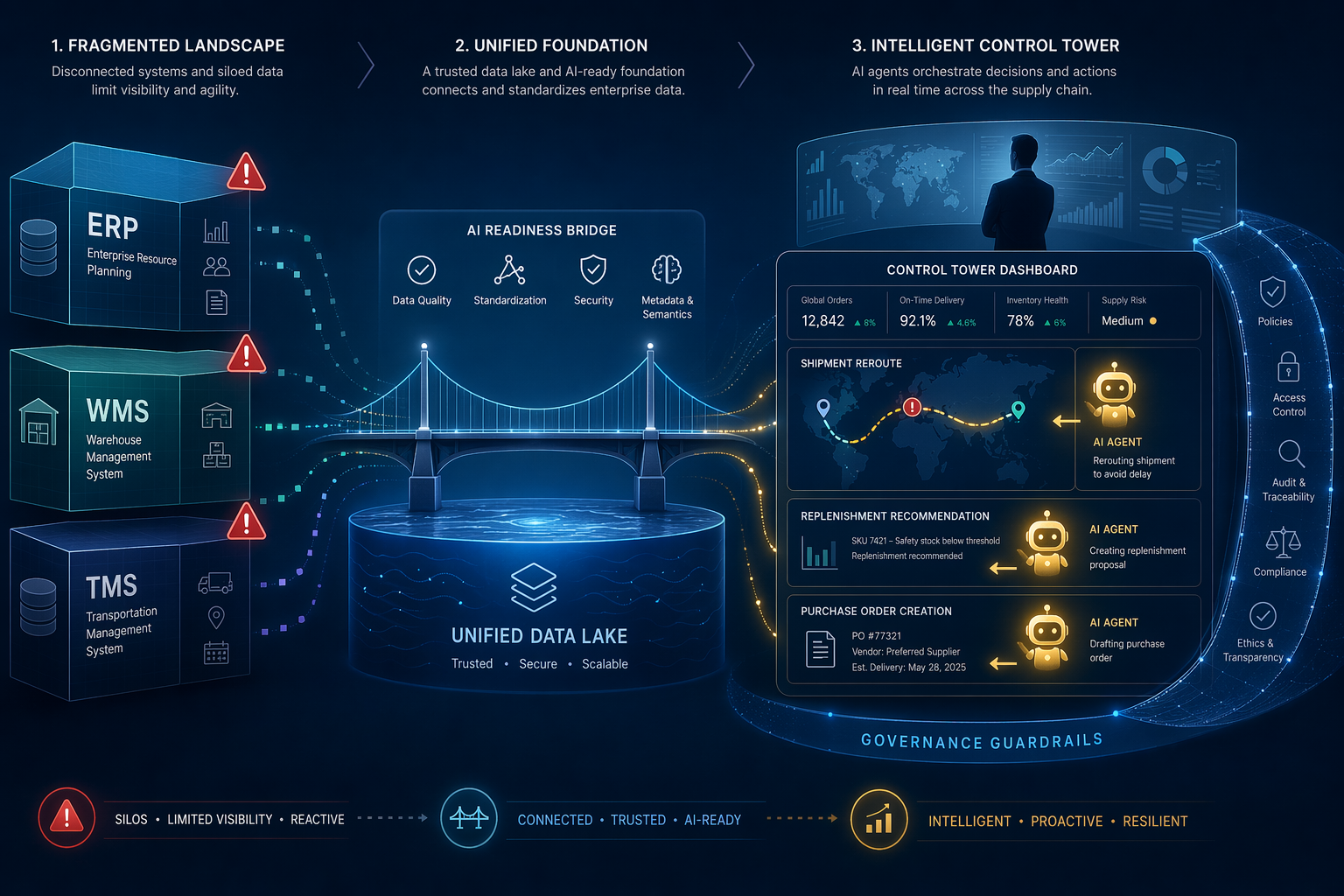
From Visibility to Execution: Why 2026 Is the Year Agentic AI Goes Operational
For the past five years, supply chain AI has been largely observational. It forecasts demand, flags disruption risks, and recommends inventory adjustments — but the final decision to act has remained with human planners. That boundary is now shifting. In 2026, a growing number of organizations are deploying AI that does not just predict outcomes but executes decisions autonomously within defined operational boundaries.
The market signals are unambiguous. According to data from Körber Stellium, 80% of manufacturing executives plan to invest in agentic AI in 2026. Gartner projects that 40% of enterprise applications will be integrated with task-specific AI agents by the end of this year, up from less than 5% in 2025. By 2030, the firm expects 50% of cross-functional supply chain management solutions to use intelligent agents that autonomously execute decisions. The agentic AI supply chain market is projected to grow from $7.8 billion today to $52 billion by 2030.
Yet the path to autonomous operations is not a binary switch from human-led to fully automated. The organizations realizing the highest returns — a reported 34% average efficiency increase and +19% ROI over traditional automation among production deployers, per Körber Stellium — are those adopting a graduated autonomy model. They deploy agents within a clearly defined authority envelope, scaling autonomy only as trust and data quality warrant.
This guide is written for supply chain planning and operations leaders who have moved past the awareness stage and are actively evaluating how to deploy agentic AI. It covers what agentic AI does differently, the five highest-ROI domains in 2026, a governance framework that makes autonomy trustworthy, common pilot failure modes, and a concrete starting playbook.
What Agentic AI Does Differently: Perceive, Reason, Act, Adapt
To understand why agentic AI represents a structural shift rather than an incremental upgrade, it helps to distinguish it from the AI capabilities most supply chain organizations already use.
Predictive AI answers the question: "What is likely to happen?" It forecasts demand, predicts lead times, and estimates supplier risk. Generative AI answers: "What content should I produce?" It drafts contracts, generates reports, and summarizes data. Both are valuable, but neither closes the loop between insight and action.
Agentic AI answers: "What should I do about it, and when should I do it?" It operates on a perceive-reason-act-adapt loop that mirrors human decision-making in a constrained environment:
- Perceive: The agent continuously ingests real-time data from ERP, TMS, WMS, IoT sensors, and external feeds — weather, port congestion, supplier status — to build a current-state picture.
- Reason: It evaluates the situation against predefined business rules, optimization objectives, and constraints. For example: "A Tier 1 supplier just flagged a 48-hour production delay. The safety stock for SKU-447 covers 72 hours of demand. No immediate action required, but flag for monitoring."
- Act: Within its authority envelope, the agent executes a decision — rerouting a shipment, adjusting a reorder point, or issuing a purchase order change — without waiting for human approval.
- Adapt: The agent monitors the outcome of its action and updates its internal model. If a rerouted shipment arrives late despite the change, the agent adjusts its routing logic for future decisions.
This loop is not theoretical. Deloitte's March 2026 analysis reports that more than half of surveyed supply chain executives have already deployed AI agents to automate workflows. The key differentiator is that these agents do not merely recommend — they execute, within boundaries that the organization defines and enforces.
Five Highest-ROI Agentic Domains in 2026
Not every supply chain function is equally suited for agentic AI. The highest-ROI domains share three characteristics: high frequency of routine decisions, clear and measurable outcomes, and low cost of error when the decision is reversible. Based on deployment data from Körber Stellium and Deloitte, five domains stand out in 2026.
| Domain | Decision Type Automated | Representative Outcomes | Autonomy Tier (Typical Start) |
|---|---|---|---|
| Logistics exception management | Reroute shipments, reassign carriers, adjust delivery windows in response to disruptions | General Mills: $20M+ savings since FY2024, 5,000+ shipments assessed daily | Tier 1 (fully autonomous) |
| Inventory replenishment & redistribution | Adjust reorder points, transfer stock between locations, trigger replenishment orders | 20–30% inventory reduction (McKinsey benchmark for AI-enabled distribution) | Tier 2 (recommended with override) |
| Procurement automation | Issue purchase orders, renegotiate terms within bands, flag supplier risk | Reduced procurement cycle time; improved compliance with contract terms | Tier 2 (recommended with override) |
| Predictive maintenance | Schedule maintenance windows, order replacement parts, adjust production schedules | Reduced unplanned downtime; extended asset life | Tier 1 (fully autonomous) |
| Demand forecasting & planning | Continuously reconcile demand signals, capacity, and financial targets | 10–20% forecast accuracy improvement (Gartner benchmark); always-on IBP | Tier 3 (human-led with agent support) |
Comments
Join the discussion with an anonymous comment.