
The Architectural Fork in AI Supply Chain Software
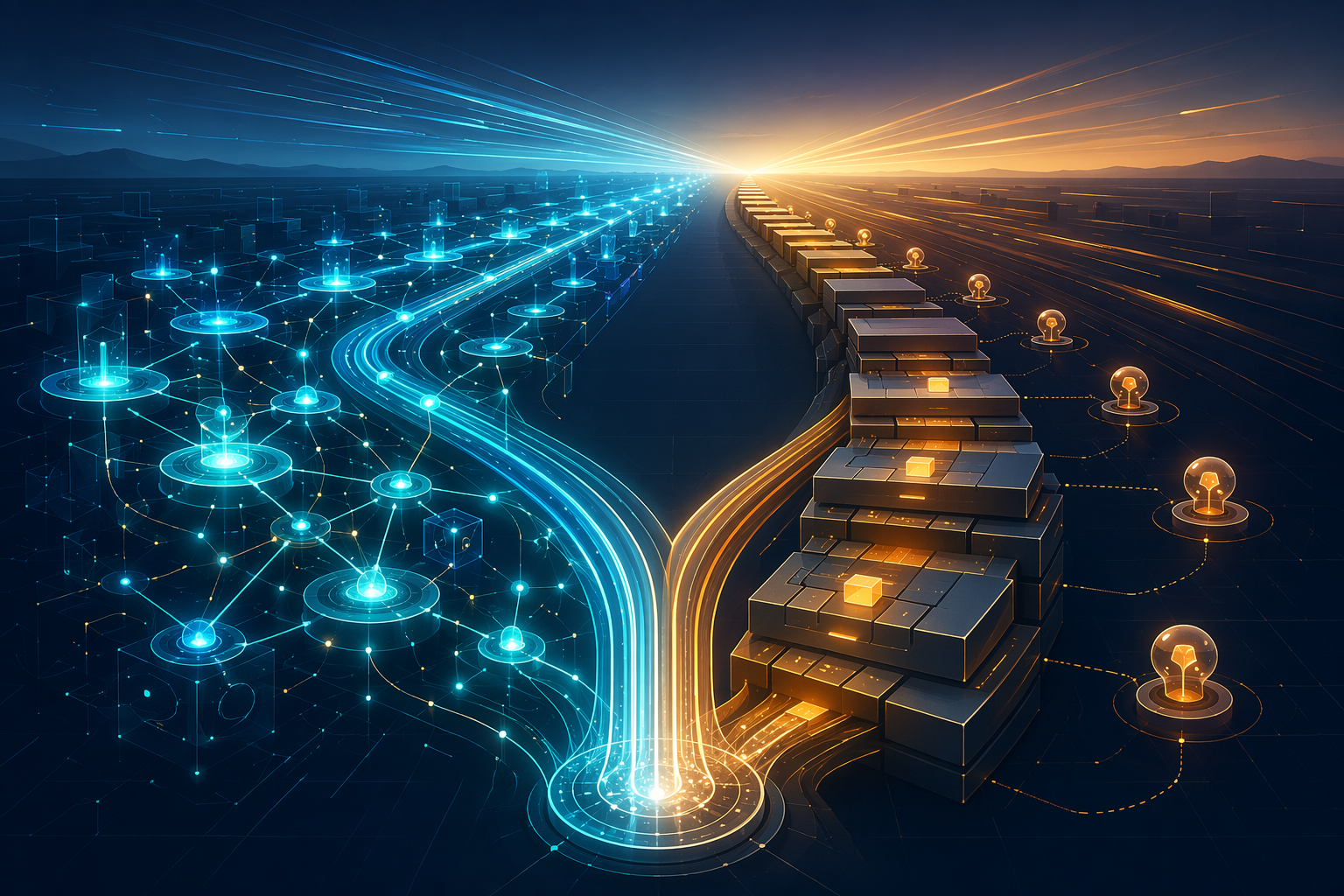
In 2026, the most consequential decision a supply chain technology architect faces is not whether to adopt AI — that question has been settled. The real fork in the road is architectural: do you extend the ERP backbone you already own, layering on AI agents and copilots, or do you adopt a platform purpose-built for continuous, concurrent AI reasoning from the ground up?
This choice determines something more fundamental than feature lists or total cost of ownership. It determines velocity — specifically, how quickly your AI can move from generating a recommendation to executing an autonomous action at enterprise scale. The architectural divide between platforms like Kinaxis and o9 Solutions, which were designed for continuous networked reasoning, and incumbent ERP systems retrofitting AI onto batch-processing logic, creates a durable gap in how fast each can act on its own insights.
This article is a companion to our earlier analysis, AI-Native vs. Legacy Supply Chain Platforms: The Real Performance Gap in 2026, which focused on current production adoption and performance gaps. Here, we extend that lens forward: how does platform architecture determine the speed at which AI can transition from a decision-support tool to an autonomous decision-maker? For CSCOs and digital transformation leads at enterprises with $500M+ in revenue, this is the question that will define the next planning cycle.
How AI-Native Platforms Are Built for Speed: Kinaxis, o9 Solutions, and Relex
The defining characteristic of AI-native supply chain platforms is not that they use machine learning — every major vendor now does. It is that their core data architecture was designed for continuous, concurrent reasoning across multiple planning domains simultaneously, rather than processing one planning cycle at a time in batch.
Kinaxis: Concurrent Planning as a Structural Moat
Kinaxis has been a Gartner Magic Quadrant leader for 11 consecutive years, a longevity that reflects the durability of its underlying architecture. Its concurrent planning engine enables continuous, connected planning across demand, supply, inventory, and capacity — all in a single environment. Independent analyst assessments note that this architecture is "difficult to replicate retroactively in systems built on batch-processing logic."
The practical consequence for autonomy velocity is significant. Because Kinaxis processes planning variables in parallel rather than sequentially, its AI models can evaluate trade-offs across the entire supply network in near-real time. When a demand signal shifts, the system does not wait for the next batch cycle to re-optimize inventory positions, supplier allocations, and capacity constraints. It recalculates continuously.
Jabil, a global manufacturing services company, has publicly credited Kinaxis Maestro Agents with helping its planning teams reach faster human-supervised decisions. The key phrase is "human-supervised" — the platform's architecture allows AI to generate and evaluate options at machine speed while keeping a human in the loop for final approval, a balance that aligns with the 54% of supply chain leaders who prefer a hybrid human-in-the-loop approach (RELEX 2026 State of the Supply Chain report).
o9 Solutions: The Enterprise Knowledge Graph Advantage
o9 Solutions takes a different architectural path to the same end. Its platform is built on a proprietary graph-based data model — the Enterprise Knowledge Graph — that connects demand, supply, and revenue planning in a single environment. Rather than moving data between siloed planning modules, o9 represents the entire planning ecosystem as a connected graph, which allows AI models to traverse relationships between variables that batch-processing systems treat as independent.
This graph architecture has a direct effect on autonomy speed. When a procurement disruption occurs — say, a raw material price spike — an o9 model can trace the impact through supplier contracts, inventory positions, production schedules, and revenue forecasts in a single traversal. A batch-processing system would need to run separate optimization cycles for each domain and reconcile the results manually.
o9 was named a Leader in both the 2026 Gartner Magic Quadrant for Supply Chain Planning (Discrete Industries) and the 2026 Gartner Magic Quadrant for Supply Chain Planning (Process Industries), and closed an investment round at a $3.7 billion valuation in late 2025 — a signal that the market recognizes the structural advantage of its architecture.
Relex: Unified Data Model for Retail-First Planning
Relex, while more narrowly focused on retail and CPG demand planning and replenishment, shares the same architectural DNA. Its unified data model eliminates the need to stitch together forecasts, inventory targets, and promotion plans from separate systems. The result is a platform where AI can move from demand signal to replenishment action in a single continuous flow, rather than across batch boundaries.
| Platform | Core Architecture | Planning Model | Autonomy Velocity Factor |
|---|---|---|---|
| Kinaxis Maestro | Concurrent planning engine | Continuous, connected across demand, supply, inventory, capacity | Parallel trade-off evaluation enables near-real-time re-optimization |
| o9 Digital Brain | Enterprise Knowledge Graph (graph-based data model) | Single environment connecting demand, supply, revenue | Graph traversal allows cross-domain impact analysis in one pass |
| Relex | Unified data model | Integrated demand, inventory, promotion planning | Single continuous flow from signal to action |
How Incumbents Are Retrofitting AI: SAP Joule, Oracle Fusion Agentic Apps, and Microsoft Copilot
The incumbent approach to AI in supply chain is not architecturally inferior by default — it is architecturally constrained by design. ERP systems like SAP S/4HANA and Oracle Fusion Cloud were built to manage transactional data and enforce business rules in batch cycles. They were not designed to host continuous, concurrent AI reasoning. The AI layer must be added on top, which creates latency between data ingestion, model inference, and action execution.
SAP Joule: Breadth of Agent Catalog vs. Depth of Integration
SAP's Joule platform had expanded to more than 40 specialized agents and over 2,000 packaged skills by early 2026. This is an impressive catalog by any measure. The question is not whether Joule has capability breadth — it clearly does — but how quickly those agents can act on the data flowing through SAP's batch-oriented transactional systems.
The SLB case (formerly Schlumberger) demonstrates the value that SAP AI can deliver at scale. SLB reported approximately 90% forecast accuracy and $1 billion in inventory savings using SAP's AI capabilities. These are real, verifiable outcomes. But they were achieved within the constraints of SAP's architecture — meaning the AI operates on periodic data snapshots rather than continuous streams, and decisions require human review before execution.
Industry surveys suggest that production usage of these agentic capabilities still trails announced capability. The gap between what vendors demonstrate at conferences and what runs in production at customer sites is a well-documented pattern in enterprise software. For SAP and Oracle, 2026–2027 is a proving period during which customers will determine whether the agent catalog translates into production velocity.
Oracle Fusion Agentic Applications and Microsoft Copilot
Oracle introduced Fusion Agentic Applications — a dozen AI-driven applications embedded within its Fusion Cloud suite. Like SAP, Oracle's advantage is depth of integration with its own transactional data. The limitation is the same: the underlying architecture processes transactions in batches, and the AI layer must work within that cadence.
Microsoft Copilot for Supply Chain takes a different approach, acting as an orchestration layer that connects to multiple data sources rather than owning the transactional backbone. This gives it flexibility but also introduces latency from data movement between systems. Copilot's ability to act autonomously is limited by the speed at which it can pull data from source systems, run inference, and push actions back.
| Vendor | AI Platform | Agent / Skill Count | Architecture Constraint | Production Maturity Signal |
|---|---|---|---|---|
| SAP | Joule | 40+ agents, 2,000+ skills | Batch-oriented transactional backbone; AI operates on periodic snapshots | SLB reported ~90% forecast accuracy, $1B inventory savings — but within batch constraints |
| Oracle | Fusion Agentic Apps | ~12 applications | AI embedded in Fusion Cloud but constrained by batch processing cadence | Announced early 2026; production adoption still being proven |
| Microsoft | Copilot for Supply Chain | Orchestration layer (no fixed count) | Data movement latency between source systems and inference engine | Flexible but dependent on integration maturity of each deployment |
Data-Driven Comparison: Market Positions, Sizing, and Deployment Complexity
The architectural divide is reflected in market data. Kinaxis has held a Gartner Magic Quadrant leadership position for 11 years. o9 Solutions was named a Leader in both Discrete and Process Industries in 2026. These positions are not merely marketing badges — they reflect analyst assessments of architectural completeness, customer satisfaction, and vision.
Market sizing for AI in supply chain varies significantly by analyst scope, which is worth noting explicitly:
| Source | 2025 Market Size | Projected Size | CAGR | Scope Note |
|---|---|---|---|---|
| Precedence Research (2026) | $9.94 billion | $236.42 billion by 2035 | 37.3% | Narrower AI-specific scope — focused on AI software and platforms for supply chain |
| Grand View Research | $40.4 billion | $101.8 billion by 2033 | 10% | Broader scope — includes supply chain management software with AI capabilities |
Beyond market size, the deployment complexity gap between AI-native and incumbent platforms is significant. McKinsey research found that AI-enabled distribution delivers 5–20% logistics cost reduction and 20–30% inventory reduction — but these outcomes depend heavily on data quality and integration maturity. For organizations extending an existing ERP, the integration path is shorter (data is already in the system) but the architectural ceiling is lower (batch-processing constraints limit autonomy velocity). For organizations adopting an AI-native platform, the integration path is longer (data must be extracted from ERP and loaded into the new platform) but the architectural ceiling is higher (continuous concurrent reasoning enables faster autonomous action).
The RELEX 2026 survey of 500+ supply chain leaders provides critical context for this trade-off: 54% prefer a hybrid human-in-the-loop approach, while only 10% trust AI for fully autonomous decisions. This means that even the most architecturally advanced AI-native platform must earn planner trust before it can act autonomously. The architecture determines the ceiling; organizational readiness determines how close you get to it.
Decision Framework: When to Extend vs. When to Adopt New
For CSCOs and technology architects at $500M+ revenue enterprises, the decision to extend an existing ERP investment or adopt a new AI-native platform depends on four factors:
- Existing ERP investment depth: How much of your planning and execution runs on SAP, Oracle, or Microsoft? If the answer is "most of it," the switching cost of adopting a standalone platform is higher, but so is the architectural ceiling.
- Data integration maturity: Can you extract, transform, and load planning data from your ERP into an AI-native platform at the frequency required for continuous reasoning? Organizations with mature data pipelines have a lower adoption barrier.
- Organizational readiness for autonomous decision-making: Only 10% of supply chain leaders trust AI for fully autonomous decisions (RELEX 2026). If your planning culture is not ready for machine-speed action, the architectural advantage of an AI-native platform will go unrealized.
- Speed requirement: How quickly does your business need AI to move from recommendation to action? If your competitive advantage depends on responding to demand shifts or supply disruptions in hours rather than days, the architectural ceiling of an AI-native platform becomes a strategic necessity.
| Decision Factor | Extend ERP (Incumbent Path) | Adopt New (AI-Native Path) |
|---|---|---|
| Integration complexity | Lower — data already in the system | Higher — requires data extraction and pipeline construction |
| Architectural ceiling | Lower — batch-processing constraints limit autonomy velocity | Higher — continuous concurrent reasoning enables faster autonomous action |
| Time to first AI use case | Shorter — leverage existing data and workflows | Longer — requires platform deployment and data migration |
| Long-term autonomy potential | Limited by underlying architecture | Determined by organizational readiness, not platform constraints |
| Best fit for | Organizations with deep ERP investment and moderate autonomy ambition | Organizations prioritizing speed of autonomous action over integration ease |
For readers who want a wider market view beyond the architectural-fork comparison, our AI Supply Chain Tools Buyer's Comparison: Leaders, Specialists, and Hype vs. Reality in 2026 covers the full vendor landscape. For those ready to start the selection process, The 2026 AI Supply Chain Tool Buyer's Guide: How to Evaluate, Compare, and Select the Right Platform provides a practical step-by-step framework.
The Autonomy-Velocity Trajectory: What the Architecture Decision Means for 2027–2030
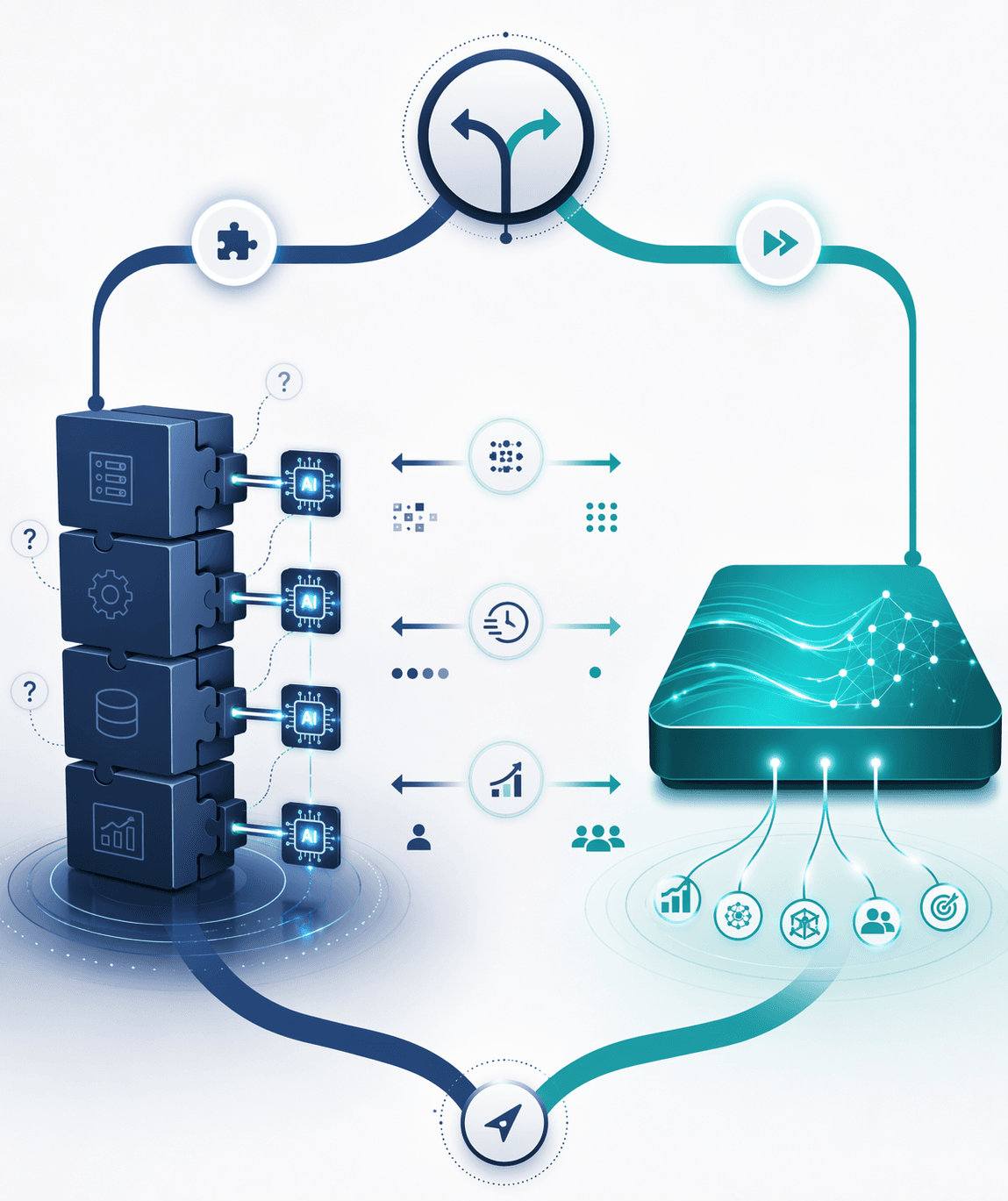
Gartner predicts that 15% of daily logistics decisions will be made autonomously by AI agents by 2028, and that 60% of supply chain disruptions will be resolved without human intervention by 2031. These are not distant scenarios — they are the trajectory that the architectural decision made today will accelerate or constrain.
An organization that extends its existing ERP with AI agents will likely reach the 15% autonomy threshold — but it will hit the architectural ceiling of batch-processing logic before it can scale to 60%. The AI agents will be constrained by the cadence of the underlying transactional system. They will generate recommendations faster than before, but they will still need human approval for every cross-domain decision because the system cannot evaluate trade-offs across demand, supply, inventory, and capacity in a single continuous pass.
An organization that adopts an AI-native platform will face a steeper initial integration curve but will have an architecture that can scale to the 60% autonomy threshold. The continuous concurrent reasoning engine can evaluate trade-offs at machine speed, generate options, execute actions, and flag exceptions — all without waiting for the next batch cycle.
But architecture alone is not enough. The RELEX data showing that 54% of supply chain leaders prefer a hybrid human-in-the-loop approach, and only 10% trust AI for fully autonomous decisions, is a reminder that organizational readiness is the binding constraint. The most architecturally advanced platform will fail if planners do not trust its recommendations. AI explainability — the ability for a model to show its reasoning in terms a supply chain planner can understand and validate — is as important as raw model accuracy.
"Planner distrust is the most common failure point in supply chain AI deployments."
This observation, from a buyer's guide on supply chain AI software options, underscores a critical point: the architectural decision determines the ceiling, but organizational change management determines how close you get to it. The platforms that will win in 2027–2030 are not necessarily the ones with the most sophisticated AI models — they are the ones that combine architectural speed with the explainability and trust-building features that enable planners to cede control incrementally.
Comments
Join the discussion with an anonymous comment.