

The most useful AI statistic for supply chain leaders in 2026 is not an adoption rate. It is the gap between confidence and permission. In RELEX’s 2026 State of Supply Chain Survey of more than 500 leaders across retail, wholesale, and manufacturing, 67% said they are more confident in AI than they were last year, but only 10% said they trust AI to make critical decisions without human supervision.[1] In the same vendor-sponsored survey, 54% preferred a hybrid human-in-the-loop approach over full autonomy.[1]
That gap is not hesitation for its own sake. It is the operating reality of AI and supply chain work: executives can approve automation budgets, but someone still has to answer when a purchase order consumes working capital, a supplier commitment locks in a price, or a logistics decision moves a customer order into the wrong lane. The practical question is no longer whether agentic AI can reason across supply chain data. It is where conditional autonomy is narrow enough, valuable enough, and auditable enough to deserve real decision rights.

There is also a workforce clock running underneath the technology discussion. Record baby boomer retirements are turning experienced planning, procurement, and operations knowledge into a continuity risk, not just a staffing issue. AI agents are not being introduced because they are automatically better than senior planners. They are being introduced because the organization may soon have fewer people who know which supplier exception matters, which forecast override is harmless, and which logistics disruption will turn into a customer escalation.
Waiting for perfect trust before redesigning workflows sounds prudent until the people who trained the old workflow have left. The better path is staged: use AI first to expose evidence and shorten analysis, then let it execute within bounded rights, and only then expand autonomy where the organization can prove the agent is explainable, reversible, and better than the shrinking expert capacity it is meant to support.
The transition is from assistance to decision rights
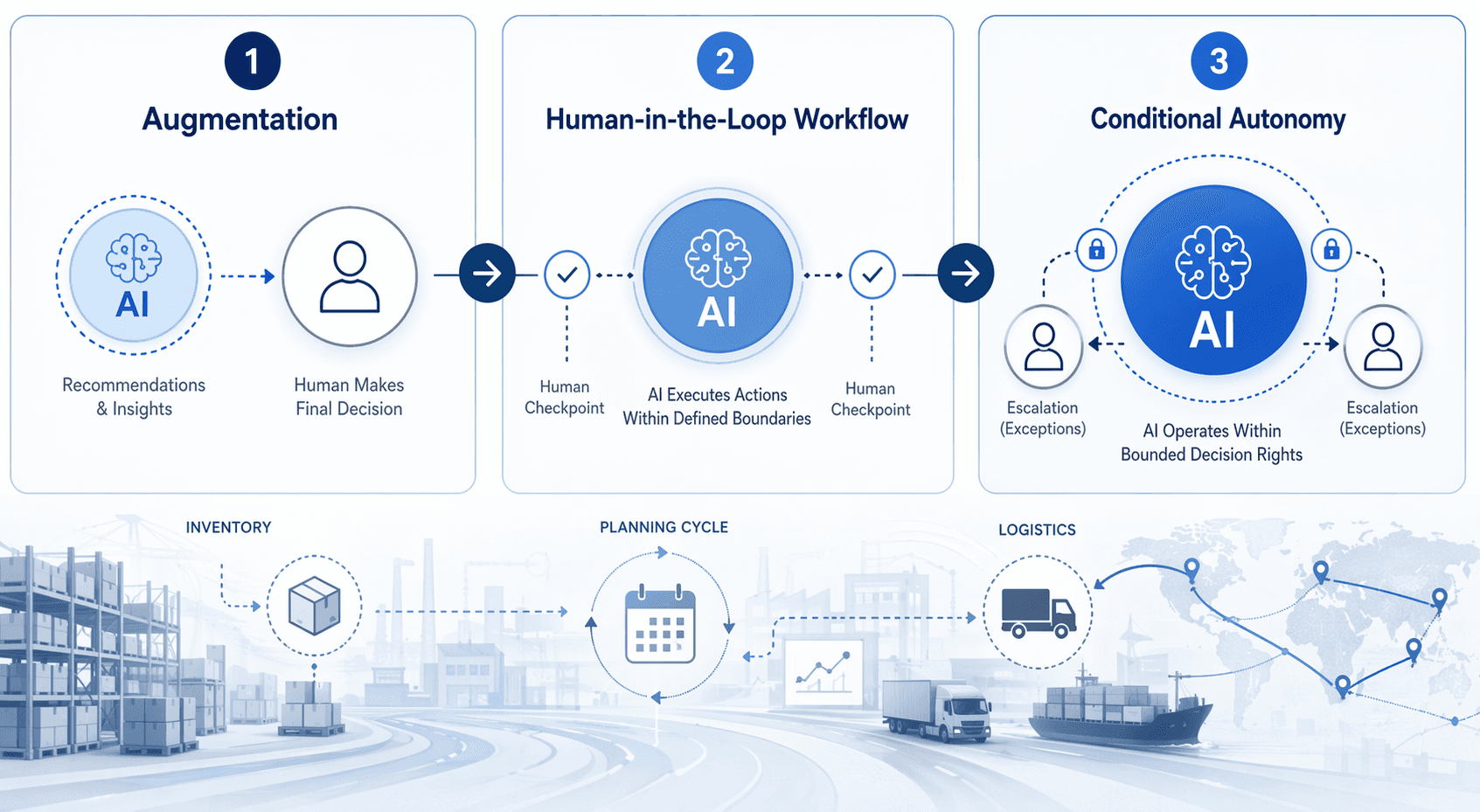
The phrase “autonomous supply chain” hides too many operating differences. A demand-planning copilot that drafts an exception note, a procurement agent that prepares supplier negotiation scenarios, and a replenishment agent that releases orders below an approval threshold all carry different risk. Lumping them together makes governance harder, not easier.
| Operating mode | What the agent does | What the human still owns | Where it fits first |
|---|---|---|---|
| Augmentation | Finds patterns, drafts recommendations, explains trade-offs | Every material decision | Planning review, exception analysis, negotiation preparation |
| Human-in-the-loop workflow | Executes workflow steps and prepares actions for confirmation | Approval at defined checkpoints | Purchase recommendations, forecast updates, logistics exception queues |
| Conditional autonomy | Acts within bounded decision rights and escalates exceptions | Policy design, threshold changes, exception resolution | Low-to-medium-risk decisions with strong data trails |
The line that matters is not whether a human is somewhere near the process. The line is whether the agent has the right to change the operational state: place or modify an order, reallocate supply, adjust a plan, release a shipment, open a supplier action, or close an exception. A staged model forces that question into the design before production rollout.
Market projections support the direction of travel, but they should be treated as pressure signals rather than deployment instructions. Dataiku and Deloitte describe agentic AI as a 2026 supply chain trend that can produce double-digit efficiency gains and reduce decision latency from days to seconds; the same discussion cites BCG’s estimate that agentic AI systems represented 17% of total AI value in 2025 and could reach 29% by 2028.[2] Dataiku also cites Gartner projections that 15% of daily logistics decisions will be autonomous by 2028 and that 60% of supply chain disruptions could be resolved without human intervention by 2031.[2] Those figures are useful because they show where expectations are moving. They do not remove the need to decide which decisions an agent is allowed to make on Tuesday morning.
Hotspot 1: purchase optimization, where autonomy meets money
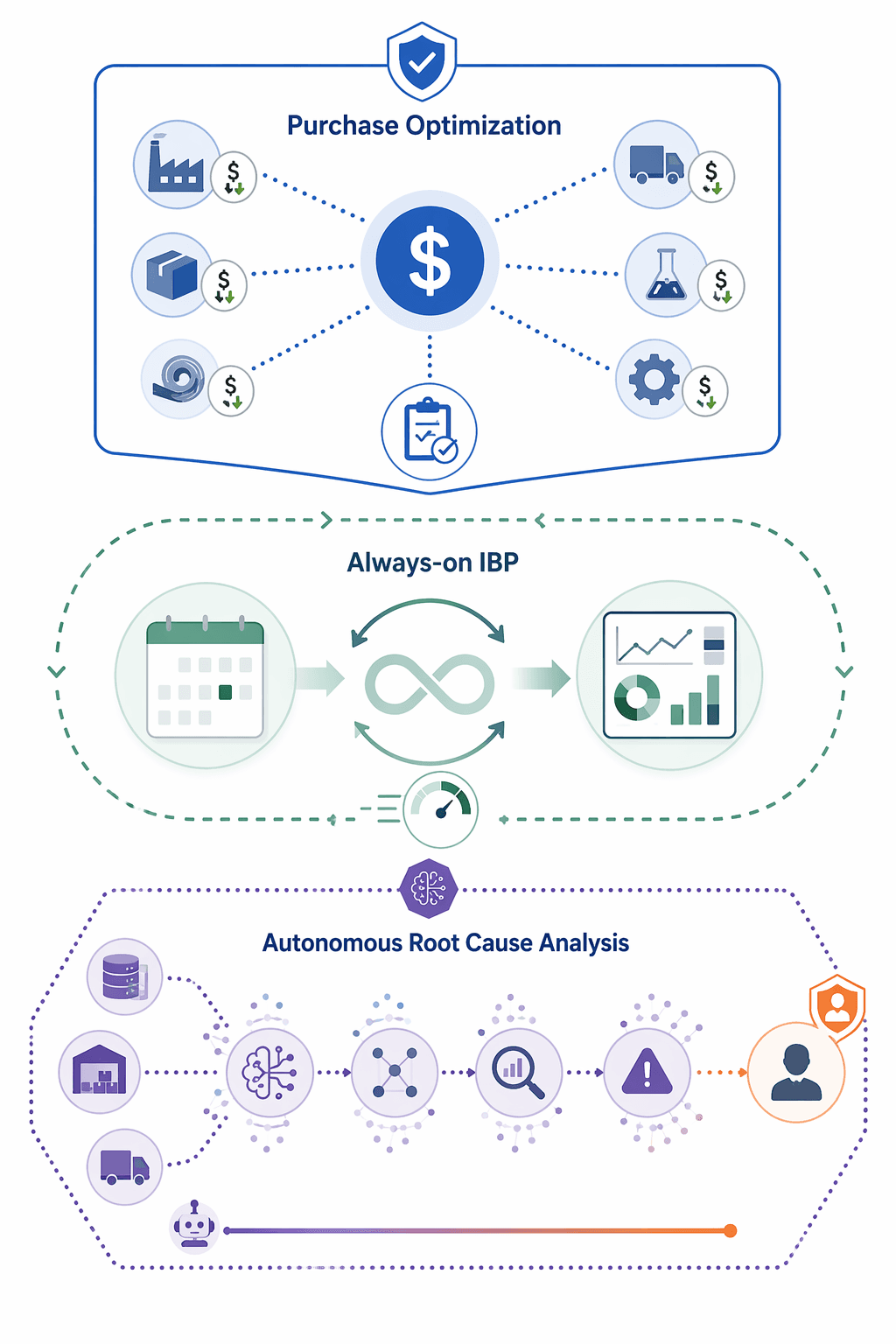
Purchase optimization is the hardest of the three near-term hotspots because it touches cash, supplier leverage, category strategy, and internal politics at the same time. It is also where bounded autonomy can be most concrete. The agent does not need a vague mandate to “optimize procurement.” It needs a defined right to assemble demand, compare supplier terms, model order timing, and recommend coordinated purchasing moves across categories.
The value comes from coordination. A planner may see a replenishment need in one category. A procurement lead may know that a supplier negotiation is open in another. Finance may care about working capital timing, while operations cares about service risk. An agent can hold those threads together continuously: pending purchase orders, contracted price breaks, supplier minimums, lead-time variability, inventory targets, and upcoming demand changes.
In augmentation mode, the agent prepares the case. It flags that several categories could be negotiated together, shows the inventory and service implications of buying now versus later, and identifies which supplier terms are driving the recommendation. The buyer still decides. This is often the right first deployment because it improves the quality and speed of the meeting without pretending the agent understands supplier relationship nuance.
In a human-in-the-loop workflow, the agent moves further. It can draft purchase recommendations, route them to category owners, collect approvals, and prepare supplier-facing negotiation packages. The human checkpoint is not a ceremonial “approve all” button. It is placed where judgment is still material: unusual supplier exposure, a category strategy conflict, a working capital threshold, or a service-risk trade-off that requires commercial accountability.
Conditional autonomy becomes reasonable only after the organization writes the purchasing boundaries in operational language. That means thresholds by spend, category, supplier concentration, contract status, service criticality, and variance from the approved plan. A procurement agent may be allowed to release a routine order under a defined value limit when it uses an approved supplier, stays within contracted terms, does not increase inventory beyond policy, and leaves an audit trail. The same agent should escalate when the recommendation depends on a supplier substitution, a price exception, a long-horizon demand assumption, or a working capital impact above the agreed tolerance.
- Allowed to decide: routine purchase releases inside approved supplier, price, inventory, and spend limits.
- Allowed to recommend: coordinated buys across categories, negotiation timing, supplier allocation changes, and order consolidation.
- Required to show: demand signal, inventory position, contract terms, supplier constraints, working capital effect, and service-risk assumptions.
- Required to escalate: threshold breaches, supplier substitutions, off-contract pricing, unusual demand drivers, or category-owner conflicts.
This is where many AI rollouts become uncomfortable in a useful way. The governance discussion exposes old ambiguity. If no one can state which purchasing decisions are low risk, which require category approval, and which require finance sign-off, then the organization has not discovered an AI problem. It has discovered that its human process relied on tacit judgment that was never encoded.
Hotspot 2: always-on IBP, where the planning cadence changes
Integrated business planning has traditionally been organized around a calendar. Teams collect inputs, reconcile demand and supply, review scenarios, and escalate decisions through a monthly or periodic cycle. That cadence gives structure, but it also creates waiting time. A disruption that appears just after the planning meeting may sit in dashboards and email threads until the next formal review, even when the data trail is already visible.
Always-on IBP is not a replacement for executive trade-off decisions. It is a way to keep the plan alive between meetings. An agent can monitor demand changes, inventory movements, production constraints, logistics events, and supplier updates; compare them with the current plan; and open exceptions before a monthly cycle would normally catch them. That is where the “days to seconds” latency claim becomes tangible: the improvement is not magic productivity, but the removal of dead time between signal detection and decision preparation.[2]
In augmentation mode, the agent acts like a tireless planning analyst. It finds plan deviations, ranks exceptions, drafts scenario summaries, and explains which constraint has changed. A human planner still chooses whether to adjust the plan. This mode is especially useful when the planning team is experienced but overloaded; it reduces time spent finding the issue so more time is left for judging the consequence.
Human-in-the-loop workflow changes the meeting itself. Instead of arriving with static reports, planners arrive with pre-built scenarios: what happens if demand is reallocated, if production is pulled forward, if a supplier delay is absorbed from safety stock, or if a customer allocation rule is triggered. The agent can route those scenarios to sales, finance, procurement, and operations owners before the meeting, capturing objections and missing inputs.
Conditional autonomy in IBP should be narrower than the phrase suggests. The agent may update low-risk plan parameters, re-rank exceptions, trigger replenishment or production review tasks, or rebalance within preapproved tolerance bands. It should not silently make trade-offs that change revenue expectations, customer allocation, margin, or strategic supply commitments. Those are business decisions, even when the calculation underneath them is routine.
The evidence requirement is different from procurement. A purchasing agent must prove why a financial commitment is safe. An IBP agent must prove why the current plan is no longer valid, which alternatives were considered, and which functions are affected. A good exception packet should show the original plan, the triggering signal, the affected constraints, the recommended action, the rejected alternatives, and the owner who must decide.
PwC’s 2026 Digital Trends in Operations survey, based on 767 US-based operations executives, reinforces the broader adoption context: operations leaders are actively investing in digital capabilities, but the value depends on how those capabilities change work, not on adoption alone.[3] For IBP, that means the implementation target should not be “more AI in planning.” It should be fewer stale decisions, fewer unresolved exceptions, and faster preparation of cross-functional choices.
Hotspot 3: autonomous root cause analysis, where agents investigate before people remediate
Autonomous root cause analysis is the cleanest early use case because the agent’s first job is investigative, not executive. When an order is late, inventory is missing, production is constrained, or a shipment misses a milestone, the agent can trace the event across ERP, WMS, and TMS data before a human analyst starts triage.
The decision boundary is straightforward. The agent can gather evidence, connect events, identify likely causes, and recommend remediation paths. It can say that a delivery failure appears linked to a warehouse pick delay, a carrier handoff issue, a master-data mismatch, or a supplier confirmation gap. It can attach timestamps, affected orders, related exceptions, and confidence indicators. The human owner decides the remedy when the action affects customers, cost, supplier accountability, or service commitments.
Conditional autonomy may still apply at the edge. If the root cause falls into a known, low-risk pattern, the agent can open a corrective task, notify the responsible owner, update the exception queue, or trigger a standard operating procedure. It should escalate when the cause is uncertain, the data conflicts, the remediation has customer impact, or multiple functions would bear the consequence.
This is also where auditability becomes visible to frontline teams. A planner is more likely to trust an agent that shows the sequence of events than one that simply declares a cause. The useful output is not “late because of logistics.” It is a traceable chain: supplier confirmation changed, inbound receipt slipped, warehouse allocation failed, transportation appointment was missed, and the customer order is now at risk. The agent has done the digging; the human can spend judgment on the fix.
How to design the boundary before deployment
The move from augmentation to conditional autonomy should be designed around decision rights, not around model capability. A technically impressive agent is still unsafe if no one has defined what it may change, what it must explain, and who receives the escalation when the evidence is weak.
- Name the decision, not the workflow. “Optimize replenishment” is too broad; “release purchase orders under approved terms and below a defined spend threshold” is governable.
- Separate recommendation rights from execution rights. Many agents should be allowed to analyze more than they are allowed to change.
- Write escalation logic before go-live. Threshold breaches, missing data, conflicting systems, unusual suppliers, and customer-impacting actions should not be discovered during production incidents.
- Require evidence packets. The agent should show the data used, alternatives considered, policy constraints applied, and reason for escalation or execution.
- Make reversibility part of the design. If an action cannot be reversed or compensated without material cost, it deserves a higher approval bar.
This is where the hybrid preference in the RELEX survey becomes operationally useful rather than philosophically vague.[1] Human-in-the-loop does not mean every AI action waits for a senior manager. It means the organization has decided which decisions require human confirmation, which require human review after execution, and which can proceed under policy until an exception appears.
SAP’s 2026 supply chain trends discussion frames agentic AI as part of a broader move toward orchestration, which is the right direction as long as orchestration is not confused with uncontrolled autonomy.[4] The agent should coordinate work across planning, procurement, logistics, and execution systems, but coordination still needs policy. Otherwise, the organization simply moves old ambiguity into faster software.
What to evaluate once the deployment logic is clear
Platform evaluation should come after the decision-boundary work, not before it. A vendor demo can show an agent drafting scenarios, triggering workflows, or explaining exceptions. The harder question is whether the platform can enforce the organization’s actual autonomy model: approval thresholds, role-based permissions, exception queues, evidence capture, rollback, and audit history.
For teams comparing planning and execution platforms, a useful next step is to look at how agentic capabilities appear inside specific suites, including Blue Yonder, Manhattan, and Oracle. The comparison should be grounded in the hotspots and controls already defined, not in generic AI feature claims. A platform that looks strong for autonomous root cause analysis may not have the same maturity for procurement approval boundaries or always-on IBP governance. See the Blue Yonder vs. Manhattan vs. Oracle comparison once the internal decision-rights model is clear.
The strongest near-term cases for agentic AI in supply chain have three traits: the decisions recur often, the data trail already exists, and escalation can be designed before the agent is put into production. Purchase optimization, always-on IBP, and autonomous root cause analysis meet those conditions in different ways. Procurement forces spend controls and supplier accountability. IBP forces cross-functional timing and plan validity. Root cause analysis forces traceability across systems before remediation.
That is enough work for 2026. Start where the decision space is narrow enough to govern. Use human oversight to train trust and expose exceptions. Expand autonomy only after the organization can prove that the agent’s actions are explainable, reversible, and better than the expert capacity the business is losing.
References
- RELEX 2026 State of Supply Chain, RELEX Solutions, https://www.relexsolutions.com/resources/supply-chain-ai/
- Supply Chain AI Trends 2026, Dataiku, https://www.dataiku.com/stories/blog/supply-chain-ai-trends-2026
- 2026 Digital Trends in Operations, PwC, https://www.pwc.com/us/en/services/consulting/supply-chain-operations/library/digital-trends-operations-survey.html
- Supply chain trends for 2026: From agentic AI to orchestration, SAP, https://www.sap.com/blogs/supply-chain-trends-for-2026-from-agentic-ai-to-orchestration
Comments
Join the discussion with an anonymous comment.