
Why Supply Chain AI Adoption Fails When Treated as a Monolith
The global AI in supply chain market was valued at $7.3 billion in 2024 and is projected to reach $63.8 billion by 2030, growing at a 42.7% CAGR, according to Strategic Market Research. Yet despite this surge in investment, only 23% of supply chain organizations have a formal AI strategy, per Gartner 2025 data. The gap between spending and strategic readiness is not a funding problem — it is a framing problem.
Too many organizations approach AI adoption as a single initiative: "We need AI for our supply chain." This framing obscures a fundamental reality — each supply chain function (demand forecasting, inventory optimization, logistics routing, procurement, warehouse operations) maps to a distinct set of AI/ML techniques, each with its own data prerequisites, maturity level, and ROI profile. Treating AI as a monolith leads to mismatched expectations, underpowered pilots, and stalled deployments.
This article provides a structured architecture reference for supply chain technology leaders. It maps specific AI/ML techniques to the functions they serve, outlines the data infrastructure each technique requires, benchmarks maturity levels, and offers a decision framework for selecting the right approach. It is designed to be used alongside ChainSignal's existing Machine Learning in Supply Chain Management glossary, which covers ML techniques in depth, and the AI Readiness Paradox editorial, which explores why most supply chains are not ready to scale AI.
Technique-by-Function Mapping: Which AI/ML Method Fits Which Supply Chain Problem
The table below maps the primary AI/ML techniques to the supply chain functions they serve, along with the typical problem type each technique addresses. This is not an exhaustive list — hybrid approaches that combine multiple techniques are increasingly common — but it provides a starting point for matching technique to function.
| AI/ML Technique | Primary Supply Chain Function | Problem Type Addressed | Example Application |
|---|---|---|---|
| Supervised Learning (Regression, Time Series) | Demand Forecasting, Lead Time Prediction | Predicting a continuous value from historical data | Forecasting SKU-level demand for seasonal CPG products |
| Supervised Learning (Classification) | Shipment Delay Prediction, Supplier Risk Scoring | Predicting a categorical outcome (on-time vs. delayed) | Classifying inbound shipments as high-risk for delay |
| Reinforcement Learning | Route Optimization, Inventory Replenishment | Sequential decision-making under uncertainty | Dynamic last-mile routing that adapts to real-time traffic |
| Computer Vision | Warehouse Quality Inspection, Slotting Optimization | Visual pattern recognition and anomaly detection | Automated defect detection on inbound pallets |
| Natural Language Processing (NLP) | Procurement Document Intelligence, Contract Analysis | Extracting meaning from unstructured text | Automated PO matching and supplier contract clause extraction |
| Generative AI | Scenario Simulation, What-If Analysis | Generating novel scenarios or natural language responses | Conversational interface for S&OP what-if queries |
| Agentic AI | Autonomous Exception Handling, Multi-Echelon Coordination | Autonomous reasoning, planning, and execution within guardrails | Self-correcting inventory allocation across distribution centers |
For a deeper look at how supervised learning drives demand forecasting in practice, see the AI Demand Forecasting in CPG and Retail use case entry. For the evolution of agentic AI from visibility to autonomous execution, refer to the agentic AI editorial.
Data Infrastructure Prerequisites for Each Technique Type
Data readiness is the single most common blocker in AI deployment. The technique you choose dictates the data infrastructure you need — and many organizations discover only after selecting a technique that their data environment cannot support it. The table below outlines the core data prerequisites for each technique category.
| Technique Category | Core Data Requirement | Infrastructure Needs | Common Failure Mode |
|---|---|---|---|
| Supervised Learning | Clean historical data with labeled outcomes | Data warehouse/lake, feature store, labeled training set | Insufficient historical depth or poor label quality |
| Reinforcement Learning | Simulation environment or real-time feedback loop | Digital twin or simulator, real-time data pipeline, reward function design | Lack of safe simulation environment for training |
| Computer Vision | Labeled image or video datasets | Edge inference hardware, image storage, annotation pipeline | Insufficient labeled images for rare defect classes |
| Natural Language Processing | Unstructured text corpora (contracts, POs, emails) | Document parsing pipeline, entity extraction models, secure storage | Poor OCR quality on scanned documents |
| Generative AI | Structured knowledge bases, prompt templates, guardrails | LLM API or self-hosted model, vector database, content safety filters | Hallucination in high-stakes planning scenarios |
| Agentic AI | Event streams, API access to operational systems, orchestration layer | Event bus, API gateway, agent orchestration framework, monitoring dashboard | Unclear escalation paths when agents cannot resolve exceptions |
The talent dimension compounds these infrastructure challenges. Strategic Market Research reports that 71% of EU firms and 68% of US firms report shortages in AI and data talent. Without the right people to build and maintain these pipelines, even well-funded infrastructure projects stall. The AI Readiness Paradox article explores this gap in depth, including why readiness assessments often miss the organizational prerequisites for scaling AI.
Maturity Heatmap: Established, Emerging, and Experimental Technique-Function Pairs
Not all technique-function pairings are equally ready for production deployment. The heatmap below classifies each pairing into one of three maturity levels: Established (widely deployed with documented ROI), Growing (gaining traction with early production deployments), and Emerging (active research and pilot-stage, with limited production evidence).
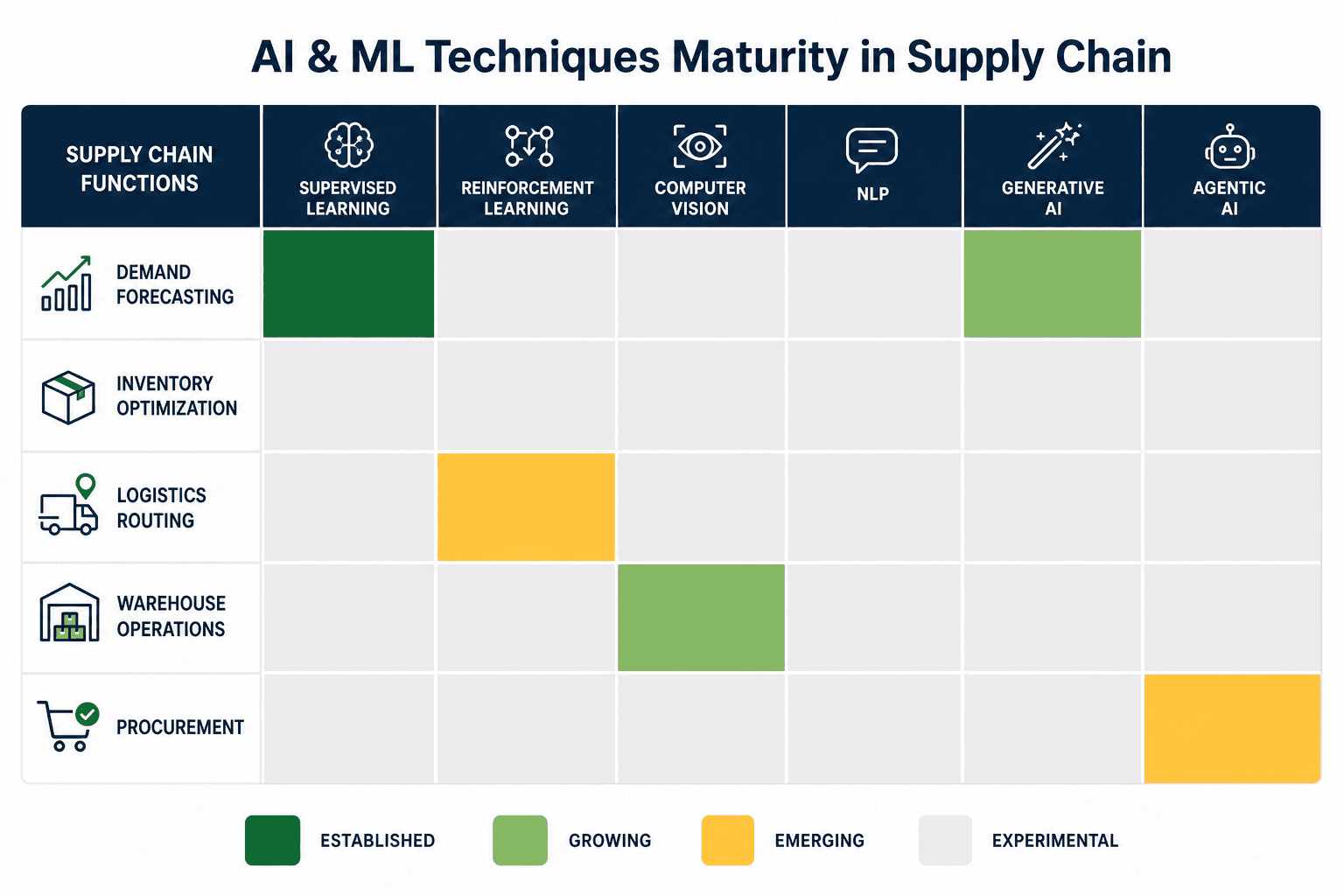
Several patterns stand out. Demand forecasting with supervised learning is the most mature pairing — it accounts for the dominant share of AI in supply chain technology spending, per Strategic Market Research, and has the deepest body of ROI evidence. At the other end, agentic AI for multi-echelon coordination is still emerging: Gartner forecasts that SCM software with agentic AI will grow from less than $2 billion in 2025 to $53 billion in spend by 2030, and predicts that 60% of enterprises using SCM software will have adopted agentic AI features by 2030, up from 5% in 2025. That trajectory signals rapid maturation, but production deployments today remain limited.
For a more detailed breakdown of where enterprises actually stand across the maturity curve, see the Gartner's 2025 Supply Chain AI Maturity Data Decoded article, which analyzes the survey data behind these adoption statistics.
Measured ROI by Technique: What the Data Shows
ROI claims in supply chain AI are notoriously variable — outcomes depend on data quality, deployment scope, organizational readiness, and the specific problem being solved. The table below compiles the most frequently cited, source-attributed figures from the research context. These are directional benchmarks, not guaranteed outcomes.
| Technique / Application | Reported Outcome | Source & Year | Notes |
|---|---|---|---|
| ML demand forecasting | 20–50% reduction in forecast errors | McKinsey (2021) | Well-cited but based on pre-2022 data; directional |
| AI in supply chain (broad) | 23% average reduction in fulfillment costs | Capgemini Research (2025) | Single survey; methodology and sample size not independently verified |
| AI in supply chain (broad) | Up to 85% improvement in forecast accuracy | Capgemini Research (2025) | Same Capgemini survey; upper bound may reflect best-case deployments |
| AI in supply chain (broad) | 15% reduction in logistics costs, 35% inventory reduction, 65% service level improvement | McKinsey (2021) | Same McKinsey report; directional benchmarks |
| Agentic AI in SCM | 67% of deploying companies saw significant revenue increase | ICRON (2026) | Vendor-adjacent source; treat as directional |
| Predictive maintenance (ML) | 30–50% reduction in downtime | McKinsey (2021) | Same McKinsey report; applies to manufacturing equipment |
For a broader view of ROI across five supply chain functions, see the Predictive Analytics in Supply Chain article, which provides function-specific ROI evidence with source attribution.
Decision Framework: Selecting the Right Technique for Your Supply Chain Problem
The following decision framework guides technique selection based on four key characteristics of your supply chain problem. It is designed to prevent the common failure of choosing a technique before understanding the problem's data and decision structure.
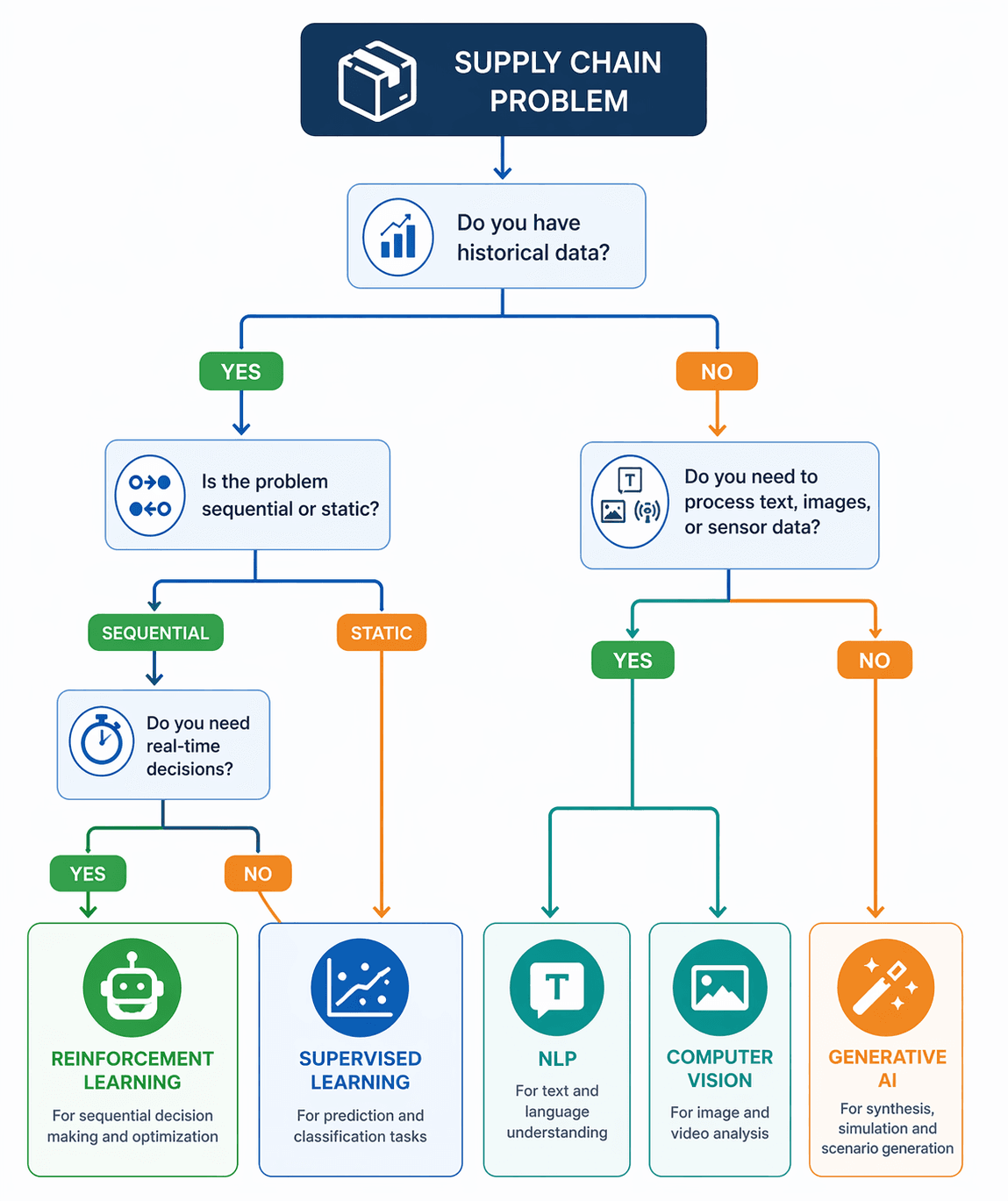
The framework asks four sequential questions:
- What data do you have? If you have clean historical data with labeled outcomes, supervised learning is viable. If you have only unlabeled data or need to discover patterns without predefined labels, consider unsupervised methods or start with a data labeling effort.
- Is the problem sequential or static? If decisions are made in sequence and each decision affects future states (e.g., routing, replenishment), reinforcement learning or agentic AI may be appropriate. If the problem is a one-time prediction (e.g., next month's demand), supervised learning is sufficient.
- What is the input data modality? Structured tabular data points to supervised or reinforcement learning. Unstructured text points to NLP. Images or video point to computer vision. Mixed modalities may require hybrid approaches.
- What level of autonomy is required? If the system only needs to recommend actions to a human planner, supervised or generative AI is appropriate. If the system needs to execute actions autonomously within guardrails, agentic AI or reinforcement learning is required — but this also demands significantly more robust governance and monitoring.
For a practical implementation roadmap that follows this framework, see the How to Implement Machine Learning in Logistics guide. For an evaluation of how platform architecture (AI-native vs. legacy) affects technique feasibility, see the AI-Native vs. Legacy Supply Chain Platforms comparison.
Key Implementation Risks and How to Mitigate Them
Even with the right technique selected, deployment failures remain common. The following risks are the most frequently cited across the research context, along with mitigation approaches.
- Data quality and integration complexity. Poor data quality is the most common reason AI projects fail in supply chain. Mitigation: invest in data readiness assessment before selecting a technique. The AI Readiness Paradox article provides a structured readiness framework.
- Talent shortages. 71% of EU firms and 68% of US firms report shortages in AI and data talent (Strategic Market Research). Mitigation: prioritize techniques that align with your existing team's capabilities, and consider managed services or platform-based approaches that reduce the need for in-house ML engineering.
- Overreliance on AI without human-in-the-loop oversight. Autonomous decisions in high-stakes supply chain contexts (e.g., inventory allocation during a disruption) can amplify errors if not supervised. Mitigation: design human-in-the-loop escalation paths, particularly for agentic AI deployments. The agentic AI editorial covers governance patterns for autonomous systems.
- Model drift in dynamic supply chain environments. Demand patterns, lead times, and supplier behavior change constantly. Models trained on historical data degrade. Mitigation: implement model monitoring and retraining pipelines as part of the initial deployment, not as an afterthought.
- Governance gaps for autonomous decisions. Agentic AI and reinforcement learning systems that execute actions without human approval introduce new governance requirements. Mitigation: establish clear accountability frameworks, audit trails, and rollback mechanisms before deploying autonomous systems in production.
The goal of this architecture reference is to help supply chain technology leaders move from treating AI as a monolith to treating it as a portfolio of techniques, each with specific requirements and appropriate applications. The technique-function mapping, maturity heatmap, and decision framework provide the structural foundation for that shift. The next step is applying this framework to your specific operational context — starting with the data readiness assessment and technique selection process outlined above.