
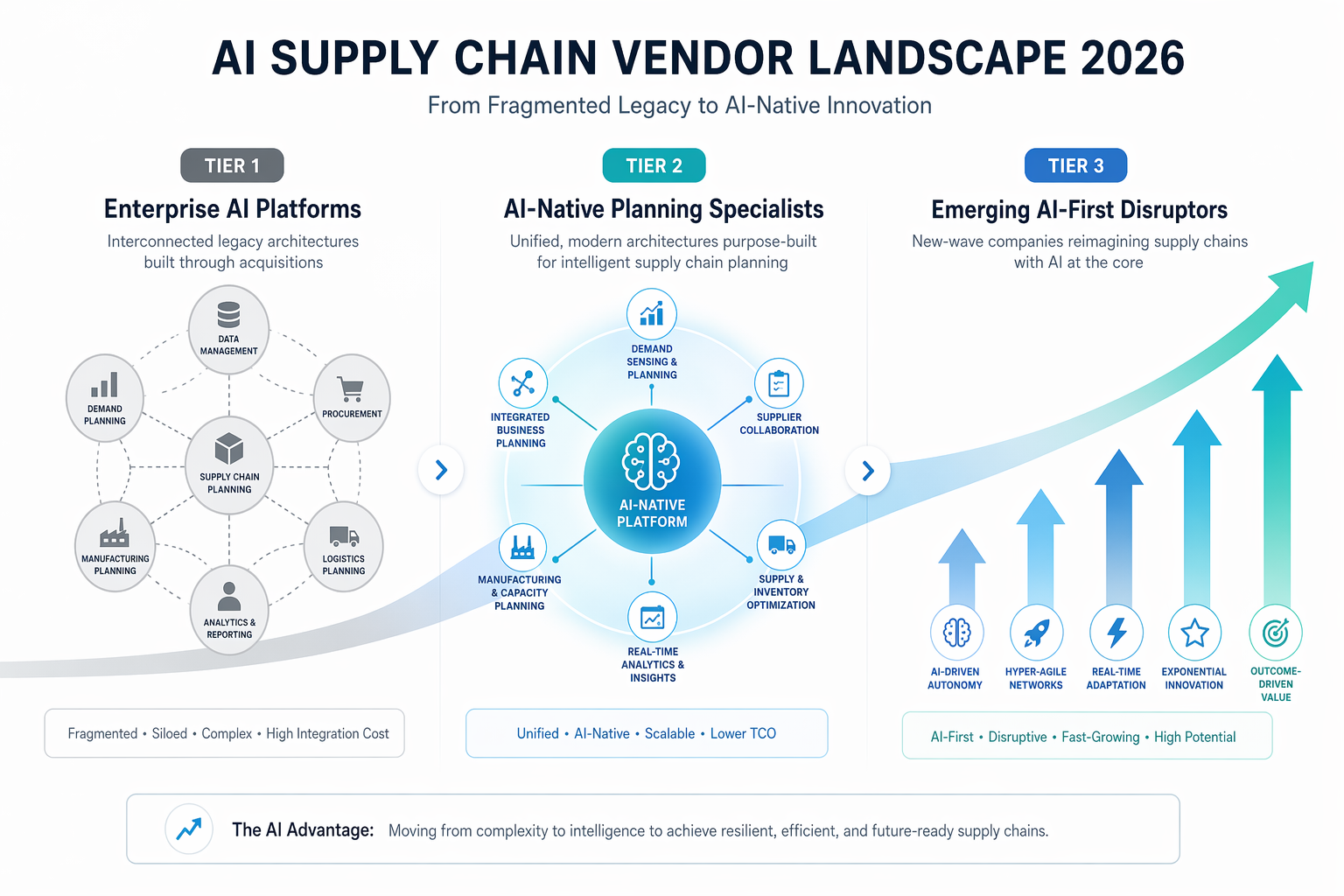
The AI-Washing Problem in Supply Chain Software
Every major supply chain software vendor now claims to be AI-powered. Marketing pages feature neural network diagrams, press releases announce "cognitive" capabilities, and analyst briefings emphasize machine learning roadmaps. But for supply chain technology evaluators building a shortlist, the critical question is not whether a vendor talks about AI — it is whether customers are actually using that AI in production to make planning, procurement, or logistics decisions.
The gap between marketing claims and real-world adoption is wider than most buyers realize. According to a 2025 Gartner survey cited by Open Sky Group, only 23% of supply chain organizations have a formal AI strategy in place. Meanwhile, 94% of companies plan to deploy AI or generative AI for decision support within two years, per ABI Research. That 71-point gap between intent and readiness creates a fertile environment for vendors to overstate their AI maturity.
A detailed comparison published by Flowlity in early 2026 found that at Blue Yonder — a vendor that markets heavily around AI — "almost no customers [are] using AI" in day-to-day planning operations. The same analysis showed that AI-native platforms built on unified codebases consistently score higher on user satisfaction than legacy suites that added AI as a feature layer over acquired, fragmented architectures.
This article extends the architectural framework established in our AI-Native vs. AI-Enhanced analysis by focusing on measurable performance outcomes: G2 user ratings, implementation timelines, actual use-case breadth, and independent analyst findings. The goal is to provide evidence-based differentiation that helps evaluators separate genuine AI capability from rebranded legacy functionality.
What Makes a Platform Truly AI-Native?
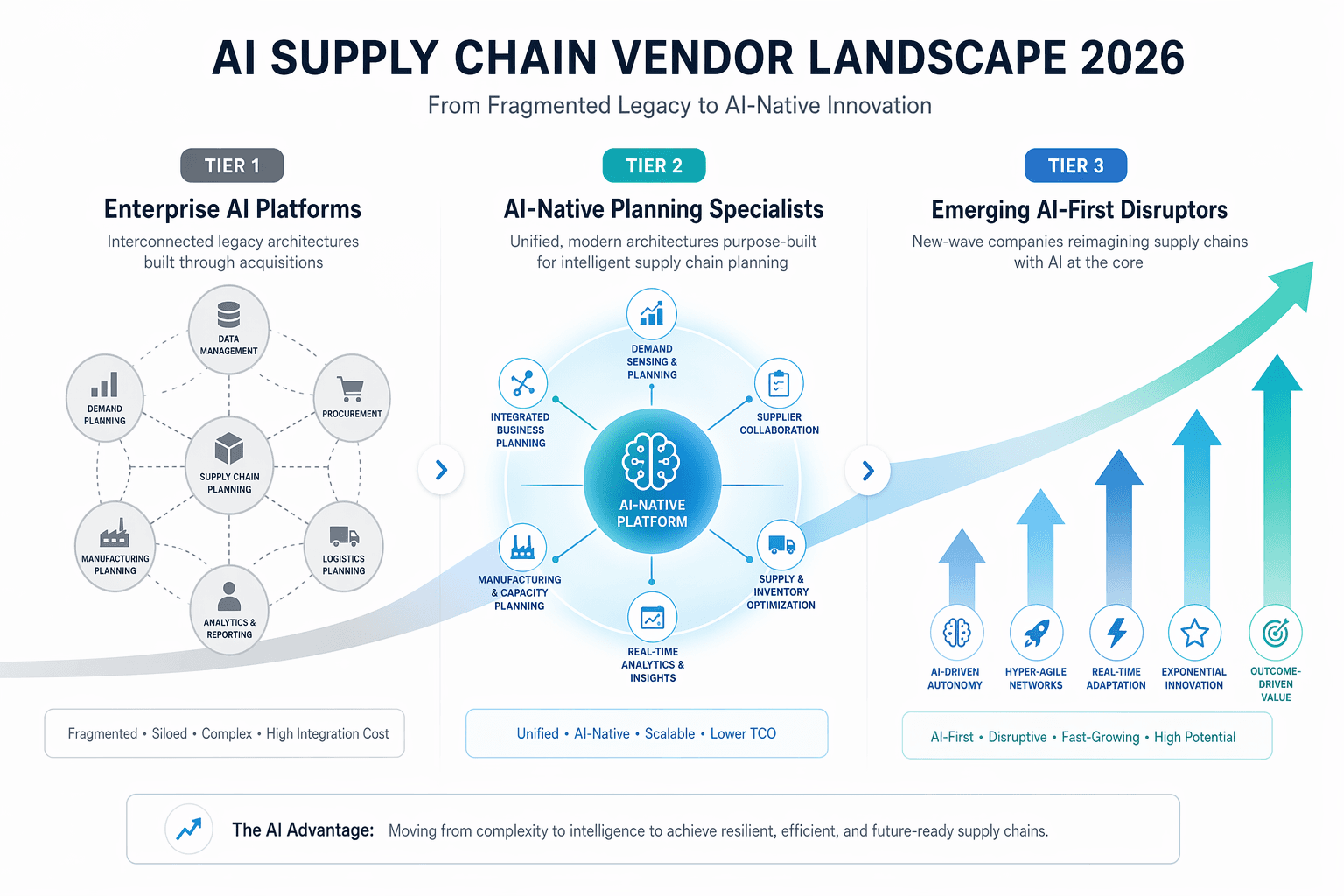
The distinction between AI-native and AI-enhanced platforms is not a marketing label — it is an architectural reality that directly affects what the software can deliver. According to Deposco's analysis of leading supply chain platforms, systems built through multiple acquisitions carry significant technical debt that fundamentally limits AI performance. The reason is straightforward: AI models require unified, real-time data access across planning, execution, and analytics to deliver value. When data lives in separate databases with different schemas and update cadences, the AI layer can only work with stale, fragmented inputs.
McKinsey's research supports this directly: companies with integrated data foundations spanning planning, execution, and analytics deliver 2 to 3 times greater ROI from AI than those with disconnected solutions. This is not a marginal difference — it is the difference between an AI initiative that justifies its investment and one that becomes another shelfware project.
The key architectural characteristics that define AI-native platforms include:
- Unified codebase and data model: A single platform built from the ground up, rather than a collection of acquired products stitched together with APIs and middleware.
- Real-time data ingestion: The ability to consume and process transactional data (orders, shipments, inventory movements) as they happen, not in nightly batch cycles.
- Embedded ML pipelines: Machine learning models that are natively integrated into planning workflows, not external analytics modules that require separate data exports.
- API-first architecture: Designed for bidirectional data flow with ERP, WMS, and TMS systems, enabling the AI to both receive data and push recommendations back into operational systems.
- Explainability built in: The ability to show planners why a specific forecast or recommendation was generated, which Viewpoint Analysis identifies as the most critical factor for user adoption.
Legacy platforms, by contrast, typically run AI models on top of data warehouses that aggregate information from multiple acquired systems. The AI layer is an add-on — often a separate module with its own licensing — rather than a core capability woven into the platform's DNA.
Vendor-by-Vendor AI Authenticity Analysis
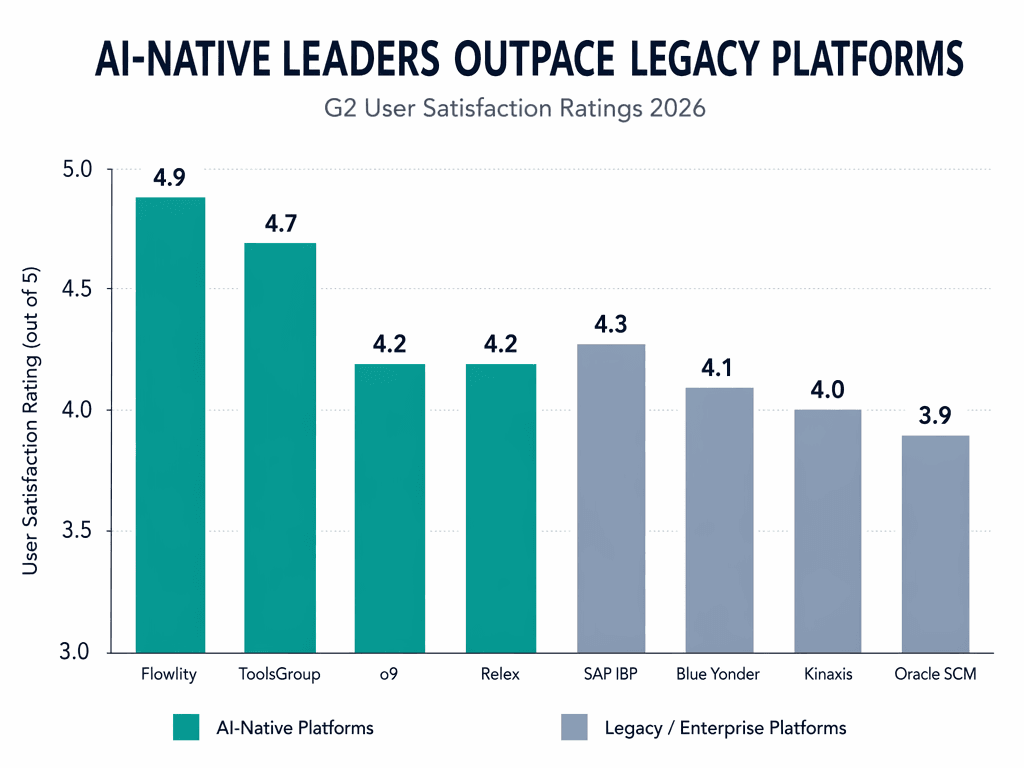
The following analysis evaluates major supply chain AI vendors across three dimensions: user satisfaction (G2 ratings), actual AI use-case adoption in production, and implementation complexity. The evidence draws from independent comparison research, user reviews, and analyst assessments.
| Vendor | G2 Rating | Architecture Type | AI Adoption Evidence | Implementation Timeline |
|---|---|---|---|---|
| Flowlity | 4.9/5 | AI-Native | Production-ready MCP server; AI used in daily planning workflows | ~90 days |
| ToolsGroup | 4.7/5 | AI-Native | AI-driven demand sensing and inventory optimization widely deployed | ~90 days |
| o9 Solutions | 4.2/5 | AI-Native | Enterprise Knowledge Graph powers AI planning; strong CPG/retail adoption | 3-6 months |
| Relex | ~4.2/5 | AI-Native | AI-native forecasting for retail and grocery; proven at scale | 3-6 months |
| SAP IBP | 4.3/5 | Legacy Suite | AI features added via HANA Cloud; limited native planning workflow integration | 12-18 months |
| Blue Yonder | 4.1/5 | Legacy Suite | Cognitive Solutions AI agents on Azure; limited production AI use per independent analysis | 12-18 months |
| Kinaxis | 4.0/5 | Legacy Suite | Maestro Chat adopted by ~2/3 of users; Maestro Agents launched Oct 2025 | 6-12 months |
| Oracle SCM | N/A | Legacy Suite | 50+ embedded Gen AI capabilities in Fusion Cloud; adoption varies by module | 12-18 months |
AI-Native Platforms: Evidence of Real Adoption
Flowlity's 4.9/5 G2 rating is the highest among all reviewed platforms. The vendor was one of the first to ship a production-ready MCP (Model Context Protocol) server — an integration capability that none of the other reviewed vendors offered as of April 2026. This is a concrete signal of AI-first engineering: the platform is designed to let AI agents access and act on planning data programmatically, not just present dashboards to human users.
ToolsGroup (4.7/5) has built its reputation on AI-driven demand sensing and inventory optimization for complex, multi-echelon supply chains. Its user reviews consistently cite the platform's ability to handle probabilistic forecasting at scale — a genuine AI use case, not a rebranded statistical model.
o9 Solutions (4.2/5) and Relex (~4.2/5) occupy the middle ground of AI-native platforms. o9's Enterprise Knowledge Graph — a graph-based data model that connects demand, supply, inventory, and financial data — is architecturally AI-native. The platform has strong adoption in CPG and retail for integrated business planning. Relex is purpose-built for retail and grocery demand forecasting, with AI models that learn from promotional calendars, weather data, and historical demand patterns.
Legacy Suites: Where AI Claims Meet Reality
Blue Yonder's 4.1/5 G2 rating places it below every AI-native platform in the comparison. The vendor has introduced "Cognitive Solutions" AI agents built on Microsoft Azure AI Foundry, and its Orchestrator Gen AI capability aims to synthesize data for decision intelligence. However, the Flowlity analysis found that almost no customers are using AI in day-to-day planning despite the heavy marketing emphasis. Blue Yonder reported $1.3 billion in annual recurring revenue (fiscal year 2023), but revenue scale does not equal AI adoption depth. For a deeper evaluation, see our Blue Yonder Supply Chain AI Platform profile.
SAP IBP (4.3/5) scores higher than Blue Yonder on user satisfaction, but its AI capabilities are layered on top of the HANA Cloud platform. SAP announced MCP support for HANA Cloud starting Q1 2026, but not natively within IBP's planning workflows — meaning the AI integration requires additional configuration and middleware.
Kinaxis (4.0/5) has made progress with its Maestro Chat interface, which about two-thirds of its user base has adopted. The vendor launched Maestro Agents in October 2025, adding autonomous response capabilities for exception management. However, Kinaxis does not offer an MCP server, and its concurrent planning architecture — while innovative for its time — was not originally designed for AI-native data models. Our Kinaxis Maestro vendor profile provides additional evaluation context.
Why Implementation Timelines Differ So Dramatically
One of the most concrete differentiators between AI-native and legacy platforms is implementation speed. According to Deposco's analysis, AI-native platforms average 90 days to deploy, while legacy enterprise platforms require 12 to 18 months or more. This is not a minor scheduling difference — it represents fundamentally different approaches to data architecture and system integration.
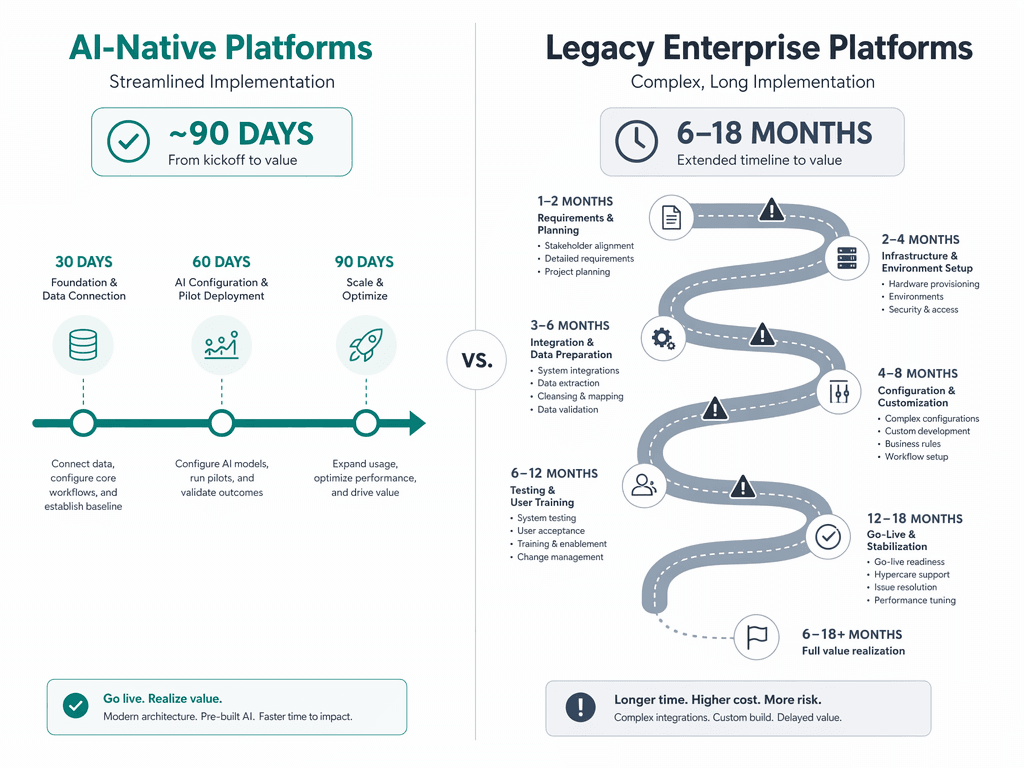
The reasons for this gap are structural, not procedural:
- Technical debt from acquisitions: Legacy platforms like Blue Yonder and Oracle SCM have grown through dozens of acquisitions. Each acquired product brings its own database schema, API conventions, and data quality standards. Integrating these into a unified AI-ready data layer requires extensive ETL work, data cleansing, and custom middleware.
- Data fragmentation: AI models need real-time access to transactional data across planning, execution, and analytics. In legacy architectures, this data lives in separate silos — demand data in one system, inventory in another, logistics in a third. Unifying it for AI consumption is a multi-month project.
- Configuration complexity: Enterprise suites often require extensive configuration of master data, business rules, and user permissions before the AI layer can function. AI-native platforms, by contrast, are designed to ingest raw data and learn patterns with minimal upfront configuration.
- Change management overhead: Longer implementations create organizational fatigue. By the time a legacy platform's AI module goes live, the original business sponsors may have moved on, and the data assumptions used during configuration may no longer hold.
Deposco also notes that license fees represent only 20-30% of the true total cost of ownership for enterprise supply chain platforms. The remaining 70-80% comes from implementation services, integration work, data migration, and ongoing customization. For a 12-18 month implementation, these costs can easily exceed the software license itself by a factor of three or four.
Selection Criteria: How to Assess Real AI Capability During Evaluation
When evaluating supply chain AI platforms, the goal is to distinguish between vendors that have genuinely embedded AI into their architecture and those that have added AI features as a marketing layer. Based on the Viewpoint Analysis buyer guide and independent research, the following criteria provide a practical evaluation framework.
| Evaluation Criterion | What to Look For | Red Flags |
|---|---|---|
| AI explainability | The platform can show planners why a specific forecast or recommendation was generated, with traceable logic and data sources. | Black-box outputs with no explanation; vendor says "the AI just knows" or deflects to model complexity. |
| Data integration architecture | Real-time bidirectional data flow with your ERP, WMS, and TMS; no batch processing requirements for AI inputs. | AI module requires separate data warehouse; nightly batch updates; custom ETL pipelines sold as separate services. |
| Production AI use cases | Named customers using AI in daily planning decisions, not just pilot programs or proof-of-concept projects. | Vendor cannot provide customer references for production AI use; all examples are "in development" or "coming soon." |
| Implementation methodology | Clear, bounded implementation timeline with fixed-price options; vendor takes responsibility for data integration. | Open-ended timeline with multiple phases; implementation costs quoted as time-and-materials; data readiness treated as customer problem. |
| Model governance and monitoring | Built-in tools for model drift detection, performance monitoring, and human-in-the-loop review of AI recommendations. | No model governance capabilities; AI outputs cannot be audited or overridden; no mechanism to retrain models on new data. |
| API and integration ecosystem | Open APIs for bidirectional data exchange; MCP server or similar protocol for AI agent integration. | Proprietary integration methods; vendor charges extra for API access; no support for modern AI integration protocols. |
Comments
Join the discussion with an anonymous comment.