
What Is Machine Learning in Supply Chain Management?
Machine learning (ML) in supply chain management refers to a family of algorithmic approaches that learn patterns from historical and real-time data to make predictions, classifications, or decisions without being explicitly programmed for every rule. This distinguishes ML from traditional rules-based automation — where a planner manually sets a reorder point at 30 days of cover — and from general artificial intelligence, which encompasses a broader set of reasoning and autonomy capabilities.
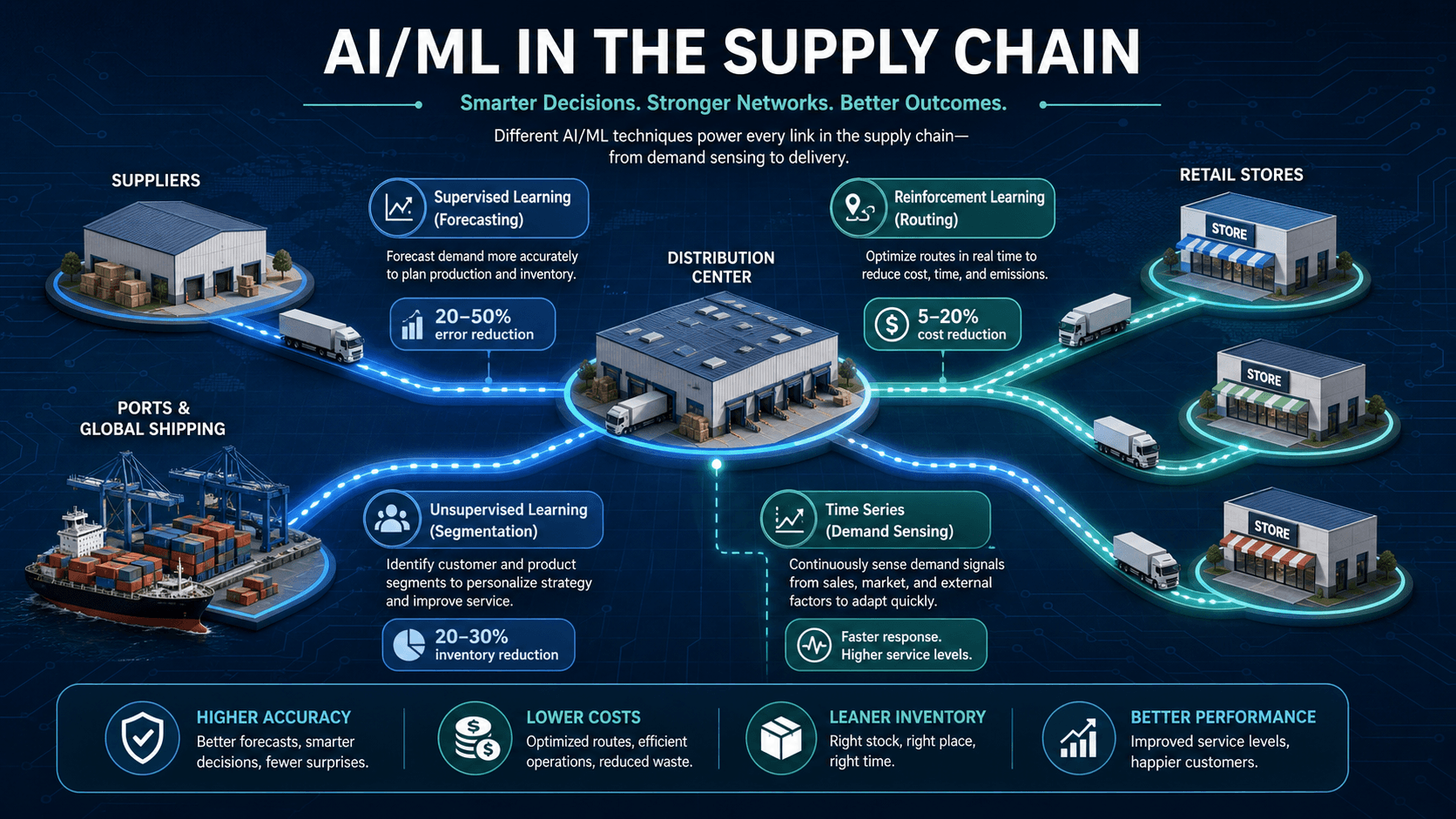
In practice, ML in supply chain is not a single technology that a company "turns on." It is a toolkit: supervised learning for demand forecasting, reinforcement learning for dynamic routing, clustering for SKU segmentation, and time series methods for demand sensing. Each technique is suited to a specific class of operational problems, and each has documented, source-attributed outcome ranges that supply chain leaders can use to set realistic expectations.
Key ML Techniques Used in Supply Chain
Five ML technique families dominate supply chain applications. Understanding the core mechanism of each helps practitioners evaluate vendor claims and match algorithms to problems.
- Supervised Learning (Regression & Classification): The model is trained on labeled historical data — input features (price, promotions, weather) mapped to known outcomes (units sold). Regression predicts continuous values like demand volume; classification predicts discrete categories like supplier risk tier. This is the most widely deployed ML technique in supply chain today.
- Unsupervised Learning (Clustering & Anomaly Detection): The model finds hidden patterns in unlabeled data. Clustering groups similar items — for example, segmenting 10,000 SKUs into 15 inventory policy groups. Anomaly detection flags outliers in freight invoices or supplier delivery times without pre-defining what "normal" looks like.
- Reinforcement Learning: An agent learns optimal decisions through trial-and-error interaction with an environment, receiving rewards for favorable outcomes. In supply chain, this is most commonly applied to route optimization (minimizing cost per delivery) and dynamic inventory replenishment where the system must balance stockouts against holding costs.
- Time Series Forecasting: A specialized class of supervised learning where the input is sequential historical data (daily sales, weekly shipments) and the output is a future value. Methods range from classical ARIMA to modern deep learning architectures like LSTMs and Transformers. Time series is the backbone of demand forecasting and demand sensing.
- Deep Learning: Multi-layer neural networks capable of capturing complex non-linear relationships. Used in supply chain for image-based quality inspection (computer vision), natural language processing for contract analysis, and high-dimensional demand forecasting where traditional methods struggle with sparse or noisy data.
Technique-to-Function Mapping
The following table maps each ML technique to the supply chain domains where it is most commonly and effectively applied. This mapping is the core differentiator of this glossary entry — it moves beyond generic "AI in supply chain" claims to specify which algorithmic approach fits which operational problem.
| ML Technique | Supply Chain Function | Typical Application | Common Algorithm Examples |
|---|---|---|---|
| Supervised Learning (Regression) | Demand Planning | Forecast unit-level demand using price, promotion, and external features | Gradient boosting, random forest, linear regression |
| Supervised Learning (Classification) | Procurement / Supplier Risk | Classify suppliers into risk tiers based on financial health, geopolitical exposure | Logistic regression, support vector machines, XGBoost |
| Unsupervised Learning (Clustering) | Inventory Management | Segment SKUs into inventory policy groups (ABC-XYZ analysis) | K-means, DBSCAN, hierarchical clustering |
| Unsupervised Learning (Anomaly Detection) | Logistics / Freight Audit | Flag anomalous freight invoices, detect carrier service failures | Isolation forest, autoencoders, one-class SVM |
| Reinforcement Learning | Transportation / Route Optimization | Optimize delivery routes dynamically under changing traffic and order conditions | Q-learning, deep Q-networks, proximal policy optimization |
| Time Series Forecasting | Demand Sensing / S&OP | Generate short-term forecasts from point-of-sale or IoT sensor data | ARIMA, Prophet, LSTM, Transformer-based models |
| Deep Learning (Computer Vision) | Warehouse Operations / Quality | Inspect incoming goods for defects, automate pick-and-place | Convolutional neural networks, YOLO, ResNet |
| Deep Learning (NLP) | Procurement / Contract Analysis | Extract terms, clauses, and obligations from supplier contracts | BERT, GPT, transformer-based language models |
Key Applications and Measured Impact
The following applications represent the most mature and well-documented ML use cases in supply chain. All outcome ranges are sourced from published analyst research and should be treated as benchmarks, not guarantees — actual results depend on data quality, organizational readiness, and implementation rigor.
| Application | Primary ML Technique | Reported Outcome Range | Source |
|---|---|---|---|
| Demand Forecasting | Time series, supervised regression | 20–50% reduction in forecast error | McKinsey 2024 |
| Inventory Optimization | Supervised learning, clustering | 20–30% reduction in inventory levels | McKinsey 2024 |
| Logistics Cost Reduction | Reinforcement learning, supervised learning | 5–20% reduction in logistics costs | McKinsey 2024 |
| Predictive Maintenance | Supervised learning (classification), anomaly detection | 30–50% reduction in unplanned downtime; 10–40% lower maintenance costs | McKinsey 2024 |
| Procurement Spend Reduction | Supervised learning, NLP | 5–15% reduction in procurement spend | McKinsey 2024 |
| Autonomous Planning (End-to-End) | Reinforcement learning, supervised learning | Up to 20% reduction in obsolete inventory; 10% reduction in supply chain expenditures | McKinsey 2024 |
Beyond these core applications, ML is increasingly deployed for supplier risk scoring — where classification models assess financial health, geopolitical exposure, and delivery reliability — and for demand sensing, which uses time series and deep learning to generate short-term forecasts from point-of-sale, IoT, and weather data. The UPS ORION system, a well-known reinforcement learning deployment, saves approximately 100 million miles of driving and 10 million gallons of fuel per year, illustrating the scale of impact possible when ML is applied to route optimization at network level.
For deeper dives into specific applications, see the ChainSignal glossary entries on Demand Forecasting AI and Multi-Echelon Inventory Optimization (MEIO), as well as the use case entry on AI Demand Forecasting in CPG and Retail.
Adoption Benchmarks and Market Context
Adoption of ML in supply chain has accelerated significantly, but the gap between investment intent and strategic readiness remains wide. The following table summarizes key benchmarks from multiple analyst sources.
| Metric | Figure | Source & Year |
|---|---|---|
| Supply chain leaders who have integrated AI into selected functions | 57% | PwC 2025 |
| Companies planning to use AI/Gen AI for decision support within 2 years | 94% | ABI Research 2025 |
| Organizations with a formal AI strategy | 23% | Gartner 2025 |
| Profitability premium for AI-mature supply chain organizations | 23% more profitable than peers | Accenture 2024 |
| Large organizations expected to adopt AI-based supply chain forecasting by 2030 | 70% | Gartner 2025 |
| Supply chain leaders who say AI capabilities are important when evaluating new technology | 64% | ABI Research 2025 |
| Logistics employees who adopted AI tools in 2024 | 72% | ActivTrak 2025 |
The market for AI in supply chain is also growing rapidly, though estimates vary significantly depending on scope. Precedence Research valued the market at $9.94 billion in 2025, projecting growth to $236 billion by 2035 (37.3% CAGR). Strategic Market Research offers a narrower estimate of $7.3 billion in 2024, reaching $63.8 billion by 2030 (42.7% CAGR). These differences stem from varying definitions — some analysts include all AI software and services, while others focus on ML-specific platforms or exclude embedded AI within ERP systems.
The 23% profitability premium for AI-mature supply chains, reported by Accenture in 2024, is one of the most frequently cited benchmarks in vendor materials. However, it is important to note that this figure compares organizations with mature, scaled AI deployments against those with limited or no AI adoption — it does not represent the average return for a first-time implementation.
Implementation Prerequisites
Successful ML deployment in supply chain requires more than selecting the right algorithm. The following prerequisites are consistently cited across analyst research and practitioner case studies as necessary conditions for achieving the outcome ranges listed above.
- Data quality and unified data layer: ML models are only as good as the data they train on. Fragmented data across ERP, WMS, TMS, and external sources is the most common barrier to production-grade ML. Organizations need a unified data layer — often a data lake or warehouse — with consistent definitions for SKUs, locations, and time periods.
- Cross-functional team structure: ML in supply chain cannot be owned solely by IT or data science. Effective deployments involve supply chain planners, procurement managers, and logistics operators working alongside data engineers and ML engineers. The "translator" role — someone who understands both supply chain operations and ML capabilities — is often the critical success factor.
- Executive sponsorship with realistic expectations: ML is not a quick fix. Leaders must commit to a multi-year investment and resist the temptation to judge success solely on short-term ROI. The 2–4 year timeline for satisfactory returns, reported by Deloitte, should be communicated to stakeholders before the project begins.
- Integration with existing ERP/SCM systems: ML models must operate within the existing planning and execution workflow. If a demand forecast generated by ML cannot be fed into the S&OP process or the inventory planning system, its value is severely limited. API compatibility and data pipeline reliability are non-negotiable.
- Human-in-the-loop design: Even the most accurate ML models produce errors. Supply chain planners need visibility into model outputs, the ability to override recommendations, and clear escalation paths for anomalous predictions. Trust is built through transparency, not through black-box automation.
For a more detailed treatment of these prerequisites, see the ChainSignal Supply Chain Control Tower AI glossary entry, which discusses how ML techniques integrate into broader visibility and decision-support systems.
Common Pitfalls and Realistic Timelines
The gap between AI investment and realized value is well documented. Deloitte's 2025 survey found that while 85% of organizations increased AI investment, only 6% saw ROI in under a year. Most achieved satisfactory returns within 2–4 years. This timeline is not a sign of failure — it reflects the complexity of data integration, organizational change, and model refinement required for production-grade ML.
- Data fragmentation: The most common failure mode. ML models trained on incomplete or inconsistent data produce unreliable outputs, eroding trust and leading to abandonment. Organizations should expect to spend 60–80% of initial project time on data preparation, not model building.
- Black-box model concerns: Supply chain planners are often skeptical of models they cannot explain. If a forecasting model recommends a 40% increase in safety stock for a specific SKU, the planner needs to understand why. Techniques like SHAP values and LIME can help, but explainability should be a selection criterion when evaluating ML platforms.
- Organizational resistance: Planners and buyers who have spent years developing intuition about demand patterns and supplier behavior may resist algorithm-driven recommendations. Change management — including training, transparent communication about model limitations, and gradual rollout — is as important as technical implementation.
- Over-reliance on vendor claims: Vendor case studies often report best-case outcomes from carefully selected pilot deployments. The 20–50% forecast error reduction cited by McKinsey is a benchmark range, not a guarantee. Organizations should validate vendor claims against their own data through structured proof-of-concept projects before committing to full deployment.
- Underestimating ongoing maintenance: ML models degrade over time as data distributions shift — a phenomenon known as model drift. Production ML requires ongoing monitoring, retraining, and governance. Organizations that treat ML as a "build once, deploy forever" project will see accuracy erode within months.
For a more detailed discussion of the distinction between demand sensing, demand forecasting, and demand planning — and how ML techniques apply to each — see the ChainSignal glossary entry on Demand Sensing vs. Demand Forecasting vs. Demand Planning.