
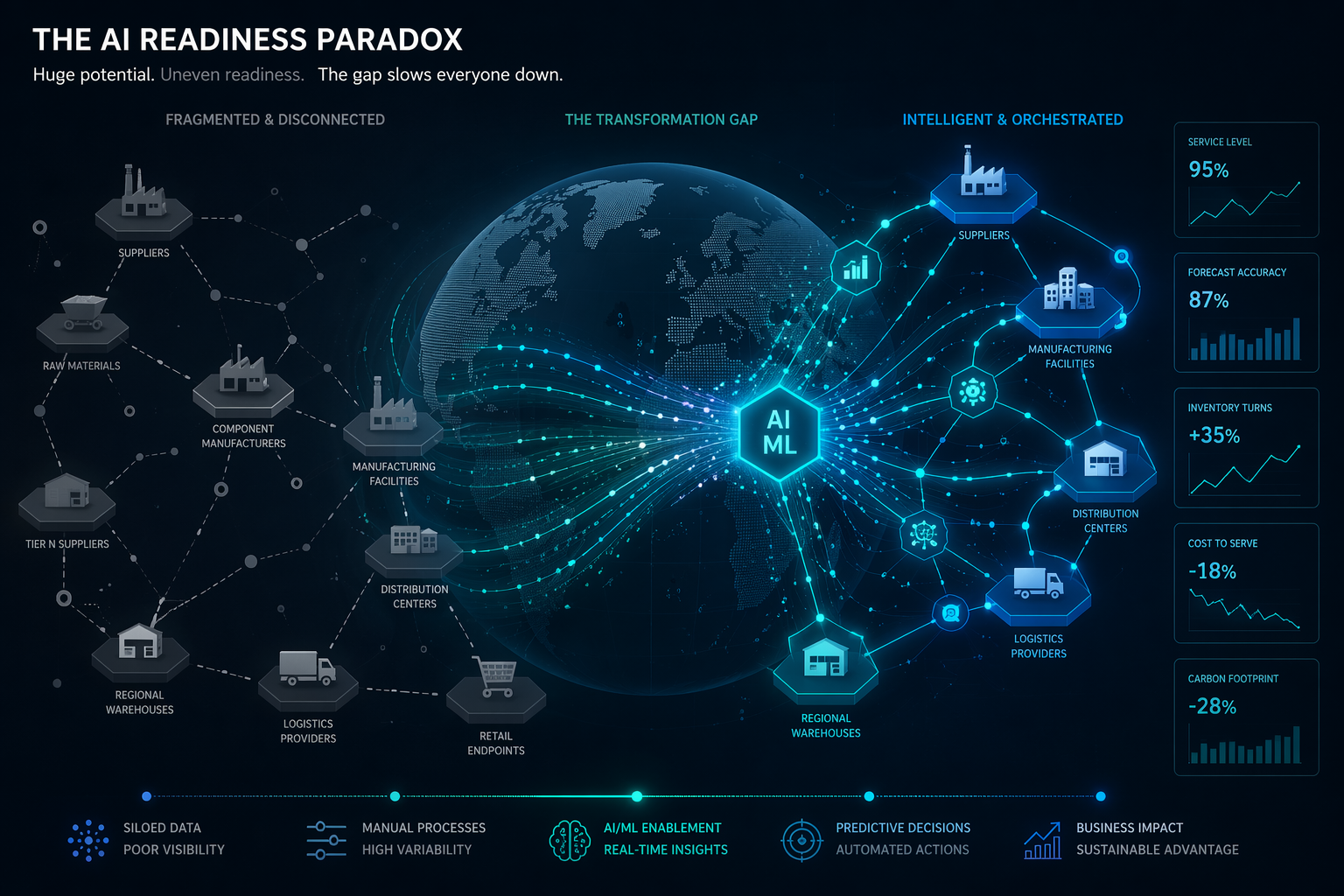
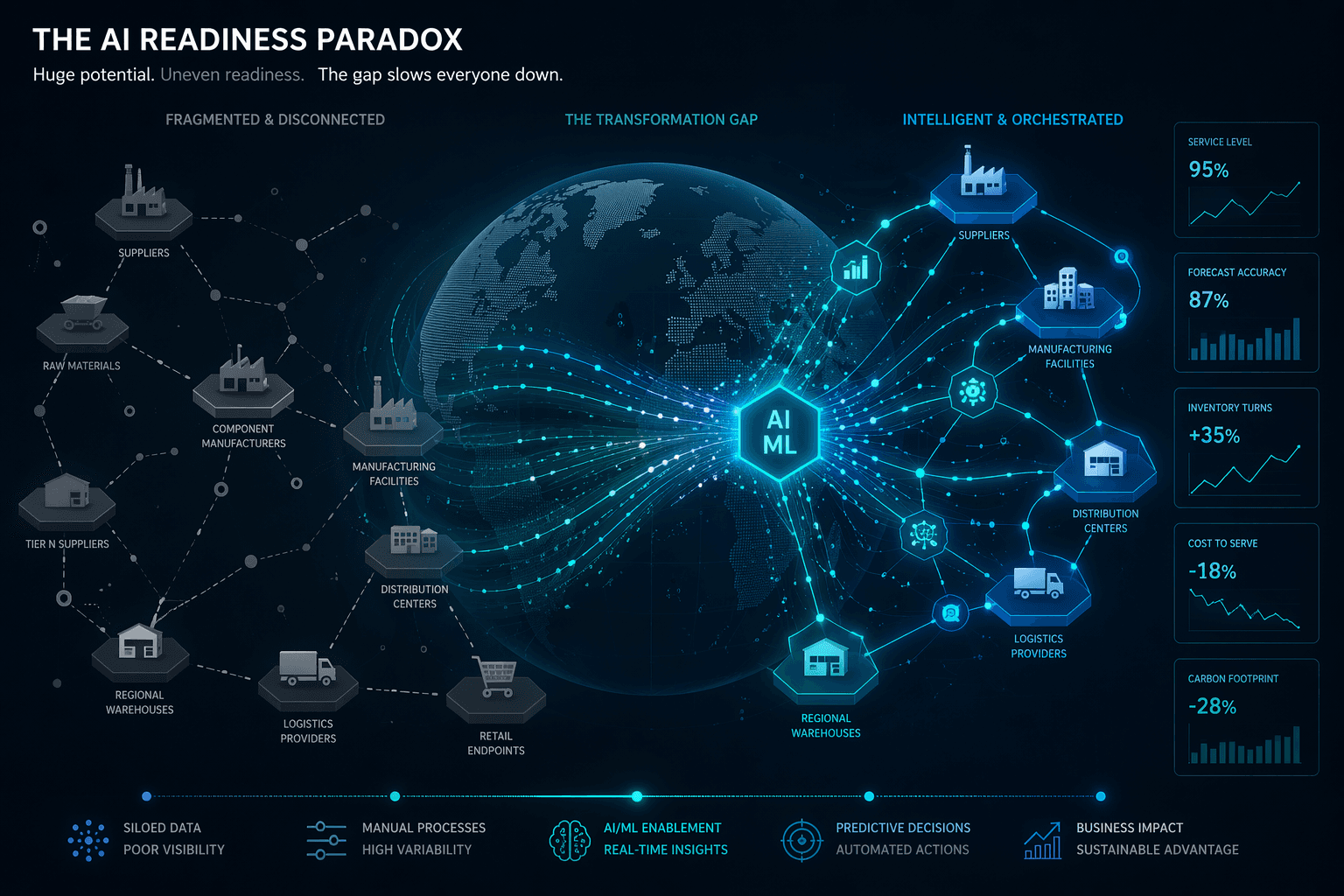
The Paradox: Near-Universal AI Intent vs. Low Execution Readiness
The numbers paint a picture of almost unanimous conviction. According to ABI Research, 94% of supply chain companies plan to deploy AI or generative AI for decision support within two years. A separate survey by Supply Chain Brain found that 85% of executives intend to increase AI spending in 2026. The intent is not in question.
Yet when you look past the investment plans and examine what organizations have actually built to support those ambitions, the picture shifts sharply. Gartner reported in February 2025 that only 23% of supply chain organizations have a formal AI strategy, and just 29% have developed the capabilities needed for future readiness. The gap between what companies say they will do and what they are equipped to execute is not a minor implementation lag — it is the defining structural challenge of AI adoption in supply chain today.
IBM's 2026 analysis of AI adoption challenges confirms this diagnosis directly: "the biggest barrier to AI in supply chain is no longer technology capability — it's organizational readiness." The remainder of this article unpacks five specific readiness barriers — data quality, strategy, talent, governance, and legacy integration — and provides a structured playbook, drawn from Gartner's CSCO roadmap and IBM's adoption data, for closing the execution gap.
Barrier #1: Data Quality and Readiness
Every AI model is only as reliable as the data it consumes. In supply chain, where data flows across ERP systems, warehouse management platforms, transportation management systems, supplier portals, and IoT sensors, the probability of encountering fragmented, inconsistent, or stale data is not an edge case — it is the norm.
IBM's 2026 research identifies data readiness as the single largest barrier to enterprise AI adoption. This finding is reinforced by a Tradeverifyd survey showing that 67% of enterprises report that their return on investment from visibility tools has stalled because of continued reliance on fragmented legacy systems. When data lives in disconnected silos — order management in one database, inventory in another, supplier lead times in spreadsheets — even the most sophisticated forecasting model will produce outputs that cannot be trusted.
The consequences of poor data readiness are not theoretical. Models trained on incomplete or inconsistent historical data generate forecasts that planners override, which defeats the purpose of automation. Trust erodes. The AI initiative gets labeled as "not ready for production," and the organization retreats to manual processes. This pattern — pilot, stall, retreat — is the most common trajectory for supply chain AI projects that fail to scale.
Deepak Singh, Co-founder and Chief Innovation Officer at Adeptia, captured the operational reality in a January 2026 interview: "Success hinges on data quality. While AI excels at demand forecasting and route optimization, the real breakthrough will be handling partner data chaos. Data readiness is the barrier."
For a deeper treatment of the specific steps required to prepare data for AI consumption, see The CSCO's Data Readiness Checklist for Supply Chain AI Implementation, which covers data lineage, master data management, and pipeline modernization in detail.
Barrier #2: The Strategy Gap
A supply chain organization can purchase the best AI platform on the market and still fail to generate value if it lacks a coherent strategy for where, why, and how to deploy the technology. The data bears this out starkly: Gartner found that only 23% of supply chain organizations have a formal AI strategy. The remaining 77% are operating without a documented plan that aligns AI investments with business priorities, data readiness, and organizational capacity.
The absence of a strategy produces predictable failure modes:
- Pilot proliferation without path to production. Multiple teams run independent experiments on different platforms, solving narrow problems in isolation. None of the pilots are designed to scale, and none are integrated into core planning processes.
- Misaligned investment. Budget is allocated to the most visible or vendor-persuasive use case rather than the one that addresses the highest-impact operational bottleneck.
- Stakeholder fatigue. When AI initiatives are not tied to a shared roadmap, different functions — planning, procurement, logistics — pursue conflicting priorities. The result is organizational friction that slows every project.
A formal AI strategy does not need to be a 100-page document. It needs to answer four questions: Which supply chain processes will AI augment first? What data and integration prerequisites must be met before deployment? How will success be measured and by whom? And what governance structure will oversee model performance, drift, and accountability? Organizations that cannot answer these questions are not ready to scale, regardless of how much they spend on software.
For a detailed breakdown of how maturity levels correlate with strategy sophistication, see Gartner's 2025 Supply Chain AI Maturity Data Decoded.
Barrier #3: Talent and Workforce Readiness
Even with clean data and a clear strategy, AI initiatives stall when the people who must build, maintain, and trust the models are not in place. The talent shortage in AI and data science is acute and geographically broad. According to data from the OECD cited by Strategic Market Research, 71% of EU firms and 68% of US firms report a shortage in AI and data talent. This is not a niche problem — it is a systemic constraint on the entire industry's ability to scale.
The talent gap has two dimensions. The first is technical: organizations lack data engineers, ML engineers, and data scientists who understand both the modeling techniques and the supply chain domain. The second is cultural: the workforce that will interact with AI tools daily — planners, buyers, warehouse managers — often lacks confidence in the technology and has not been trained to use it effectively.
Accenture's 2026 research on workforce AI readiness found that 43% of employees say clear, comprehensive training would be the single most effective factor in increasing their confidence using AI tools. This finding underscores a critical point: the readiness gap is not just about hiring data scientists. It is about equipping the existing supply chain workforce to collaborate with AI systems — to know when to trust a model's recommendation, when to override it, and how to identify when model performance is degrading.
| Dimension | Current State | Target State |
|---|---|---|
| Technical talent | 71% of EU firms and 68% of US firms report AI talent shortages (OECD) | Dedicated data engineering and ML roles embedded in supply chain teams |
| Workforce confidence | 43% of employees cite training as the top factor for AI confidence (Accenture 2026) | Structured upskilling programs covering model interpretation, exception handling, and escalation |
| Change management | Ad hoc; no formal program for AI transition | Dedicated change management function with clear communication, feedback loops, and role redesign |
KPMG's 2026 outlook on AI in supply chain, published in Supply Chain Management Review, reinforces the urgency: organizations need "comprehensive upskilling programs for employees while simultaneously addressing concerns over job loss due to intelligent automation." The trust factor between workers and the technology — and between workers and the company deploying it — is a prerequisite for adoption, not an afterthought.
Barrier #4: Governance and Trust
As AI moves from descriptive analytics ("what happened?") to prescriptive and autonomous decision-making ("what should we do?" and "do it"), the governance question becomes existential. Who is accountable when an AI-driven inventory optimization model recommends a stock position that leads to a stockout? How do you audit a procurement agent that autonomously negotiates with suppliers? What happens when a demand forecasting model drifts because consumer behavior changed and the training data no longer reflects reality?
The industry is making progress on governance, but from a low base. IBM's 2026 adoption analysis reports that AI-specific governance roles grew 17% in 2025, and the share of businesses with no responsible AI policies fell from 24% to 11% over the same period. These are positive trends, but they still mean that one in nine organizations operating AI systems has no formal policy governing how those systems should be developed, validated, or monitored.
For supply chain specifically, governance must address:
- Model explainability. Planners and procurement managers need to understand why a model produced a particular recommendation. Black-box systems that cannot be interrogated will be overridden or ignored.
- Drift monitoring. Supply chain conditions change constantly — new products, shifting supplier lead times, demand shocks. Models that are not continuously monitored for accuracy degradation will produce increasingly unreliable outputs.
- Human-in-the-loop design. For high-stakes decisions — inventory rebalancing, supplier selection, pricing — the governance framework must specify the threshold at which human approval is required before an AI recommendation is executed.
- Audit trail. Every AI-influenced decision should be traceable: which model version produced the recommendation, what data it used, whether a human overrode it, and what the outcome was.
Organizations that treat governance as a compliance checkbox rather than an operational necessity will find that their AI systems erode trust internally — and, in regulated industries, externally. Governance is not a brake on AI adoption; it is the foundation that makes responsible scaling possible.
Barrier #5: Integration with Legacy Systems and Proving ROI
The final barrier is the one that most directly affects the CFO's willingness to fund the next phase of AI investment. Supply chain technology stacks are notoriously heterogeneous. A typical enterprise runs an ERP (SAP, Oracle, or Microsoft Dynamics), a WMS, a TMS, a procurement platform, and multiple planning tools — often from different vendors, on different deployment models, with different data schemas.
Tradeverifyd's 2026 supply chain statistics report that 67% of enterprises report that despite increasing their financial commitment to visibility tools, the return on investment has stalled due to the continued use of fragmented legacy systems. The integration problem is not just a technical nuisance — it is the primary reason that AI projects fail to deliver measurable business value at scale.
The ROI challenge compounds the integration problem. Deloitte's 2025 AI investment survey found that only 6% of organizations see ROI from AI in under a year; most achieve satisfactory returns within two to four years. For supply chain leaders who must justify AI investments on annual budget cycles, this timeline creates a fundamental tension. The projects that deliver the highest long-term value — end-to-end demand sensing, autonomous replenishment, dynamic network optimization — require the deepest integration and the longest payback period.
The practical implication is clear: organizations cannot wait until all legacy systems are replaced to start their AI journey. They must adopt an incremental integration strategy — connecting AI platforms to the most critical data sources first, demonstrating value on a bounded use case, and expanding the integration footprint as ROI is proven. This is the approach that separates organizations that scale from those that stall.
For a detailed analysis of common failure modes and how to avoid them, see Why 70% of Supply Chain AI Projects Fail — and How Data-First Implementation Fixes It.
Gartner's CSCO Roadmap: Four Priorities for Building an AI Foundation
In March 2026, Gartner published a CSCO roadmap specifically addressing the readiness gap. Authored by Julia Heyman, the framework identifies four essential actions that chief supply chain officers must take to build an AI-ready organization. These actions are not technology decisions — they are leadership and organizational design decisions.
| Priority | What It Means in Practice |
|---|---|
| Grow AI expertise | Invest in structured upskilling for the supply chain team, not just the data science team. Build AI literacy among planners, buyers, and warehouse managers so they can effectively collaborate with models. |
| Study peers | Benchmark against organizations at similar or higher maturity levels. Understand what readiness prerequisites they met before scaling, and what barriers they encountered. |
| Assess organizational readiness | Use Gartner's AI Maturity Model to evaluate current capabilities across data, talent, governance, and strategy dimensions. Identify the specific gaps that must be closed before scaling. |
| Advance role in enterprise AI strategy | CSCOs must move from being consumers of enterprise AI decisions to active participants in setting the AI agenda. Supply chain is one of the highest-value domains for AI — it needs a seat at the strategy table. |
These four priorities are sequenced deliberately. Expertise comes first because without it, the organization cannot evaluate vendor claims, assess readiness, or govern model behavior. Peer study comes next because the fastest path to readiness is learning from organizations that have already navigated the barriers. Readiness assessment provides the diagnostic. And advancing the CSCO's role in enterprise AI strategy ensures that supply chain's unique requirements — real-time data, high-stakes decisions, complex integration — are not subordinated to generic enterprise AI initiatives.
A Practical Playbook for Closing the Readiness Gap
The five barriers and Gartner's four priorities translate into a concrete set of actions that any supply chain organization can take, regardless of its current maturity level. The playbook below is drawn from the Gartner CSCO roadmap, IBM's adoption analysis, and the ICRON agentic AI playbook, synthesized into a single actionable framework.
- Assess AI maturity using a structured model. Gartner's AI Maturity Model provides a framework for evaluating where your organization stands across data, talent, governance, and strategy. Without a baseline assessment, you cannot prioritize investments or track progress.
- Secure master data ownership. Treat data as a P&L-level asset, not an IT responsibility. Assign clear ownership for master data domains — product, customer, supplier, location — and establish service-level agreements for data quality, freshness, and completeness.
- Implement hybrid governance. Centralize policy-setting for model validation, explainability standards, and audit requirements. Delegate day-to-day model management to the functional teams (demand planning, procurement, logistics) that understand the operational context.
- Build multidisciplinary teams or centers of excellence. AI in supply chain cannot be owned by IT alone or by the supply chain function alone. Create cross-functional teams that include data engineers, supply chain domain experts, and change management professionals.
- Institutionalize ethical governance. Define the decision rights for AI-influenced actions. Specify which decisions require human approval, how model performance will be monitored, and what the escalation path is when a model produces unexpected recommendations.
- Strengthen signal quality for early automation. As recommended by ICRON's agentic AI playbook, focus on improving the quality and latency of the data signals that feed AI models before attempting to automate decisions. Clean, real-time signals are a prerequisite for autonomous operations.
- Measure outcomes, not activity. Track business metrics — forecast accuracy, inventory turns, on-time delivery, procurement savings — not technical metrics like model training time or inference latency. ROI conversations are won or lost on business outcomes.
The Cost of Inaction vs. The Cost of Rushing
The readiness gap creates two distinct risks, and both are costly.
The cost of inaction is competitive displacement. Accenture's 2024 research found that companies with AI-mature supply chains are 23% more profitable than their peers and six times as likely to use AI or generative AI widely. As the market for AI in supply chain expands from its 2025 valuation of $9.94 billion (Precedence Research) toward a projected $236.42 billion by 2035, the gap between leaders and laggards will widen. Organizations that delay readiness investments will find themselves competing against supply chains that can forecast more accurately, respond to disruptions faster, and operate with lower inventory and logistics costs.
The cost of rushing is equally dangerous. Deploying AI without data readiness, strategy, talent, governance, or integration produces failed projects, wasted investment, and eroded trust. Gartner has warned that over 40% of current agentic-AI projects are expected to be scrapped by 2027 due to cost, integration drag, and unclear business value. The organizations that rush into production without addressing the five barriers will not only waste capital — they will make it harder to secure funding for future AI initiatives.
The path forward is not to move faster. It is to move with intention: diagnose the readiness gaps that exist in your organization today, prioritize the barriers that matter most for your specific use case, and invest in the foundational capabilities — data, strategy, talent, governance, integration — that make scaling possible.
The readiness paradox is not a reason to delay AI adoption. It is a reason to start the readiness work today — not by buying more software, but by building the organizational foundation that makes software investments pay off.
Comments
Join the discussion with an anonymous comment.