
The 2025 Benchmark Moment: Why AI Maturity Is Now the Defining Supply Chain Metric
Two numbers from Gartner's 2025 supply chain AI research define the current moment better than any trend narrative: only 23% of supply chain organizations have a formal AI strategy, and fewer than 5% have adopted agentic AI in their SCM software — yet Gartner projects that 60% will have done so by 2030. That five-year gap is not a forecast about technology availability. It is a forecast about organizational readiness — and most supply chain organizations are not on track to close it.
What makes 2025 a benchmark moment is the bifurcation the data reveals. A minority of organizations — those with dedicated AI leadership, centralized governance, and formal ROI measurement — are sustaining AI deployments at scale and beginning to position for the agentic AI transition. The majority are accumulating point solutions without a coherent architecture, generating short-term wins that do not compound.
This analysis draws on four distinct Gartner research streams published between June 2025 and April 2026: the formal strategy survey of 120 supply chain leaders, the AI Maturity Model study of 432 cross-industry respondents, the 2025 Hype Cycle for Supply Chain Strategy, and the April 2026 agentic AI spend forecast. The goal is not to summarize any single report. It is to give supply chain leaders a unified maturity benchmark — organized by strategy, technology type, and function — that they can use to locate their own organization and prioritize the next investment decisions.
The Strategy Gap: What the 77% Without a Formal AI Strategy Are Actually Doing
The 23% figure from Gartner's June 2025 survey of 120 supply chain leaders is not a measure of AI investment volume. All 120 respondents had deployed AI within the prior 12 months. The question was whether that deployment was guided by a formal strategy — and 77% said it was not.
What those organizations are doing instead is investing project by project, chasing near-term ROI opportunities without a defined architecture for how those projects connect. Each individual project may deliver a positive return. The problem is systemic: each new AI tool gets layered onto the last, integration complexity compounds, and the resulting architecture becomes increasingly difficult to extend or govern.
Gartner analyst Benjamin Jury describes the outcome as 'franken-systems' — complex, layered architectures that hinder scalability and extend the payback period for AI transformations. The short-term ROI pressure that drives project-by-project investment creates long-term architectural fragility.
The franken-system risk is not hypothetical. Organizations that have deployed demand forecasting ML, a separate GenAI procurement assistant, and a standalone route optimization tool — each from a different vendor, each with its own data pipeline — face a growing integration burden that consumes IT capacity, delays model updates, and makes it nearly impossible to move toward the cross-functional AI integration that defines higher maturity levels.
The formal strategy is not a planning document for its own sake. It is the mechanism that forces decisions about data architecture, vendor consolidation, governance structure, and investment sequencing before those decisions are made by default through accumulated point solutions.
The AI Technology Maturity Map: Where GenAI, Traditional ML, and Agentic AI Sit on the Curve
Gartner's 2025 Hype Cycle for Supply Chain Strategy places three AI technology categories at meaningfully different points on the maturity curve — and understanding those positions is essential for making rational investment decisions across a portfolio.
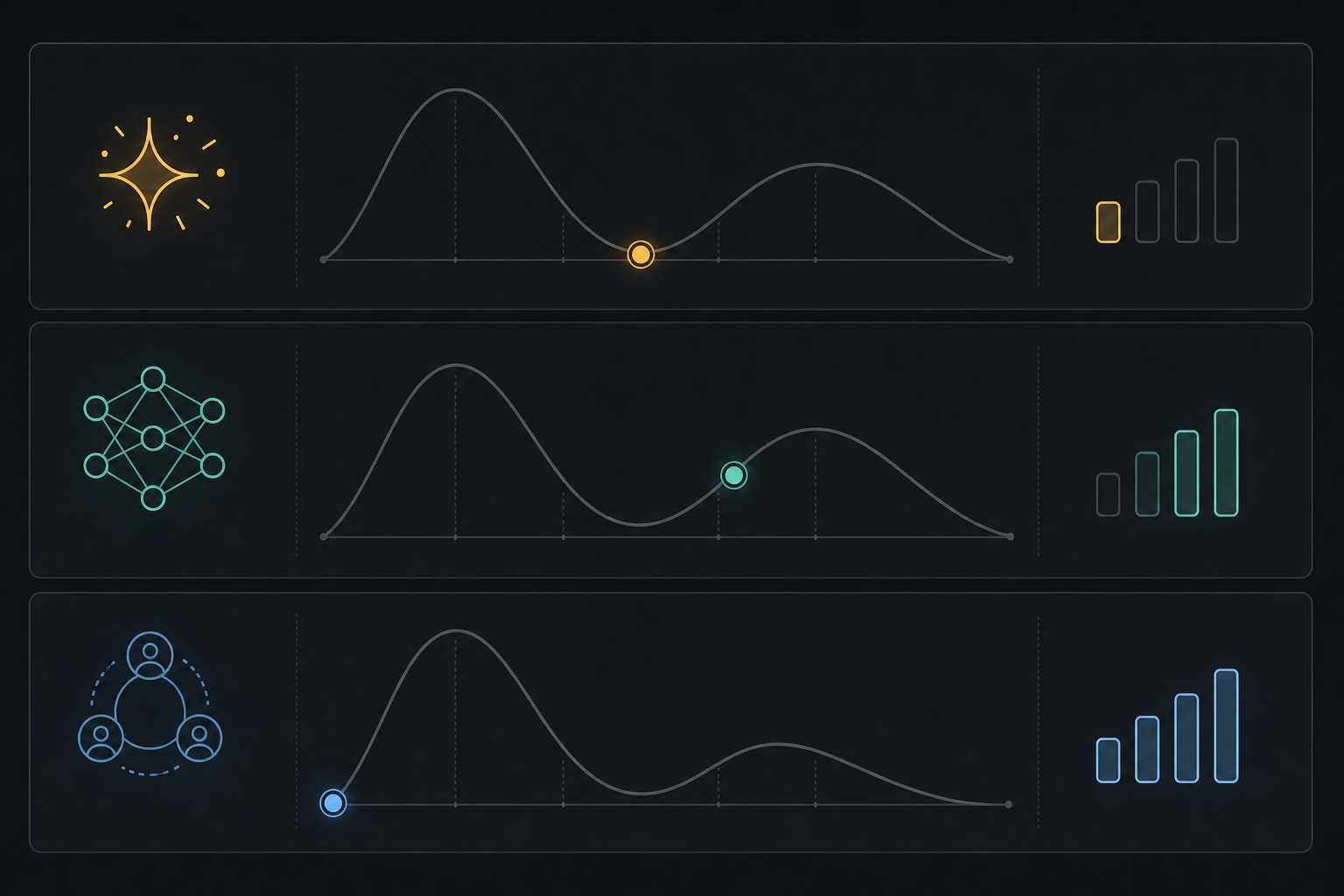
Generative AI has entered the trough of disillusionment. This is a specific Hype Cycle designation, not a general verdict on the technology's value. It means the gap between early expectations and production reality has become visible — and organizations are recalibrating.
Gartner VP Analyst Noha Tohamy: 'As more organisations grapple with the challenges of scaling Gen AI pilots and integrating the technology into legacy systems, it will appear as less of a silver bullet solution.'
The pilot-to-production failure rate for supply chain GenAI is high. Research cited by Trax Technologies and attributed to the MIT Center for Transportation & Logistics indicates that fewer than 30% of supply chain AI pilot projects successfully transition to production, with integration obstacles and data governance as the primary causes. TMS and WMS integration alone consumes 40–60% of project timelines in many deployments. These are not reasons to abandon GenAI investment — they are the specific obstacles that organizations need to plan for rather than discover mid-project.
Traditional ML is in a different position. Gartner's Hype Cycle places it advancing toward the slope of enlightenment — meaning practical deployments are accumulating demonstrated ROI across planning, sourcing, logistics, and inventory management. The enthusiasm is more measured, the use cases are more bounded, and the outcomes are more predictable. This is where the quiet success stories are.
Gartner VP Analyst Noha Tohamy: 'The ongoing enthusiasm for Gen AI's potential, along with the emergence of agentic AI, has rapidly accelerated the progress we have seen with ML-based AI, which has evolved from an emerging technology to a key enabler of supply chain transformation.'
Agentic AI — systems capable of autonomous multi-step decision-making across supply chain processes — is just entering enterprise awareness. Current adoption in SCM software is under 5%. But the trajectory is steep: Gartner's April 2026 forecast projects spend growing from under $2 billion in 2025 to $53 billion by 2030, with 60% of enterprises using SCM software having adopted agentic AI features by that date.
| AI Technology | Hype Cycle Position (2025) | Current SCM Adoption | Primary Obstacle | Investment Posture |
|---|---|---|---|---|
| Generative AI | Trough of disillusionment | Widespread pilots, low production rate | Legacy system integration; data governance gaps | Structured pilot-to-production programs; integration investment |
| Traditional ML | Slope of enlightenment | Active deployment across planning, logistics, inventory | Data quality; model maintenance | Scale proven use cases; deepen ROI measurement |
| Agentic AI | Early enterprise awareness | <5% of SCM software users (2025) | Adjacent layer readiness: data, workforce, governance | Build foundational capabilities; monitor vendor roadmaps |
High-Maturity vs. Low-Maturity Organizations: The Behavioral and Structural Differences
Gartner's AI Maturity Model — a seven-question framework scored from Level 1 ('planning/beginning') to Level 5 ('leadership') — was applied to 432 respondents across the US, UK, France, Germany, India, and Japan in Q4 2024. This is a cross-industry model, not a supply chain-specific instrument. High-maturity organizations in this study averaged scores of 4.2–4.5; low-maturity organizations averaged 1.6–2.2.
The behavioral and structural differences between these two groups are specific and measurable. They are not primarily about which AI technologies organizations have deployed — they are about how AI programs are governed, measured, and sustained over time.
| Dimension | High-Maturity Organizations | Low-Maturity Organizations |
|---|---|---|
| 3-year AI project survival rate | 45% of AI initiatives remain in production for 3+ years | 20% of AI initiatives remain in production for 3+ years |
| Dedicated AI leadership | 91% have appointed dedicated AI leaders | Minority have dedicated AI leaders (implied) |
| Formal ROI measurement | 63% run formal financial analysis including ROI and customer impact | Ad-hoc or absent measurement common |
| Business-unit trust in AI | 57% of business units trust and are ready to use new AI solutions | 14% of business units trust and are ready to use new AI solutions |
| Governance structure | ~60% have centralized AI strategy, governance, data, and infrastructure | Decentralized or absent governance common |
| Top implementation barrier | Data availability/quality (cited by 29%) | Data availability/quality (cited by 34%) |
| Secondary barrier | Security threats (cited by 48%) | Less frequently cited |
Several of these findings deserve direct interpretation for supply chain leaders. The 45% vs. 20% project survival gap is the most operationally consequential: it means that in low-maturity organizations, four out of five AI projects are either shut down, deprioritized, or never reach full production within three years. The investment is real; the sustained return is not.
The 57% vs. 14% business-unit trust gap points to a change management failure that precedes the technology. When business units do not trust AI outputs, planners and procurement managers override model recommendations, logistics teams revert to manual routing, and the AI investment delivers a fraction of its potential value. High-maturity organizations have solved this — through transparency, explainability, and sustained performance track records — before scaling deployments.
Data quality as the top barrier across both maturity levels is a significant finding. It means that even organizations with mature governance structures, dedicated AI leaders, and formal ROI measurement still cite data availability and quality as a primary constraint. This is not a problem that high maturity eliminates — it is a problem that high-maturity organizations manage more systematically.
Function-Level Maturity Signals: How Planning, Procurement, Logistics, and Warehouse AI Compare
Enterprise-level maturity scores obscure a pattern that is almost universal in practice: supply chain functions within the same organization are at different maturity levels. A company can have sophisticated ML-based demand forecasting in its planning function while its procurement AI is still at the spreadsheet-and-exception stage. Treating the enterprise as a single maturity unit produces a misleading average.
The Umbrex AI-Driven Planning Maturity Model defines five levels for demand, forecasting, and planning AI specifically — from Level 1 (reactive, spreadsheet-driven) through Level 5 (closed-loop, autonomous-with-guardrails) — and explicitly notes that most organizations are heterogeneous: different supply chain categories or regions sit at different levels simultaneously. Advancing one level within a focused scope typically takes 3–6 months; enterprise-wide progression takes 9–18 months, with data latency and change management as primary pacing factors.
Logistics presents a distinctive profile. According to industry analysis citing the Gartner Supply Chain Technology Report 2025, only 35% of logistics firms are actively deploying AI, while 65% remain at ad-hoc experimentation — despite logistics having among the highest data density of any supply chain function. The gap between data richness and deployment readiness is explained by workforce readiness barriers (cited by 68% of logistics operators as the primary constraint) and the integration cost of legacy TMS and WMS systems, which consumes 30–40% of total AI project cost in logistics deployments.
Gartner's February 2026 survey of 509 supply chain leaders adds a forward-looking dimension: high-performing organizations — those exceeding expectations on customer lead time, revenue growth, and sustainability — show significantly higher agentic AI adoption than peers across all five supply chain functions: procurement, production, logistics, warehouse management, and planning. This suggests that the organizations already operating at higher maturity levels in traditional ML are also the first movers in agentic AI.
| Supply Chain Function | Current AI Maturity Signal | Primary Deployment Barrier | Agentic AI Readiness |
|---|---|---|---|
| Demand Planning | Most advanced; probabilistic forecasting and ML-based sensing emerging at scale | Data latency; change management for planner adoption | Moderate — data infrastructure more mature |
| Procurement | Growing adoption of spend analytics and supplier risk scoring; autonomous procurement nascent | Unstructured data integration; policy governance for autonomous decisions | Low-to-moderate — governance frameworks underdeveloped |
| Logistics / Routing | 35% active deployment; route optimization showing 2–4 month payback at scale | Workforce digital literacy (68% cite as primary barrier); TMS/WMS integration cost | Low — workforce readiness is the binding constraint |
| Warehouse Operations | Robotics and computer vision advancing; AI-assisted slotting and labor planning growing | Capital intensity; integration with WMS; safety governance | Low-to-moderate — physical system dependencies slow transition |
- Planning functions tend to be furthest along because demand data is relatively structured, ML forecasting use cases are well-defined, and the ROI case (forecast error reduction, inventory reduction) is measurable.
- Logistics has the data but not the readiness — high data volume from TMS and carrier systems is not translating to structured AI deployment at the rate the data density would suggest.
- Procurement AI is growing but governance lags — autonomous procurement decisions require audit trail and accountability frameworks that most organizations have not yet built.
- Warehouse operations face a physical-digital integration challenge that is distinct from the data-governance challenges in planning and procurement — robotics and AI systems must be coordinated with physical infrastructure and safety requirements.
The Run-Grow-Transform Framework: Structuring AI Investment Across the Portfolio
Gartner's Supply Chain practice publicly recommends a run-grow-transform framework for structuring AI investment — not as a sequential roadmap where organizations complete one tier before starting the next, but as a portfolio balancing tool that allocates investment across three simultaneous investment horizons.
| Investment Tier | Focus | Representative Supply Chain Applications | Minimum Maturity to Activate |
|---|---|---|---|
| Run | Operational efficiency and cost optimization | Predictive maintenance, automated exception management, carrier rate optimization, inventory replenishment automation | Level 2 — digitized baselines and basic ML deployment |
| Grow | Cross-functional AI integration into key processes | AI-assisted S&OP, integrated demand-supply balancing, procurement analytics integrated into planning cycles | Level 3 — advanced analytics and probabilistic planning active |
| Transform | Strategic bets on consumer insights and proactive demand shaping | Consumer behavior modeling, proactive demand sensing, supply chain digital twin for scenario planning | Level 4 — integrated AI and optimization; cross-functional data flows established |
The portfolio logic matters because organizations at different maturity levels should be allocating investment differently. A Level 2 organization that invests primarily in Transform-tier initiatives — before its data infrastructure and governance structures can support them — will generate the pilot-to-production failures that characterize the trough of disillusionment. A Level 4 organization that over-invests in Run-tier automation may be optimizing operational efficiency at the expense of the strategic positioning that agentic AI will require.
The run tier is where most organizations should be generating near-term ROI to fund and justify the grow and transform investments. Logistics route optimization, for example, delivers payback in 2–4 months at scale — a Run-tier application that can fund the longer-horizon investments in cross-functional AI integration.
Practical Self-Assessment: 10 Diagnostic Questions to Locate Your Organization on the Maturity Curve
The following questions draw on the scoring dimensions of Gartner's AI Maturity Model (Level 1 to Level 5) and the seven capability dimensions of the Umbrex AI-Driven Planning Maturity Model: data and architecture, forecasting and analytics, decisioning and optimization, process and governance, technology and platforms, organization and talent, and value and performance management.
These are diagnostic questions, not a scored assessment. Use them to identify which dimensions are constraining your maturity progression and which are ahead of the rest of your portfolio.
- Strategy formalization: Does your organization have a documented AI strategy for supply chain that specifies investment priorities, governance structure, and a multi-year roadmap — or are AI investments approved project by project?
- Dedicated AI leadership: Is there a named individual (or team) with explicit accountability for supply chain AI strategy, vendor selection, and governance — or is AI oversight distributed across IT, supply chain, and finance without clear ownership?
- Data readiness: Can your organization access clean, timely, integrated data across demand, inventory, supplier, and logistics domains — or are AI models running on data that requires significant manual preparation before each use?
- ROI measurement: Do your AI initiatives have formal financial analysis including pre-deployment ROI projections, in-production performance measurement, and post-implementation review — or is value assessment informal and retrospective?
- Governance structure: Is AI strategy, data governance, and infrastructure managed centrally — or does each function or business unit operate its own AI program independently, without shared standards?
- Business-unit trust: Do your supply chain planners, buyers, and logistics managers act on AI recommendations as a matter of course — or do they routinely override model outputs and revert to manual judgment without documented rationale?
- Pilot-to-production conversion: What percentage of your AI pilots from the past three years have reached full production deployment and remained operational? Is that rate improving?
- Function-level coverage: Have you mapped AI deployment status across each supply chain function — planning, procurement, logistics, warehouse — or is your maturity assessment based on enterprise-level averages that may obscure function-level gaps?
- Talent pipeline: Does your workforce development program specifically address AI literacy, human-in-the-loop decision-making skills, and the new roles that AI-augmented supply chain operations require — or is talent development lagging behind technology deployment?
- Agentic AI readiness: Have you assessed whether your data management infrastructure, operations management processes, and workforce AI-readiness are sufficient to support agentic AI deployment — or is agentic AI on your radar only as a vendor feature?
| Score Pattern | Likely Maturity Level | Primary Constraint |
|---|---|---|
| Most answers indicate absent or informal | Level 1–2 (Gartner: 1.6–2.2 average) | Strategy formalization and data foundation |
| Mixed — some structured, some ad-hoc | Level 2–3 | Governance centralization and ROI measurement discipline |
| Most answers indicate structured and active | Level 3–4 (Gartner: approaching 4.2–4.5) | Cross-functional integration and business-unit trust |
| Consistently structured, with active agentic AI planning | Level 4–5 | Adjacent layer readiness for agentic AI; talent pipeline redesign |
Priority Actions for the Next 90 Days: Differentiated by Where You Score
The actions that matter in the next 90 days depend entirely on where your organization sits on the maturity curve. Applying high-maturity actions to a low-maturity organization — for example, investing in agentic AI orchestration before a data foundation exists — produces the pilot-to-production failures that define the trough of disillusionment. The following recommendations are sequenced by maturity level.
Low-Maturity Organizations (Level 1–2): Build the Foundation
- Formalize the AI strategy: Document a multi-year supply chain AI roadmap that specifies investment priorities by function, governance structure, and data infrastructure requirements. This is the prerequisite for everything else — without it, each new project reinforces the franken-system pattern.
- Appoint a dedicated AI lead: 91% of high-maturity organizations have done this. The role does not need to be a C-level position, but it needs clear accountability for AI governance, vendor relationships, and program performance measurement.
- Address the data foundation before the next AI project: Data availability and quality is the top barrier at every maturity level. Gartner's CSCO roadmap explicitly frames the supply chain AI foundation as requiring intentional investment in master data management — not just tool deployment. Identify the two or three data quality gaps that are blocking your highest-priority use cases and treat them as project prerequisites.
- Map function-level maturity: Use the self-assessment questions above to identify which supply chain functions are furthest along and which are lagging. Prioritize the run-tier use cases in your most data-ready function for the first structured deployment.
Mid-Maturity Organizations (Level 2–3): Consolidate and Measure
- Implement formal ROI metrics on all active AI programs: 63% of high-maturity organizations run formal financial analysis including ROI and customer impact measurement. If your AI programs do not have pre-defined success metrics and a measurement cadence, establish them now — before the next budget cycle requires you to defend the investment.
- Centralize AI governance: Nearly 60% of high-maturity organizations have centralized their AI strategy, governance, data, and infrastructure. Gartner's CSCO roadmap recommends a hybrid model — centralized policy-setting with decentralized management — as the practical implementation path. If your functions are running independent AI programs without shared standards, this is the structural change that will most accelerate maturity progression.
- Convert GenAI pilots to structured programs: If you have GenAI pilots that have been running for more than six months without a clear production pathway, make an explicit decision: invest in the integration and governance work required to reach production, or shut the pilot down and reallocate resources. The trough of disillusionment is most damaging for organizations that sustain inconclusive pilots indefinitely.
- Build business-unit trust systematically: The 57% vs. 14% trust gap is not closed by technology improvement alone. It requires transparency about how models make recommendations, documented track records of model performance, and structured processes for planners to flag model errors without those flags being treated as failures.
High-Maturity Organizations (Level 3–5): Prepare for the Agentic AI Transition
- Assess adjacent layer readiness for agentic AI: Gartner VP Analyst Balaji Abbabatulla identifies four adjacent layers that must be investment-ready before agentic AI can deploy at scale: data management, operations management, workforce AI-readiness, and network-centricity. Organizations that assume agentic AI features from SCM vendors will be plug-and-play are likely to encounter the same integration delays that derailed GenAI pilots.
- Redesign the talent pipeline now: 86% of supply chain leaders in Gartner's February 2026 survey agreed that agentic AI adoption will require new processes for developing future talent pipelines. The supply chain workforce implications are significant — 55% expect entry-level hiring reductions, 51% expect overall workforce reductions. But Gartner's Marco Sandrone frames the leadership posture clearly: high-performing organizations are using AI to reinvent how work gets done, not as a headcount reduction instrument.
- Build human-in-the-loop governance for autonomous decisions: Appropriate human-in-the-loop levels are identified by Gartner as especially critical during early stages of agentic AI deployment. For procurement, inventory replenishment, and logistics routing decisions that agentic systems will increasingly execute autonomously, the governance question is not whether to include human oversight but where in the decision workflow that oversight is most effective — and how to document accountability when autonomous decisions produce errors.
- Benchmark function-level agentic AI adoption against high performers: High-performing organizations in Gartner's February 2026 survey show significantly higher agentic AI adoption across all five supply chain functions. Use this as a directional benchmark — not to match the pace of the most aggressive adopters, but to identify which functions in your organization are furthest from the high-performer profile and sequence your agentic AI investment accordingly.
Comments
Join the discussion with an anonymous comment.