
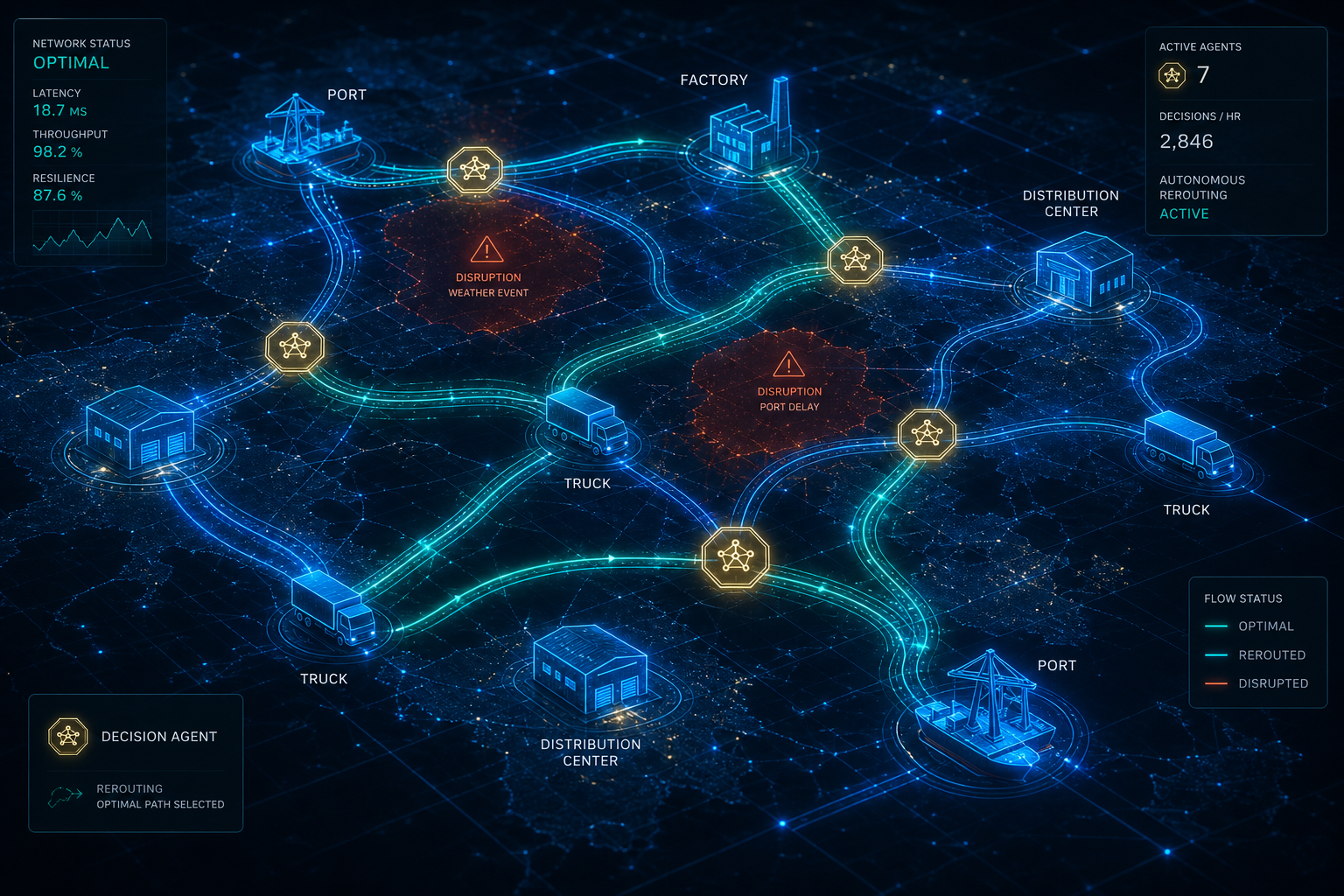
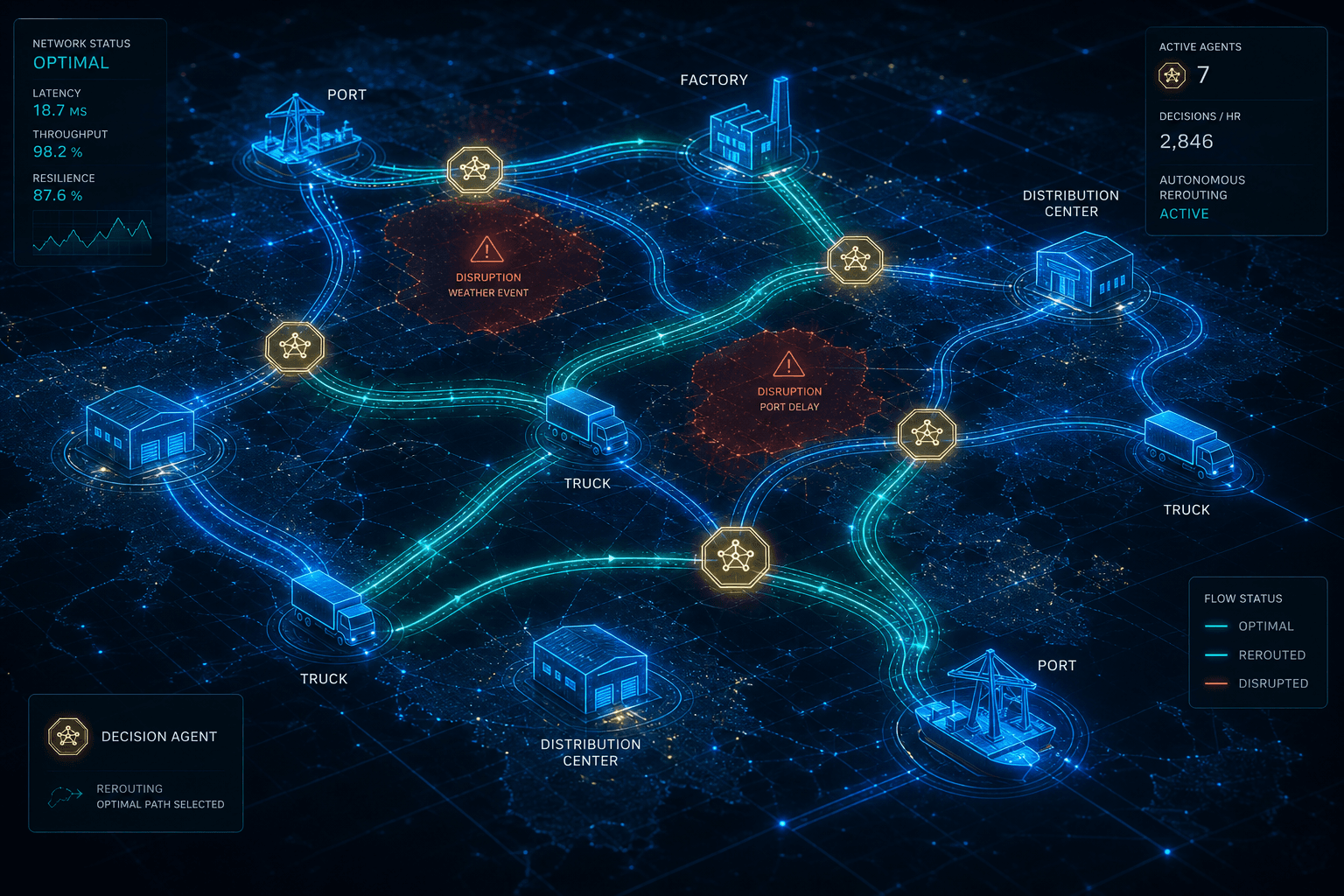
The End of Passive Dashboards: Why Visibility Alone Is No Longer Enough
For the better part of a decade, the supply chain technology narrative has been dominated by a single promise: visibility. Real-time dashboards, control towers, and alerting systems promised to illuminate the dark corners of the extended supply network. And they have delivered — to a point. A supply chain leader in 2026 can see a port closure in Rotterdam, a supplier production delay in Shenzhen, or a truck stuck at a border crossing within minutes of the event.
But seeing a problem in real time is not the same as solving it. Knowing that a shipment will be late does not reroute it. Knowing that a supplier will miss a commitment does not trigger an alternative sourcing action. The gap between awareness and action is where value is lost — and in 2026, that gap is becoming the defining competitive differentiator.
The data supports the urgency. A 2025 BCG analysis found that agentic systems accounted for 17% of total AI value generated across industries, with a projected increase to 29% by 2028. Gartner forecasts that by 2031, 60% of supply chain disruptions will be resolved without human intervention, and that by 2028, 15% of daily logistics decisions will be made autonomously by AI agents. These are not distant possibilities — they are the trajectory that organizations must prepare for today.
The organizations that will lead in this new environment are not those with the most sophisticated dashboards. They are the ones that have built the data foundation, governance frameworks, and organizational readiness to trust machines with operational decisions. This article examines what agentic AI is, where it is already being deployed, what stands in the way of broader adoption, and what supply chain leaders need to do now to prepare for the autonomous operations era.
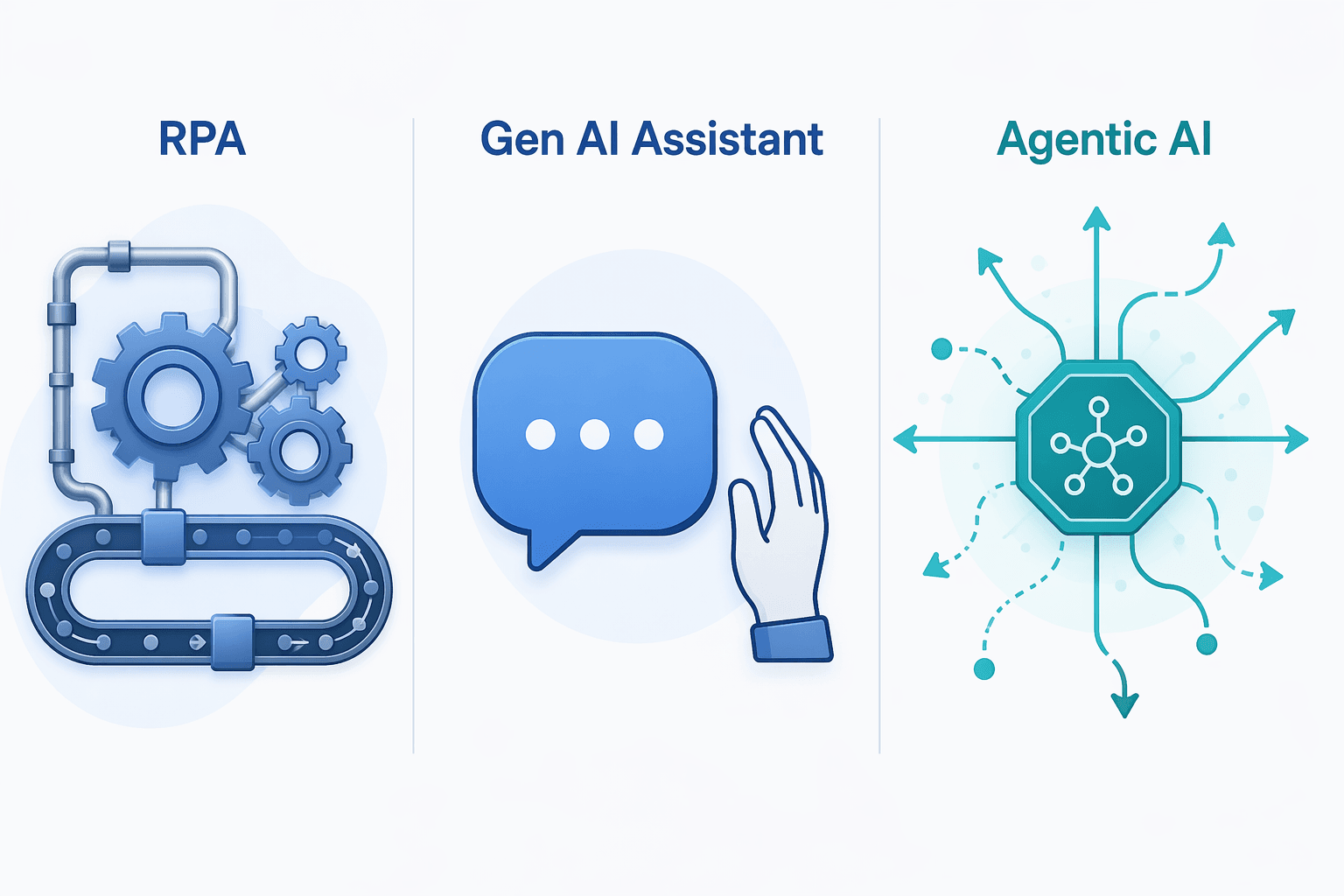
What Agentic AI Is (and Isn't): Distinguishing Autonomous Agents from GenAI Assistants and RPA
The term "agentic AI" is increasingly used in supply chain technology discussions, but it is often conflated with other AI paradigms. For practitioners evaluating these systems, a clear operational definition is essential.
Agentic AI refers to autonomous software agents that detect exceptions, reason across multiple systems, and take corrective action within predefined rules. Unlike generative AI assistants — which generate content, recommendations, or analysis in response to user prompts — agentic AI systems act independently. They do not wait for a human to ask "what should I do?" They execute the response within the boundaries set by operators.
This distinction matters because the operational requirements, risk profiles, and governance needs differ substantially across these technology categories.
| Capability | RPA (Robotic Process Automation) | Generative AI Assistant | Agentic AI |
|---|---|---|---|
| Core mechanism | Rule-based script execution | Large language model generation | Autonomous reasoning + action |
| Trigger | Scheduled or event-driven | User prompt | Detected exception or goal |
| Decision scope | Fixed, predefined paths | Content generation within context | Multi-system reasoning and execution |
| Human involvement | Setup and monitoring | Review and approval of output | Policy definition and exception handling |
| Supply chain example | Automated invoice matching | Drafting a supplier email | Rerouting a shipment around a port closure |
| Error handling | Fails on unexpected input | May hallucinate incorrect data | Escalates to human when confidence is low |
The closest existing concept in supply chain technology is the control tower, which has evolved from a visibility-and-alerting platform into a capability spectrum that includes autonomous execution at its highest maturity level. Agentic AI represents the operational engine that makes that highest maturity level possible — the difference between a control tower that tells you a disruption occurred and one that resolves it.
The Market Signal: Agentic AI Is Moving from Pilot to Production
The shift from visibility to autonomous execution is not a theoretical argument — it is visible in market data from multiple independent sources. The convergence of these projections across different analysts and methodologies strengthens the signal.
- BCG (2025) reported that agentic systems accounted for 17% of total AI value in 2025 and are projected to reach 29% by 2028 — nearly a doubling of their share in three years.
- Gartner forecasts that 60% of supply chain disruptions will be resolved without human intervention by 2031, and that 15% of daily logistics decisions will be made autonomously by AI agents by 2028.
- ABI Research (2025, n=490) found that 94% of supply chain companies plan to use AI for decision support within two years, indicating a broad intent to move beyond descriptive analytics.
- PwC's 2026 survey of 767 US operations leaders found that 83% agree AI agents will accelerate the breakdown of functional silos — a necessary precondition for end-to-end autonomous execution.
- Deloitte's 2025 survey of 1,854 executives found that 57% of all respondents are already using AI agents, though only 10% currently realize significant ROI from those deployments.
The Deloitte finding that only 10% of agentic AI users see significant ROI today is particularly instructive. It suggests that the technology is in the early stages of the adoption curve — the infrastructure, data readiness, and governance frameworks required for full value realization are still being built. However, half of agentic AI users expect returns within three years, indicating confidence that the current investments will pay off as the supporting capabilities mature.
These market signals point to a clear pattern: the technology is being deployed, the investment is increasing, and the expected returns are significant — but the path to production value requires deliberate preparation in data quality, integration, and governance.
Real-World Applications: Where Agentic AI Is Already Acting
While the market projections provide the macro context, the most compelling evidence for the shift to autonomous execution comes from specific operational applications where agentic AI is already in production. These use cases span the major supply chain functions and share a common pattern: the AI system detects an exception, reasons across multiple data sources, and executes a corrective action without waiting for a human decision.
Logistics Exception Management
Route optimization has been a staple of supply chain AI for years, but agentic AI takes it a step further. Instead of optimizing routes in a planning cycle and then executing them, agentic systems monitor real-time conditions — weather, port congestion, traffic, carrier availability — and dynamically reroute shipments when disruptions occur. The system does not alert a logistics manager that a route is compromised; it evaluates alternatives, checks carrier capacity, and issues new routing instructions within seconds.
Gartner's projection that 15% of daily logistics decisions will be made autonomously by AI agents by 2028 reflects the trajectory of this use case. The technology is already deployed in early-adopter organizations, and the primary barrier to broader adoption is not algorithmic capability but integration with legacy TMS platforms and carrier networks.
Supplier Commitment Monitoring
One of the most operationally significant applications of agentic AI is in supplier commitment monitoring. A Fortune 500 manufacturer deployed an AI-driven system that continuously monitors supplier commitments against actual production and shipment data. The system achieved 100% visibility into supplier commitments, provided three weeks' advance warning of potential supplier disruptions, and delivered a 30% reduction in supply-driven stockouts.
Inventory Replenishment and Procurement Automation
Agentic AI is also being applied to inventory replenishment decisions. Traditional replenishment systems operate on fixed reorder points or periodic review cycles. Agentic systems, by contrast, continuously monitor demand signals, lead time variability, supplier performance, and inventory positions across the network. When a signal indicates that a stockout risk is emerging, the agent can trigger a purchase order, adjust safety stock parameters, or reallocate inventory from another location — all within the guardrails set by the planning team.
In procurement, agentic AI is being used to automate the RFQ (request for quotation) process. The system identifies a sourcing need, queries approved suppliers, evaluates responses against price, lead time, and quality criteria, and issues a purchase order — escalating to a human buyer only when responses fall outside predefined parameters.
The Data Foundation Bottleneck: Why Most Organizations Aren't Ready
The most significant barrier to agentic AI adoption is not the sophistication of the algorithms — it is the quality and accessibility of the operational data that feeds them. Agentic AI systems are only as powerful as the data they can reason across. If that data is fragmented across legacy ERP instances, inconsistent in format, or unreliable in timeliness, the agent's decisions will be correspondingly flawed.
The scale of this problem is well documented. PwC's 2026 survey of 767 US operations leaders found that 87% say poor data quality has impacted the value they have been able to extract from digital initiatives. Only 30% report significant improvement in data quality over recent periods. This is not a minor friction point — it is a systemic barrier that undermines the entire AI value proposition.
The Trax Technologies analysis puts an even finer point on the problem: 70% of AI projects fail due to data quality issues rather than algorithmic limitations. Poor data quality costs organizations an average of $12.9 million annually. The report emphasizes that AI amplifies existing data problems rather than solving them — a critical insight for organizations that view AI as a shortcut around data quality work.
The data foundation challenge is particularly acute for agentic AI because these systems need to reason across multiple operational systems — ERP, TMS, WMS, supplier portals, IoT sensors — in real time. Most large organizations spend up to 80% of their data engineering effort on extracting, cleaning, and formatting raw data from complex ERP systems like Oracle, NetSuite, and SAP. This leaves little capacity for the advanced analytics and model development that would unlock the value of agentic AI.
Organizations that invest in data infrastructure first achieve significantly better outcomes. Companies that prioritize data consolidation, validation, and enrichment before deploying advanced analytics see 3x better AI ROI compared to those that rush into algorithmic solutions. This finding underscores a critical strategic point: the path to autonomous execution runs through data discipline, not through faster algorithms.
For readers evaluating platform decisions, the choice between AI-native and legacy supply chain platforms becomes particularly consequential in the context of agentic AI. Legacy platforms often require extensive data extraction and transformation work before AI can be applied, while AI-native platforms are built with data accessibility as a core design principle.

Governance for Autonomous Operations: Confidence Scoring, Audit Trails, and Human Escalation
Deploying agentic AI in production supply chain environments requires a governance framework that is fundamentally different from what most organizations have in place for analytics or reporting tools. When a system has the authority to reroute shipments, trigger purchase orders, or reallocate inventory, the stakes are higher — and the governance requirements are correspondingly more stringent.
Three architectural components are essential for safe and effective autonomous operations: confidence scoring, comprehensive audit trails, and clearly defined human escalation paths.
| Governance Component | Purpose | Implementation Pattern |
|---|---|---|
| Confidence scoring | Agent acts only when its confidence in the correct action exceeds a defined threshold | Each decision is assigned a confidence score (0-100%); actions below threshold are escalated |
| Audit trail | Every autonomous decision is logged with context for review and compliance | Immutable log recording: what was detected, what action was taken, when, and why |
| Human escalation | Exceptions the agent cannot resolve with sufficient confidence are routed to human operators | Tiered escalation: agent handles routine exceptions; complex or high-impact cases go to humans |
| Guardrail definition | Operational boundaries within which the agent is authorized to act | Configurable rules: maximum order value, approved supplier list, geographic constraints |
| Performance monitoring | Continuous tracking of agent decision quality and drift from expected behavior | Automated dashboards showing agent activity volume, escalation rate, and decision accuracy |
The confidence scoring mechanism is particularly important. It addresses the fundamental tension between autonomy and risk: an agent that never acts is useless, but an agent that acts incorrectly can be damaging. By setting confidence thresholds that vary by decision type — higher for financial commitments, lower for informational actions — organizations can calibrate the level of autonomy to their risk tolerance.
The audit trail requirement is not just a technical consideration — it has regulatory and compliance implications. In regulated industries such as pharmaceuticals and food and beverage, every decision that affects product quality, traceability, or patient safety must be documented. Agentic AI systems must be designed from the ground up to support this requirement, not retrofitted after deployment.
PwC's 2026 survey data underscores the governance challenge: while 83% of operations leaders agree that AI agents will accelerate the breakdown of functional silos, only 37% are comfortable assigning AI agents to execute end-to-end processes. This gap between perceived potential and organizational comfort is the central governance challenge that supply chain leaders must address.
The Workforce Shift: From Execution to Oversight and Policy Definition
The shift to autonomous execution has profound implications for the supply chain workforce. The role of supply chain professionals will not disappear — but it will change fundamentally. The day-to-day work will move from executing routine operational tasks to defining policies, setting guardrails, managing exceptions, and overseeing agent behavior.
This transition mirrors patterns seen in other industries that have adopted autonomous systems. In aviation, pilots have moved from manually controlling every aspect of flight to managing autopilot systems and handling exceptions. In manufacturing, operators have shifted from direct machine operation to monitoring and optimizing automated production lines. Supply chain operations are following a similar trajectory.
- Policy definition: Supply chain professionals will define the rules and boundaries within which agents operate — which suppliers are approved, what price variance is acceptable, which customers get priority during shortages.
- Exception management: When agents encounter situations they cannot resolve with sufficient confidence, humans will step in to make the judgment call. This shifts the work from handling hundreds of routine decisions to handling the most complex and consequential ones.
- Agent oversight: Teams will monitor agent performance, review audit trails, and adjust guardrails based on observed outcomes. This is a continuous improvement role, not a one-time setup task.
- Cross-functional coordination: Agentic AI systems that operate across procurement, logistics, and inventory management will require humans who understand the end-to-end process, not just their functional silo.
The workforce transition is not without friction. PwC found that only 37% of leaders are comfortable assigning agents to end-to-end processes. Deloitte's data shows that only 10% of organizations using agentic AI currently see significant ROI, though half expect returns within three years. These numbers suggest that the organizational and cultural shift is proceeding more slowly than the technology deployment.
For supply chain leaders, the workforce implications are not a secondary concern — they are central to the business case for agentic AI. An agentic AI deployment that fails to account for the human transition will underperform, regardless of how sophisticated the technology is. The organizations that succeed will be those that invest in training, change management, and new role definitions alongside the technology implementation.
The broader strategic context for this workforce shift is explored in the article on the AI readiness paradox, which examines why most supply chains are not yet prepared to scale AI despite increasing investment. The readiness gap is not just about technology — it is about organizational capability, data discipline, and workforce transformation.
The Path Forward: From Visibility to Autonomous Execution
The transition from passive visibility to autonomous execution is not a single event — it is a capability-building journey that spans technology, data, governance, and workforce. The organizations that will lead in 2026 and beyond are those that recognize this transition is already underway and are taking deliberate steps to prepare.
- Invest in data infrastructure first. The evidence is clear: organizations that prioritize data quality and integration achieve 3x better AI ROI. Agentic AI amplifies existing data problems — fix the data before deploying the agents.
- Build governance frameworks alongside technology. Confidence scoring, audit trails, and escalation paths are not afterthoughts — they are core architectural requirements for autonomous operations.
- Start with bounded use cases. Supplier commitment monitoring or logistics exception management are lower-risk entry points than full end-to-end autonomous planning. Prove the model in a constrained domain before expanding.
- Invest in workforce transition. The shift from execution to oversight requires new skills, new role definitions, and deliberate change management. The technology will not succeed without the organizational readiness to support it.
- Track the market signals. The BCG, Gartner, and PwC projections provide a roadmap for where the technology is heading. Use them to inform investment timing and capability-building priorities.
The era of passive dashboards is ending. The question for supply chain leaders is not whether autonomous execution will arrive — it is whether their organizations will be ready when it does.
Comments
Join the discussion with an anonymous comment.