
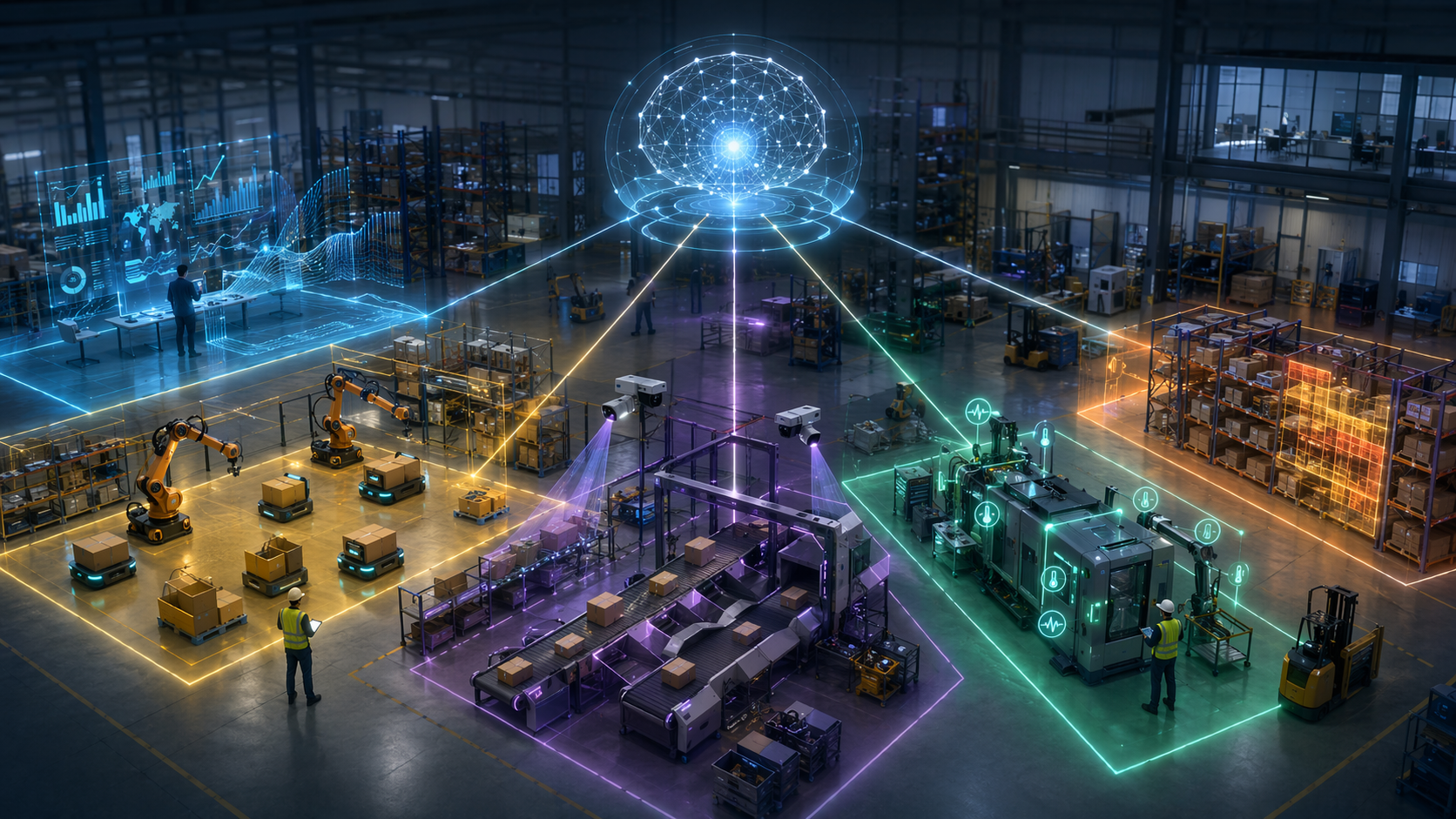
The first problem with evaluating AI for warehouse management is that the phrase hides too many different purchases. A forecasting model that changes replenishment decisions, a vision system that rejects bad labels, and an AMR fleet that changes pick paths may all sit under the same “AI warehouse” budget request. They do not carry the same integration work, operational risk, maintenance burden, or payback logic.
That matters when a warehouse leader has to defend the business case after the pilot. The useful question is not whether AI belongs in the warehouse. It is which use case is mature enough for the facility, which constraint it relieves, and whether the ROI evidence is comparable to the operator’s own volume, labor market, systems landscape, and process discipline.
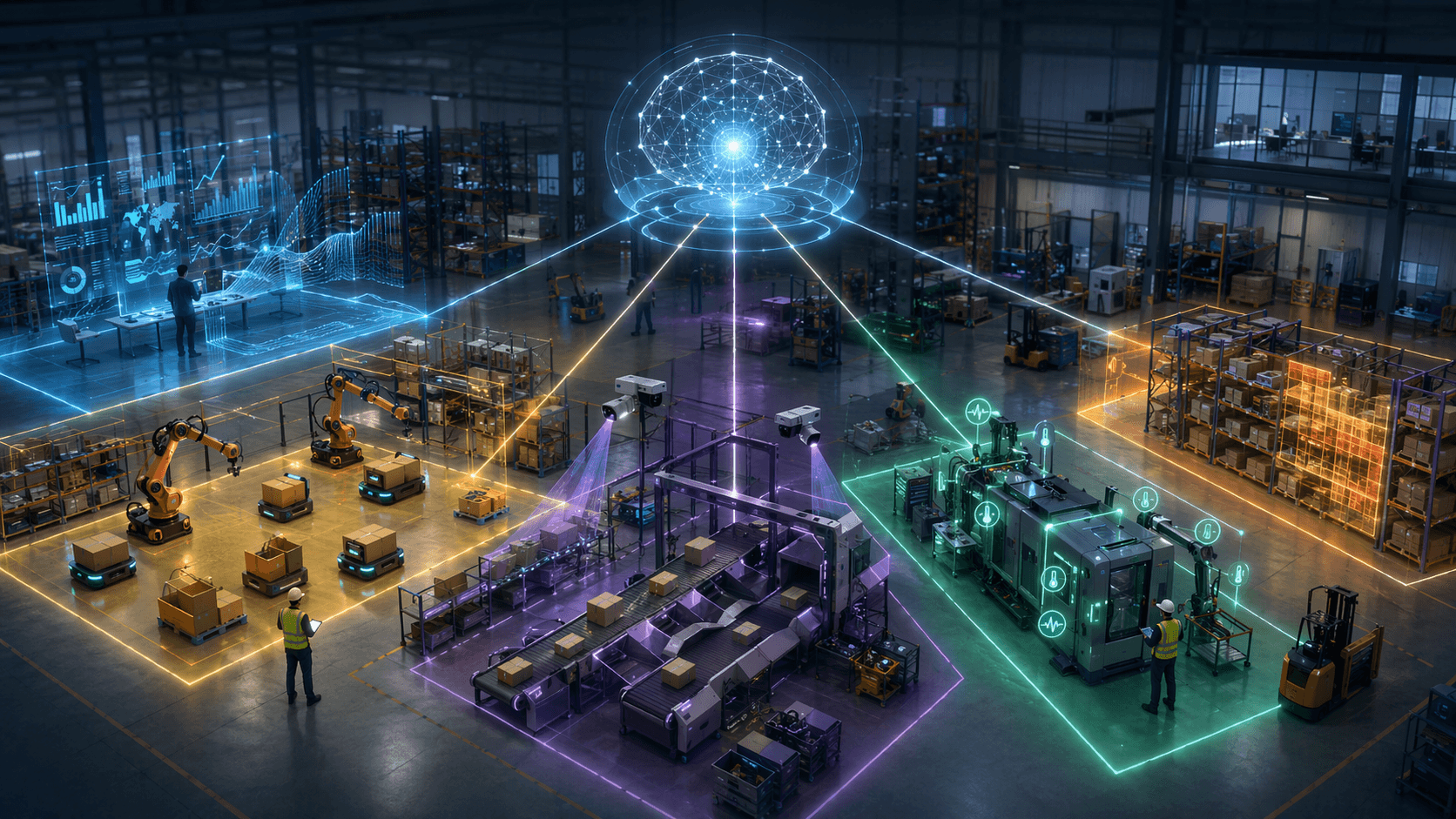
Warehouse AI use cases compared
The table below is the working surface. It separates warehouse AI by operational job rather than by vendor label. “Maturity” is a practical reading of how investable the use case looks today, based on adoption evidence, benchmark availability, and implementation dependency.
| Use case | Relative maturity | Representative ROI or payback evidence | Typical vendor ecosystem | Warehouse-specific value driver | Main implementation risks |
|---|---|---|---|---|---|
| Demand forecasting | Established to growing | Gartner projects 70% of large organizations will use AI-based forecasting by 2030; McKinsey-cited benchmarks point to 20–30% inventory reduction and 5–20% logistics cost reduction.[1][2] | SCM suites, WMS-adjacent planning modules, demand planning platforms, custom ML teams | Better inventory positioning, fewer avoidable expedites, improved labor and space planning before demand hits the dock | Poor demand history, promotion and seasonality noise, weak connection between forecast output and replenishment or warehouse execution decisions |
| Predictive maintenance | Established in automation-heavy operations | Benchmarks cited by Appinventiv point to 30–50% lower unplanned downtime and 15–25% lower maintenance costs.[2] | CMMS/EAM platforms, equipment OEM analytics, sensor and IoT platforms, automation integrators | Less conveyor, sorter, AS/RS, forklift, and robotics downtime; better maintenance scheduling | Sensor coverage gaps, failure-label quality, maintenance team adoption, unclear ownership between operations, engineering, and vendors |
| AI-directed picking | Growing, with strong warehouse-native ROI evidence | The Thinking Company reports EUR 50–100K investment, EUR 200–500K annual savings, 4–8 month payback, and 250–400% three-year ROI for European mid-market deployments.[3] | WMS/WES vendors, pick-path optimization tools, voice/vision picking systems, robotics and orchestration providers | Fewer touches, shorter travel, lower pick errors, higher lines per labor hour | WMS data quality, exception handling, associate training, unstable SKU/location discipline, overstated labor-savings assumptions |
| Computer vision sorting or quality control | Growing | The Thinking Company reports EUR 100–200K investment, EUR 300–700K annual savings, 6–12 month payback, and 200–350% three-year ROI for European mid-market deployments.[3] | Industrial vision vendors, camera and sensor providers, automation integrators, parcel/sorter systems, AI inspection platforms | Automated label, dimension, damage, count, routing, or quality checks at receiving, packing, induction, or sortation | Lighting variation, camera placement, model drift, exception workflows, integration to sorter controls or WMS status updates |
| AMRs and autonomous picking | Growing, hardware-dependent | SellersCommerce reports 250%+ ROI and payback under 24 months for AMR deployments.[5] | AMR vendors, goods-to-person robotics providers, WES orchestration platforms, systems integrators, RaaS providers | Reduced walking, more flexible capacity, better flow in high-volume picking or replenishment zones | Facility layout constraints, charging and traffic management, integration with WMS/WES, maintenance coverage, peak-volume stress |
| Slotting optimization | Growing | Often justified through labor, travel, replenishment, and congestion reduction; benchmark ROI is less consistently disclosed in the research set than for picking, vision, or maintenance. | WMS slotting modules, WES tools, labor-engineering analytics, specialized optimization software | Places fast movers, correlated items, fragile items, cube-sensitive SKUs, or replenishment-heavy SKUs where they reduce work | Dirty item dimensions, unstable assortment, manual overrides, weak cadence for re-slotting, conflict between storage density and pick efficiency |
| Warehouse-to-transport route optimization | Established in logistics, cross-boundary for warehouses | McKinsey-cited supply-chain AI benchmarks include 5–20% logistics cost reduction, but this is broader than warehouse-only route planning.[2] | TMS platforms, last-mile routing vendors, yard/dock scheduling tools, network optimization systems | Improves dock scheduling, load sequencing, dispatch timing, carrier handoff, and last-mile readiness | Data handoff between WMS, TMS, yard, carrier systems, and customer delivery constraints; benefits may sit outside the warehouse P&L |
| Labor and workforce planning | Growing | Useful where demand, order mix, and labor availability vary; the research set does not provide a warehouse-specific ROI range strong enough to treat as a benchmark. | Labor management systems, workforce management platforms, WMS labor modules, analytics tools | Better shift planning, cross-training decisions, overtime control, and alignment between forecasted workload and available labor | Employee data governance, local labor rules, supervisor trust, forecast accuracy, change management on the floor |
The ROI ranges deserve a careful reading. The Thinking Company’s figures are useful because they name investment bands, annual savings, payback periods, and three-year ROI ranges, but the source frames them as European mid-market benchmarks. They are good modeling inputs, not a transferable guarantee for a US enterprise network with different labor rates, automation density, real estate costs, and integration complexity.[3]
Demand forecasting earns a larger seat at the warehouse table
Demand forecasting is not a warehouse-only use case, which is exactly why it often matters inside the warehouse. A warehouse inherits demand decisions as inbound volume, forward-pick pressure, space constraints, labor plans, replenishment waves, and service failures. If the forecast improves but the warehouse execution layer cannot use it, the benefit leaks away before it reaches the floor.
The adoption signal is stronger here than in many warehouse-native AI categories. Oracle cites Gartner’s projection that 70% of large organizations will adopt AI-based forecasting by 2030.[1] Appinventiv, citing McKinsey benchmarks, reports that AI-enabled supply-chain planning can reduce inventory by 20–30% and logistics costs by 5–20%.[2] Those are not warehouse-only outcomes, but they are operationally relevant to warehouses because excess inventory, misplaced inventory, and late demand signals become storage, labor, congestion, and expedite problems.
For investment evaluation, the warehouse-specific test is simple: does the forecast change a decision the facility controls or directly depends on? Useful connections include labor planning by expected order profile, replenishment rules for forward pick locations, inbound appointment smoothing, slotting cadence, safety stock positioning, and cross-dock or flow-through decisions. A planning model that lives only in a corporate dashboard may be valuable, but it is not yet a warehouse management improvement.
Forecasting also has a different risk shape from robotics or vision. The capital intensity is usually lower, but accountability can be blurrier. Merchandising, sales, supply planning, transportation, and warehouse operations may all touch the inputs or consequences. When the forecast misses, the warehouse may absorb the overtime and service pain even if it did not own the model.
What to validate before shortlisting forecasting vendors
- Whether the model forecasts at a level the warehouse can act on: SKU-location, order profile, channel, region, customer group, or another operationally meaningful cut.
- Whether promotion, seasonality, new-item, substitution, and stockout effects are handled explicitly rather than hidden inside a single accuracy score.
- Whether forecast outputs feed WMS, WES, labor, slotting, replenishment, or transportation workflows without manual spreadsheet translation.
- Whether improvement is measured against the current planning process and tied to inventory, service, labor, and logistics metrics rather than forecast accuracy alone.
AI-directed picking is where warehouse AI becomes visible
Picking is a good test of whether an AI proposal understands the warehouse. The value is not in saying “optimize the pick path.” The value is in deciding which orders to batch, which locations to sequence, when to split work, when to direct a replenishment before a picker arrives, and how to handle exceptions without forcing supervisors to babysit the system.
The ROI evidence is concrete enough to take seriously, with the earlier caveat about geography and company profile. The Thinking Company reports EUR 50–100K investment, EUR 200–500K in annual savings, 4–8 month payback, and 250–400% three-year ROI for AI picking optimization in European mid-market logistics and supply-chain deployments.[3] Synkrato, citing OPEX data, reports that manual picking error rates can reach up to 4%, while automated picking systems can reduce errors to 0.04% or lower.[4]
Those two types of evidence measure different things. The Thinking Company gives a financial benchmark; Synkrato’s figure is an accuracy comparison. Neither means a facility automatically gets both maximum labor productivity and near-perfect quality. A warehouse with poor inventory accuracy, frequent location overrides, or unstable packaging rules can make a clever picking engine look worse than it is.
The best candidates are usually facilities with enough order volume and repeatable process rules for optimization to matter: e-commerce, retail replenishment, spare parts, healthcare distribution, or any operation where pick travel, mispicks, congestion, and replenishment interruptions are visible cost drivers. Smaller or highly irregular warehouses may still benefit, but the business case has to be built around the specific bottleneck rather than a generic productivity claim.
Computer vision sorting and quality control: strong payback, unforgiving details
Vision systems can be easy to underestimate from a conference slide. A camera reads a label, checks a carton, detects damage, verifies count, measures dimensions, or diverts a parcel. On the floor, the difficult parts are lighting, camera angle, SKU variation, speed, exception handling, and the handoff to the WMS, sorter, or quality workflow.
The financial benchmarks are again specific enough to model. The Thinking Company reports EUR 100–200K investment, EUR 300–700K annual savings, 6–12 month payback, and 200–350% three-year ROI for computer vision sorting systems in its European mid-market benchmark set.[3]
This is one of the places where a bounded pilot can be meaningful. A vision model at a defined induction point, pack station, receiving lane, or sorter can be measured against false accepts, false rejects, manual review time, throughput impact, and downstream claims. The pilot should not only ask whether the model can classify an image. It should ask who clears the exceptions at peak, how rejected items re-enter flow, and whether the operation can tolerate the added decision point.
Computer vision tends to look better where the inspection task is frequent, costly, and standardized: parcel sortation, label validation, damage inspection, pallet or case counting, regulated product checks, and packaging compliance. It looks worse when the process is too variable to train reliably or when exception handling simply moves work from one labor pool to another.
AMRs and autonomous picking need a different investment template
AMRs are often presented beside software optimization use cases, but the evaluation should not be the same. Robots bring hardware, charging, traffic rules, maintenance coverage, facility layout constraints, safety review, and operational choreography. A model that recommends better pick sequencing can be changed in software. A robot fleet that jams at a cross-aisle on the third shift has a different failure mode.
SellersCommerce reports 250%+ ROI and payback under 24 months for AMR deployments.[5] That may be attractive, especially against labor scarcity and long walking distances, but it should be compared with the facility’s actual travel profile, order density, aisle structure, mezzanine constraints, charging strategy, maintenance support, and WMS/WES integration readiness.
The strongest AMR cases usually reduce non-value-added travel or make capacity more flexible without rebuilding the whole warehouse. They can be especially compelling in high-throughput e-commerce and retail distribution, where labor is expensive to flex and peak volume stresses manual movement. They are less convincing when the warehouse has low pick density, frequent layout disruption, poor Wi-Fi or location infrastructure, or no clear owner for robot uptime outside normal engineering hours.
Predictive maintenance is mature, but most valuable where downtime is expensive
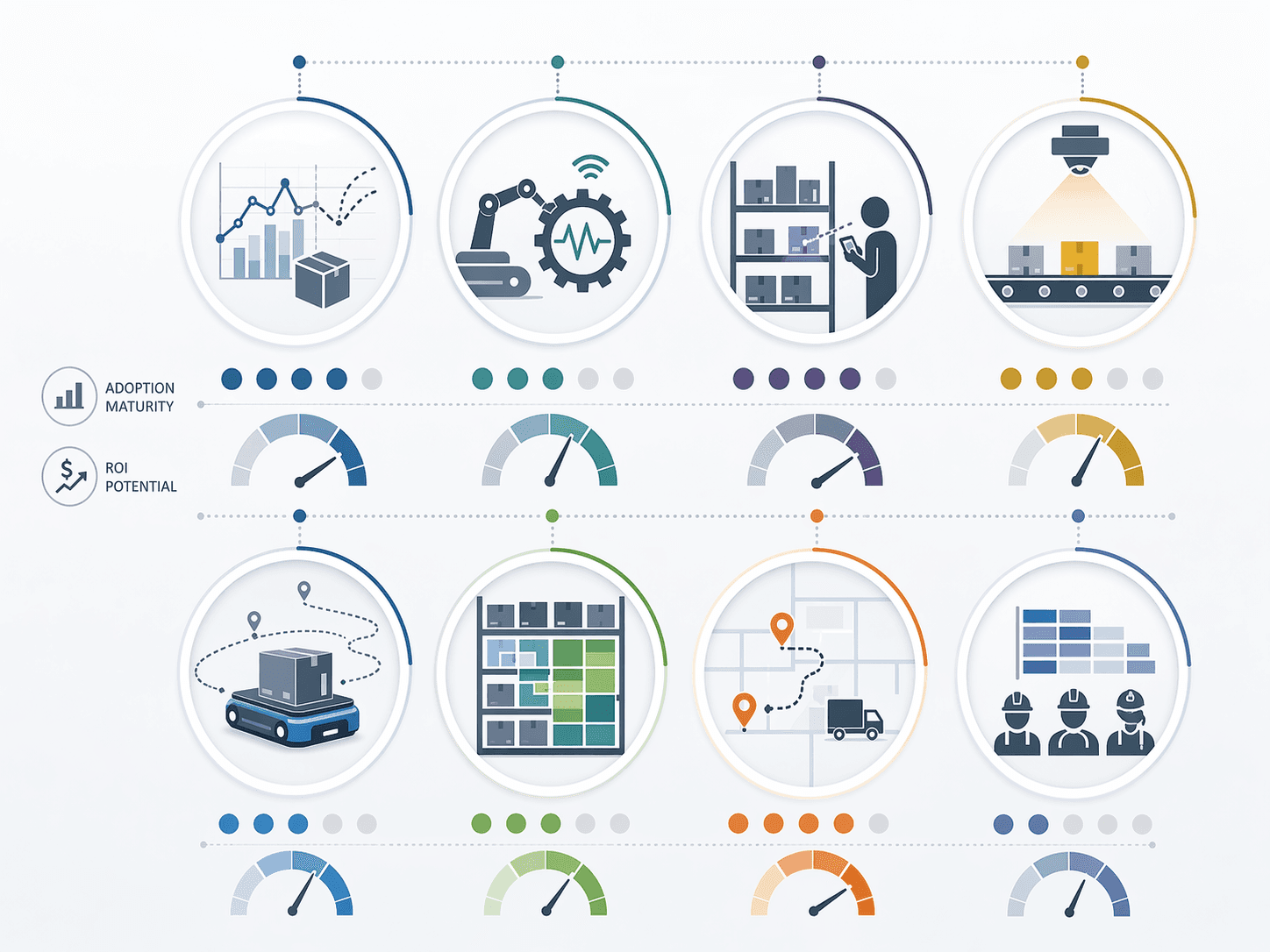
Predictive maintenance is one of the more credible AI warehouse use cases because the operational problem is concrete: a conveyor, sorter, AS/RS crane, forklift, shuttle, compressor, or robot fails at the wrong time, and the facility loses throughput while labor and orders wait.
Appinventiv cites McKinsey benchmarks indicating predictive maintenance can reduce unplanned downtime by 30–50% and maintenance costs by 15–25%.[2] That does not mean every warehouse needs a full predictive maintenance program. The case is strongest where equipment uptime is a binding constraint: automated storage and retrieval, high-speed sortation, conveyor-heavy parcel or e-commerce operations, cold chain facilities, and sites where scarce technicians cover large operating windows.
The evaluation should start with the asset list and downtime economics, not the algorithm. Which failures stop the building? Which ones only inconvenience a zone? Which assets already produce usable telemetry? Which maintenance records are reliable enough to train or validate a model? If the historical data says “fixed belt” for every event, the AI program has a data problem before it has a model problem.
Slotting, labor planning, and route optimization are useful but easier to overstate
Slotting optimization is often the quietest warehouse AI use case, and sometimes one of the most practical. Better slotting can reduce travel, replenishment touches, congestion, damage, and ergonomic strain. It depends heavily on clean item dimensions, velocity data, order affinity, storage constraints, pick method, replenishment rules, and a re-slotting cadence the operation can actually execute.
The caution is that slotting benefits are easy to claim and harder to isolate. A facility may improve pick productivity after re-slotting, but the same period may also include labor changes, volume mix changes, new packaging rules, or WMS configuration work. For investment purposes, slotting should be measured against baseline travel, replenishment, touches, and congestion in the zones where the model actually changed locations.
Labor and workforce planning has a similar profile. AI can help translate expected demand, order mix, and process standards into staffing plans, overtime alerts, cross-training needs, and shift-level work allocation. The implementation risk is less about mathematical possibility and more about trust: supervisors need to believe the plan reflects the actual floor, not an average warehouse that exists only in historical data.
Route optimization sits at the warehouse-to-transport boundary. It can improve load sequencing, dock scheduling, dispatch timing, carrier handoffs, and last-mile readiness, but some of the value may accrue to transportation rather than the warehouse budget. Appinventiv’s McKinsey-cited 5–20% logistics cost reduction benchmark is relevant, but it should not be treated as a warehouse-only route optimization ROI figure.[2]
How warehouse profile changes the priority order
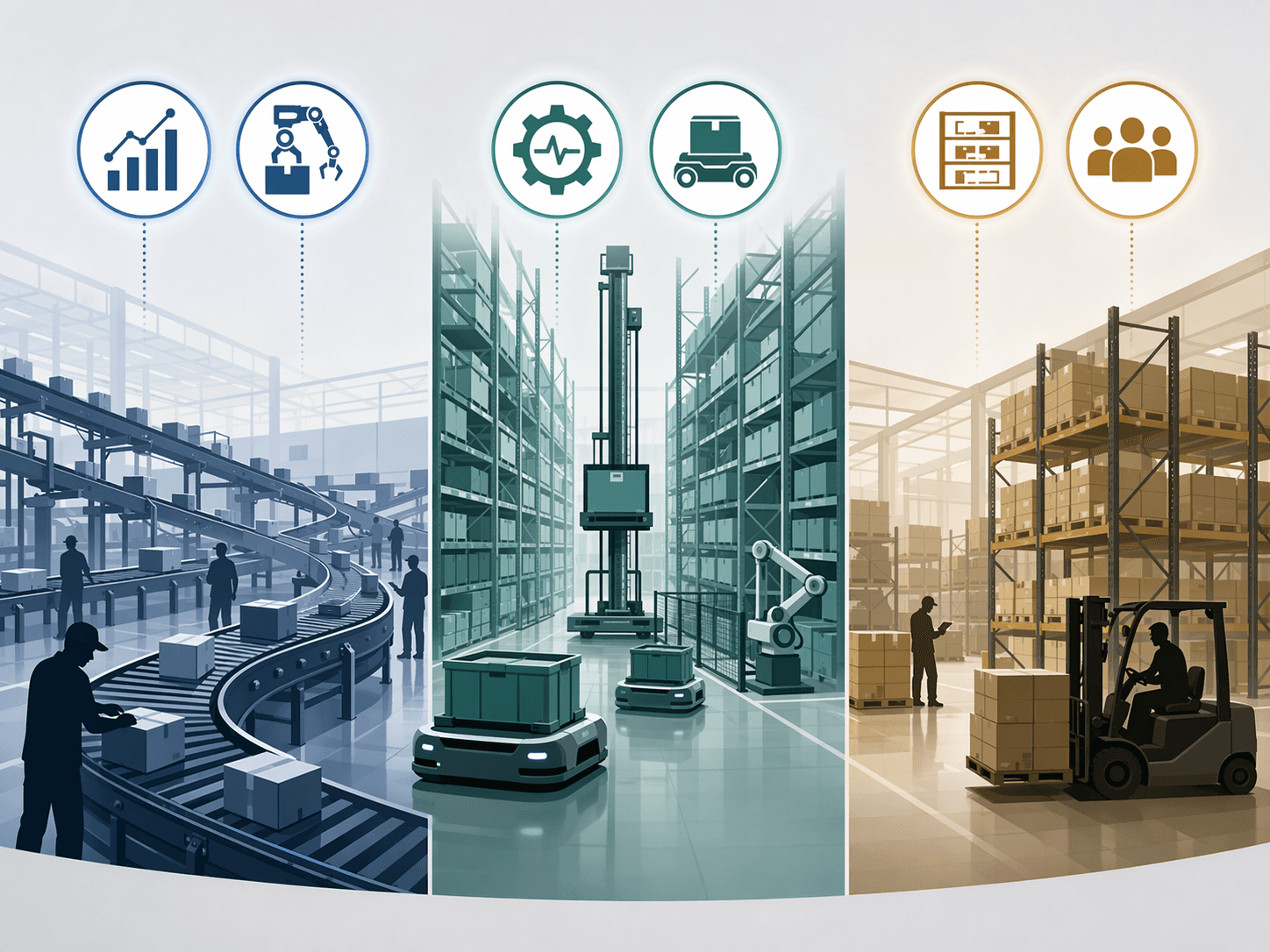
A single ranked list of warehouse AI use cases is usually less helpful than a profile-based shortlist. The same technology can be obvious in one building and premature in another.
| Warehouse profile | Likely first-look use cases | Why these move up the list | What to be conservative about |
|---|---|---|---|
| High-throughput e-commerce or retail DC | AI-directed picking, AMRs, computer vision sorting, slotting optimization, labor planning | Volume, pick density, return pressure, carton variation, peak labor needs, and service-level pressure make small process improvements financially visible. | Assuming labor savings convert cleanly to headcount reduction; underestimating exception handling, replenishment discipline, and peak congestion. |
| Automation-heavy facility | Predictive maintenance, computer vision, AMR or robotics orchestration, slotting tied to automated storage | Downtime is expensive and equipment constraints can dominate throughput. | Building a model without enough sensor coverage, maintenance history, or third-shift support. |
| Inventory-positioning or replenishment-constrained operation | Demand forecasting, slotting optimization, labor planning, warehouse-to-transport route optimization | The warehouse pain starts before the order reaches the picker: inventory is in the wrong place, arrives at the wrong time, or creates avoidable labor and transport pressure. | Treating broad supply-chain cost benchmarks as if they belong entirely to the warehouse. |
| Traditional manual warehouse with limited systems maturity | Demand forecasting, labor planning, basic slotting analytics, selective vision checks | Software-heavy or bounded workflows may be easier to operationalize before robotics-heavy automation. | Buying advanced automation before inventory accuracy, location discipline, WMS process compliance, and supervisor workflows are ready. |
This profile view is also where vendor conversations should become more disciplined. A WMS module, a robotics provider, a vision platform, a labor management system, and a custom analytics team may all claim to solve “warehouse AI.” They are rarely interchangeable. The shortlisting question is whether the vendor owns the operational workflow where value is created, or whether it depends on another system to make the recommendation executable.
Evidence quality matters as much as the ROI percentage
The warehouse AI evidence base is uneven. Forecasting has broad adoption and supply-chain performance benchmarks. Predictive maintenance has mature industrial logic and useful downtime benchmarks. Picking and computer vision have concrete payback ranges in the research set, but the most useful figures here come from a European mid-market context. AMR ROI claims are compelling, but hardware deployments need closer scrutiny of facility fit and operational support.
Large-company examples can be informative without becoming universal proof. Appinventiv cites CDO Times reporting that Amazon saved $1.6 billion in transportation and logistics costs through logistics AI.[2] That is a real scale signal, but it is not a warehouse manager’s payback model. Amazon’s network density, engineering depth, data environment, and capital base are not portable assumptions.
A practical investment committee should separate four kinds of evidence: independent or analyst benchmarks, vendor or company case studies, bounded pilot results, and internal baselines. Vendor case studies can help identify what is technically possible. Internal baselines decide whether the business case survives contact with the building.
A usable portfolio view
For many operators, the earliest evaluation should go to mature, software-heavy applications where the operating decision is already visible: demand forecasting, predictive maintenance in equipment-heavy sites, labor planning, and slotting. These are not always the highest-drama projects, but they can expose whether the data, governance, and execution cadence are ready for more capital-visible automation.
AI-directed picking, computer vision sorting, and AMRs can justify faster movement when volume, repeatability, integration readiness, and floor ownership are present. They are also the cases where sloppy ROI modeling is easiest to spot. If a proposal claims labor savings without explaining travel reduction, exception handling, WMS integration, maintenance coverage, and peak behavior, it is not ready for approval.
Emerging or cross-boundary applications should be modeled more conservatively, especially when benefits fall outside the warehouse P&L. Route optimization, for example, may be a strong logistics investment and still require a different sponsor than a warehouse automation project.
For deeper investment planning, pair this use-case library with a warehouse AI ROI reality check, the broader supply-chain AI use-case view, the adjacent logistics AI use-case comparison, real-world logistics deployment evidence, and the warehousing AI strategy-gap analysis. The useful next step is not a larger AI label. It is a narrower model of the decision, cost, owner, risk, and evidence for each use case under consideration.
References
- AI in Warehouse Management: Impacts and Use Cases — Oracle
- AI in Warehouse Management: Use Cases, ROI & Risk Control — Appinventiv
- AI ROI in Logistics & Supply Chain — 2026 Guide — The Thinking Company
- Warehouse Automation Statistics 2026 — Synkrato
- Warehouse Automation Statistics (2026) — SellersCommerce
Comments
Join the discussion with an anonymous comment.