
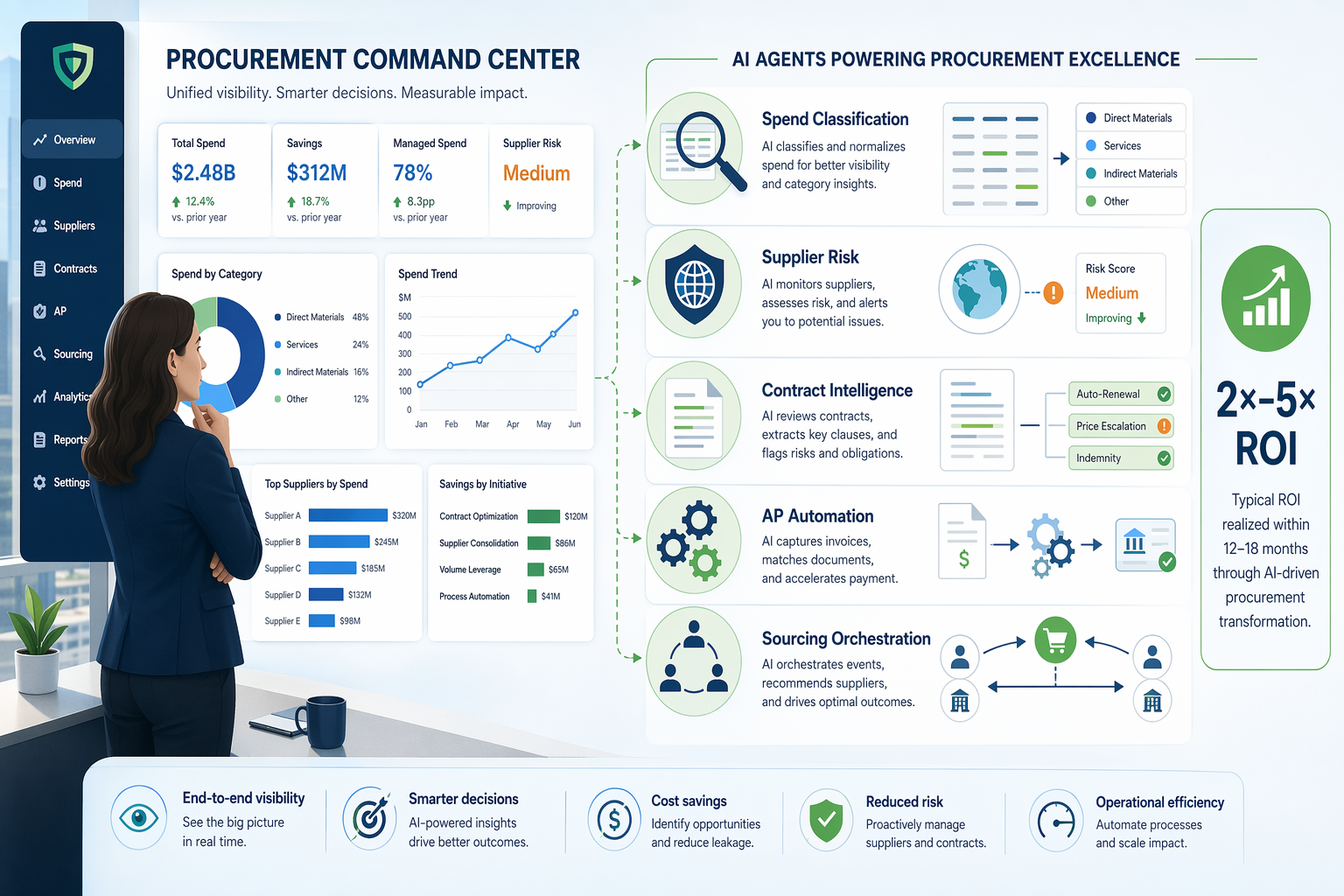
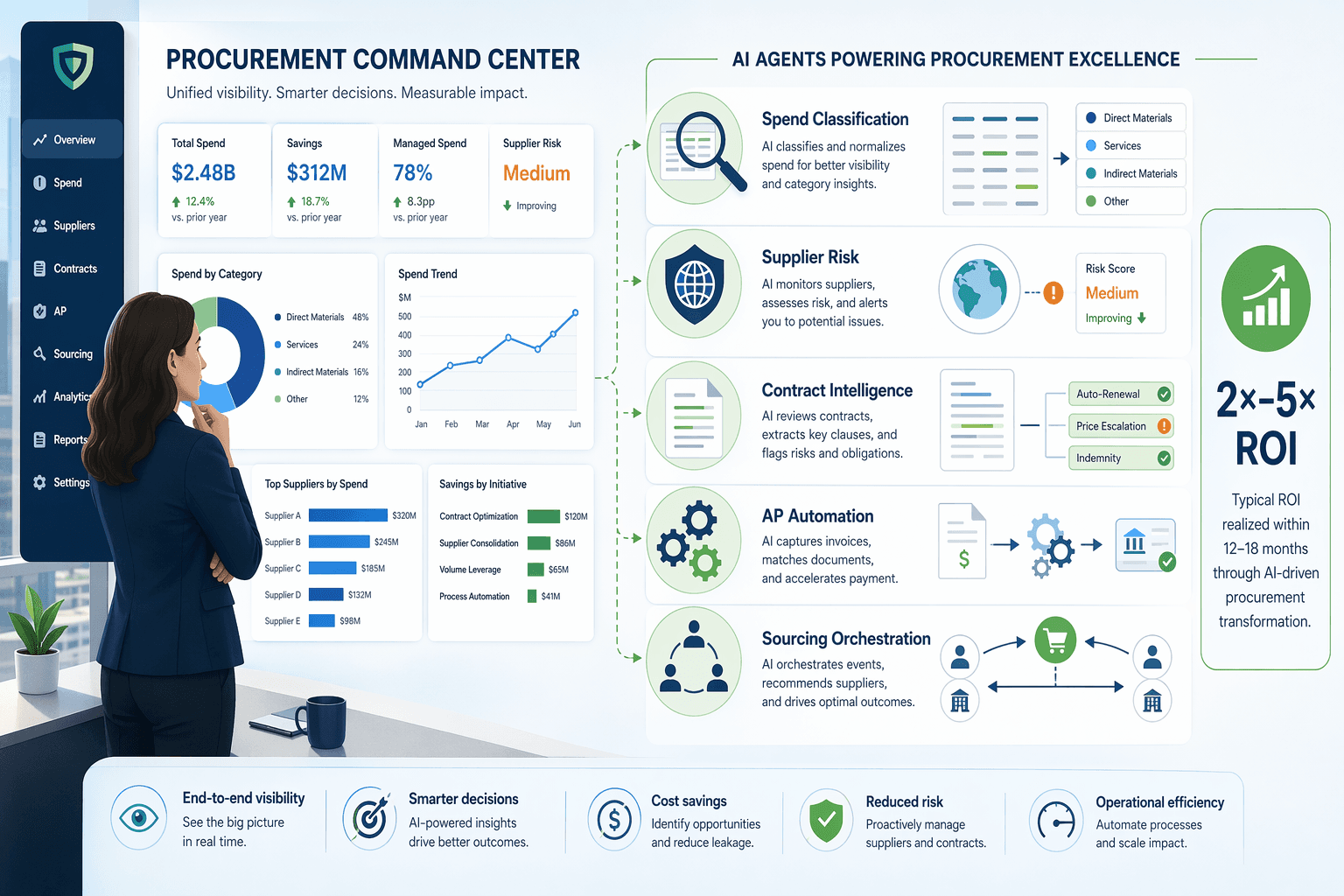
What Is Agentic AI in Procurement — and Why It Matters Now
Procurement leaders have spent the past two years experimenting with generative AI — drafting RFPs, summarizing contracts, and generating spend reports. The results have been mixed. According to the 2026 State of AI in Procurement report, 94% of procurement executives now use generative AI at least weekly, up 44 percentage points year-over-year. Yet only 4% of organizations have achieved large-scale deployment. The gap between experimentation and production is the opening that agentic AI is designed to close.
Agentic AI represents a structural shift in what procurement software can do. Where generative AI assists with individual tasks — writing a sourcing memo or summarizing a supplier contract — agentic AI autonomously orchestrates multi-step workflows. It analyzes spend data holistically, makes proactive recommendations, and executes decisions within defined boundaries. The Sievo guide on AI in procurement defines it as a more autonomous form of artificial intelligence designed to analyze data holistically, offer proactive recommendations, and even automate decision-making when appropriate.
The market trajectory underscores the urgency. Gartner projects that agentic AI in supply chain and procurement software will grow from $2 billion in 2025 to $53 billion by 2030 — a compound annual growth rate of 93.5%. That figure reflects a market that is not merely expanding but redefining the category. For CPOs and procurement transformation leads, the question is no longer whether agentic AI will affect procurement operations, but how to sequence adoption, which workflows to target first, and what governance structures to put in place.
The adoption gap itself is instructive. The same report that shows 94% weekly GenAI usage also found that 49% of procurement organizations piloted generative AI in 2024, but only 4% scaled those pilots into production. The bottleneck is not willingness to try — it is the difficulty of moving from task-level assistance to reliable, autonomous workflow execution. Agentic AI platforms are being built to address that transition, but they also demand a level of data readiness that most procurement organizations do not yet have. Gartner reports that 74% of procurement leaders say their data is not AI-ready, a statistic that should temper expectations even as it clarifies the work ahead.
For a broader view of how agentic AI is moving from pilots to production across supply chain functions, see our companion article Agentic AI in Supply Chain: How Autonomous Agents Are Moving from Pilots to Production in 2026.
The 4-Tier Capability Progression: From Assisted to Agentic
One of the challenges in evaluating AI procurement software is that vendors use overlapping terminology — "autonomous," "agentic," "AI-powered" — to describe capabilities that range from basic automation to fully independent decision-making. A structured capability framework helps procurement leaders assess where a given platform or use case actually sits, and more importantly, where their organization should target its next investment.
The following four-tier progression maps the evolution from human-driven task assistance to fully autonomous agentic orchestration. Each tier represents a distinct level of AI capability, human involvement, and organizational readiness required.
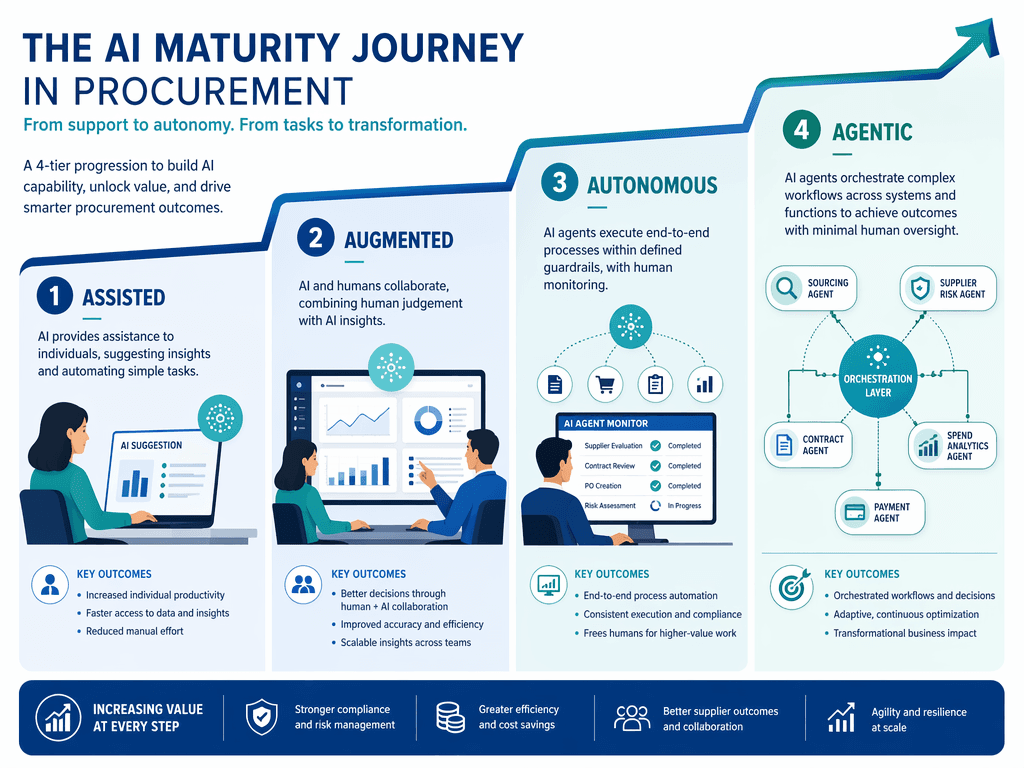
| Tier | What the AI Does | Human Role | Procurement Example |
|---|---|---|---|
| 1. Assisted | Responds to direct queries; retrieves and summarizes information | Human initiates every action and reviews all output | Ask a chatbot to summarize a supplier contract or find a PO status |
| 2. Augmented | Provides recommendations, flags anomalies, suggests next actions | Human reviews recommendations and decides whether to act | Spend classification tool flags misclassified categories and suggests corrections |
| 3. Autonomous | Executes defined workflows within bounded parameters without step-by-step human approval | Human sets rules and monitors exceptions; AI handles routine decisions | Self-executing RFx for standardized categories where criteria are well-defined |
| 4. Agentic | Orchestrates multi-step workflows across systems; adapts to new information; makes trade-off decisions within governance boundaries | Human defines goals and constraints; AI plans and executes; human reviews outcomes and handles exceptions | Autonomous category agent that monitors market conditions, adjusts sourcing strategy, and executes supplier negotiations within pre-approved parameters |
Comments
Join the discussion with an anonymous comment.