

The hard part of AI sales forecasting is not the algorithm’s promise inside the revenue organization. It is the Monday handoff after the number has moved, procurement has already committed, and demand planning is asked to turn a fresher sales view into inventory, capacity, and service-level decisions without creating a new mess downstream.
That handoff used to be easier to describe, if not easier to live with. Sales owned the revenue forecast. Supply chain owned demand planning. Somewhere between them sat a periodic snapshot: monthly, quarterly, or tied to the S&OP calendar. AI changes the input before it changes the decision. The sales forecast can now arrive as a rolling signal, refreshed more often, with confidence intervals attached instead of a single clean number. SAP describes this shift as moving sales forecasting toward real-time refresh and probability-aware outputs rather than static point estimates.[1]

The useful question, then, is narrower than most vendor pages make it sound: can demand planning absorb a rolling, probabilistic sales signal without flattening it back into a slightly shinier point estimate?
The handoff starts with a language problem
Sales forecasting, demand forecasting, and demand planning are often discussed as if they are interchangeable. They are not interchangeable when someone has to decide whether to buy components, reserve line time, or protect service levels with safety stock.
Sales forecasting is usually revenue-side work: opportunities, pipeline movement, bookings, rep judgment, account signals, channel activity, and close probability. Demand forecasting is closer to the expected customer demand for products, locations, and time buckets. Demand planning turns that forecast into an operating plan, usually with constraints, inventory policy, service targets, and supply realities attached. For a fuller terminology hierarchy, see Demand Sensing, Demand Forecasting, and Demand Planning: Definitions, Hierarchy, and AI Roles.
This distinction matters because an AI sales forecast may be materially better at predicting revenue and still arrive in a form that demand planning cannot use safely. A higher-confidence enterprise software close date does not automatically translate into product-level demand. A regional booking signal may need allocation rules before it touches a plant schedule. A pipeline acceleration may represent timing pull-forward, not incremental demand.
The first implementation decision is therefore not which model is most impressive. It is where the sales forecast enters the planning hierarchy and what translation layer sits between revenue probability and supply-chain commitment.
AI changes the forecast object: cadence and uncertainty
A static forecast is a number with a timestamp. A rolling AI forecast is closer to a living input: it refreshes as new CRM, market, order, activity, or channel signals arrive. That difference is operational, not cosmetic. A forecast that updates every 30 days changes the exception queue, the freeze policy, and the timing of when planners are willing to reopen a decision.
The reason cadence matters is that forecast accuracy decays with time. Optifai benchmark data reported through Prospeo, based on a sample of 939 forecasts, places accuracy decay at 5–8% per month. In that benchmark framing, a 30-day forecast at 87% accuracy weakens to roughly 70% by 90 days, while rolling AI forecasts refreshed every 30 days can maintain accuracy in the 85–90% range.[2]
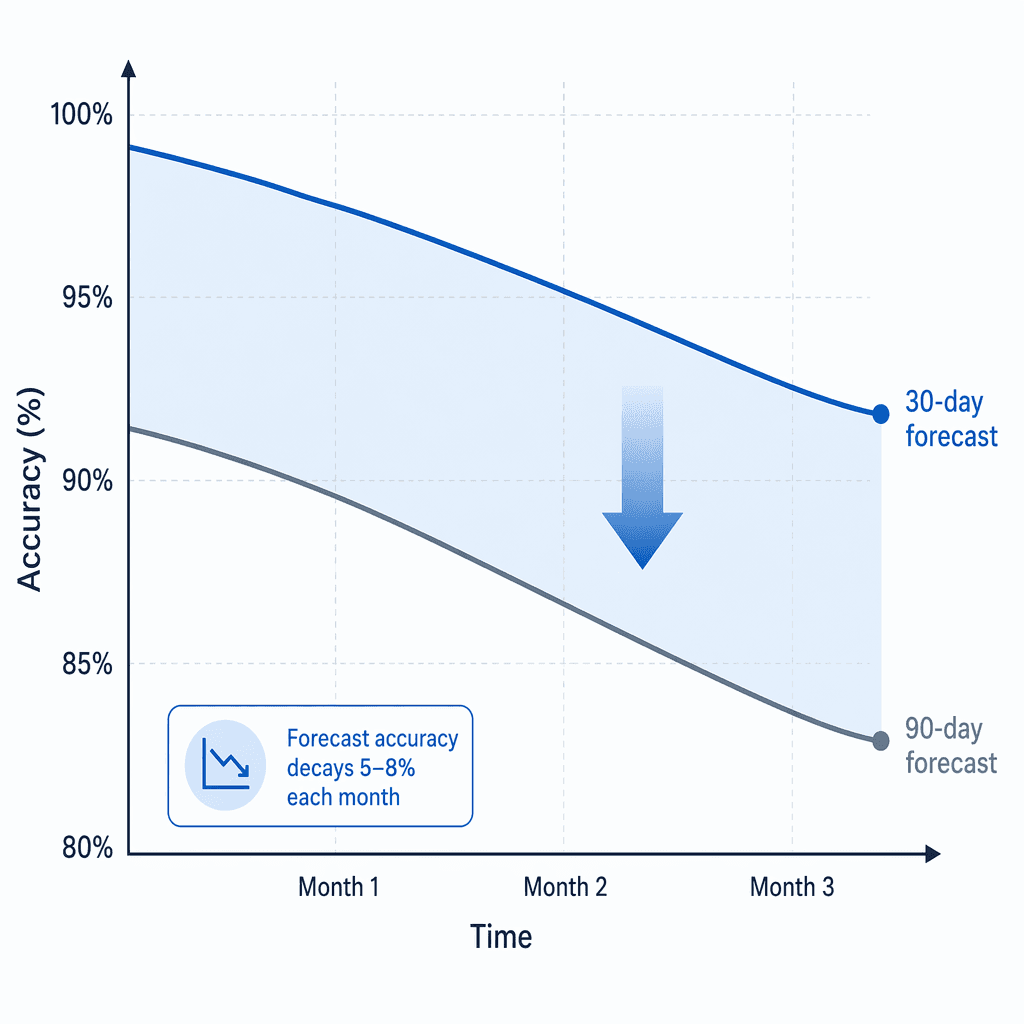
A planning team can do something with that mechanism. It can shorten the period in which demand assumptions remain untouched. It can separate near-term commitments from medium-term sensing. It can move some reviews from calendar-driven cycles to exception-driven cycles. None of that happens if the AI forecast is exported once a month, rounded to a single number, and pasted into the same workbook cell the old forecast used to occupy.
The second change is uncertainty format. Confidence intervals are inconvenient because they force the planning organization to admit what it already knows: the forecast does not become true because the number is clean. A forecast range with confidence attached gives planners a way to connect uncertainty to scenario planning, safety stock, and service-level policy. It also makes bad handoffs more visible. If sales sends a wide range and demand planning treats the midpoint as commitment, the process has destroyed the information the model produced.
What demand planning has to redesign
Consuming AI sales forecasting outputs well usually requires changes in four places: refresh frequency, scenario logic, exception review, and system ingestion. These are not glamorous changes, but they are where the downstream value either survives or disappears.
| Planning element | Old handoff behavior | AI-enabled behavior | Planning consequence |
|---|---|---|---|
| Refresh cadence | Periodic snapshot aligned to S&OP or quarterly review | Rolling update as new sales and market signals arrive | Forecast changes can trigger earlier exception review instead of waiting for the next cycle |
| Forecast format | Single number by period, region, or product family | Range with confidence interval or probability distribution | Planners can connect uncertainty to scenario planning and safety stock decisions |
| Decision trigger | Manual reconciliation after sales changes the number | Threshold-based alerts when probability, range width, or volume movement crosses a limit | Attention moves to material exceptions rather than every forecast movement |
| System intake | Spreadsheet upload or manually adjusted demand plan | Probabilistic input ingested into planning platforms | Planning systems can run upside, base, and downside scenarios without rebuilding the forecast by hand |
Refresh frequency needs a freeze policy, not just a faster feed
A rolling forecast can become noise if every update is allowed to reopen every decision. The intake design should distinguish between horizons. Near-term production or purchase commitments may remain protected by a freeze window. Mid-term demand assumptions may update when the sales signal crosses a materiality threshold. Longer-term capacity or supplier discussions may use trend direction rather than exact period-level changes.
This is where planning calendars still matter. The AI forecast may refresh continuously, but the organization still needs rules for when a change becomes plan-relevant. A five-point probability movement in a small account may not deserve the same review as a widening confidence band on a high-volume product family with long lead-time components.
Confidence intervals should alter safety-stock thinking
When a forecast arrives as a range, the planning question changes. The midpoint may still be useful for base planning, but it should not be the only value that flows into inventory policy. A narrow range around stable demand may support leaner positioning. A wide range around the same midpoint may justify buffers, postponement, or delayed commitment until the next refresh clarifies the signal.
For example, a hypothetical planner looking at two product families with the same midpoint forecast should not treat them equally if one has a tight confidence band and the other has a wide band driven by volatile opportunity timing. The first may be a normal replenishment decision. The second may belong in an exception review with sales, finance, and supply before procurement locks in material.
The operational value is not that uncertainty disappears. It is that uncertainty is preserved long enough to influence inventory posture, capacity timing, and service-level trade-offs.
Exception review has to include the reason the forecast moved
A planner does not only need to know that the forecast increased. She needs to know whether it increased because pipeline probability improved, a large deal shifted timing, channel orders accelerated, seasonality was reweighted, or the model incorporated a new external signal. Those reasons do not all deserve the same supply response.
- If the upside comes from a few large late-stage opportunities, the supply response may need sales validation before inventory is committed.
- If the upside comes from broad-based order velocity across accounts, the demand plan may deserve a stronger adjustment.
- If the confidence interval widens while the midpoint barely changes, the right response may be scenario planning rather than a volume change.
- If forecast accuracy deteriorates for a product, region, or segment, the issue belongs in model monitoring as much as in S&OP debate.
Forecast decay and model drift are different problems, but they meet in the same review room. Demand teams need to watch whether the model’s usefulness is weakening by horizon, segment, or market condition. The monitoring discipline overlaps with the controls discussed in AI Model Drift Detection and Response Framework for Demand Planning.
Planning systems must ingest probability, not just volume
The system layer is easy to underestimate because it often appears after the strategy discussion. But if SAP IBP, Kinaxis Maestro, Blue Yonder, o9, or another planning environment receives only a finalized point forecast, the probabilistic advantage has already been stripped away. SAP notes that AI sales forecast outputs can be integrated into planning systems as probability-aware signals rather than fixed estimates.[1]
The practical requirement is to map the forecast range into the planning model. That may mean storing upside, base, and downside scenarios; passing confidence bands into safety-stock logic; or creating exception thresholds based on range width and forecast movement. Platform architecture matters here, especially for teams comparing how advanced planning systems handle probabilistic demand inputs. See Blue Yonder vs. Kinaxis vs. o9 Solutions: Demand Planning AI Architecture Comparison (Q2 2026) and AI Demand Planning Software: Vendor Landscape Snapshot, Q2 2026 for related platform context.
What the evidence does—and does not—prove
The quantitative case for AI forecasting is encouraging, but it needs clean boundaries. There is direct evidence about AI sales forecasting performance, adjacent evidence about AI demand forecasting outcomes, and illustrative case evidence about machine learning outperforming traditional forecasting methods in a specific setting. Those are not the same claim.
On the sales side, MarketsandMarkets and SalesPlay report that AI sales forecasting can deliver 15–20% higher accuracy, 25% shorter sales cycles, and up to 30% improvement in quota attainment.[3] Those are revenue-process outcomes. They matter because a better upstream signal gives demand planning a better starting point, but they do not by themselves prove lower inventory, fewer expedites, or higher service levels.
On the supply chain side, Oracle cites McKinsey figures indicating that AI-powered demand forecasting can reduce supply chain forecast errors by 20–50% and reduce product unavailability by up to 65%.[4] This is strong adjacent evidence for AI forecasting in demand and supply chain contexts. It should not be read as direct proof that an AI sales forecast automatically improves downstream outcomes after passing through the revenue-to-demand handoff.
The distinction is not academic. AI demand forecasting usually works directly with demand signals and planning granularity. AI sales forecasting may start from pipeline, CRM, opportunity, and account behavior. The translation from one to the other can lose information, introduce bias, or create false precision unless governance is designed around the handoff.
Genpact offers a useful but narrower example. In a CPG case using weekly cereal sales data, a machine-learning ensemble produced 11.61% MAPE compared with 15.17% MAPE for a traditional ARIMAX model.[5] That case illustrates why machine learning methods can improve forecast performance in some demand contexts. It is a single-category example, not a universal benchmark for every industry or for the sales-to-demand conversion specifically.
This is the evidence boundary that should shape implementation expectations. AI sales forecasting can improve the upstream signal. AI demand forecasting has documented supply chain benefits in adjacent research. The bridge between the two is a process and data-design problem, not a guaranteed pass-through.
The data handoff is part of the control system
A probabilistic sales forecast depends on the quality of the signals feeding it. CRM hygiene, opportunity stage discipline, product attribution, customer hierarchy, channel tagging, and historical close behavior all affect the model before demand planning ever sees the output. Planning master data then adds its own problems: item-location mapping, substitutions, lead times, minimum order quantities, and calendar alignment.
If sales stages are inconsistently maintained, the AI forecast may learn the habits of the CRM rather than the behavior of the market. If product mappings between CRM and planning systems are weak, a revenue forecast may land at a level too aggregated for supply decisions. If the demand planning system cannot retain confidence intervals, the model’s uncertainty becomes invisible at the exact moment it should influence safety stock.
This is why data readiness should be treated as an operational prerequisite, not an IT cleanup task. The same discipline behind Data Readiness Assessment for AI Inventory Optimization applies here: the output is only as useful as the governed data path that carries it into decisions.
Where the process should become more precise
For demand planning teams, the implementation work can start with a few specific design choices.
- Define which sales forecast outputs are plan-relevant: revenue, units, product family, customer segment, region, channel, probability, confidence range, or timing movement.
- Set horizon rules: what changes can affect the frozen period, the tactical planning window, and the longer-range capacity view.
- Create exception thresholds: volume movement, probability shift, range widening, or forecast bias by segment.
- Preserve uncertainty in the system of record: store ranges or scenarios rather than only a midpoint.
- Assign governance: sales explains commercial movement, demand planning translates it into demand assumptions, supply planning evaluates feasibility, and finance understands when revenue probability does not equal supply commitment.
The governance point is usually where optimism meets consequence. Sales may be right that the market has moved. Planning may be right that the supply base cannot react without cost. A better AI-generated signal does not remove that tension; it makes the timing and uncertainty of the tension visible earlier.
AI sales forecasting should also be viewed as one node in a broader supply chain AI portfolio, not the whole operating model. Demand sensing, inventory optimization, production scheduling, and supplier risk analytics may all affect downstream results. For a broader functional map, see AI Use Cases in Supply Chain by Function: Where the ROI Is Real in 2026.
The practical claim
AI sales forecasting can improve downstream supply chain outcomes, but only after the demand planning process is redesigned to use what the model is actually producing. The important shift is not simply from a worse number to a better number. It is from a static point estimate to a rolling, probabilistic input that can change review cadence, scenario logic, safety-stock posture, and exception governance.
If the organization collapses every AI forecast into one number and runs the same monthly reconciliation meeting, most of the value will be lost at the interface. If it preserves cadence and uncertainty through the handoff, the sales forecast becomes a useful upstream signal for demand planning rather than another late change that planners are expected to absorb.
References
- How AI redefines sales forecasting, SAP, https://www.sap.com/resources/how-ai-redefines-sales-forecasting
- AI Sales Forecasting Accuracy, Prospeo, https://prospeo.io/s/ai-sales-forecasting-accuracy
- AI Sales Forecasting & Pipeline Strategy 2026, MarketsandMarkets, https://www.marketsandmarkets.com/AI-sales/ai-sales-forecasting-pipeline-strategy-2026
- AI Demand Forecasting, Oracle, https://www.oracle.com/scm/ai-demand-forecasting/
- The evolution of forecasting techniques: Traditional versus machine learning methods, Genpact, https://www.genpact.com/insight/the-evolution-of-forecasting-techniques-traditional-versus-machine-learning-methods
Comments
Join the discussion with an anonymous comment.