
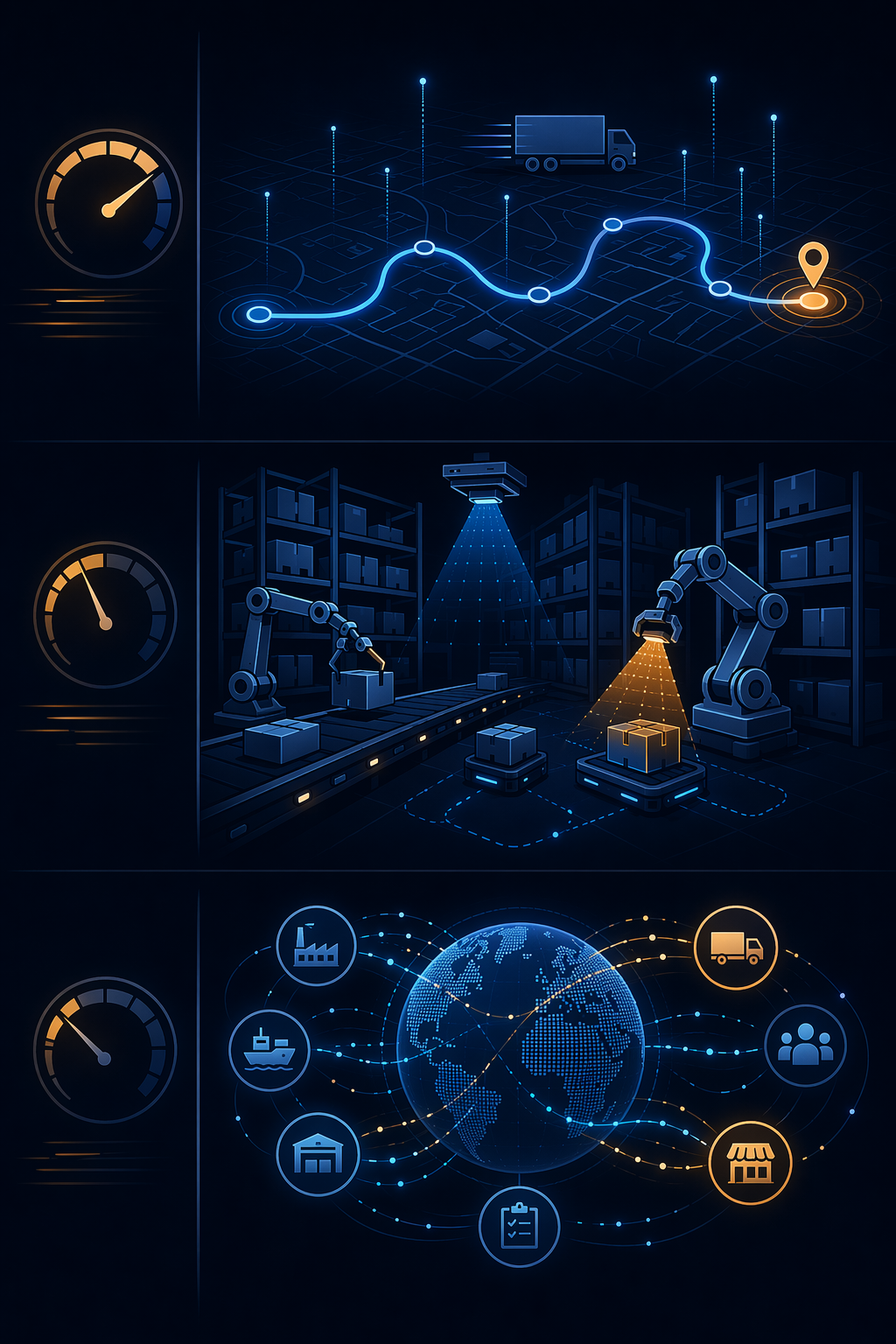
AI for logistics is already paying for itself in measurable places: fewer miles driven, fewer customs errors, faster warehouse movement, better parcel allocation, and earlier exception detection. The harder part is that these returns do not arrive in the same quarter, through the same systems, or with the same implementation risk. A route engine can produce a cleaner business case than a multi-node orchestration layer, even when the orchestration layer may matter more strategically over time.
That mismatch matters because logistics leaders are being asked to move quickly before many organizations are ready. Aggregated 2025 statistics show 35% of logistics firms actively deploying AI, below a 44% cross-industry average, while 94% plan to deploy within two years and only 23% have a formal strategy; the same source cites a 190% average ROI figure that is useful as context, not as a promise for any single logistics operation. [1]
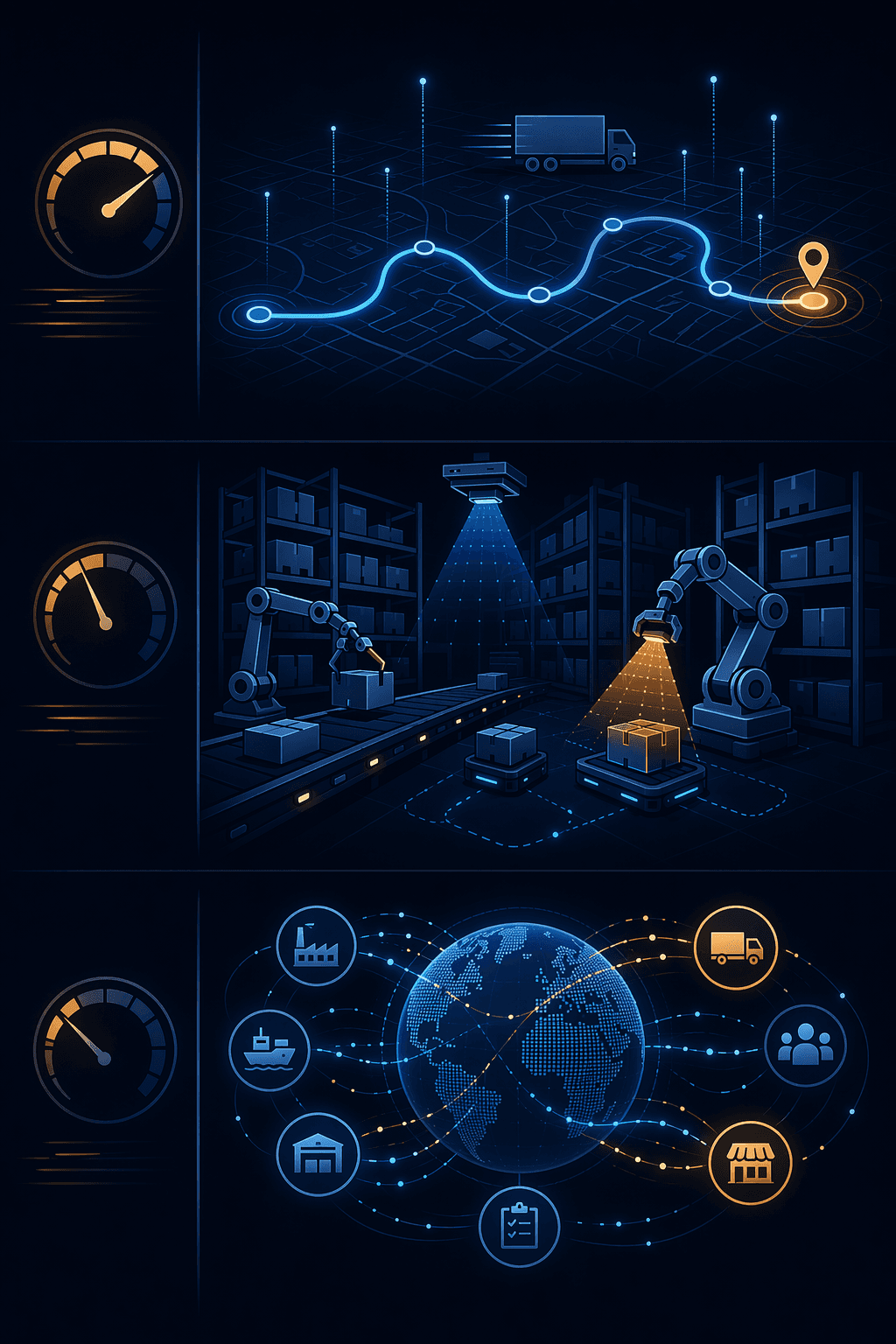
Where AI Produces Returns in Logistics
A useful comparison starts by separating the operating layer. Transport, warehouse, and orchestration use cases all get called “AI in logistics,” but they touch different systems, different labor groups, and different P&L lines. The ROI ranges below come from secondary analysis attributed to Gartner and McKinsey, so they should be treated as directional benchmarks for screening and stakeholder discussion, not as finance-ready guarantees. [2]
| Operational layer | Use case | Reported or benchmarked ROI signal | Typical payback window | Maturity | Main implementation risk |
|---|---|---|---|---|---|
| Transport | Route optimization and last-mile planning | 800-1,200% 3-year ROI benchmark on EUR 80-150K investment; DHL reported a 14% distance reduction, EUR 180M in annual fuel savings, and 127,000 tonnes of CO2 reduction in a European parcel network deployment. [2][3] | 2-4 months in the benchmark case for a 500-vehicle fleet. [2] | High | Poor address data, driver constraints, depot cutoffs, customer time windows, and weak TMS integration |
| Transport | Predictive maintenance for fleet and equipment | 300-500% ROI benchmark. [2] | 4-8 months. [2] | Medium-high | Sensor coverage, maintenance history quality, and planner trust in model alerts |
| Warehouse | AI-assisted picking, slotting, and labor planning | 250-400% ROI benchmark; Amazon reported that DeepFleet increased robotic fleet speed by 10%, while GXO has cited AI inventory counting capability up to 10,000 pallets per hour. [2][4] | 4-8 months. [2] | Medium | WMS integration, congestion modeling, SKU master data, and supervisor adoption |
| Warehouse | Computer vision and automated inventory counting | Operational gains depend on pallet density, scan frequency, and exception workflow design; GXO’s reported throughput gives a useful ceiling, not a universal norm. [4] | Usually tied to warehouse rollout waves rather than a single go-live | Medium | Camera placement, item identification quality, cycle count rules, and reconciliation workload |
| Supply chain orchestration | Customs document automation | Kuehne+Nagel reported a 61% error reduction and 72% document processing time reduction across 2.1M annual declarations in 43 countries. [4] | 5-10 months in the customs automation benchmark. [2] | Medium | Document variability, regulatory review, exception handling, and cross-country process differences |
| Supply chain orchestration | Parcel allocation and capacity optimization | InPost reported a 41% reduction in overflow events and 34% reduction in misrouted parcels in parcel locker optimization. [4] | Depends on parcel density, locker network maturity, and routing integration | Medium | Local capacity imbalance, inaccurate demand signals, and operational handoffs between sorting and delivery |
| Supply chain orchestration | Demand sensing and inventory-positioning support | 200-350% ROI benchmark. [2] | 5-9 months. [2] | Medium | Forecast governance, planning calendar fit, and handoff between commercial demand signals and logistics execution |
The table is not saying that route optimization is always the most important AI investment. It is saying that route optimization often has the cleanest first business case: the model changes a route plan, the route plan changes miles, miles change fuel, driver hours, service reliability, and emissions. The line from algorithm to operating result is shorter than it is in most warehouse and orchestration deployments.
Warehouse and orchestration tools can still create more durable value, especially when the same data layer, integration work, and exception management process support several use cases. That portfolio effect is real, but it is also where many business cases become too neat. Shared infrastructure lowers the marginal cost of the second or third use case only if the first rollout actually leaves behind reusable integrations, governed data, and an operating team that trusts the system.
Route Optimization Has the Clearest Early Payback
Route optimization is where AI in logistics most easily escapes the demo room. It uses familiar operating inputs: orders, stops, delivery windows, vehicle capacity, driver hours, depot location, traffic conditions, and service constraints. The output is not an abstract probability score; it is a dispatch plan someone can compare against yesterday’s plan.
The DHL example is compelling because the reported outcomes sit in the same operational chain. In its European parcel network, DHL reported a 14% reduction in total distance, EUR 180M in annual fuel savings, and 127,000 tonnes of CO2 reduction. [3] Distance fell first; fuel and emissions followed. That is the sort of sequence a logistics VP can defend without pretending AI magically improved every metric at once.
The transferability depends on density and routing complexity. A fleet with hundreds of vehicles, many stops, variable time windows, and repeated planning cycles gives the optimizer room to find savings. A simple shuttle operation with fixed lanes and stable volume has less room to improve. The same software may be impressive in both places; the payback will not be.
Route optimization also exposes the practical integration question early. A routing engine that cannot receive clean orders from the TMS, respect real driver rules, update dispatchers quickly, and send feasible plans back into execution will create arguments at the dispatch desk. The mechanics of AI route optimization depend on combining constraints, delivery commitments, and live operating data rather than simply drawing a shorter line on a map. [5]
For teams that want a deeper technical view of this transport layer, the related guide on AI in TMS, route optimization, last-mile delivery, and predictive freight rate analytics is a more focused companion. The operating point here is narrower: route optimization deserves early priority when route variability, fleet scale, and dispatch discipline are already present.
Warehouse AI Pays Back Through Flow, Not Just Automation
Warehouse AI is harder to judge from a single metric because the work is more physical and more interdependent. A picking model can improve travel paths, but congestion may erase part of the gain. A vision system can count inventory faster, but the exception queue still has to be reconciled. A labor-planning model can predict tomorrow’s staffing need, but supervisors still have to absorb callouts, wave changes, late trailers, and priority orders.
The benchmarked ROI range for warehouse picking AI is lower than route optimization but still meaningful: 250-400% with a 4-8 month payback window. [2] That timeline is plausible when the facility has enough volume, repeatable processes, accurate SKU and location data, and a WMS that can accept recommendations without forcing supervisors into duplicate work.
Amazon’s DeepFleet case illustrates a different warehouse value path. The reported 10% increase in robotic fleet speed is not a generic picking productivity claim; it is a movement-efficiency claim inside a highly instrumented robotic environment. [4] That matters. A warehouse with autonomous mobile robots, telemetry, and mature control systems has a richer feedback loop than a manual operation with patchy scan compliance.
GXO’s AI inventory counting example points to another useful but bounded category. Counting up to 10,000 pallets per hour is attractive because it attacks a recurring warehouse tax: the time spent confirming what the system thinks is on hand. [4] The gain is not just counting speed. The operational value appears when faster counts reduce search time, prevent bad replenishment decisions, and shrink the pile of inventory exceptions waiting for review.
Warehouse use cases should therefore be staged around flow constraints. If the constraint is picker travel, start with slotting and pick-path intelligence. If the constraint is inventory accuracy, start with counting and reconciliation. If the constraint is labor volatility, start with forecasting and shift planning. Buying a broad warehouse AI layer before naming the constraint usually produces a prettier dashboard than a better labor plan.
Customs, Parcel Allocation, and Orchestration Need More Patience
Supply chain orchestration use cases often look less dramatic than robots and route maps, but they can remove some of the most stubborn friction in logistics: document errors, exception queues, capacity mismatches, handoff delays, and planning decisions that arrive too late for operations to use.
Kuehne+Nagel’s customs automation figures show why document-heavy workflows belong in the AI conversation. The company reported a 61% error reduction and 72% document processing time reduction across 2.1M annual declarations in 43 countries. [4] That is not the same kind of gain as reducing miles. It changes who waits, who reviews, and how many declarations enter a manual exception queue.
The transferability is strong only when the document process is repeatable enough for automation and governed enough for exceptions. Customs work is full of local rules, product classifications, customer-specific paperwork, and compliance risk. A model that accelerates clean documents but floods specialists with ambiguous exceptions can move the bottleneck rather than remove it.
InPost’s parcel locker optimization is a cleaner capacity example. The reported 41% reduction in overflow events and 34% reduction in misrouted parcels points to a very specific operating problem: parcels arriving where locker capacity, customer behavior, and delivery execution do not line up. [4] AI helps when it improves allocation before the parcel reaches the wrong location or creates avoidable driver rework.
Demand sensing sits further upstream. The benchmarked ROI range of 200-350% and 5-9 month payback window is attractive, but logistics leaders should be careful about ownership. [2] Demand sensing may improve inventory positioning and capacity planning, yet the benefits depend on commercial forecasts, planning calendars, procurement decisions, and warehouse execution. If those teams do not share decision rights, the model may predict demand faster than the organization can act on it.
The same caution applies to agentic or orchestration tools that propose actions across transport, warehouse, and inventory decisions. They can be valuable when autonomy is graduated and reviewed, but they should not be dropped into exception-heavy operations without clear approval rules. The practical question is not whether the agent can suggest a better action; it is whether the organization knows which actions it may take, which require review, and who owns the consequence. For that deeper autonomy question, see the guide to agentic AI in supply chain.
The Integration Burden Belongs in the First Business Case
The most common AI business case error in logistics is treating integration as a technical afterthought. The available industry analysis estimates that legacy TMS and WMS integration consumes 30-40% of total AI project cost and 40-60% of project timelines. [2] If that work is missing from the business case, the payback window is probably wrong before the vendor demo starts.
Integration is not just API labor. It includes data mapping, exception-code cleanup, master-data repair, process redesign, user permissions, testing against old workflows, and the awkward discovery that two facilities use the same field to mean different things. The model may be the clever part, but the interface is where operations decide whether it is usable.
This also explains why broad ROI claims should be handled carefully. Aggregated sources report that only 6% of organizations see ROI in under one year, while most satisfactory returns arrive over a two-to-four-year period. [1] That does not contradict the shorter payback windows for route optimization or other narrow use cases. It means portfolio-level AI programs include the slow work: integration, governance, training, process redesign, and scaling beyond the first site.
PwC’s operations survey is another warning against judging AI readiness by interest alone. Its reported leader cohort is small, and disappointment remains common among digital operations programs. [6] For logistics leaders, the lesson is not to slow everything down. It is to keep the first deployment close enough to operations that bad assumptions surface early, while the cost of correction is still manageable.
A Practical Prioritization Framework
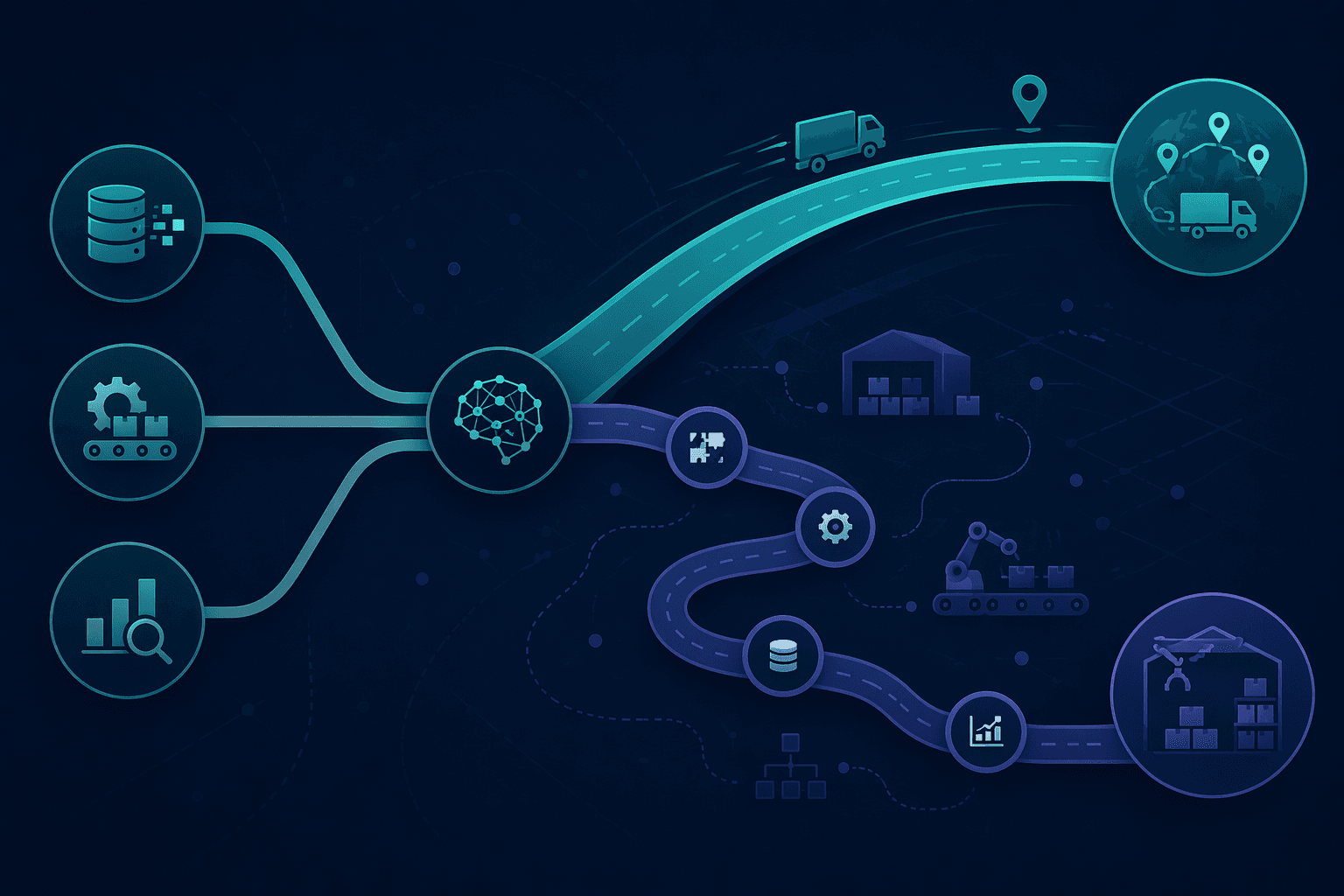
The best first AI use case is rarely the one with the largest theoretical value. It is the one where the operating pattern repeats often, the data is available, the decision can be changed, and the payback can be measured without a consulting archaeology project.
| Screening question | What a strong answer looks like | What a weak answer signals |
|---|---|---|
| Is the decision repeated often enough? | Daily routing, recurring wave planning, frequent customs declarations, repeated parcel allocation, or regular inventory counting | A rare planning event where AI has little opportunity to learn or compound value |
| Can the AI recommendation change an operational action? | A dispatcher changes a route, a supervisor changes a labor plan, a customs team clears documents faster, or a parcel is allocated differently | The model produces insight but no one owns the next action |
| Is the required data already captured with reasonable quality? | Orders, locations, timestamps, scans, inventory records, maintenance history, and exception codes are available and understood | Critical fields are missing, inconsistent, or maintained outside core systems |
| Can the result be measured against a baseline? | Miles, fuel, service levels, errors, processing time, overflow events, misroutes, or labor hours can be compared before and after | Success depends on a blended productivity story that finance cannot isolate |
| Will the integration work be reusable? | The same TMS, WMS, data layer, or exception workflow can support later use cases | The project creates a one-off connection that becomes another system to maintain |
This screen tends to put transport optimization near the front for fleet-heavy operations. It also puts customs automation near the front for forwarders and cross-border shippers with high document volumes. It may push warehouse robotics or orchestration lower on the list if the facility data is weak, the WMS is brittle, or supervisors already work around system recommendations.
A defensible sequence for many logistics organizations looks like this:
- Start with a high-frequency decision where baseline measurement is clean, such as route optimization, customs document classification, or inventory counting.
- Include the full integration cost in the first business case, especially TMS/WMS work, data cleanup, exception handling, and user acceptance testing.
- Design the workflow around the person who handles exceptions after the model acts or recommends.
- Expand only when the first use case leaves behind reusable data, integrations, governance, and operating trust.
- Treat portfolio ROI as a second-stage argument, not as a substitute for proving the first deployment.
For broader ROI benchmarking, the related analysis of supply chain AI ROI timelines and business case reality is useful because it separates fast operational wins from slower enterprise returns.
What to Delay, Stage, or Avoid
Some AI use cases should not be rejected, but they should be staged. Network-wide orchestration, autonomous exception resolution, and multi-echelon planning support can be valuable when the operating foundation is ready. They become expensive distractions when the organization still cannot trust location data, inventory balances, carrier status messages, or handoff rules between planning and execution.
Delay a use case when the main value depends on changing several departments at once and no one owns the cross-functional decision. Stage it when the same capability can first be proven inside a narrower lane, facility, country, document type, or product family. Avoid it, at least for now, when the model’s recommendation would be manually re-keyed into another system and then manually reconciled by the same team the project claims to help.
Vendor selection should follow the same discipline. A good logistics AI vendor should be able to explain which operational decision changes, which system receives the recommendation, what happens when the recommendation is wrong, and how the baseline will be measured. A vendor that can only talk about model sophistication is not yet talking about logistics.
The implementation risk is not a reason to avoid AI. It is the reason to stop treating AI in logistics as one investment class. Transport optimization can justify itself quickly when fleet scale and routing complexity are present. Warehouse AI can pay back through flow improvements when facility data and supervisor workflows are ready. Orchestration use cases can create larger portfolio value, but they require patience, governance, and integration work that has to be funded honestly from the beginning.
References
- Supply Chain AI Statistics: 18+ Statistics You Should Know for 2026, OpenSky Group
- AI in Logistics & Supply Chain — Complete 2026 Guide, The Thinking Company
- AI in Logistics and Last-Mile Delivery, DHL
- Top 20 AI in Supply Chain Examples, Inbound Logistics
- AI Route Optimization: Enhancing Delivery Efficiency in 2026, Descartes
- 2026 Digital Trends in Operations Survey, PwC
Comments
Join the discussion with an anonymous comment.