


The Strategic Disconnect: Intent vs. Readiness in Warehouse AI
The numbers are stark. According to an ABI Research survey of 490 supply chain professionals conducted in 2025, 94% of supply chain companies plan to deploy AI or generative AI for decision support within two years. Yet a separate Gartner survey of 120 supply chain leaders from the same period found that only 23% of organizations have a formal AI strategy in place — even among those already running AI initiatives. That 71-point gap between intention and structured execution is not a minor planning lag. It is the single largest risk factor for warehouse AI investments in 2026.
This article does not re-litigate why AI projects fail in general supply chain contexts. Our existing analysis of why most supply chain AI initiatives fail already covers the cross-functional failure patterns. Instead, we narrow the aperture to warehouse operations — the physical heart of the supply chain where AI promises the most tangible gains in throughput, safety, and cost, but where the absence of structured strategy creates the most expensive failure modes.
| Metric | Source | Year |
|---|---|---|
| 94% of supply chain companies plan to use AI/Gen AI for decision support within two years | ABI Research (survey of 490 professionals) | 2025 |
| Only 23% of supply chain organizations have a formal AI strategy | Gartner (survey of 120 supply chain leaders) | 2025 |
| 71-point gap between intent and formal strategy | Calculated from above | 2025 |
| Only 29% have built capabilities needed for future readiness | Gartner | Feb 2025 |
Warehouse operators face a specific version of this gap. The global warehouse automation market reached $29.98 billion in 2026 and is projected to grow at an 18.7% CAGR to $59.52 billion by 2030, according to SellersCommerce. Approximately 4.7 million warehouse robots are now installed across over 50,000 facilities worldwide. But hardware deployment without strategic software integration — particularly AI for decision-making, optimization, and safety — is a recipe for underutilized assets and stalled pilots.
Why the Strategy Gap Matters: The Cost of Flying Blind
Deploying AI in a warehouse without a formal strategy is not neutral — it is actively expensive. The costs manifest in four distinct ways.
- Wasted capital on unintegrated point solutions. A computer vision safety system that cannot talk to the WMS, a slotting optimization engine that runs on stale data, a labor forecasting model trained on pre-automation shift patterns — each works in isolation but fails to compound into system-level improvement.
- Pilot purgatory. Without a governance framework and clear success criteria, pilots run indefinitely. The organization never reaches the scale where AI economics work. The Deloitte 2025 survey found that while 85% of organizations increased AI investment, only 6% saw ROI in under a year. The rest are waiting — often without a timeline.
- Missed competitive advantage. Accenture's 2024 analysis of 1,148 companies across 10 industries found that companies with AI-mature supply chains are 23% more profitable than peers and six times as likely to use AI and generative AI widely. The gap between the AI-mature minority and the rest is widening, not narrowing.
- Unmanaged workforce risk. ActivTrak's 2025 behavioral study of 774 companies found that 72% of logistics employees had adopted AI tools in 2024 — the highest rate across all industries surveyed. These workers are using AI without organizational direction, creating shadow AI deployments that bypass governance, security, and training protocols.
The core problem is not technology availability. It is that most organizations are embedding AI capabilities into their WMS, automation stacks, and safety systems without the strategic scaffolding — data foundations, workforce planning, governance protocols, and ROI measurement frameworks — needed to scale beyond isolated pilots. The result is a growing divide between a small group of AI-mature warehouse operators who are compounding their advantages and the majority who are spending money without building strategic capability.
The Five Dimensions of an AI Warehouse Strategy
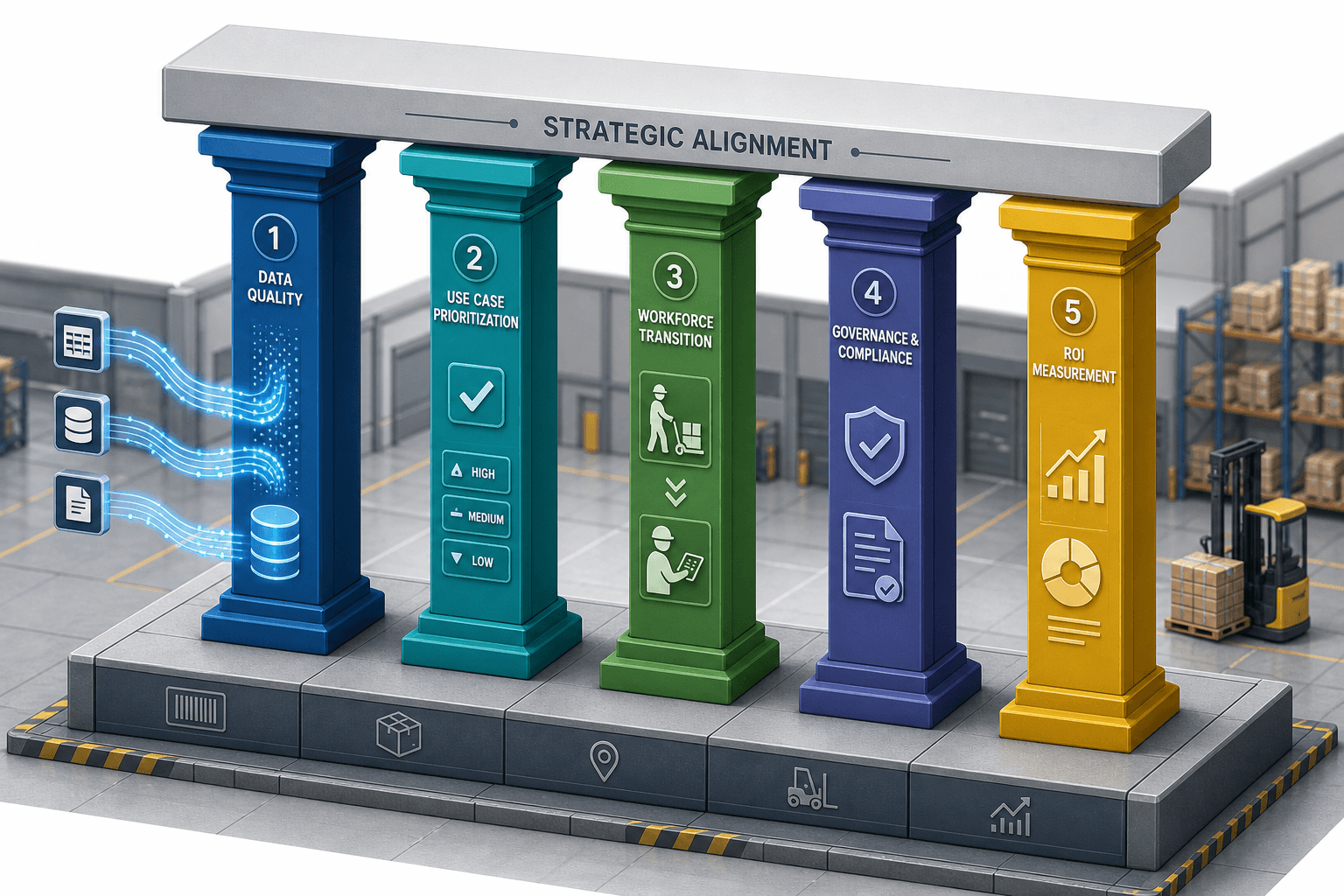
A warehouse AI strategy is not a technology roadmap. It is a set of interconnected decisions across five dimensions that must be developed in parallel. Neglecting any one dimension creates a bottleneck that prevents the others from delivering value.
- Data Quality — The foundational layer. AI models are only as reliable as the data they consume. Inconsistent SKU master data, inaccurate real-time inventory counts, and incomplete order histories produce models that look good in testing and fail in production.
- Use Case Prioritization — The sequencing decision. Not all warehouse AI use cases deliver equal ROI at equal complexity. Slotting optimization, labor forecasting, predictive maintenance, and computer vision for safety each have different data requirements, integration depths, and payback periods.
- Workforce Transition — The human dimension. AI changes what warehouse workers do, not whether they are needed. Over 50% of organizations grew their workforce after AI implementation, per Voxel AI's analysis of Mecalux/MIT collaboration data. The transition from manual execution to supervisory and exception-handling roles requires deliberate change management.
- Governance & Compliance — The trust layer. Algorithmic bias in labor forecasting, opaque decision-making in autonomous routing, and regulatory exposure under emerging AI rules all require structured governance. Without audit trails, human-in-the-loop design, and model drift monitoring, AI deployments create operational risk rather than reducing it.
- ROI Measurement — The accountability framework. The Deloitte finding that 85% of organizations increased AI investment but only 6% saw returns in under a year is not an argument against AI. It is an argument for setting realistic timelines — typically 2–4 years for satisfactory ROI — and tracking the right metrics: labor productivity, inventory accuracy, injury reduction, and throughput.
The following sections unpack each dimension with specific guidance for warehouse operators.
Dimension 1: Data Quality — The Foundational Barrier
Data quality is the most common reason warehouse AI initiatives stall. The problem is not that warehouses lack data — modern WMS platforms generate millions of transaction records daily. The problem is that the data is inconsistent, incomplete, or structured for reporting rather than for machine learning.
Consider what a warehouse AI model actually needs. A slotting optimization algorithm requires accurate product dimensions, velocity classifications, and order affinity patterns. A labor forecasting model needs historical shift-level productivity data, not daily aggregates. A predictive maintenance system needs sensor time-series data with consistent timestamps and clear failure event labels. Most warehouses have some of these data streams. Few have all of them in a usable state.
The data readiness prerequisites for warehouse AI include:
- SKU master cleanliness: Every active SKU must have accurate dimensions, weight, storage requirements, and velocity classification. Inactive or duplicate SKUs must be purged or flagged.
- Real-time inventory accuracy: Cycle count programs must achieve 95%+ accuracy before AI-driven replenishment or slotting can be trusted. Many warehouses operate at 80–85% and do not know it.
- Order history completeness: At least 12–24 months of order-level data with timestamps, pick paths, and exception flags. Aggregated daily summaries are insufficient for training models that need to learn temporal patterns.
- Labor data granularity: Shift-level productivity data by task type (receiving, putaway, picking, packing, shipping) with employee identifiers. Without this, labor forecasting models cannot distinguish between process inefficiency and individual performance variation.
- Equipment sensor data: For predictive maintenance, sensor logs must include consistent timestamps, error codes, and maintenance event labels. Many warehouses have sensor data but lack the labeled failure events needed to train supervised models.
Dimension 2: Use Case Prioritization — Sequencing for Maximum Impact
Warehouse AI encompasses a broad set of use cases, each with different data requirements, implementation complexity, and ROI profiles. The mistake most organizations make is pursuing too many use cases simultaneously or starting with the most technically interesting rather than the most strategically valuable.
A structured prioritization framework evaluates each use case on two axes: business impact and implementation feasibility. Business impact includes quantifiable metrics like labor productivity, throughput, inventory accuracy, and safety. Implementation feasibility considers data readiness, integration complexity, change management burden, and vendor ecosystem maturity.
| Use Case | Business Impact | Implementation Complexity | Typical Payback | Data Readiness Required |
|---|---|---|---|---|
| Computer vision for safety compliance | High (injury reduction, regulatory compliance) | Low-Medium | 6–12 months | Camera infrastructure, labeled incident data |
| Slotting optimization | High (throughput, travel time reduction) | Medium | 12–18 months | SKU master, order affinity data, velocity profiles |
| Labor forecasting | Medium-High (labor cost, service level) | Medium | 12–24 months | Shift-level productivity data, order volume history |
| Predictive maintenance | Medium (downtime reduction, equipment life) | Medium-High | 18–36 months | Sensor time-series, labeled failure events |
| Autonomous mobile robot (AMR) fleet optimization | High (throughput, labor substitution) | High | 2–3 years | Facility layout, traffic patterns, order profiles |
| Inventory demand forecasting at SKU-location level | Medium-High (stockout reduction, inventory turns) | High | 2–4 years | POS or order data, lead time data, promotion calendar |
The recommended sequencing for most warehouse operators is to start with computer vision for safety and slotting optimization. Both have relatively low data barriers, clear ROI metrics, and established vendor ecosystems. Safety use cases in particular have demonstrated rapid payback: Voxel AI reports that clients often achieve positive ROI within the first year, with documented outcomes including a 77% injury reduction at Americold and a 98% near-miss reduction at Vertical Cold Storage within six months.
For a more detailed decision framework on which warehouse AI use cases to sequence first, see our AI use case matrix for supply chain leaders, which provides a structured approach to investment sequencing based on measured ROI across multiple deployment contexts.
Dimension 3: Workforce Transition — Managing the Human Side of AI
The workforce dimension of warehouse AI strategy is the most underestimated. The dominant narrative — that AI will replace warehouse workers — is not supported by the data. Voxel AI's analysis of Mecalux/MIT collaboration data found that over 50% of organizations grew their workforce after AI implementation, and over 75% saw a rise in employee productivity and satisfaction. The real story is not job elimination but role transformation.
Warehouse AI shifts worker roles from manual execution to three new categories:
- Exception handlers: Workers who monitor AI-driven systems and intervene when the model encounters edge cases — a mis-scanned item, an unexpected product dimension, a safety rule violation that the computer vision system flags but cannot resolve.
- System supervisors: Workers who manage fleets of AMRs, monitor slotting optimization outputs, and adjust labor forecasts based on local knowledge that the model cannot capture — upcoming holidays, local events, manager judgment about team capacity.
- Continuous improvement analysts: Workers who use AI-generated data to identify process bottlenecks, training gaps, and layout inefficiencies. This role requires basic data literacy and the ability to translate model outputs into operational changes.
The challenge is that 72% of logistics employees have already adopted AI tools without organizational direction, per ActivTrak's 2025 study. These workers are using publicly available AI tools — ChatGPT for documentation, Copilot for spreadsheet analysis, automated scheduling tools — outside any governance framework. The strategy gap at the workforce level means organizations are not training workers on approved tools, not establishing boundaries for AI use, and not capturing the productivity gains that structured adoption would deliver.
Dimension 4: Governance & Compliance — Building Trust and Managing Risk
Warehouse AI governance is not an abstract compliance exercise. It addresses concrete operational risks that emerge when AI systems make or influence decisions that affect worker safety, labor allocation, inventory accuracy, and regulatory compliance.
The governance requirements for warehouse AI fall into four categories:
- Audit trails: Every AI-generated decision that affects operations — a slotting recommendation, a labor forecast adjustment, a safety alert escalation — must be logged with the model version, input data snapshot, confidence score, and human override record. Without audit trails, post-incident analysis is impossible.
- Human-in-the-loop design: High-stakes decisions — particularly those affecting worker safety or employment terms — must require human confirmation before execution. A labor forecasting model can recommend staffing levels, but a human manager should approve the final schedule. A computer vision system can flag a safety violation, but a human supervisor should determine the response.
- Model drift monitoring: Warehouse conditions change — product mix shifts, seasonal patterns emerge, new equipment is introduced. Models trained on historical data degrade over time. Organizations need automated monitoring that tracks prediction accuracy against actual outcomes and triggers retraining when performance drops below a threshold.
- Explainability requirements: When an AI system recommends a course of action — reduce safety stock for a SKU, reassign a worker to a different zone, flag an incident as high-risk — the rationale must be explainable to operators, managers, and regulators. Black-box models that produce accurate but uninterpretable outputs are difficult to govern and harder to defend in disputes.
The regulatory landscape for AI in warehouse operations is evolving rapidly. Emerging AI rules in the EU and proposed frameworks in other jurisdictions impose specific requirements on systems that make or inform decisions affecting workers. Organizations that establish governance frameworks now — rather than waiting for regulatory mandates — will have a significant compliance advantage.
Dimension 5: ROI Measurement — Setting Realistic Timelines and Metrics
The most dangerous ROI mistake in warehouse AI is expecting payback within the first year. Deloitte's 2025 survey found that while 85% of organizations increased AI investment, only 6% saw ROI in under a year. The majority achieve satisfactory returns within 2–4 years. This is not a failure of AI — it is a mismatch between investment timing and benefit realization.
Warehouse AI investments follow a characteristic J-curve: upfront costs for data remediation, integration, and change management; a period of flat or negative returns as the system learns and workers adapt; then accelerating returns as the model improves and processes stabilize. Organizations that abandon projects during the flat period — typically months 6–18 — never reach the acceleration phase.
| Metric | Baseline (Typical Warehouse) | AI-Enabled Target | Measurement Method | Typical Timeline to Impact |
|---|---|---|---|---|
| Labor productivity (units picked per hour) | 100–150 | 130–225 (30–50% improvement) | WMS time-stamped pick data | 6–18 months |
| Inventory accuracy | 85–92% | 95–99%+ | Cycle count variance | 12–24 months |
| Order fulfillment speed (hours from receipt to ship) | 24–48 | 14–29 (40% improvement) | Order lifecycle tracking | 6–18 months |
| Shipping cost per order | $5–8 | $3.75–6.80 (15–25% reduction) | Carrier invoice analysis | 12–24 months |
| Operational cost per unit | Baseline | Up to 30% reduction | Total cost accounting | 18–36 months |
| Warehouse injury rate (per 100 FTE) | 4.7 (BLS national average) | 1.1–2.4 (50–77% reduction) | OSHA recordable incident tracking | 6–12 months |
The key to managing ROI expectations is to define leading indicators — metrics that predict future financial returns — alongside lagging indicators. Leading indicators include model accuracy (forecast error rate, pick path optimization rate), system adoption rate (percentage of decisions made using AI recommendations), and data quality scores. Lagging indicators include labor productivity, inventory accuracy, and injury rates. If leading indicators are improving but lagging indicators are not, the problem is likely in the change management or integration layer, not in the AI model itself.
For a deeper treatment of warehouse AI ROI, including risk-adjusted payback calculations and sensitivity analysis, see our dedicated article on AI in warehouse management ROI: a risk-adjusted reality check for 2026. The strategic framework here is designed to create the conditions under which those ROI outcomes become achievable.
Building Your Warehouse AI Strategy in 90 Days: A Step-by-Step Action Plan
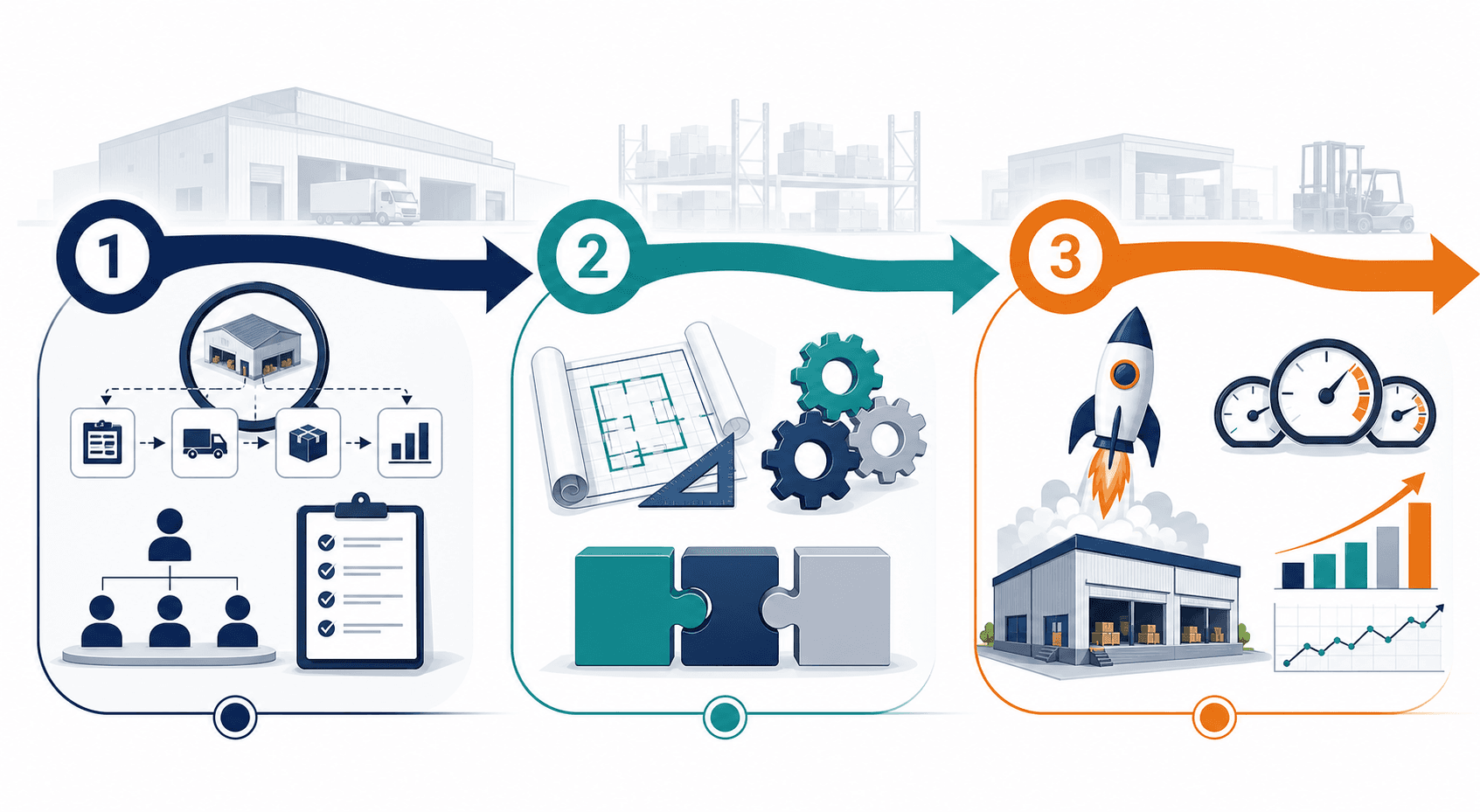
The following 90-day plan is designed to move an organization from the 77% without a formal strategy to the 23% that have one. Each phase has specific deliverables, not just activities.
Phase 1: Assess & Align (Days 1–30)
The goal of Phase 1 is to establish a baseline — where you are today across all five dimensions — and secure executive alignment on the strategy's scope and timeline.
- Data audit: Inventory every data source relevant to warehouse AI — WMS transaction logs, labor management system data, equipment sensor feeds, order history, SKU master. Score each source on completeness, accuracy, timeliness, and accessibility. Publish a data quality scorecard.
- Stakeholder alignment: Conduct structured interviews with warehouse managers, IT leaders, safety officers, and finance. Identify existing AI initiatives, shadow AI use, and resistance points. Document the current state of each of the five dimensions.
- Current state assessment: Score your organization on each dimension using a simple maturity scale (1 = ad hoc, 2 = defined, 3 = managed, 4 = optimized). Most organizations will score 1 or 2 on governance and ROI measurement, and 2 or 3 on data quality and workforce transition.
- Executive briefing: Present the assessment results, the 71-point strategy gap, and the 90-day plan. Secure explicit sponsorship for the strategy development process and a decision on which warehouse facilities will be included in the initial scope.
Phase 2: Design & Build (Days 31–60)
Phase 2 translates the assessment into a concrete strategy document with use case selection, vendor evaluation criteria, governance framework, and ROI targets.
- Use case selection: Apply the prioritization matrix to select 2–3 use cases for the initial wave. Document the rationale — why these use cases, why now, and what data and organizational prerequisites must be met before launch.
- Vendor evaluation: Develop a weighted scoring framework aligned with your use case priorities. Include criteria for data integration, model explainability, deployment model (SaaS vs. on-premise), and vendor governance capabilities. Shortlist 3–5 vendors per use case.
- Governance framework: Draft the governance policies — audit trail requirements, human-in-the-loop decision thresholds, model drift monitoring cadence, bias testing protocol, and incident response process. Assign ownership for each governance function.
- ROI model: Build a financial model with conservative, expected, and optimistic scenarios. Include upfront costs (data remediation, integration, training), ongoing costs (licensing, monitoring, retraining), and benefit timelines. Set the expected payback window at 2–4 years, with leading indicator targets at 6-month intervals.
- Pilot design: Define the pilot scope — which facility, which shift, which SKU categories, which metrics. Establish success criteria and a decision gate for moving from pilot to limited production.
Phase 3: Launch & Measure (Days 61–90)
Phase 3 launches the pilot, establishes measurement cadences, and creates the feedback loops that will inform the scaling plan.
- Pilot execution: Deploy the selected AI solution in the pilot facility with full monitoring. Document all integration issues, data quality problems, and workforce adoption challenges in real time — do not wait for the post-mortem.
- KPI tracking: Establish a weekly review cadence for leading indicators (model accuracy, system adoption rate, data quality scores) and a monthly review for lagging indicators (labor productivity, inventory accuracy, safety incidents). Publish a dashboard accessible to all stakeholders.
- Feedback loops: Create structured channels for warehouse workers and supervisors to report model errors, usability issues, and improvement suggestions. Every piece of feedback should be logged, triaged, and responded to within the review cadence.
- Scaling plan: Based on pilot results, develop a phased scaling plan that sequences additional facilities, use cases, and data sources. Include updated cost estimates, resource requirements, and timeline adjustments. Present the scaling plan to executive sponsors with a recommendation to proceed, pivot, or pause.
| Phase | Duration | Key Deliverables | Success Criteria |
|---|---|---|---|
| Assess & Align | Days 1–30 | Data quality scorecard, stakeholder alignment document, current state assessment, executive sponsorship commitment | Executive sign-off on strategy scope and timeline |
| Design & Build | Days 31–60 | Use case selection document, vendor evaluation framework, governance policies, ROI model, pilot design | Approved strategy document with resource allocation |
| Launch & Measure | Days 61–90 | Pilot deployment, KPI dashboard, feedback loop infrastructure, scaling plan | Pilot meeting success criteria; scaling recommendation approved |
Case in Point: How NSG Group Scaled from One Pilot to 10 Countries
The NSG Group's experience with AI-powered safety monitoring illustrates how structured measurement and governance enable scaling from a single warehouse pilot to enterprise-wide deployment. NSG Group, a global glass manufacturer, deployed Voxel AI's computer vision platform in one warehouse to address safety compliance. The results in the first 30 days: safety vest incidents reduced by 62%. Between Q3 and Q4 2024, improper bends — a key ergonomic risk factor — dropped by 57%. Pedestrian zone violations fell by 79% within three months.
What distinguished NSG Group's approach was not the technology but the strategy behind it. The organization established clear measurement criteria before deployment, defined human-in-the-loop protocols for safety alerts, and created a governance structure that allowed rapid scaling once the pilot demonstrated results. Within months, the deployment expanded from one warehouse to facilities across 10 countries.
The NSG Group example demonstrates the pattern that the five-dimension framework is designed to produce: start with a bounded, measurable use case; establish governance and measurement before deployment; use pilot results to build the case for scaling; and expand systematically rather than opportunistically. This is the opposite of the 77% of organizations that deploy AI without a formal strategy and then struggle to move beyond isolated pilots.
Conclusion: The Strategy Gap Is Closing — Will You Be on the Right Side?
The 71-point gap between AI deployment intent and formal strategy is not a permanent condition. It is a window of opportunity. The organizations that close this gap in 2026 — that build the data foundations, sequence their use cases, manage workforce transitions, establish governance, and set realistic ROI timelines — will be the AI-mature minority that Accenture found to be 23% more profitable and six times as likely to use AI widely. The organizations that continue to deploy AI without strategy will find themselves with underperforming assets, stalled pilots, and a growing competitive deficit.
The five-dimension framework and 90-day action plan in this article provide a structured path from the 77% to the 23%. The work is not easy — data remediation, workforce transition, and governance design are hard organizational problems that technology alone cannot solve. But the alternative — continuing to deploy AI without strategy — is more expensive in the long run.
The strategy gap is closing. The question is which side of it your warehouse operations will be on.
Comments
Join the discussion with an anonymous comment.