
What Separates Proven AI Deployments From Experimental Ones
The logistics industry has passed the point where AI is a speculative investment. The global AI in logistics and supply chain market was valued at USD 20.1 billion in 2024 and is projected to grow at a 25.9% CAGR to USD 196.58 billion by 2034, according to GM Insights. But that headline growth masks a critical distinction: some AI deployments produce measurable, auditable returns within months, while others stall in pilot purgatory or fail to scale.
A December 2025 retrospective by Logistics Viewpoints identified five areas where AI underperformed in 2025: fully autonomous forecasting (human judgment remained essential), AI-driven carrier selection (data inconsistencies limited accuracy), autonomous warehouse operations (too many edge cases), chatbots for customer service (unreliable without strict retrieval control), and generative AI for operational decision-making (lacked grounding when data inputs were incomplete). The common thread across these failures is scope creep — attempting to automate broad, ambiguous processes rather than narrow, well-defined operational bottlenecks.
The deployments that delivered in 2025 — and those scaling in 2026 — share a consistent pattern: they target a specific, measurable operational metric; they are deployed first in a controlled environment with clean data; and they are tightly integrated with existing TMS, WMS, or ERP workflows rather than operating as standalone systems. This article documents 10 such deployments across three logistics layers — transport, warehouse, and orchestration — with specific quantified outcomes that operations directors and supply chain VPs can use to build internal business cases.
Transport Layer: Route Optimization and Fleet Efficiency
Transport is the logistics layer with the deepest bench of documented AI deployments, largely because the operational problem is well-bounded: move goods from point A to point B at minimum cost while meeting service constraints. Route optimization algorithms have been studied for decades, but the shift from deterministic to machine-learning-driven routing — where models learn from historical traffic patterns, weather data, and delivery density — has produced step-change improvements in the last three years.
DHL European Parcel Network: 14% Distance Reduction, EUR 180M Annual Fuel Savings
DHL's European parcel network processes 2.3 million delivery stops daily across 14 countries. In 2024, the company deployed an AI-optimized routing system across this entire network, replacing a rules-based routing engine that had been incrementally modified over two decades. The results, reported in the DHL Sustainability Report 2025, are among the most compelling in the industry: a 14% reduction in total distance driven, EUR 180 million in annual fuel savings, and 127,000 tonnes of CO2 reduction.
The implementation spanned 18 months across the full network, but the company achieved positive ROI after just four months in the first deployment region. This rapid payback is consistent with broader industry benchmarks: route optimization on a 500-vehicle fleet typically requires an investment of EUR 80,000 to 150,000 and generates EUR 1.5 million to 3 million in annual savings, yielding a 2- to 4-month payback period and 800–1,200% three-year ROI, according to Gartner's Supply Chain Technology Report 2025 and McKinsey's The State of AI in Supply Chain 2025.
Uber Freight: Cutting Empty Miles From 30% to 10–15% With ML Routing
Empty miles — the distance trucks travel without a load — represent one of the largest inefficiencies in freight transportation. In the United States, trucks run empty approximately 30% of the time on average, according to industry data cited by MIT Sloan. Uber Freight applied machine learning to this problem by algorithmically designing optimal routes that pair backhauls with forward loads, reducing empty miles to between 10% and 15%.
Chris Caplice, executive director of the MIT Center for Transportation and Logistics, has noted that Uber Freight's approach combines traditional AI, generative AI, and operations research to improve routing outcomes. The key insight is that the problem is not purely algorithmic — it requires integrating real-time market data, carrier preferences, and shipper requirements into a single optimization framework. This hybrid approach, where AI augments rather than replaces human dispatchers, is a recurring pattern across successful logistics AI deployments.
For a broader discussion of how AI is transforming transportation management systems — including route optimization, last-mile delivery, and predictive freight rate analytics — see the ChainSignal use-case page: AI in TMS: Route Optimization, Last-Mile Delivery, and Predictive Freight Rate Analytics.
Warehouse Layer: Automated Operations and Parcel Allocation
Warehouse AI deployments face a different set of constraints than transport-layer systems. The physical environment introduces edge cases — irregular package shapes, conveyor jams, inventory discrepancies — that pure software models struggle to handle. The most successful warehouse AI deployments are those that tightly couple machine learning with physical automation and human oversight, rather than attempting full autonomy.
InPost Poland: 41% Reduction in Locker Overflow, 23% Faster Collection
InPost operates 22,000+ parcel lockers across Poland, making it one of the densest automated parcel machine networks in Europe. The company deployed an AI-driven allocation system that determines which locker to assign each parcel to, based on predicted collection patterns, locker capacity, and neighborhood delivery density. The results, reported in the InPost Annual Report 2025, are striking: a 41% reduction in locker overflow events, 23% faster customer collection times, and a 34% reduction in misrouted parcels.
The key architectural decision was that InPost did not attempt to build a fully autonomous allocation system. Instead, the AI model generates recommendations that human dispatchers can override based on local knowledge — a human-in-the-loop design that acknowledges the limitations of pure algorithmic allocation in a system with thousands of physical endpoints and unpredictable human behavior patterns.
Ocado: AI-Powered Robots Handling 50,000+ Orders Per Week
Ocado's fully automated warehouses represent the most ambitious deployment of AI-powered robotics in grocery fulfillment. The company's system uses a grid of thousands of robots that move along a three-dimensional framework, picking and sorting grocery items for customer orders. According to Unframe AI, these warehouses handle over 50,000 orders per week using AI-powered robots.
What makes Ocado's deployment notable is not just the scale — it is the integration of multiple AI techniques. Computer vision systems verify item picks, reinforcement learning algorithms optimize robot routing across the grid, and demand forecasting models determine inventory placement within the warehouse to minimize travel time. This multi-model architecture, where different AI systems handle different sub-problems within a single operational context, is increasingly the standard for advanced warehouse automation.
| Metric | InPost Poland | Ocado |
|---|---|---|
| Primary AI function | Parcel-to-locker allocation optimization | Multi-robot coordination and item picking |
| Scale of operation | 22,000+ lockers across Poland | 50,000+ orders per week per warehouse |
| Key outcome 1 | 41% reduction in locker overflow events | Automated handling of complex grocery orders |
| Key outcome 2 | 23% faster customer collection times | Optimized robot routing across 3D grid |
| Key outcome 3 | 34% reduction in misrouted parcels | Computer vision verification of picks |
| Human-in-the-loop? | Yes — dispatchers can override AI recommendations | Limited — exception handling for edge cases |
| Source | InPost Annual Report 2025 | Unframe AI (vendor blog) |
Orchestration Layer: Customs, Visibility, and Digital Twins
The orchestration layer — encompassing customs classification, supply chain visibility, and digital twin simulation — represents the most complex AI deployment environment. These systems must integrate data from multiple upstream and downstream systems, handle regulatory variability across jurisdictions, and provide decision support under uncertainty. The deployments that succeed in this layer are those that narrow the scope to a specific, high-volume, high-error-rate process.
Kuehne+Nagel Customs AI: 2.1M Declarations/Year, 61% Error Reduction
Kuehne+Nagel's AI customs classification system processes 2.1 million declarations annually across 43 countries. The system uses machine learning to classify goods according to harmonized system codes — a notoriously error-prone manual process that varies by country and product category. According to the Kuehne+Nagel Digital Logistics Report 2025, the AI system achieved a 61% reduction in classification errors and a 72% reduction in document processing time.
The deployment's success hinges on a narrow, well-defined scope: customs classification is a bounded problem with clear input-output mappings (product description to HS code), a large historical dataset for training, and measurable error rates. Kuehne+Nagel did not attempt to build a general-purpose AI for logistics operations — they targeted a specific, high-volume, high-cost-error process and deployed AI where the data and problem structure supported it.
FourKites Fin AI: 3M+ Shipments Tracked Daily Across 6,000+ Data Points
FourKites' Fin AI is a natural language interface that automates supply chain visibility tasks. According to Built In (updated February 2026), the system tracks over 3 million shipments per day across more than 6,000 data points and 18 million estimated time of arrival (ETA) calculations. The scale of data integration required — pulling from carrier systems, telematics providers, weather services, and port operating systems — makes this one of the most ambitious visibility-layer AI deployments in production.
Fin AI's natural language interface allows supply chain managers to query shipment status, predicted delays, and alternative routing options using conversational language rather than navigating complex dashboards. This reduces the cognitive load on operations teams and allows them to focus on exception handling rather than data gathering.
FedEx Supply Chain Digital Twin: 14 Million Scenarios Simulated Daily
FedEx operates one of the most sophisticated supply chain digital twins in the logistics industry. According to the FedEx Technology Report 2025, the system simulates 14 million scenarios daily to anticipate disruptions — ranging from weather events and port congestion to labor shortages and equipment failures. The digital twin allows FedEx to run "what-if" analyses on routing, capacity allocation, and contingency planning without disrupting live operations.
The key architectural insight from FedEx's deployment is that the digital twin does not replace human decision-making — it augments it by surfacing the most likely disruption scenarios and their operational implications. Human planners review the simulation outputs and make the final decisions, using the AI's scenario analysis as decision support rather than as an autonomous planning system.
| Metric | Kuehne+Nagel | FourKites | FedEx |
|---|---|---|---|
| Primary AI function | Customs classification (HS code assignment) | Supply chain visibility and ETA prediction | Disruption simulation and scenario analysis |
| Scale of operation | 2.1M declarations/year across 43 countries | 3M+ shipments/day, 18M ETAs | 14M scenarios simulated daily |
| Key outcome 1 | 61% reduction in classification errors | Natural language interface for querying shipment status | Anticipation of weather, congestion, and labor disruptions |
| Key outcome 2 | 72% reduction in document processing time | 6,000+ data points integrated per shipment | What-if analysis without disrupting live operations |
| Human-in-the-loop? | Yes — AI recommends codes, humans verify | Yes — managers query system, review exceptions | Yes — planners review simulation outputs |
| Source | Kuehne+Nagel Digital Logistics Report 2025 | Built In (Feb 2026) | FedEx Technology Report 2025 |
What These Deployments Share: Data, Integration, and Change Management
Across all 10 deployments — from DHL's route optimization to FedEx's digital twin — three common prerequisites emerge. These are not optional; every deployment that failed to address them either stalled in pilot or produced results below expectations.
Data Prerequisites by Layer
- Transport layer: Requires clean, structured historical route data with timestamps, distances, fuel consumption, and delivery outcomes. DHL's 18-month implementation timeline was driven primarily by data cleaning and normalization across 14 countries with different data standards.
- Warehouse layer: Requires real-time inventory data, parcel dimension data, and historical collection patterns. InPost's 34% reduction in misrouted parcels came only after a full process redesign that standardized data capture at every locker.
- Orchestration layer: Requires integration with customs databases, carrier APIs, weather services, and port operating systems. Kuehne+Nagel's 72% faster processing time was enabled by pre-integrating 43 countries' customs classification databases into a single training corpus.
Integration Architecture Patterns
Every successful deployment in this article uses a tight-coupling integration pattern — the AI system is embedded within the existing TMS, WMS, or ERP workflow rather than operating as a standalone application. DHL's routing AI feeds directly into the dispatch system. InPost's allocation AI writes recommendations into the locker management interface. Kuehne+Nagel's customs AI is integrated into the declaration submission pipeline. Standalone AI systems that require manual data export and import consistently underperform.
Change Management Approaches
The most consistent pattern across all deployments is the pilot-first, controlled-environment approach. DHL deployed in one region first, achieved positive ROI in four months, then scaled. InPost tested the allocation AI in a subset of lockers before rolling out to the full network. FedEx's digital twin was initially used for post-hoc analysis before being trusted for real-time scenario simulation.
This approach directly addresses the most common failure mode in supply chain AI: attempting to scale before validating. According to Deloitte's 2025 survey, only 6% of organizations saw AI ROI in under one year, while most achieve satisfactory ROI within 2–4 years. The companies that see faster returns are those that start narrow, validate rigorously, and scale methodically.
Building the Business Case: Portfolio Economics Beat Individual ROI
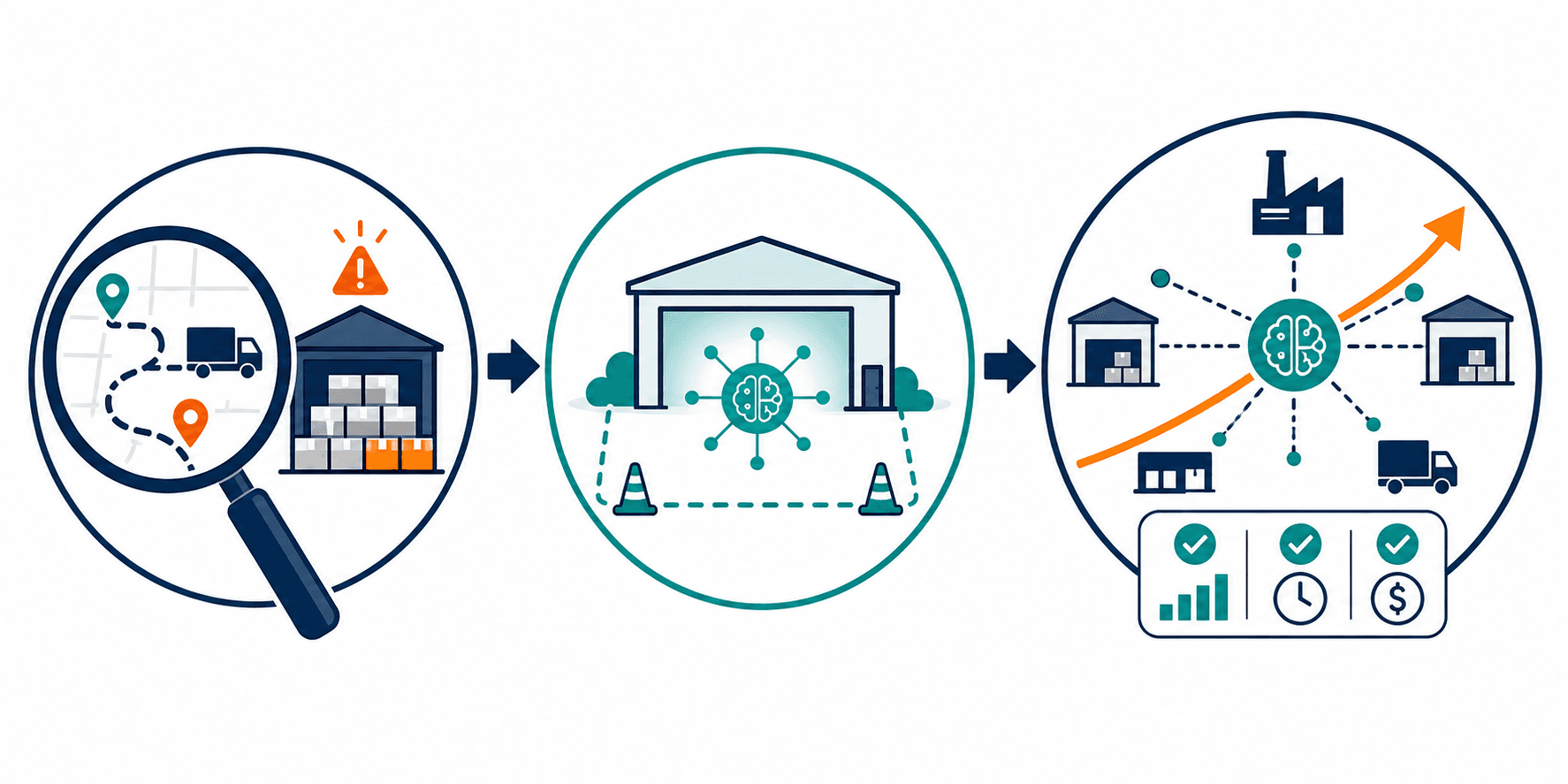
One of the most common mistakes in AI logistics investment is evaluating each use case in isolation. Individual business cases for route optimization, warehouse automation, or customs classification may each show positive ROI, but the combined economics are significantly stronger when infrastructure costs are shared across a portfolio of use cases.
According to data from The Thinking Company's 2026 guide, allocating infrastructure costs across a portfolio of use cases improves combined ROI by 40–60% versus individual business cases. This portfolio effect occurs because the same data pipeline, integration layer, and model monitoring infrastructure can serve multiple AI applications. A company that deploys route optimization and warehouse picking AI on the same data platform will see higher combined returns than two separate deployments on separate infrastructure.
The portfolio economics argument is particularly compelling for mid-market 3PLs. The average mid-market 3PL operates on 4–7% net margins, according to the European Logistics Association's 2025 Industry Report. A 2–3% total cost reduction through AI translates to a 30–75% margin improvement — a level of impact that is difficult to achieve through any single operational improvement initiative.
| Use Case | Typical Investment | Annual Savings | Payback Period | 3-Year ROI |
|---|---|---|---|---|
| Route optimization (500-vehicle fleet) | EUR 80K–150K | EUR 1.5M–3M | 2–4 months | 800–1,200% |
| Warehouse picking AI | EUR 50K–100K | EUR 200K–500K | 4–8 months | 250–400% |
| Mid-market 3PL portfolio (combined) | EUR 150K–300K | EUR 2M–5M | 3–6 months | 500–900% |
For a related discussion of how to build a disciplined AI adoption sequence — including how to avoid the pilot trap and structure portfolio-level business cases — see the ChainSignal article: The Business Case for AI in Procurement: ROI Data, the Pilot Trap, and a Disciplined Adoption Sequence. The portfolio economics framework described there applies directly to logistics AI investments as well.
The 10 deployments documented in this article demonstrate that AI in logistics is not a speculative technology — it is a proven operational tool when applied to narrow, well-defined problems with clean data, tight integration, and methodical scaling. The companies that are seeing the strongest returns — DHL, Uber Freight, InPost, Ocado, Kuehne+Nagel, FourKites, and FedEx — all followed the same pattern: identify a specific operational bottleneck, deploy AI in a controlled environment, validate the economics, and scale only after proving the model works in production.
As the AI in logistics market grows from USD 20.1 billion in 2024 to a projected USD 196.58 billion by 2034, the gap between companies that follow this pattern and those that attempt broad, unfocused AI deployments will only widen. The evidence is clear: narrow scope, tight integration, and portfolio economics are the defining characteristics of AI logistics deployments that deliver measurable, auditable returns.
Comments
Join the discussion with an anonymous comment.