
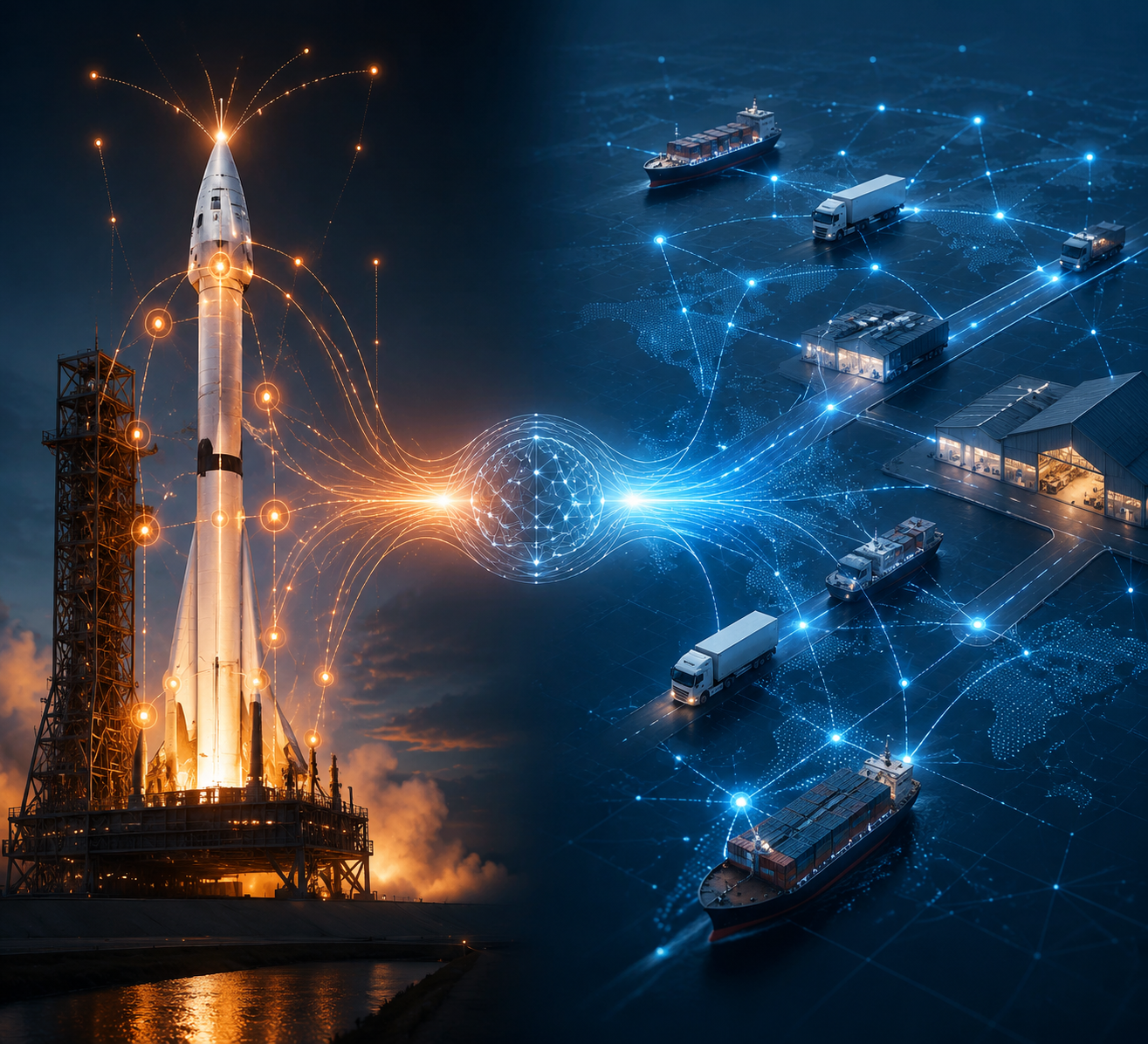
The useful question behind applying AI to rocket launch abort safety systems is not whether a supply chain should behave like a rocket. It should not. The useful question is narrower and more demanding: when many imperfect signals arrive under time pressure, what does a serious safety culture do before it lets software escalate, hold, or act?
That question is familiar to anyone who has watched a control tower drown in late shipment notices, carrier pings, weather alerts, supplier emails, warehouse scans, and inventory exceptions. The cost of waiting rises, but the cost of acting on a bad signal is not free either. Aerospace has spent decades making that tension explicit. Supply chain AI can borrow from that discipline, provided it does not borrow the mythology.
The sensor fusion lesson is real, but not magical
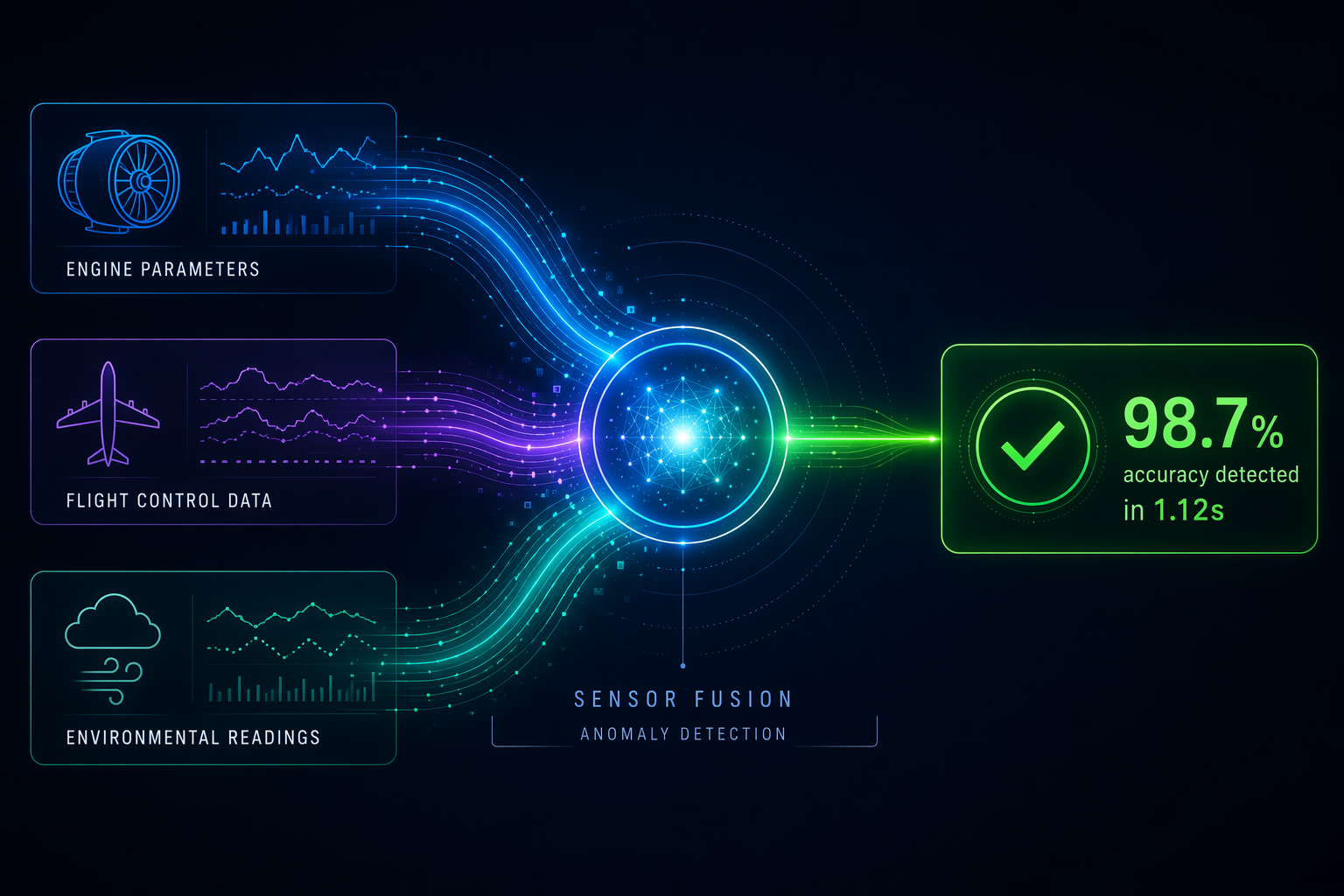
The strongest evidence in this comparison comes from a 2024 study on rocket engine anomaly detection. The researchers fused three engine parameters with five flight-control parameters using a convex-optimized information fusion method. In their simulated environment, the method reached 98.7% anomaly detection accuracy, detected anomalies in 1.12 seconds, and improved accuracy by 17.7% compared with single-parameter methods.[1]
Those numbers deserve attention because they measure an operational improvement, not just a model leaderboard. The system did not treat one parameter as the truth. It combined engine and flight-control signals so the abnormal state became clearer than it would have been from any single stream. That is exactly the kind of move supply chain risk monitoring keeps promising and often fails to deliver.
The caveat matters just as much as the benchmark. The rocket study used a simulated environment with Monte Carlo sampling across 25 simulation runs, including 20 test runs and 5 training runs. The authors identified the simulated setup as a limitation, so the result should be read as research-stage evidence rather than proof of deployed flight performance.[1]
For supply chains, the practical translation is not “copy rocket AI.” It is this: stop asking one feed to carry the burden of truth. A port delay notice, a vessel ETA shift, a flood forecast, a supplier quality score, and a warehouse scan may each be weak evidence alone. Fused well, they can change the timing and confidence of an intervention.
That is where modern control tower design becomes more than a dashboard exercise. The better pattern is a fusion layer that treats operational events, physical constraints, and external risk signals as related evidence. Visibility matters, but the hard work starts when the system must decide whether to ignore the noise, ask a planner to review, or trigger a constrained response. That distinction is also why the difference between control tower AI features and a visibility-only dashboard is not cosmetic.
| Aerospace pattern | Supply chain translation | Boundary |
|---|---|---|
| Fuse engine and flight-control parameters before judging an anomaly | Fuse orders, ETAs, inventory, supplier, asset, and weather signals before escalating a disruption | Supply chain feeds are less standardized and often arrive late or incomplete |
| Detect abnormal states fast enough to preserve decision time | Detect risk early enough to reroute, expedite, allocate, or resequence | Not every supply chain event needs second-level response |
| Separate anomaly detection from termination logic | Separate risk scoring from autonomous execution | Operator accountability must remain explicit |
One anomaly model will not see every failure
NASA’s work on Space Shuttle Main Engine anomaly detection is useful because it is refreshingly unsentimental about model choice. Researchers investigated four unsupervised machine learning methods: Orca, GritBot, IMS, and one-class SVM. The important finding was not that one method won. It was that no single algorithm detected all failure types; different algorithms detected different anomalies.[2]

That finding maps cleanly to supply chain monitoring. Supplier deterioration, transport exceptions, warehouse equipment drift, demand shocks, customs risk, vessel route deviation, and weather exposure do not fail in the same shape. A model tuned to find unusual transit behavior may miss a slow supplier quality decline. A model watching inventory balances may not understand why a route deviation near a piracy-prone corridor deserves attention. A model built for asset-health telemetry may be irrelevant to supplier communication risk.
The supply chain answer is not to buy four models because NASA tested four models. The answer is to stop treating anomaly detection as a single scoring function. A serious design lets different detectors specialize, then manages their disagreement. One detector may flag statistical distance from normal behavior. Another may compare an event sequence with known failure patterns. Another may look for combinations that rarely occur together. The control tower’s job is then to decide which combinations of alerts deserve human review, which deserve automated containment, and which deserve suppression.
This is especially relevant for external risk monitoring. Piracy warnings, flood forecasts, and hurricane paths are not the same kind of data as purchase order milestones. They arrive with different confidence levels and time horizons. Treating them as one generic “risk score” strips away the information that makes them operationally useful. The stronger approach is to let specialized systems detect route anomalies, weather exposure, and facility vulnerability, then fuse those outputs into decisions a planner can actually use. That is the bridge between real-time anomaly detection in pirate hijacking prevention, predictive flood monitoring, and hurricane planning.
The scaling problem is also getting harder. A 2026 hybrid CNN-LSTM-GRU launch vehicle study describes anomaly detection across more than 1,500 launch vehicle telemetry parameters and more than 2,000 checkout parameters at the same time.[3] The public material does not justify claims about all implementation details, but the direction is clear enough: multi-sensor environments are outgrowing simple thresholding, and deep learning architectures are being tested against that complexity.
Supply chains have their own version of this scale problem, though with dirtier inputs. A manufacturer may have thousands of SKUs, hundreds of suppliers, multiple transport modes, regional weather exposure, plant constraints, inventory policies, and customer penalties. The volume is large, but the data is not launch telemetry. It is frequently sparse, vendor-formatted, manually corrected, and semantically inconsistent. The lesson from aerospace is not that deep learning solves this automatically. It is that complexity should be handled through architecture, validation, and model diversity rather than one grand dashboard score.
Autonomy starts with rules, validation, and uncomfortable accountability
Launch termination is where loose language becomes dangerous. Deployed autonomous flight termination systems are not evidence that certified machine learning is making abort decisions in flight. The prominent real-world systems are rule-based. They compare the vehicle’s state against predefined safety envelopes and initiate termination when those rules are violated.
SpaceX’s Falcon 9 launch on February 19, 2017, was reported as the first fully autonomous flight termination system in U.S. launch history.[4] Rocket Lab later announced that its Autonomous Flight Termination System moved termination logic onboard and eliminated the human-in-the-loop termination role after four shadow-mode validation flights.[5] The discipline in the Rocket Lab example is not the word “autonomous.” It is the validation path: run the autonomous system in shadow mode, compare its decisions against the existing safety process, and only then remove the human operator from that specific loop.
That pattern is more useful to supply chain teams than the dramatic idea of an automated abort. A control tower should not begin by allowing AI to cancel purchase orders, reroute freight, or allocate scarce inventory just because it can detect an anomaly. It can begin with shadow-mode recommendations. Would the model have escalated the same supplier risk the planner escalated? Would it have rerouted around the same storm exposure? Would it have suppressed alerts that analysts repeatedly dismissed? Only after that comparison is visible should the organization decide which actions can become semi-autonomous.
This is also where hardware heritage offers a useful kind of humility. L3Harris describes its RCC-319-certified Autonomous Flight Termination Unit as using M-code GPS and fault-tolerant redundant initiation circuits, and states that its flight termination hardware heritage has had zero operational failures across more than 60 years.[6] That is not a supply chain software benchmark. It is a reminder that autonomy in safety-critical settings is wrapped in redundancy, certification, and failure-mode discipline.
Supply chain AI usually receives the language of autonomy without the surrounding rigor. A recommendation engine is called an agent. A dashboard action is called orchestration. A rule fires and someone calls it intelligent. The aerospace comparison makes those shortcuts harder to defend. If an automated decision can increase cost, disrupt a customer promise, shift scarce material away from one plant, or bury a planner in false exceptions, it needs an explicit operating envelope.
Learning-based abort logic is still a frontier, not a certified template
There is serious research on learning-based abort and fault-tolerant ascent control. Texas A&M’s Vehicle Systems & Control Laboratory describes NASA JSC-funded Adaptive-Reinforcement Learning Control that combines fault-tolerant adaptive model inversion with reinforcement learning to learn safe abort handling for non-nominal ascent scenarios without requiring an explicit fault detection scheme.[7] That is a meaningful research direction. It is not the same thing as saying certified launch vehicles are letting neural networks decide termination.
The distinction matters for supply chains because control tower buyers are often sold the endpoint before the evidence exists. Machine learning can improve detection. It can rank possible interventions. It can identify unusual combinations of signals that a planner might miss. But moving from detection to decision changes the accountability problem. If the system flags a likely shortage, the planner can review it. If the system reallocates inventory away from a lower-priority customer, someone owns that tradeoff. If it expedites freight on a false positive, the cost is real even when the warehouse never goes down.
This is why the most transferable aerospace practice is not full automation. It is separation of functions. Detection asks, “Is this state abnormal?” Diagnosis asks, “What is probably causing it?” Decision asks, “What action is permitted?” Execution asks, “Who or what carries it out?” Audit asks, “Can we explain why it happened?” A control tower that collapses those layers into one AI confidence score has not become intelligent. It has just made accountability harder to find.
There are supply chain situations where limited autonomy makes sense. A system can automatically enrich a supplier alert with open orders, alternate sources, and current inventory. It can hold a replenishment recommendation for review when weather risk crosses a defined threshold. It can create a draft reroute option when a shipment enters a high-risk corridor. It can suppress duplicate alerts that add no new evidence. These are not glamorous actions, but they protect the analyst from brittle automation while still reducing delay.
The false-positive problem is different on the ground
Aerospace and supply chain operations both care about false positives, but not in the same way. A false flight termination can destroy a vehicle. A false supply chain alert usually destroys something quieter: planner trust, working time, budget discipline, or confidence in the next recommendation. Those consequences are not equivalent, but they are operationally serious.
This changes the adoption path. In launch safety, the acceptable decision envelope is narrow and formal. In supply chains, the decision envelope is often negotiated across procurement, logistics, manufacturing, finance, and customer service. One team may prefer early escalation because premium freight is cheaper than a line-down event. Another may reject the same alert because it creates churn in a constrained warehouse. A useful AI system must expose that tradeoff rather than hide it behind a risk color.
Weather planning shows the point well. A flood signal may be weak days before impact, stronger as forecasts converge, and operationally urgent only when paired with supplier location, inventory coverage, lane exposure, and customer demand. The same is true for hurricane planning, where the response window matters as much as the forecast itself. Supply chain AI becomes useful when it connects those signals to decisions, not when it merely announces that risk exists. That is the practical boundary between flood disruption planning and hurricane disruption planning as operational systems rather than alert feeds.
The market is moving in this direction outside launch safety as well. AI-enabled predictive maintenance in aerospace is projected to grow from $1.3 billion in 2026 to $4.4 billion in 2034.[8] That projection does not prove effectiveness for supply chains, and it should not be treated as evidence that every predictive maintenance model works. It does show that aerospace health monitoring techniques are becoming commercially important beyond isolated research programs.
What supply chain teams can actually borrow
The useful borrowing is architectural. Supply chain teams should fuse heterogeneous signals before escalation, validate multiple detectors against different failure patterns, and keep decision authority explicit. They should be more skeptical of single-score risk engines and more interested in how the system behaves after the alert fires.
- Use sensor fusion as an operating principle: combine internal milestones, external risk, physical constraints, and asset signals before judging disruption severity.
- Run different anomaly detectors in parallel when the failure modes differ; supplier risk, transport deviation, inventory distortion, and equipment drift do not need the same model.
- Separate detection from action; a high-confidence anomaly is not automatically permission to reroute freight, reallocate inventory, or change a production sequence.
- Validate autonomy in shadow mode before allowing execution; compare recommendations with planner decisions and measure both missed risks and unnecessary escalations.
- Define false-positive tolerance by decision type; creating a work item, holding a recommendation, expediting freight, and changing customer allocation carry different costs.
This also explains why execution-capable control towers are a different category from visibility tools. A visibility-only tower can display fused signals and still leave every hard decision to a human queue. An execution-capable tower must define where automation is allowed, where a human must approve, and where the system should stay silent. That distinction is central to the ROI debate around control tower models, because intelligence without decision design usually becomes another alert stream.
Aerospace does not give supply chain teams a ready-made abort system. It gives them a mature reference for fusing signals, testing more than one anomaly detector, validating autonomous behavior before deployment, and refusing to confuse research-stage learning systems with certified rule-based control. The transfer works only when data quality, false-positive tolerance, and human accountability are made explicit before autonomy is allowed to act.
References
- Anomaly Detection Method for Rocket Engines Based on Convex Optimized Information Fusion, Sensors, 2024
- NASA successfully researchers detection of anomalies in rocket propulsion using machine learning, Best Practice AI
- Anomaly detection in launch vehicle telemetry using hybrid CNN-LSTM-GRU framework, Innovations in Systems and Software Engineering, June 2026
- SpaceX Launch Pioneered Autonomous Termination System, Air & Space Forces Magazine, 2017
- Rocket Lab Debuts Fully Autonomous Flight Termination System, Rocket Lab, December 2019
- Autonomous Flight Termination Unit (AFTU), L3Harris
- Fault and Abort Tolerant Intelligent Ascent Control for Launch Vehicles, Texas A&M Vehicle Systems & Control Laboratory
- AI-enabled Predictive Maintenance in Aerospace Market, Fortune Business Insights
Comments
Join the discussion with an anonymous comment.