
Pirate hijacking is again a live operating risk for maritime supply chains, not a legacy scenario reserved for security tabletop exercises. The IMB recorded 137 piracy and armed robbery incidents globally in 2025, with the Singapore Straits accounting for 80 incidents, or 58% of the total.[1] In the Somali Basin and Gulf of Aden, reporting through mid-2026 points to a different but equally uncomfortable pattern: more than 17 incidents since January, at least three commercial vessel hijackings, and a UKMTO threat level raised to “severe” on April 30, 2026.[2]
That is the environment in which AI maritime security decisions for pirate hijacking risk are now being made. The question is not whether AI can produce a cleaner dashboard. It is whether it can give a master, company security officer, naval coordination cell, or insurer earlier and more reliable warning before a suspicious approach becomes a boarding attempt.
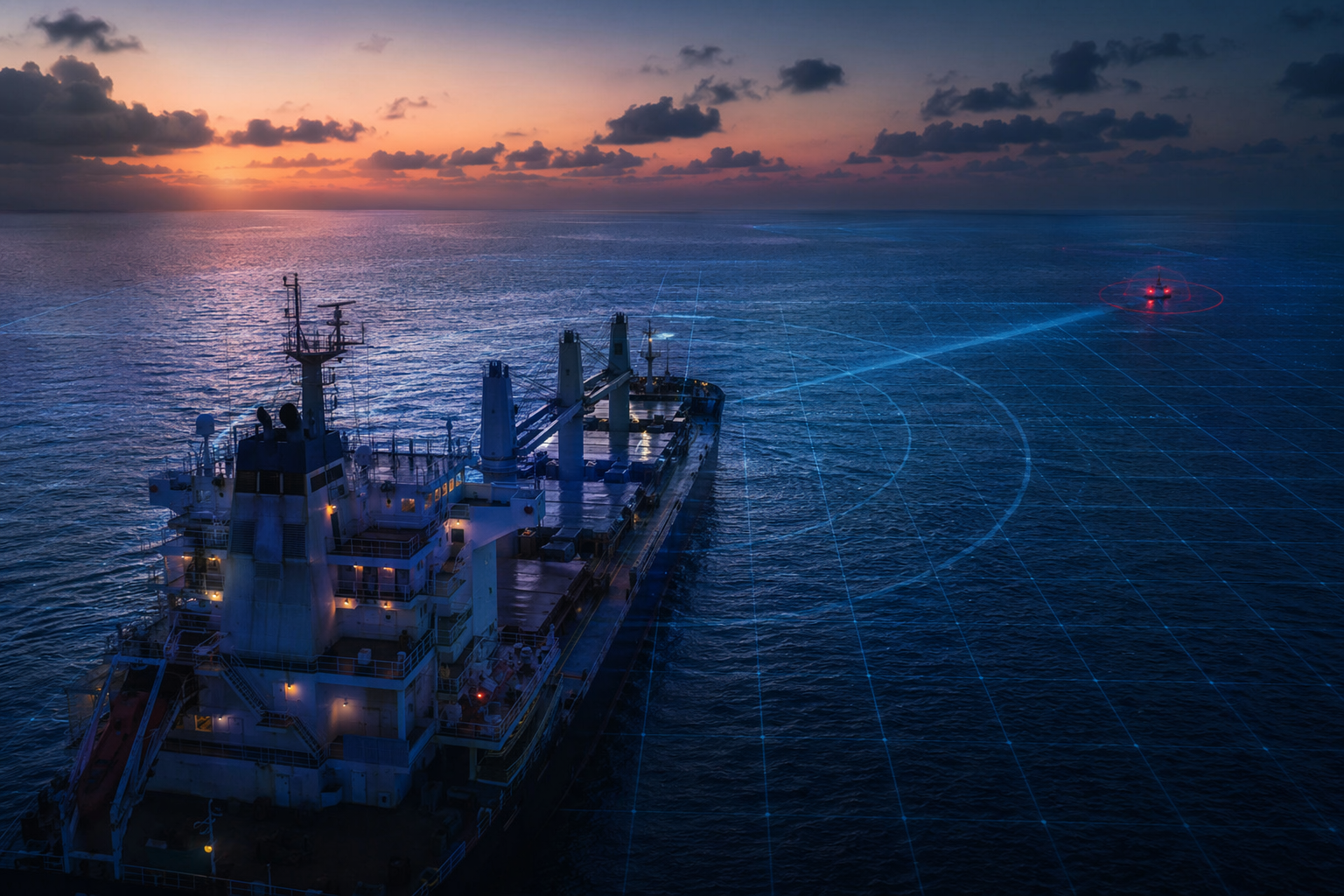
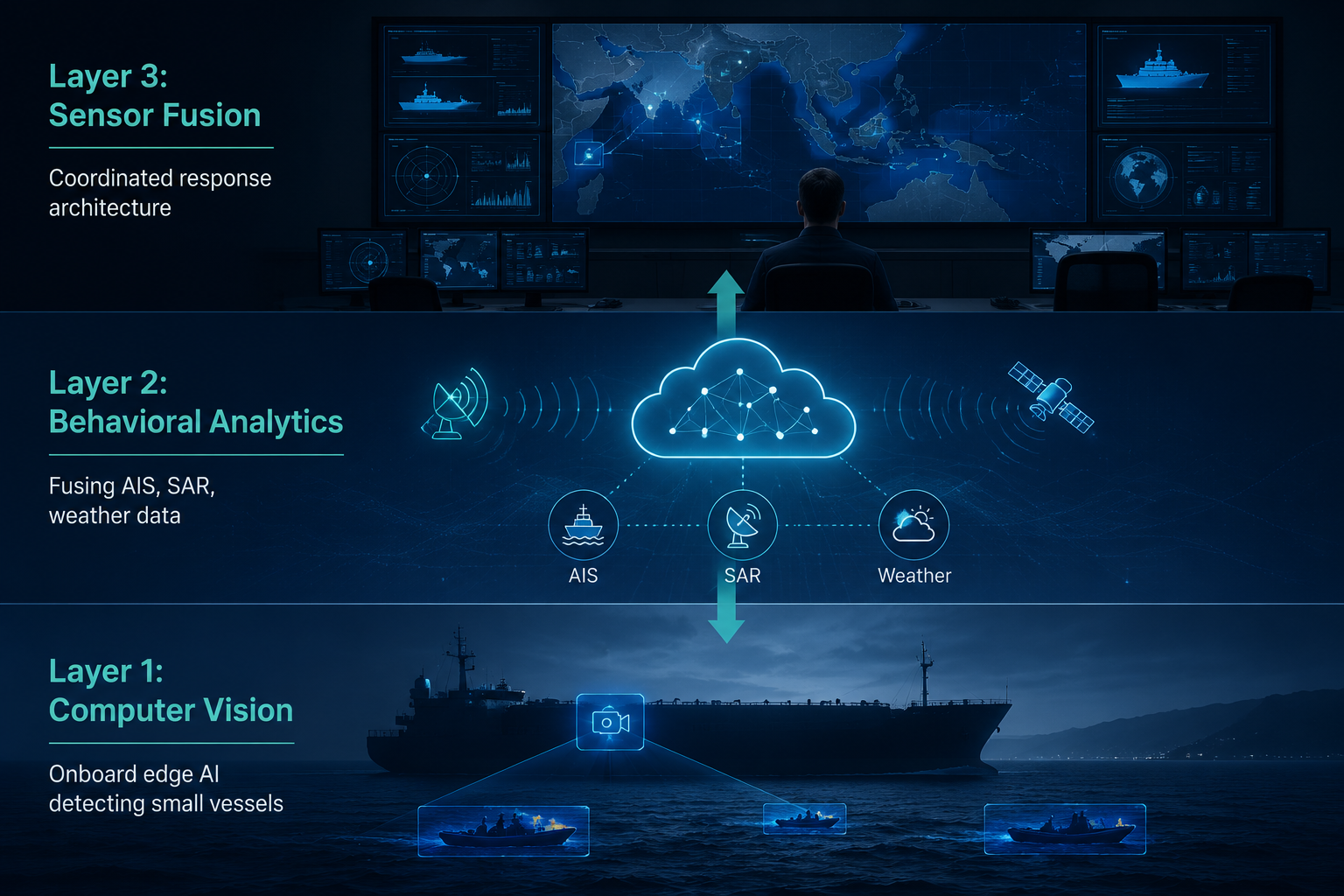
The strongest answer is layered rather than singular. Onboard computer vision can shorten the time between visual contact and bridge alert. Behavioral analytics can flag suspect patterns across AIS, satellite, weather, vessel monitoring, and open-source data before a vessel’s own cameras have anything useful to see. Regional sensor-fusion platforms can connect those warnings to patrol allocation, convoy decisions, and route changes. None of those layers prevents hijacking by itself. Together, they can change the decision window.
Where AI Enters the Hijacking Decision Chain
A hijacking attempt is rarely a single observable event. It is a sequence: a vessel enters a risk corridor; one or more small craft behave differently from ordinary traffic; AIS behavior becomes inconsistent or disappears; a mothership may loiter beyond normal fishing patterns; a skiff closes at speed; the bridge team has to decide whether to alter course, increase speed, muster crew, activate citadel procedures, call authorities, or request nearby support.
AI systems matter only if they improve that sequence. The useful outputs are not “piracy detected” in the abstract. They are: earlier small-craft detection at night, fewer minutes spent debating whether a track is abnormal, faster escalation to a shore security desk, better regional patrol tasking, and route advice that accounts for threat movement rather than last week’s incident map. For supply chain teams already using models for chokepoint disruption, such as Red Sea maritime disruption risk models, piracy prevention is a related but harsher test because the consequence of a bad call is immediate and human.
Layer 1: Onboard Computer Vision
The most direct AI layer sits on the vessel. ShipIn describes FleetVision as processing 4K CCTV and thermal feeds locally on NVIDIA Jetson hardware using TensorFlow Lite, with reported alert latency under two seconds and 95% [email protected] on maritime threat detection classes.[3] Those are vendor-reported performance figures, not a universal guarantee across every sea state, camera angle, maintenance condition, and crew workflow. They are still operationally relevant because latency is not a cosmetic metric on a bridge.
A watchstander scanning a dark horizon, a radar display, radio traffic, and normal bridge duties can miss a small craft until it is close enough to compress the response window. Edge computer vision changes the first step: the system watches continuously, highlights objects of interest, and can push an alert before a human has fully interpreted the scene. Local processing also matters because connectivity is uneven in many of the places where piracy risk is highest. A cloud-only detection workflow is poorly matched to a vessel that needs to act before its satellite link cooperates.
The limitation is equally plain. Computer vision sees what the cameras can see. Spray, glare, lens contamination, poor placement, maintenance lapses, occlusion by deck structures, and confused background motion can all weaken detection. A high mAP figure on selected maritime threat classes should be treated as a shortlisting signal, not as proof that the system will identify every hostile skiff in monsoon conditions or crowded anchorages.
Layer 2: Behavioral Analytics Before Contact
The second layer looks beyond the ship’s own cameras. Windward MaritimeAI is reported to fuse AIS, SAR from Sentinel-1/6 and Capella Space, EO imagery from PlanetScope and Maxar, VMS, weather data, and OSINT using transformer-based models and graph neural networks. TSI Magazine reports 98.7% recall on historical piracy incidents and deployment by INTERPOL, more than 15 navies, and more than 200 shipowners.[4]
Recall is an important metric for this use case because missed threats are expensive. But it is not the same as effectiveness. A model can correctly recover historical incidents and still create operational problems if it produces too many false positives, if its training data does not match a new threat pattern, or if the alert arrives without a recommended action. Historical recall also does not prove that future adversaries will behave the same way once they learn what behavior triggers scrutiny.
The practical value of behavioral analytics is in pre-contact warning. Loitering inconsistent with a vessel’s declared activity, high-speed convergence toward a merchant vessel, AIS spoofing, dark-vessel behavior, and unusual coordination among small craft are not, individually, proof of piracy. In combination, they can justify earlier routing changes, heightened watch, private security readiness, or coordination with a maritime security center. The output has to be graded and explainable enough for the person carrying the operational risk to act on it.
Layer 3: Sensor Fusion and Coordinated Response
Regional sensor fusion is where AI starts to look less like a shipboard product and more like a maritime control tower. ST Engineering’s MICA, described as a Maritime Integrated C4I Architecture, integrates radar, optical, and acoustic sensors with AI fusion for coastal surveillance.[5] The point is not simply to add more feeds. It is to reduce the time between detection, classification, tasking, and response.
That architecture resembles other supply chain control tower AI patterns, but the maritime version has less tolerance for latency and ambiguity. A container delay control tower can ask for a revised ETA. A piracy command center may need to decide whether a patrol vessel changes course, whether tankers reroute, or whether a master receives an immediate threat advisory.
The strongest operational example in the current evidence set is Nigeria’s Deep Blue Project 2.0 as reported by TSI Magazine. The article says the Nigerian Navy combined Windward and xAIS analytics across 40 patrol vessels, used predictive rerouting for more than 1,200 tanker transits, neutralized 14 mothership operations before skiff deployment, and achieved a 73% reduction in successful boarding attempts. It also reports ROI exceeding 18:1 through more than $120 million in avoided ransoms and reduced insurance uplifts.[4]
Those figures deserve attention, and they also deserve a label. They come through a TSI Magazine article citing the Nigerian Navy deployment, and the source chain could not be independently verified against primary documents in the available research. For a buyer, that means the case is useful evidence for directional confidence and vendor due diligence. It is not enough, by itself, to assume the same reduction will transfer to another coastline, navy, patrol posture, threat group, weather pattern, or commercial fleet profile.
What the Evidence Actually Measures
| AI layer | Reported measure | Who reported it | Buyer confidence |
|---|---|---|---|
| Onboard computer vision | <2-second latency and 95% [email protected] on maritime threat detection classes | ShipIn Systems | Useful for vendor screening; still needs route, camera, weather, and crew-specific validation |
| Behavioral analytics | 98.7% recall on historical piracy incidents; deployments by INTERPOL, 15+ navies, and 200+ shipowners | TSI Magazine reporting on Windward MaritimeAI | Strong directional signal; recall should not be treated as field prevention rate |
| Regional sensor fusion | 73% reduction in successful boarding attempts, 1,200+ tanker transits rerouted, 14 mothership operations neutralized, >18:1 ROI | TSI Magazine citing Nigerian Navy Deep Blue Project 2.0 | Most operationally interesting case; not independently verified from primary sources in the available material |
The distinction between detection metrics and prevention outcomes matters. mAP says something about object detection performance against labeled classes. Recall on historical incidents says something about the model’s ability to catch known cases. A reduction in successful boardings says something closer to the business outcome a security director cares about, but it also absorbs the effects of patrol vessels, route decisions, crew practices, armed security, weather, naval pressure, and adversary choices.
This is why a procurement team should not compare 95% mAP, 98.7% recall, and a 73% reduction as if they were competing answers to the same question. They sit at different points in the chain. The first helps detect an object. The second helps prioritize suspicious behavior. The third describes a campaign-level operational result, if accepted as reported. A serious evaluation asks how each layer changes a decision that would otherwise be slower, noisier, or missed.
Why the Somali Resurgence Is a Hard Test
The 2026 Somali pattern is a useful stress test because it combines distance, adaptation, and uneven protective posture. Castor Vali reports two Pirate Action Groups operating simultaneously in the Somali basin, including one conducting deep-offshore mothership operations up to 900 nautical miles from the coast using GPS and satellite communications.[2] That kind of operating area is too large for a vessel-only view and too dynamic for static risk maps.
The same reporting notes that hijacked vessels such as Honour 25, Sward, and Eureka lacked embarked armed security, while vessels that successfully deterred attacks, including Elfriede and Minerva Pisces, had armed security plus BMP-MS compliance.[2] That does not prove armed security is the only decisive variable in every case. It does reinforce a basic point: AI should not be allowed to absorb credit that belongs to layered maritime security practice, nor blame that belongs to weak procedures.
For vessels transiting a deteriorating corridor, the better question is how AI supports the whole protection stack. Does the analytics platform push a route advisory early enough to avoid a concentration of suspicious tracks? Does the shipboard camera system reduce bridge uncertainty during a night approach? Does the shore team know who must approve a course alteration? Has the crew rehearsed what happens after the alarm? If those links are missing, the model can be accurate and the response can still fail.
The Constraints Are Adoption Conditions
False positives are not a minor annoyance in maritime security. A poor alert stream can burn bridge attention, trigger unnecessary evasive actions, disrupt schedules, and teach crews to distrust the system. The available research identifies false positive management as a known implementation risk but does not provide enough published, comparable false positive data to rank vendors on that basis. That gap should be visible in every pilot plan.
AIS manipulation is another boundary. Behavioral systems can use AIS spoofing or disappearance as part of the signal, but AIS itself is not a clean truth source. Dark-vessel detection depends on alternate data such as SAR, EO imagery, VMS, weather, and contextual behavior. Those feeds differ in availability, revisit rate, cost, and interpretability. A model that performs well in a region with dense data coverage may be less useful where satellite, patrol, and local reporting are thin.
Connectivity also shapes deployment design. Onboard inference is valuable because it does not wait for shore connectivity. But a full threat picture often depends on cloud analytics and regional fusion. Buyers need to know what the system does when the satellite link degrades, which alerts remain local, which models update later, and whether the bridge sees stale risk information as if it were current.
Model drift deserves more attention than it usually gets in piracy discussions. Pirate groups change launch points, vessel types, approach profiles, and communications habits. Seasonal conditions matter too: the Somali activity picture in Q3 2026 is not a full-year trend because Southwest Monsoon conditions can suppress activity between June and September.[2] A system trained or tuned on one threat tempo may need recalibration when adversaries, weather, naval coverage, or commercial routing changes.
Crew training is the last practical constraint, and often the most underestimated. A bridge team does not need another black-box alarm. It needs thresholds, escalation rules, fallback procedures, and drills that connect the AI output to the company security plan. If an alert says a skiff approach is high risk, the crew should already know who acknowledges it, who verifies it, who calls the company security officer, who logs it, and what maneuvering authority the master retains.
Governance and Insurance Pressure
AI maritime security is also moving into a more formal governance environment. TSI Magazine reports that IMO MSC.1/Circ.1693 Annex in 2025 mandates maritime AI governance frameworks including audit trails, fallback procedures, and cyber resilience certification under IEC 62443-4-2.[4] That matters because piracy detection systems touch navigation decisions, security response, and potentially sensitive vessel data. A useful system must be auditable after an incident, not merely persuasive during a sales demo.
Insurance and chartering practices may accelerate adoption before the evidence base is perfect. TSI Magazine reports that war risk premiums in the Gulf of Guinea dropped 22% in Q4 2025 for AI-monitored fleets and that BIMCO/INTERTANKO voyage clauses increasingly mandate AI threat monitoring integration.[4] Those are industry-reported signals, not proof that AI alone caused the premium change. They do show that underwriters and counterparties are beginning to treat AI monitoring as part of a credible risk-control package.
For companies already revising supply chain AI controls under broader security policy changes, piracy systems should be evaluated with the same discipline applied to cyber, route intelligence, and control tower tools. The governance questions overlap with the concerns raised in the 2026 AI security policy overhaul for supply chains: who can override the model, what gets logged, how third-party data is secured, and how the organization proves that a human remained accountable for the final decision.
How to Evaluate a Piracy AI Deployment
A useful evaluation starts with the vessel and route, not with the vendor’s highest metric. A tanker transiting the Gulf of Guinea, a container vessel moving through the Singapore Straits, and a bulk carrier crossing the Somali Basin face different traffic density, sensor coverage, response options, and adversary behavior. The same model output can mean different things in each setting.
- Map the decision chain: identify which alerts go to the bridge, shore security desk, insurer, naval coordination center, or fleet operations team.
- Separate metric types: treat mAP, recall, false positive rate, alert latency, rerouting outcomes, and boarding reductions as different measures.
- Pilot against real constraints: test night operations, poor visibility, camera fouling, AIS gaps, weak connectivity, and crowded waters.
- Require response procedures: define who verifies alerts, who escalates, who can alter route, and what fallback procedure applies if the system fails.
- Ask for evidence boundaries: require vendors to distinguish lab validation, historical back-testing, live deployments, and independently audited results.
This is where a broader AI vendor evaluation framework helps, but maritime security adds its own burden. A warehouse optimization model can be wrong without putting a crew under attack. A piracy alerting model sits closer to life-safety, navigation, contractual risk, and military coordination.
The Buyer-Useful Conclusion
AI can meaningfully reduce pirate hijacking risk when it is deployed as part of a multi-layered maritime security program. The clearest value is not a promise that hijackings disappear. It is a better warning and response chain: cameras that alert faster than a tired human scan, analytics that identify suspicious behavior before visual contact, and fusion centers that connect threat intelligence to patrol and routing decisions.
The current evidence base supports serious shortlisting, especially where vendors can demonstrate onboard latency, historical incident recall, and live operational integration. It does not support assuming guaranteed performance across all routes, weather, crews, threat behaviors, and data environments. The right adoption posture is neither skepticism for its own sake nor trust in a headline metric. It is controlled deployment with measured outcomes, trained crews, auditable governance, and security procedures that still work when the model is uncertain.
References
- Global maritime piracy and armed robbery increased in 2025, ICC International Maritime Bureau, 2025.
- Renewed Piracy Threat in the Somali Basin and Gulf of Aden 2026, Castor Vali, 2026.
- Combating Maritime Piracy with AI, ShipIn Systems.
- Maritime Piracy Prevention in the Age of AI, TSI Magazine, February 2026.
- ST Engineering’s MICA, SAFETY4SEA / ST Engineering.
Comments
Join the discussion with an anonymous comment.