
The fastest way to overbuy a supply chain control tower in 2026 is to accept “AI-powered” as a complete answer. The screen may show shipments, inventory, suppliers, exceptions, weather, and risk scores in one polished view. That still does not prove the platform changes a decision before the business pays for the delay.
The buying pressure is real. One market estimate puts the global control tower market at USD 8.75 billion in 2026, while 64% of supply chain leaders rate AI or GenAI capabilities as important or very important when evaluating new technology.[1] That explains why so many vendor demos now lead with intelligence claims. It does not explain which capability matters once a planner has twenty late loads, a factory waiting for inbound material, and three mitigation options that all cost too much.
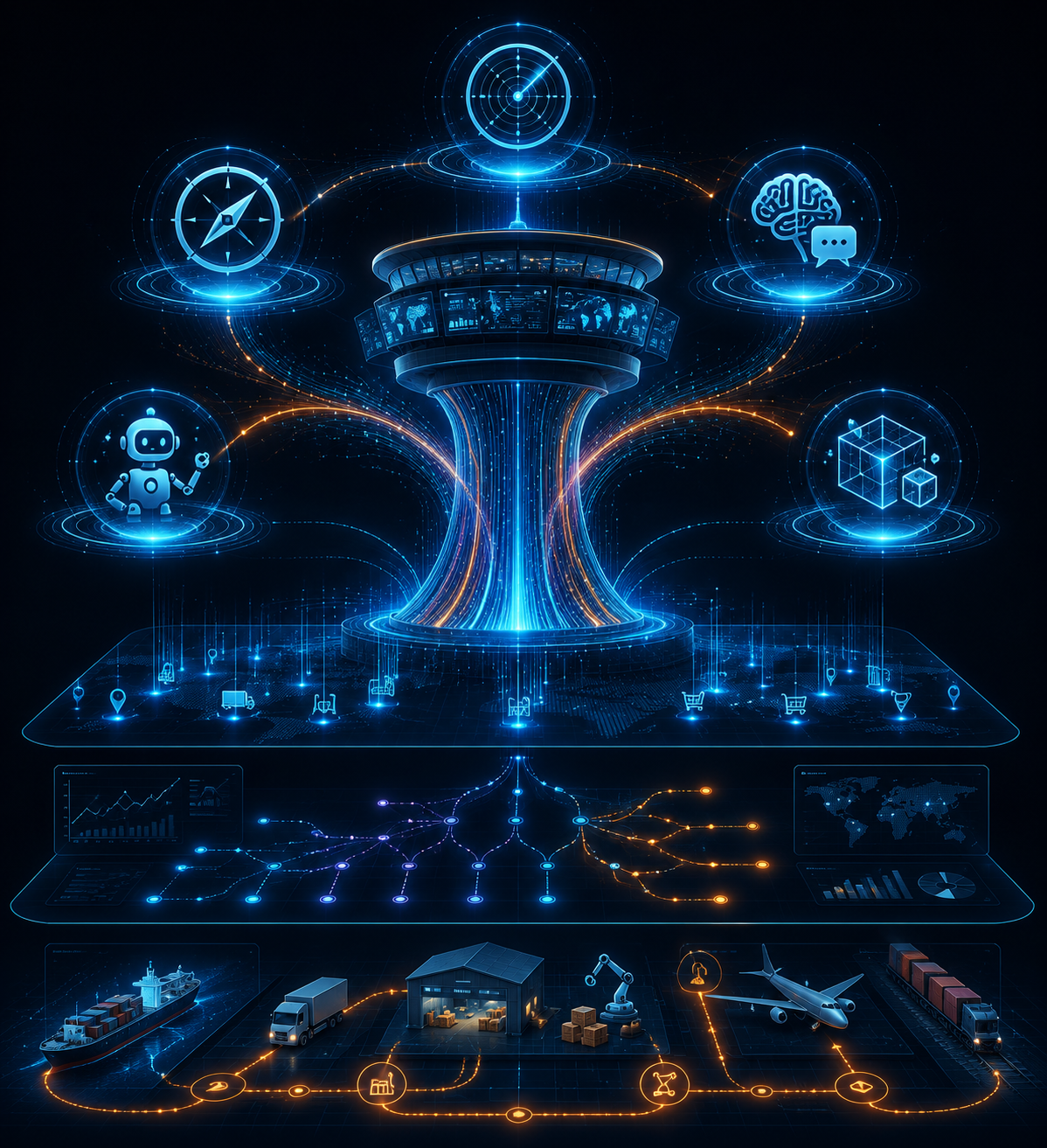
A useful evaluation starts by separating five capabilities that vendors often blend together: predictive AI, prescriptive AI, generative AI, autonomous agents, and digital twin integration. They can coexist in one control tower, but they do not solve the same bottleneck. For a broader inventory of control tower AI applications, the useful question is not whether the feature sounds advanced. It is where the feature lands in the operating rhythm: before the exception, during the trade-off, inside the data search, at the execution handoff, or before a network decision is committed.
The ROI Context Is Useful, but Too Broad to Buy Against
The business case for control tower AI is not imaginary. Accenture has quantified potential gains from control tower programs as 1% revenue uplift through reduced lost sales, 3–5% lower logistics costs, and 10–20% labor efficiency improvement.[2] OpenSkyGroup’s compilation of AI supply chain benchmarks also cites McKinsey 2024 figures of 5–20% logistics cost reduction, 20–30% inventory reduction, and 5–15% procurement spend reduction for AI-enabled distribution.[1]
Those numbers are directional, not a substitute for diagnosis. A company drowning in stale ETA data will not get the same value from a beautiful optimization engine as a company whose planners already trust the data but cannot compare mitigation scenarios fast enough. A useful supply chain control tower ROI case ties the benchmark to the constraint: elapsed time removed, manual lookups avoided, service failures prevented, or decisions executed without waiting in a queue.
1. Predictive AI: Detect the Failure Before It Becomes a Service Miss
Predictive AI is the control tower feature that should move visibility from “where is it?” to “what is likely to break next?” In practical terms, it ingests shipment status, carrier performance, weather, port congestion, inventory position, order priority, and other operating signals, then estimates which orders, loads, lanes, or facilities are drifting toward a missed commitment.
The operational question is simple: Which exception deserves attention before the SLA is breached? Some control tower materials describe predictive alerts that can flag SLA breaches 15–30 minutes before they occur and delay forecasts 2–5 days in advance by analyzing variables such as weather, port congestion, and carrier performance history.[3][4][5] The exact lead time will depend on lane type, data freshness, and the decision being supported, but the standard is clear: prediction only matters if it creates enough time to intervene.
This is where many dashboards fail. They surface late freight after everyone already knows the load is late. Predictive capability should instead change the prioritization queue. A shipment with a mediocre ETA may matter less than a shipment whose risk score just crossed a threshold because the downstream inventory buffer is thin. A supplier delay may be noise unless the same part is feeding a constrained production line. Good predictive analytics in supply chain is less about warning volume than warning quality.
The bottleneck it best addresses is visibility latency. If planners spend their mornings discovering what already went wrong, predictive AI deserves more scrutiny than advanced automation. Evaluators should ask how the model ranks exceptions, what historical and live signals it uses, how often predictions refresh, and whether the alert includes the business consequence rather than only the transport event. A useful predictive analytics definition is not “AI sees the future.” It is probabilistic early warning connected to an operating decision.
2. Prescriptive AI: Compare the Trade-Offs While There Is Still Time
Predictive AI says a problem is coming. Prescriptive AI answers the more expensive question: What should we do about it? This is the bridge between visibility and decision-making, and it is often where the demo either becomes operationally serious or slides back into dashboard theater.
Prescriptive systems compare multiple responses, such as air-freight acceleration, rerouting, alternate inventory draw, supplier substitution, or customer promise-date adjustment. AltexSoft and C3 AI describe control tower capabilities that evaluate scenarios and recommend courses of action with cost and ETA impacts calculated in seconds.[6][7] The useful output is not merely a ranked list. It is a decision package: service impact, cost impact, capacity impact, and confidence level presented quickly enough for a planner or manager to act.
| Decision Moment | Weak Control Tower Output | Prescriptive Output Worth Evaluating |
|---|---|---|
| Late inbound component threatens production | Shipment is delayed | Compare expedite, alternate supplier, and production resequencing with cost and service impact |
| DC inventory is below commitment level | Inventory is low | Recommend which orders to protect, which source to draw from, and what service trade-off follows |
| Carrier disruption affects multiple lanes | Carrier exception count increases | Prioritize affected orders by customer, margin, penalty risk, and available mitigation options |
The bottleneck here is planning throughput. Many teams can see the exception but cannot evaluate the alternatives fast enough, especially when the decision crosses procurement, logistics, customer service, and manufacturing. Prescriptive AI is valuable when it reduces the number of manual handoffs needed to move from “we have a problem” to “this is the least-bad option.”
The evaluation trap is accepting a recommendation without understanding its objective function. A platform optimized for lowest freight cost may recommend a different action than one optimized for customer fill rate, production continuity, or margin protection. A serious vendor should be able to show which constraints the engine respects, which trade-offs are configurable, and where human approval enters before money or service promises are committed.
3. Generative AI: Reduce the Labor of Finding Operational Truth
Generative AI is easy to dismiss when it appears as a chat box bolted onto a control tower. That dismissal is too quick. In many operations, the labor problem is not that planners lack intelligence; it is that the facts they need sit across ERP, WMS, TMS, supplier portals, spreadsheets, and email trails. If a natural-language interface can retrieve, join, and explain those facts reliably, it removes real work.
AltexSoft reports that C3 AI, IBM, and Oracle offer generative AI-powered search for operational data, reducing the 15–20 steps previously required to access data from disparate ERP, WMS, and TMS systems.[6] C3 AI also positions natural-language querying as part of its control tower product experience.[7] The operational question is: Can a planner ask for the status, cause, exposure, and next action without navigating five systems?
A useful query is not “show me delayed orders.” It is closer to: “Which customer orders promised for this week are exposed to supplier delays in Mexico, and which have alternate inventory available in the Midwest?” The answer should cite source systems, show freshness, expose missing data, and make clear whether it is retrieving facts, summarizing records, or inferring a likely cause.
The bottleneck it best addresses is fragmented data access. Generative AI will not fix poor master data by itself, and it should not be treated as an optimization engine unless it is connected to one. Its value is strongest when planners waste time reconstructing the same operating picture that the control tower is supposed to provide.
4. AI Agents: Execute Low-Risk Actions Without Waiting for the Planner Queue
Autonomous agents are the most interesting and easiest to oversell of the five capabilities. The promise is attractive: when a disruption meets a defined condition, the system does not merely alert a human. It triggers a workflow, updates stakeholders, reroutes freight, opens a case, requests approval, or executes a bounded action inside policy.
The current market direction is unmistakable, but the timeline matters. Gartner predicts that 50% of cross-functional supply chain management solutions will include agentic AI by 2030 and that 60% of supply chain disruptions will be resolved without human intervention by 2031.[1] Those are forecasts, not evidence that most control tower users today are safely running autonomous exception management at scale.
Existing examples are still useful. FourKites describes Digital Workers that can support automated rerouting and customer notification within its platform.[5] That is the right level of specificity to look for. “Autonomous” should not mean a vague claim that AI handles disruption. It should mean a named workflow, a trigger condition, an allowed action, an approval rule, an audit trail, and an exception path when confidence is low.
This capability best addresses execution latency. If a team already knows what to do but the action waits in a planner queue, an agent can remove idle time. Customer notifications, appointment rescheduling, case creation, tender escalation, and policy-bound rerouting are more plausible early targets than high-stakes network redesign. For a deeper treatment of where agentic AI in supply chain belongs, the dividing line is usually not intelligence. It is control.
- Good agent candidate: the action is frequent, rule-bound, reversible, and already standardized.
- Poor agent candidate: the action is rare, financially large, politically sensitive, or dependent on undocumented judgment.
- Required control: human approval thresholds, logging, fallback routing, and clear ownership when the agent is wrong.
5. Digital Twin Integration: Test the Network Before Spending Capacity
Digital twin integration shifts the control tower from monitoring the operating network to simulating it. The operational question is: What happens if we change this lane, inventory policy, facility flow, supplier allocation, or transport plan before we commit? It is less useful for deciding whether one truck should be expedited this afternoon and more useful for testing decisions whose consequences cascade across capacity, inventory, cost, and service.
The performance claims around digital twins can be substantial. BCG research cited by nShift reports that early adopters saw 20–30% better forecast accuracy and 50–80% fewer delays and downtime when simulating network decisions before execution.[8] The phrase “early adopters” matters. These figures describe advanced deployments, not a normal first-quarter implementation outcome.
Digital twin capability best addresses planning confidence. A planner choosing between two expedite options may not need a full twin. A network team evaluating inventory placement, port routing, supplier allocation, or DC capacity certainly might. The evaluator should ask what the twin actually represents, how often it is refreshed, which constraints are modeled, and whether simulation results feed back into the control tower workflow or remain a separate planning exercise.
There is a maturity warning here. A digital twin with poor process fidelity can create a more elegant version of the wrong answer. It may model transportation lead times while ignoring dock constraints, labor availability, customer allocation rules, or supplier response limits. The feature is powerful when the modeled system resembles the operating system closely enough for decisions to survive contact with execution.
Match the Feature to the Bottleneck
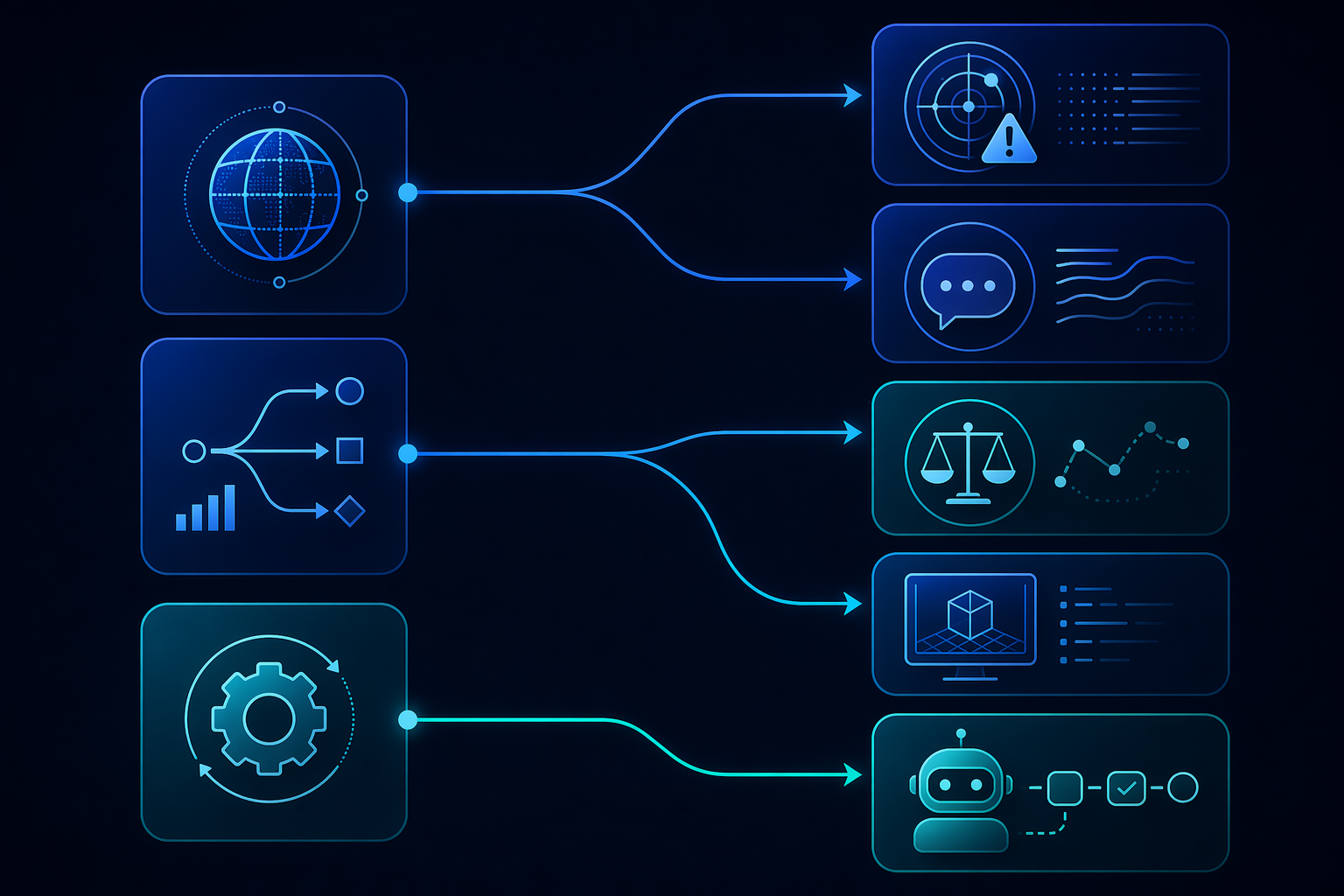
Once the five capabilities are separated, the shortlist conversation becomes more practical. Most organizations do not need the same AI feature first. They need the feature that removes the constraint currently absorbing time, money, or service credibility.
| Primary Bottleneck | Symptoms in the Operation | AI Capabilities to Prioritize | What to Test in the Demo |
|---|---|---|---|
| Visibility | Teams discover exceptions late, search across systems, or argue over whose data is current | Predictive AI and generative AI | Alert lead time, exception ranking, data lineage, natural-language answers across ERP/WMS/TMS |
| Planning | Teams see the problem but cannot compare mitigation options quickly or confidently | Prescriptive AI and digital twin integration | Scenario speed, objective function, modeled constraints, cost/service trade-offs |
| Execution | Teams know the action but lose time waiting for handoffs, approvals, notifications, or routine updates | AI agents and workflow automation | Trigger rules, approval thresholds, audit trail, fallback process, action ownership |
A visibility-led buyer should be skeptical of a platform that demonstrates beautiful optimization on top of uncertain data. Start with prediction quality and data retrieval. Can the control tower identify which orders are at risk before the customer calls? Can a planner ask why a promise is exposed and get a traceable answer?
A planning-led buyer should care less about the number of alerts and more about the decision work after the alert. Prescriptive scenario comparison and simulation matter when the expensive part of the day is choosing between imperfect responses. This is where demos should use the buyer’s real constraints, not a generic late-shipment story.
An execution-led buyer should force autonomy claims into the workflow. Who receives the recommendation? Who approves the action? Which system is updated? Which customer is notified? What happens if the carrier rejects the reroute? Real-world deployment examples can sharpen this line of questioning, especially when they show operational outcomes rather than just platform architecture; see AI logistics company deployments for that kind of evidence.
The Demo Questions That Separate Features From Labels
A control tower demo can make all five capabilities look like one continuous intelligence layer. The evaluation should pull them apart. Ask the vendor to show a real operating sequence: a disruption appears, the model predicts impact, the system recommends alternatives, a planner queries the evidence, an approved action is executed, and the result is logged.
- For predictive AI: What is the alert lead time, how is confidence calculated, and how are false positives managed?
- For prescriptive AI: Which objective is being optimized, and can the buyer change cost, service, inventory, and customer-priority weights?
- For generative AI: Which systems are queried, how fresh is the data, and does the answer show source records?
- For AI agents: Which actions can execute without approval, which require approval, and who owns the exception when the workflow fails?
- For digital twins: What parts of the network are modeled, how often is the model refreshed, and have simulation outputs changed live operating decisions?
The most revealing demo request is to bring a messy exception from the buyer’s own operation. Not the worst crisis and not the cleanest case. A normal, annoying, cross-functional exception is better: late inbound material, split inventory, a transportation constraint, a customer promise at risk, and several mitigation options with no perfect answer. That is where the platform has to prove whether its AI changes work or only describes it.
Readiness Still Decides Whether the Feature Becomes ROI
It is tempting to treat readiness as the implementation team’s problem after the selection is done. That is how capable software becomes shelfware. OpenSkyGroup cites a Gartner 2025 survey of 120 supply chain leaders who had already deployed AI in which only 23% of organizations had a formal AI strategy.[1] That sample is already inside the adopter population, which makes the governance gap harder to ignore rather than easier.
Readiness does not mean having every dataset perfect before buying. It means knowing which bottleneck the organization is trying to remove, which decisions the platform is allowed to influence, which data sources are authoritative, who approves exceptions, and how performance will be measured after go-live. A predictive model without alert ownership creates noise. A prescriptive engine without decision rights creates debate. An agent without governance creates risk. A digital twin without maintained assumptions creates false confidence.
The modern control tower is not defined by having the longest AI feature list. It is defined by whether its strongest capability matches the operating constraint. Buying planning intelligence for a visibility problem, visibility dashboards for an execution problem, or autonomy claims without data and governance is how AI becomes expensive decoration. The better question is narrower and more useful: which operational bottleneck does this control tower’s AI actually remove?
References
- Supply Chain AI Statistics, OpenSkyGroup.
- Supply Chain Control Tower, Accenture, 2023.
- Beyond Visibility: How AI Is Building the Autonomous Supply Chain Control Tower, Item.com.
- Best Supply Chain Control Tower Providers, Locus.
- FourKites Platform, FourKites.
- Supply Chain Control Tower Visibility, AltexSoft.
- C3 AI Supply Chain Control Tower, C3 AI.
- Supply Chain Control Tower 2026, nShift.
Comments
Join the discussion with an anonymous comment.