

The uncomfortable question for an AI-powered supply chain in 2026 is no longer whether the technology can produce a useful recommendation in a controlled pilot. Many organizations are already past that point. Gartner data cited by Open Sky Group says 72% of supply chain organizations have deployed GenAI, while ABI Research expects 94% to deploy it within two years; yet only 23% have a formal strategy for doing it at scale.[1] That is the gap that matters: if adoption is already this high, why is P&L impact still so thin?
The answer is usually less glamorous than the demo. PwC’s 2026 Digital Trends in Operations Survey found that 89% of operations leaders say technology investments have not fully delivered expected results, with integration complexity named as the top reason.[2] The same survey reports that only 4% of surveyed companies succeeded across all four dimensions PwC measured: AI fully embedded, agents scaled, horizontal structure, and technology investments delivering results.[2] PwC’s sample was 767 U.S.-based operations executives at companies with at least $100 million in revenue, so it should not be treated as a universal global benchmark, but it is a useful warning for large operating environments.[2]

That is pilot purgatory in operational terms. The model works when the pilot team curates inputs, shields users from exceptions, and reports success in a narrow sandbox. Then the project meets live item masters, regional planning calendars, buyer workarounds, incomplete lane data, exception queues, and finance scrutiny. The question becomes less “Did the model perform?” and more “Did the business change its decision process because of it?”
Three disciplines tend to decide the answer before scale-up begins.
| Execution discipline | What it proves before scale-up |
|---|---|
| Data standardization | The AI is reading the same operating reality that planners, buyers, logistics teams, and finance recognize. |
| Workflow embedding | The recommendation appears where decisions are already made, not in a parallel tool users can ignore. |
| Metric design | Success is measured in terms a CFO can audit, not just model accuracy or user enthusiasm. |
The data foundation is where the pilot usually gets flattered
Poor data quality is not a technical inconvenience waiting for an AI layer to smooth it over. It is an operating cost that gets pushed downstream into rework, mistrust, and manual overrides. PwC found that 87% of operations leaders say poor data quality has affected outcomes.[2] For supply chain teams, that finding should feel less like a revelation than a receipt.
A pilot can look impressive because the data problem has been temporarily narrowed. A single business unit, one product family, one geography, or one planning use case can be cleaned enough to show a good forecast, a better replenishment suggestion, or a faster supplier-risk signal. Production does not grant the same protection. It exposes every inconsistent definition the organization has been carrying: what counts as available inventory, whether lead time means contractual lead time or observed lead time, how substitutions are represented, whether expedited freight is coded consistently, and which version of demand is treated as the baseline.

The expensive mistake is assuming the model can absorb process variation that the operating system itself has never resolved. It may still generate an answer, but the answer arrives with hidden reconciliation work attached. A planner sees a recommendation that conflicts with what they know about a constrained supplier. A buyer sees savings that ignore a service-level commitment. A logistics manager sees a route suggestion that does not reflect how capacity is actually tendered. Each exception teaches users the same behavior: check the AI, then go back to the spreadsheet that has survived previous transformations.
Data standardization therefore has to be treated as an operating design task, not a pre-project hygiene slogan. The work includes agreeing on master-data ownership, harmonizing planning definitions, documenting exception rules, and deciding which source wins when systems disagree. It also means refusing to scale a use case until the business can explain which data fields drive the recommendation and who is accountable when those fields are wrong.
This is where many AI roadmaps become too polite. They list data readiness as a dependency, then fund the model as if the dependency were already solved. A stronger approach is to make data standardization part of the value case itself. If the organization cannot standardize the inputs required for a forecast, allocation, routing, or procurement recommendation, it has not merely delayed AI value; it has exposed a supply chain control problem that was already costing money.
For a deeper treatment of this readiness issue, ChainSignal’s article on building an inventory data foundation is a useful companion to the broader execution question.
A good recommendation still fails if it sits outside the work
Workflow embedding is where adoption statistics start to lose their shine. An organization can “deploy” AI and still leave the actual decision process mostly unchanged. The tool exists. The dashboard is live. Users have logins. Steering committees see screenshots. But when the quarter-end service crisis arrives, planners revert to the screens, meetings, escalation paths, and judgment calls that still control the outcome.
In planning, embedded AI should appear inside the demand review, supply review, allocation decision, or exception queue. It should show the recommendation, the confidence level where appropriate, the drivers behind the recommendation, and the action the planner can take next. If the planner must leave the planning system, open a separate analytics portal, interpret a chart, translate it into a system action, and then defend it manually in the next meeting, the organization has not embedded AI into planning. It has added another advisory layer.
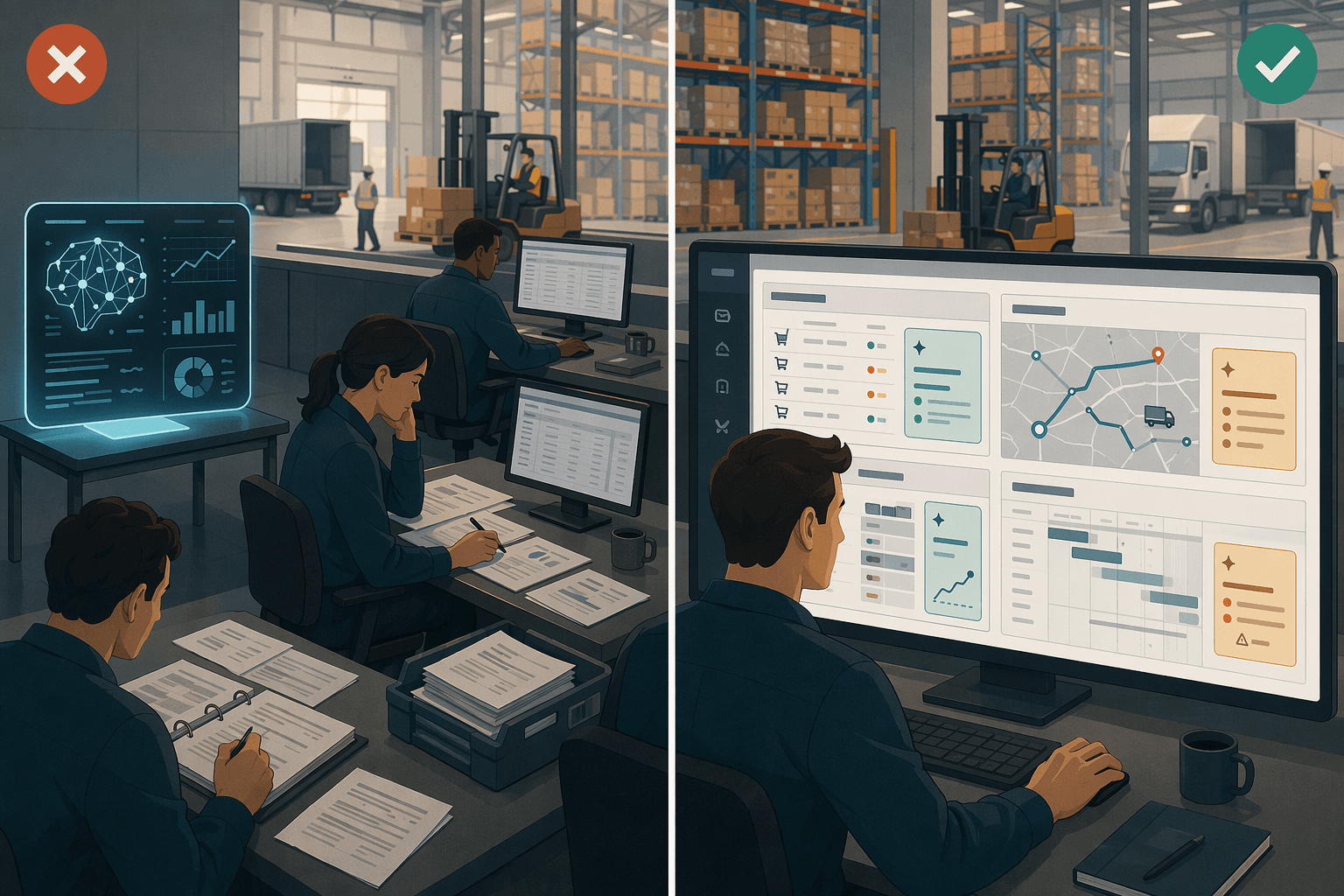
In procurement, the same principle applies. A supplier-risk signal matters only if it changes the sourcing event, approval workflow, negotiation brief, replenishment decision, or escalation route. A buyer who receives a weekly AI-generated risk report still has to decide whether the report is credible, whether the recommended action is allowed under current policy, and whether finance or legal will support the change. If those handoffs are not designed, the AI becomes a commentary feed rather than a control point.
In logistics, routing and cost recommendations face their own version of the same test. The recommendation has to meet carrier contracts, service promises, warehouse cutoffs, tendering rules, and customer constraints. If the AI recommends a cheaper lane but the transportation team has to validate every practical constraint by hand, adoption will depend on heroics. That may work during a pilot. It will not survive peak season.
Embedding does not mean forcing full automation. In many supply chain decisions, the better design is augmented judgment: the AI narrows the exception set, explains likely drivers, recommends an action, and records the human decision. That design respects the fact that planners and operators often carry context the system does not yet encode. It also creates a feedback loop. When a user overrides the recommendation, the reason should be captured in a structured way, not buried in a meeting note or an email thread.
The Capgemini finding cited by Open Sky Group gives this point a business shape: organizations with formal AI change-management plans are 2.7 times more likely to achieve ROI within 12 months.[1] That does not prove the change plan alone caused the ROI; stronger operators may be better at both planning and returns. Still, the correlation is hard to dismiss because it matches what implementation teams see on the ground. Tools that are introduced as part of role design, decision rights, training, escalation rules, and performance management have a better chance of becoming the way work gets done.
A practical workflow review before scale-up should ask:
- Which existing decision will the AI change?
- At what point in the workflow does the recommendation appear?
- Who is authorized to accept, reject, or override it?
- What happens operationally after acceptance?
- How are override reasons captured and reviewed?
- Which meeting, metric, or governance forum will inspect the results?
If these questions cannot be answered, the pilot is not ready for scale. It may be ready for another demo, but that is a different milestone.
The distinction between augmented workflows and disconnected automation is explored further in ChainSignal’s piece on AI-based inventory management.
The metric has to survive finance review
The weakest AI business cases often fail late because they were measured loosely early. Model accuracy, user logins, dashboard views, recommendation volume, and pilot satisfaction can all be useful internal signals. None of them is a P&L result by itself.
Before deployment, the organization should decide which financial or operational metric the use case is meant to move and how that movement will be attributed. In demand planning, forecast-error improvement matters only if it reduces inventory, expedites, stockouts, markdowns, or planning effort in a way the business can verify. In procurement, identified savings are not the same as realized savings. In logistics, a modeled route-cost reduction is not the same as paid freight cost after accessorials, service failures, and operational exceptions are counted.
This is where finance should be involved before the pilot exits design, not after the project team wants credit. The CFO’s office will ask what baseline was used, what changed besides the AI, whether the benefit is recurring, whether service levels were protected, and whether savings are visible in the ledger or only in an operational model. Those questions are not obstruction. They are the difference between a technology story and a business result.
The often-cited value ranges for AI in supply chain are attractive, but they need careful handling. McKinsey-derived ranges collected by secondary aggregators point to possible reductions of 20% to 50% in forecast error, 5% to 20% in logistics cost, 20% to 30% in inventory, and 5% to 15% in procurement spend.[1][3] Because these figures are available here through aggregators rather than the original McKinsey materials, they should be treated as directional benchmarks, not guaranteed business-case inputs.
The timeline also matters. Deloitte data cited by Open Sky Group says only 6% of organizations saw AI ROI in under a year, while most achieved satisfactory returns within a two-to-four-year window.[1] That does not mean leaders should tolerate vague benefits for four years. It means the business case should separate early operating indicators from later financial realization. A forecast pilot may show better signal quality before inventory turns improve. A procurement model may identify opportunities before contracts renew. A logistics optimization effort may need enough shipping cycles to prove that savings survive service constraints.
A finance-ready metric design usually includes four elements:
- A baseline period that finance accepts before deployment begins.
- A short list of operational leading indicators, such as forecast error, exception aging, expedite frequency, or supplier-risk response time.
- A defined bridge from those indicators to financial outcomes, such as working capital, freight cost, procurement savings, service penalties, or labor productivity.
- A benefit owner who is accountable after the pilot team exits.
The last point is often the one that exposes whether the initiative is real. If no operating leader is willing to own the benefit after go-live, the metric is probably not close enough to the work.
Early adopters are not the market average
There is enough evidence to justify serious investment, but not enough to justify casual scaling. Accenture data cited by Open Sky Group says AI-mature supply chains are 23% more profitable than peers and six times as likely to use AI widely.[1] That is a meaningful differential, but it describes mature adopters, not the expected outcome for any company that funds a pilot.
This distinction matters in steering meetings. Early-adopter benchmarks can show what is possible when data, workflow, talent, governance, and leadership attention line up. They should not be copied into a business case as if the average organization will capture the same return on the same timeline. A company still reconciling master data across regions, asking planners to use a separate AI portal, and measuring success through project activity is not in the same operating condition as a mature adopter.
For teams trying to place their current program on a more realistic maturity curve, ChainSignal’s AI supply chain maturity roadmap provides a broader staged view.
What has to be true before scale-up
An AI-powered supply chain does not scale because the pilot was persuasive. It scales when the operating environment is ready to absorb the recommendation and act on it repeatedly. That requires standardized data definitions, visible ownership of inputs, recommendations embedded into the actual planning or execution flow, trained users with clear decision rights, and benefit metrics that finance can audit.
The organizations most likely to get measurable ROI are not necessarily the ones with the most impressive model demonstration. They are the ones treating AI as an operating change program before they call it a scale program. The model may be necessary, but it is not the control system. Data, workflow, and metrics are what decide whether the recommendation changes the business.
References
- Supply Chain AI Statistics, Open Sky Group
- 2026 Digital Trends in Operations Survey, PwC
- Top 10 AI Use Cases in Supply Chain Management, Unframe AI
Comments
Join the discussion with an anonymous comment.