

The exposed moment in an AI based inventory management evaluation is not the first demo. It is the meeting after the demo, when finance asks why one platform is on the shortlist and another is not, IT asks how many systems must be touched, and planners quietly wonder whether they will be expected to trust a recommendation they cannot explain.
The category matters because inventory distortion is not a rounding error. IHL Group estimated that inventory issues caused $1.73 trillion in annual global losses, with stockouts and overstocks both contributing to the total drag on retail and supply chain performance.[1] That number is large enough to justify serious evaluation. It is not, by itself, enough to justify buying whichever platform has the longest AI feature list.
A defensible RFI starts with architecture. The market is easier to compare when vendors are separated into four buying motions: AI-native planning platforms, end-to-end suites with embedded AI, network-and-visibility layers, and decision-intelligence overlays. Viewpoint Analysis’ 2026 buyer guide draws a useful distinction between AI-native and AI-added architectures, as well as deployment models and industry specialization, which is the right level of comparison for a first cut.[2]

| Architectural tier | Representative vendors | Best-fit buying problem | Common RFI pressure point |
|---|---|---|---|
| AI-native planning platforms | o9, Kinaxis, RELEX | Planning-led transformation where inventory optimization, scenario planning, and planner workflows are the core problem | Prove vertical fit, explainability, model governance, and integration depth |
| End-to-end suites with embedded AI | Blue Yonder, Manhattan Associates | Organizations already committed to a broader supply chain execution or planning ecosystem | Clarify which AI capabilities are native, embedded, configured, or roadmap-dependent |
| Network-and-visibility layers | E2open, Infor Nexus | Inventory decisions that depend on suppliers, logistics partners, channels, or multi-enterprise visibility | Show how network signals change planning decisions, not just dashboards |
| Decision-intelligence overlays | Aera Technology | Companies that cannot replace ERP or SCP foundations but need better decisions, exceptions, and automation across them | Prove orchestration, auditability, and ownership of recommendations |
These are not prison cells. Blue Yonder, for example, can show strengths across retail, planning, execution, and broader suite use cases. Kinaxis can be evaluated as a planning platform while also touching execution-adjacent decisions. The point is not to flatten complex vendors into labels. The point is to force the buying team to name the primary problem being bought for.
If the buying problem is grocery replenishment, the RFI should not look like the RFI for high-tech component allocation. If the hard issue is supplier visibility across a multi-enterprise network, it should not be evaluated as though the main gap were an internal planning workbench. If the installed ERP and SCP stack is too entrenched to replace, the most elegant planning platform may still be the wrong first move.
Start with architecture, then ask whether the vendor belongs in your operating model
The first hour of a vendor meeting should not be spent admiring screens. Screens are easy. The harder question is whether the platform’s architecture matches the inventory decisions your organization actually has to make.
AI-native planning platforms: strong when planning is the transformation center
AI-native planning platforms are usually the first place to look when the inventory problem lives inside planning itself: demand sensing, supply constraints, inventory targets, allocation, scenario analysis, and planner decision support. o9, Kinaxis, and RELEX are often discussed in this tier, though their strongest vertical stories differ. Viewpoint Analysis highlights RELEX’s retail and grocery specialization, Kinaxis’ fit in high-tech and manufacturing contexts, and o9’s multi-industry positioning.[2]
This tier can be attractive when a company wants faster time-to-value than a full suite replacement and has a defined planning scope. Reported market comparisons distinguish initial cloud-native deployments measured in roughly 60–90 days from full enterprise-suite rollouts that can stretch to 12–18 months, though the real driver is scope, data readiness, integration complexity, and change management rather than the vendor logo alone.[3]
The RFI should make that difference concrete. Ask the vendor to identify which planning objects must be implemented first, which ERP and execution systems are required for the first release, and what decisions the planner will be able to make differently by the end of the initial deployment. A vague answer about an AI roadmap is a weak substitute for a release-one decision map.
Embedded suite AI: useful when the ecosystem is already part of the strategy
End-to-end suites with embedded AI are easier to justify when the organization is already leaning into a broader vendor ecosystem. Blue Yonder and Manhattan Associates are not bought only for an isolated inventory algorithm; they are often evaluated in the context of planning, execution, warehouse, transportation, fulfillment, or retail operations.
That can be a strength. A suite can reduce the number of commercial relationships, simplify some roadmap conversations, and keep planning and execution closer together. It can also create a heavier implementation footprint. Horizon Solutions reports enterprise three-year TCO estimates of roughly $4 million to $15 million or more for Blue Yonder and Kinaxis at companies above $3 billion in revenue, while Datup cites long enterprise-suite deployment windows for broader rollouts.[4][3] These are reported third-party ranges, not official vendor price sheets.
The RFI question is not “does the suite have AI?” It is “which inventory decisions are improved because planning, execution, and operational data live in the same ecosystem, and which decisions still require external integration?” If the answer stays at the feature level, the buyer has not yet tested the suite logic.
Network-and-visibility layers: necessary when inventory risk sits outside the enterprise
Some inventory problems cannot be solved by optimizing the internal plan alone. Supplier delays, in-transit uncertainty, channel inventory, outsourced manufacturing, and partner-owned nodes can make the enterprise plan look precise while the real-world supply position is still uncertain. Network-and-visibility platforms such as E2open and Infor Nexus deserve attention when the decision depends on signals crossing company boundaries.
This tier should be evaluated for the quality of the network signal and the action it enables. A control tower that shows late supply is useful. A platform that can translate the late supply into allocation, substitution, expediting, or customer-service tradeoffs is more useful. The RFI should ask where visibility stops and decision support begins.
Decision-intelligence overlays: practical when replacement is not realistic
Decision-intelligence overlays are attractive in organizations with a familiar problem: the current ERP, planning, and execution stack is imperfect, but replacing it would consume more political and technical capital than the inventory problem can carry. An overlay such as Aera Technology is evaluated less as a new planning system of record and more as a decision layer across existing systems.
That buying motion changes the questions. The RFI should test how recommendations are generated, approved, written back, and audited. It should also define ownership. If an overlay recommends a transfer, an allocation change, or a replenishment exception, who accepts it, who can override it, and where does the record of that decision live?
The RFI-ready comparison framework
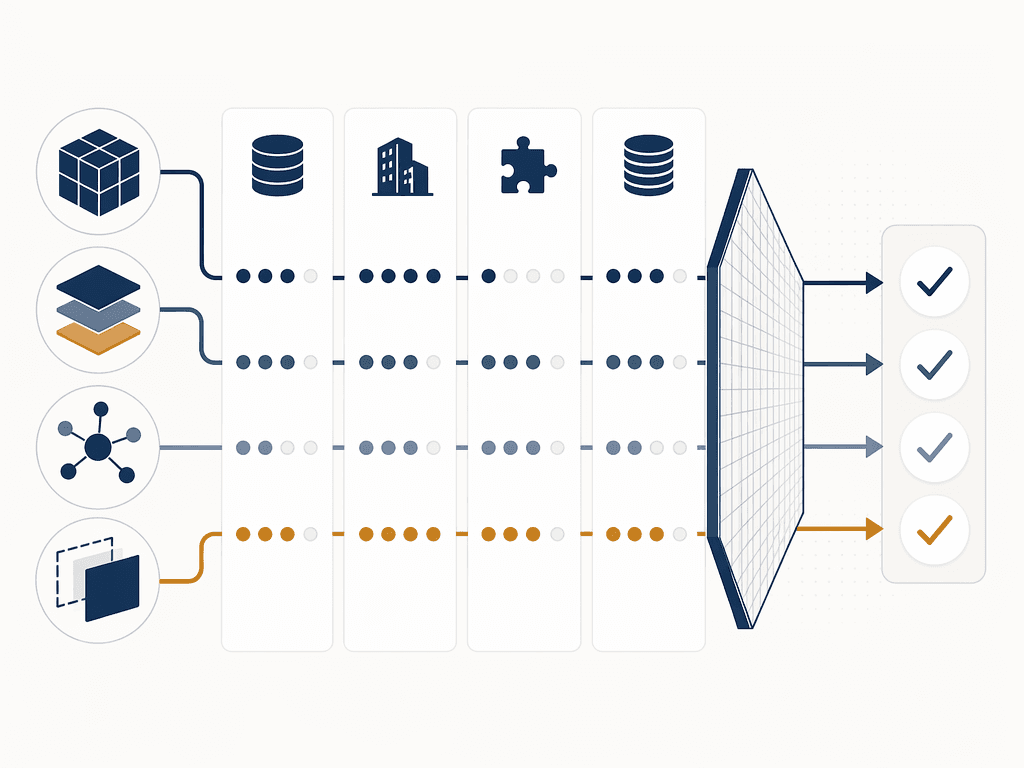
A useful RFI does not ask every vendor to perform the same generic beauty contest. It asks each vendor to prove the claims that matter for its architecture and your operating model. The following framework is built to remove weak fits before the team has invested months in demos, workshops, and reference calls.
| Evaluation area | What to ask in the RFI | What a strong answer should prove |
|---|---|---|
| Vertical fit | Which customers in our industry use this platform for comparable inventory decisions, and which planning processes are live? | The vendor has solved your type of inventory problem, not merely sold into your sector |
| Inventory decision scope | Which decisions are supported in release one: safety stock, replenishment, allocation, deployment, substitutions, exception prioritization, or scenario planning? | The implementation has a decision boundary rather than an unlimited transformation promise |
| Multi-ERP complexity | How does the platform handle multiple ERP instances, regional item masters, different calendars, and conflicting units of measure? | The vendor understands the messy data and process shape of the enterprise |
| Data maturity | What minimum data history, granularity, latency, and master-data quality are required for the proposed AI models? | The vendor can distinguish usable planning data from aspirational data |
| Explainability | Can planners see why a recommendation changed, which constraints mattered, and what assumptions drove the output? | Planner adoption is supported by the product, not delegated entirely to change management |
| Auditability | Where are recommendations, overrides, approvals, and write-backs logged? | The platform can survive finance, compliance, and post-implementation review |
| Integration burden | Which systems must be integrated for the first release, which APIs or connectors exist, and which integrations are custom? | The implementation plan reflects actual system dependencies |
| Deployment model | Is the solution multi-tenant SaaS, single-tenant, private cloud, or hybrid, and how does that affect upgrades and data controls? | The architecture fits IT policy and long-term operating cost |
| TCO | What are the three-year costs for licensing, implementation, integration, data work, support, internal resources, and expansion? | The business case is not built on license cost alone |
For readers who need a broader market inventory before building the RFI, the AI Inventory Optimization Vendor Landscape: Q2 2026 Snapshot is the better overview. This guide is the next step: turning the landscape into a shortlist logic.
Data readiness is not a housekeeping item
Most evaluation teams know to ask whether their data is clean. Fewer ask whether the data is fit for the AI decision being promised. Gartner distinguishes AI-ready data from traditional clean data, emphasizing that AI use cases require data to be representative, governed, secure, and suitable for the intended model and decision context.[5]
That distinction matters in inventory management. A SKU-location history may be clean enough for reporting and still be too sparse for an algorithm to infer demand patterns. A supplier lead-time field may be populated and still fail to capture the variability planners actually experience. A regional item hierarchy may support local operations while breaking an enterprise-wide optimization model.
The RFI should require a data-readiness response tied to the proposed use case. For demand-driven replenishment, ask for required history, handling of intermittent demand, promotion effects, and substitution logic. For constrained allocation, ask how supply constraints, customer priorities, and service commitments are represented. For multi-ERP planning, ask how item, location, customer, and supplier master data are reconciled before recommendations are generated.
Explainability is where many AI inventory projects either earn trust or lose it
Explainability is not a cosmetic feature for planner comfort. Viewpoint Analysis identifies AI explainability as a common failure point: when planners override recommendations because they do not understand or trust them, the expected ROI is lost.[2]
A planner-facing explanation layer should answer more than “the model says so.” It should show what changed: demand signal, forecast error, supplier delay, inventory target, service-level policy, capacity constraint, promotion, substitution, or exception priority. It should also make uncertainty visible enough that the planner can judge when to accept, override, or escalate.
A good RFI question is specific: “Show how the platform explains a recommendation to reduce inventory for a high-service SKU when recent demand has increased.” Another: “Show how the system records a planner override and whether that override is used in future learning, audit reports, or performance review.” The answer will reveal whether explainability is built into the workflow or added as demo narration.
TCO should be modeled before the shortlist hardens
License price is only one line in the business case. Enterprise AI TCO is usually shaped by several cost categories: infrastructure, data engineering, model development or configuration, integration, monitoring, support, and governance. Xenoss describes enterprise AI TCO through a multi-component lens that includes infrastructure, data, model, talent, integration, and ongoing operational costs.[6]
Reported market ranges show why this matters. Datup cites annual licensing estimates of approximately $250,000 to $3 million or more for Kinaxis, $300,000 to $1.5 million or more for o9, and RELEX pricing as comparable to Blue Yonder in the enterprise retail segment.[3] Horizon Solutions reports three-year enterprise TCO estimates of roughly $4 million to $15 million or more for Blue Yonder and Kinaxis at companies above $3 billion in revenue, while also stating that some mid-market alternatives can run 50–70% lower in TCO.[4]
Those figures should be treated as directional third-party ranges, not procurement-grade quotes. They are still useful because they force the buying team to model scenarios. A platform that looks expensive on license may be competitive if it reduces custom integration, shortens deployment, or avoids a second system. A lower-license alternative can become costly if it requires heavy data remediation, custom connectors, or manual planner workarounds.
| TCO component | RFI evidence to request |
|---|---|
| Subscription or license | Pricing metric, named users, modules, environments, AI add-ons, and expansion triggers |
| Implementation | Vendor services, SI services, timeline assumptions, phase plan, and acceptance criteria |
| Integration | Required connectors, custom APIs, middleware, write-back scope, and data latency expectations |
| Data work | Master-data remediation, history requirements, mapping rules, and ongoing data stewardship |
| Internal resources | Planner, IT, data, finance, and business-owner time required by phase |
| Governance and support | Model monitoring, audit logs, release management, user support, and retraining process |
| Expansion | Cost to add regions, business units, channels, suppliers, SKUs, or additional planning functions |
ROI benchmarks can help frame the upside, but they should not be copied into the business case as expected outcomes. Vendor-published and vendor-cited ROI materials, including ToolsGroup’s inventory optimization ROI guide, are useful as directional examples of where savings may appear, not as guarantees.[7] ChainSignal’s AI inventory management ROI benchmarks provide a better place to compare benefit categories before finance assigns probability and timing.
Deployment timeline is a scope question, not a vendor slogan
A 60–90 day initial deployment and a 12–18 month enterprise rollout can both be true in the same market.[3] The difference is usually not magic. It is the number of decisions in scope, the number of systems touched, the state of master data, the deployment model, the degree of workflow change, and the number of regions or business units involved.
For an RFI, avoid asking “how fast can you deploy?” Ask for a release plan tied to specific decisions. Release one might cover a subset of SKUs, a region, a business unit, or one planning process. Later releases can expand to additional inventory decisions, execution write-backs, supplier signals, or financial optimization. If the vendor cannot separate initial value from full transformation, the timeline estimate is not yet useful.
- For AI-native planning platforms, ask what decision can go live first without waiting for a full enterprise planning redesign.
- For embedded suites, ask which modules are required before the inventory AI use case becomes operational.
- For network layers, ask which partners, suppliers, or logistics feeds must be live before recommendations improve.
- For overlays, ask which systems can be read from, which systems can be written back to, and which decisions remain human-approved.
How to narrow the shortlist
A practical shortlist rarely starts with ten vendors and ends by scoring every feature equally. It starts by removing the vendors whose architecture does not fit the operating problem.
| If your primary condition is... | Put more weight on... | Be cautious about... |
|---|---|---|
| Planning-led inventory transformation with defined internal planning processes | AI-native planning platforms | Network or overlay tools that improve visibility but do not own the planning decision |
| Existing commitment to a broader supply chain suite | Embedded suite AI | Standalone tools that create duplicate workflows or integration debt |
| Inventory decisions depend heavily on suppliers, logistics partners, or external nodes | Network-and-visibility layers | Internal planning tools that lack partner signal depth |
| ERP and SCP replacement is politically or technically unrealistic | Decision-intelligence overlays | Large platform replacements disguised as quick AI projects |
| Retail or grocery replenishment is the main use case | Vendors with vertical proof in high-frequency retail planning | Generic optimization claims without comparable store, SKU, promotion, and shelf-life complexity |
| High-tech or complex manufacturing allocation is the main use case | Vendors with constraint, component, and scenario-planning depth | Retail-first workflows stretched into manufacturing language |
| Multiple ERP instances and uneven master data are unavoidable | Architectures with proven data harmonization and integration patterns | Demo environments that assume one clean system of record |
For deeper architecture comparisons, ChainSignal’s Kinaxis Maestro vs SAP IBP vs o9 Digital Brain and Blue Yonder vs. Infor CloudSuite SCM vs. Logility analyses are better suited to pair-wise review. The broader AI-native vs. legacy supply chain platforms discussion is useful when IT and supply chain disagree on how much architecture should matter.
The shortlist test
Before a platform reaches the RFI, the buying team should be able to complete six sentences without relying on marketing language.
- This platform fits our vertical because it has proof in comparable inventory decisions.
- This architecture fits our operating model because the main problem is planning, suite integration, network visibility, or decision orchestration.
- Our data is likely sufficient for the first use case, or we know what must be remediated before go-live.
- Planners will be able to understand, challenge, approve, and override recommendations inside a governed workflow.
- The integration burden is visible enough for IT to estimate effort and risk.
- The three-year TCO fits the cost envelope after implementation, integration, data, support, and internal resources are included.
If those sentences can be defended, the platform belongs in the RFI. If the case depends mainly on a broad AI feature list, it does not.
References
- IHL Group: Inventory issues cause $1.7T in annual losses, Chain Store Age
- Supply Chain AI Software Options 2026: Our Buyer Guide, Viewpoint Analysis
- Best Alternatives to Blue Yonder in 2026 | Competitors & Prices, Datup
- Blue Yonder vs Kinaxis, Horizon Solutions
- AI-Ready Data Essentials, Gartner
- Total cost of ownership for enterprise AI: Hidden costs | ROI factors, Xenoss
- Maximize Inventory Optimization ROI with AI: Expert Guide, ToolsGroup
Comments
Join the discussion with an anonymous comment.