
Snapshot Scope, Date, and Editorial Methodology
This snapshot covers three platforms only: Kinaxis Maestro, SAP IBP, and o9 Digital Brain. It reflects the vendor landscape as of Q2 2026 and is written for supply chain directors, VP Operations, and demand planning analysts at organizations with $1B+ in revenue who are 6–18 months into a formal platform evaluation. If you have received demos from all three vendors and are now trying to resolve a selection decision, this comparison is written for that moment.
The central thesis is that architectural fit — not feature coverage — is the correct selection criterion. All three platforms are 2026 Gartner Magic Quadrant Leaders in supply chain planning across both Discrete and Process Industries quadrants. At that level of market validation, feature checklists stop being useful discriminators. What differentiates the selection outcome is how each platform's AI architecture aligns with your ERP landscape, data engineering maturity, and organizational readiness to sustain a 12–18+ month implementation.
Why 2026 Is a Forced Evaluation Moment
Four converging factors have compressed evaluation timelines in 2026. These are not incremental market shifts — each one changes the risk calculus for organizations still sitting on a decision.
- SAP ECC end-of-mainstream maintenance arrives December 2027. Organizations still running ECC are now inside a 18-month window where the IBP-versus-diversify question must be answered as part of the migration decision, not deferred until after it.
- The November 2025 o9 vs. SAP IP legal dispute. o9 filed a legal complaint in November 2025 alleging that three former executives transferred confidential AI planning intellectual property to SAP. As of Q2 2026, the case is reported as active. This is vendor-risk context, not an established finding — organizations evaluating both platforms simultaneously should factor it into their risk assessment. Practitioners should verify current case status against primary legal filings or direct press coverage before drawing conclusions.
- Kinaxis Maestro's generative AI and agent layer launched in late 2024 and early 2025. Maestro Agents (launched October 2025) represent a meaningful architectural expansion of the platform's AI narrative. Evaluations conducted before this launch are now materially incomplete.
- The 2026 Gartner Magic Quadrant split into separate Discrete Industries and Process Industries quadrants. This structural change signals that industry-type fit is gaining weight as a selection criterion. A platform's positioning in Discrete may differ from its positioning in Process — evaluations should now be anchored to the quadrant relevant to your industry vertical, not the combined view.
Three AI Architectures Dissected
The most common mistake in evaluating these three platforms is treating them as equivalent architectures competing on feature coverage. They are not. Each platform has a distinct foundational AI architecture, and that architecture determines which organizational conditions are required for the AI promise to materialize.
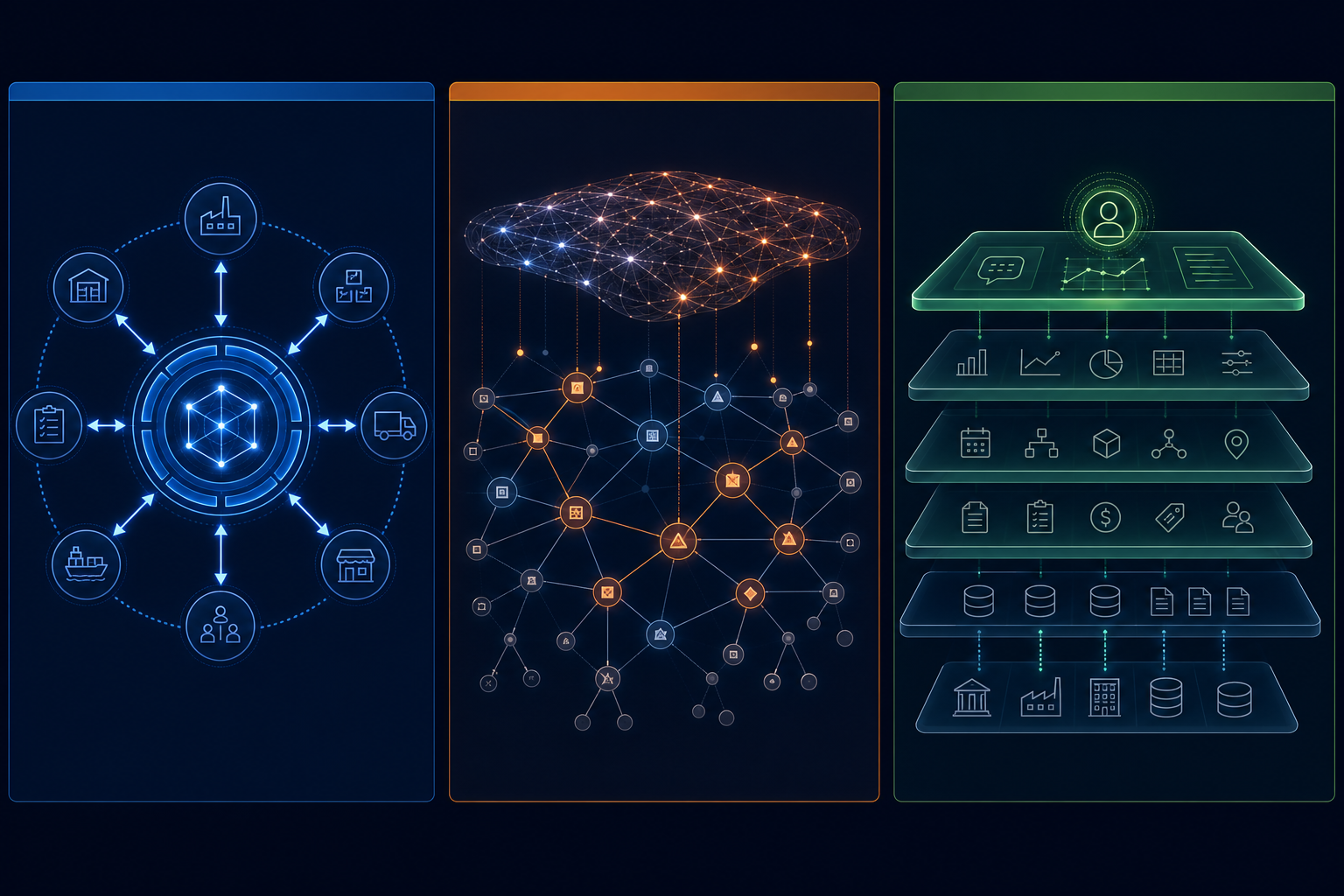
Kinaxis Maestro: Concurrent Planning as the Technical Core
Kinaxis's defensible technical foundation is its patented in-memory concurrent planning engine. When any data point changes — a supplier lead time, a demand signal, a tariff rate — the engine recalculates end-to-end supply chain impacts sub-second across all planning horizons simultaneously. This concurrency is not a performance feature layered on top of a conventional planning engine; it is the architecture.
Demand.AI, Agent Studio, and the Tariff Response tool are built on this concurrency foundation. They cannot be fairly evaluated in isolation. When a Kinaxis demo shows an AI recommendation responding instantly to a tariff change scenario, the speed of that response is a product of the concurrent engine, not the AI layer alone. Evaluating Kinaxis AI features against o9 or SAP IBP AI features without accounting for this architectural dependency produces a distorted capability picture.
o9 Digital Brain: Knowledge-Graph-Native Neuro-Symbolic AI
o9's Enterprise Knowledge Graph (EKG) is the architectural foundation of the platform — not an add-on layer. Every business entity (product, customer, supplier, location, financial metric) exists as a node in the graph, encoding relationships and context. Planning happens on this connected model, not in isolated planning modules.
APEX, launched in March 2026, extends this architecture by combining LLM neural AI with the EKG as neuro-symbolic AI. The approach uses model tournaments, gradient-boosted ensembles, deep learning, and meta-learning to continuously compare algorithms and select the best-performing approach by segment and planning horizon as patterns evolve. Demand forecasting incorporates 200+ external variables, and FVA (Forecast Value Add) analysis quantifies the impact of each step in the forecasting process — distinguishing positive FVA (human input improved the forecast), negative FVA (adjustments degraded quality), and touchless areas.
SAP IBP: AI as an Enhancement Layer on an ERP Execution Engine
SAP IBP's AI architecture is structurally different from the other two. The platform's core strength is its native integration with S/4HANA — it runs on the same data model, eliminates the connector overhead that Kinaxis and o9 must bridge, and benefits from the data quality that SAP enterprises have already invested in building.
Joule, SAP's AI copilot, reached general availability in Q2 2026 with capabilities including natural language planning queries, health checks, document grounding (including the ability to search SharePoint from within Joule in IBP), and an AI supply optimizer. The new telescopic planning capability spans strategic, tactical, and operational planning horizons simultaneously — a meaningful architectural extension of the platform's IBP scope.
ERP Integration Fit: Native, API-Connected, and Graph-Layer Agnostic
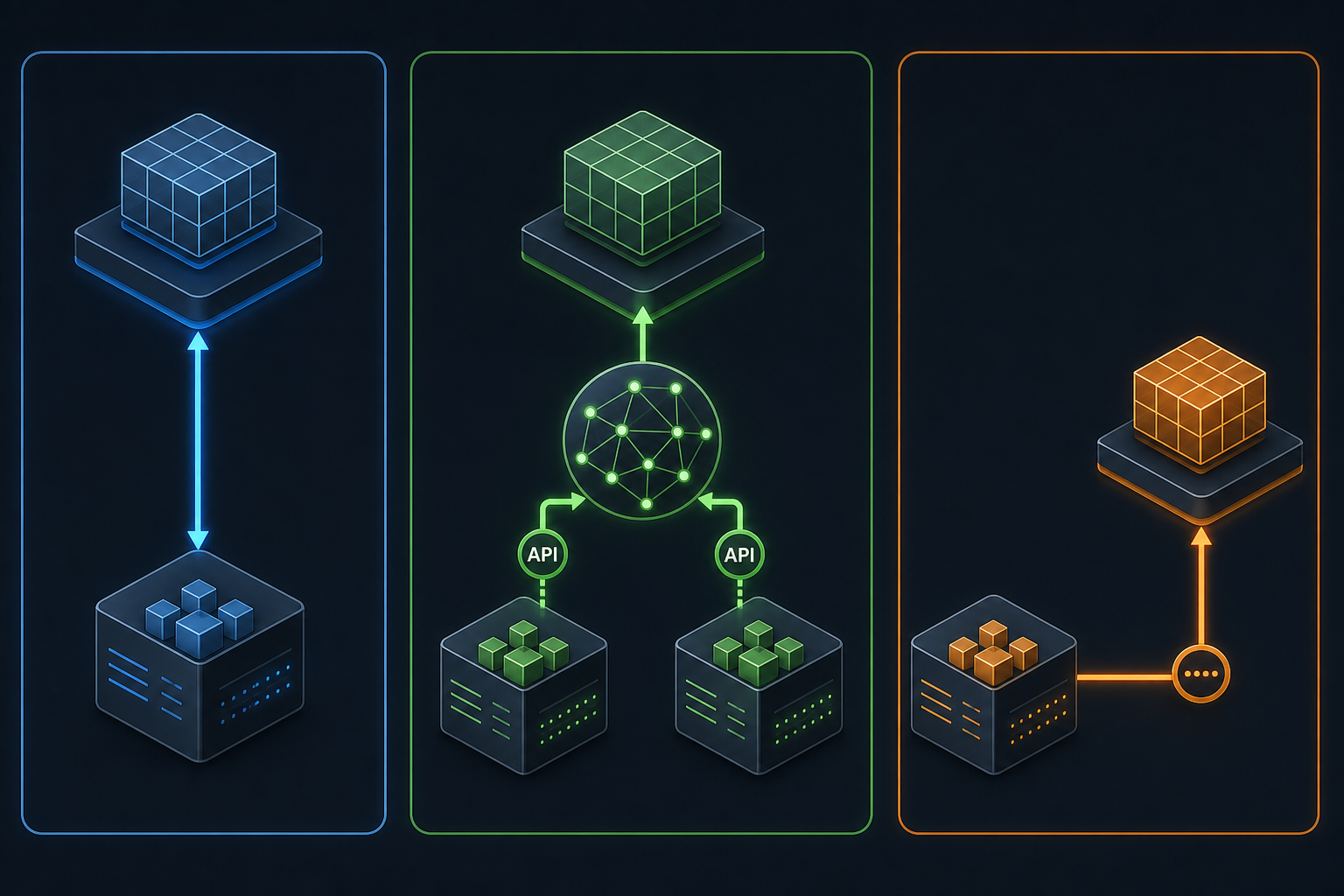
Integration topology is the most concrete differentiator among the three platforms for practitioners who need to move from architecture theory to deployment planning. Each platform takes a fundamentally different approach to connecting with enterprise ERP systems, and that approach has direct implications for data engineering investment and time-to-value.
| ERP Landscape | Recommended Platform | Integration Rationale | Key Prerequisite |
|---|---|---|---|
| SAP S/4HANA single-ERP | SAP IBP | Native integration eliminates connector overhead; data model already aligned | BTP readiness for Joule AI features |
| SAP-centric with legacy ECC migration underway | SAP IBP (evaluate urgency) | ECC end-of-maintenance Dec 2027 makes IBP the natural migration path; evaluate if IBP AI scope meets planning needs | ECC-to-S/4HANA migration timeline |
| Multi-ERP (SAP + Oracle, SAP + D365, or similar) | o9 or Kinaxis | Both are ERP-agnostic; o9 graph layer handles multi-ERP complexity well; Kinaxis API-connected approach is proven at enterprise scale | High data engineering investment for both |
| Non-SAP single ERP (Oracle, D365, Infor) | o9 or Kinaxis | Neither platform is SAP-dependent; selection narrows to data maturity and planning complexity profile | Strong data integration capability required |
| Non-SAP multi-ERP or M&A-driven heterogeneous landscape | o9 (preferred) or Kinaxis | o9 graph layer is best positioned for complex multi-source data environments; Kinaxis concurrent engine also handles multi-ERP at scale | Highest data engineering investment; o9 most sensitive to data maturity |
For practitioners whose evaluation scope extends beyond demand planning into inventory optimization, the integration topology decision has downstream implications. The AI inventory optimization vendor landscape for Q2 2026 covers how inventory optimization platforms connect to the same ERP environments — a relevant consideration if your evaluation includes multi-echelon inventory optimization as a use case adjacent to demand planning.
Data Prerequisites and Organizational Readiness Thresholds
The most consistent failure mode across all three platforms is underestimating the data integration investment required before AI features function as described — not as marketed. Each platform has a different minimum threshold, and the gap between what vendors demonstrate in controlled demo environments and what organizations encounter in production data conditions is routinely larger than expected.
| Platform | Data Maturity Requirement | Organizational Capability Required | AI Feature Dependency on Data Quality |
|---|---|---|---|
| Kinaxis Maestro | Clean transactional data across ERP and supply network; strong master data governance | Skilled data integration team; ERP integration architects | Concurrency value depends on data completeness across all planning nodes; gaps cause recalculation errors that cascade |
| o9 Digital Brain | Highest of the three; structured and unstructured data across commercial, supply chain, and financial domains | Dedicated data engineering function; graph data modeling expertise | EKG quality directly determines AI recommendation quality; APEX model tournaments require sufficient historical data volume and signal diversity |
| SAP IBP | Benefits from existing S/4HANA data quality; lower baseline data engineering investment for core IBP | SAP Basis and BTP administration capability for Joule; Cloud Identity Services consolidation | Core IBP planning functions work on existing S/4HANA data quality; Joule AI features additionally require BTP infrastructure readiness |
Implementation Complexity and Known Failure Modes
All three platforms require 12–18+ months for full enterprise deployment. SAP IBP implementations can extend to 12–24 months when BTP infrastructure readiness is a prerequisite for the AI feature scope. Kinaxis TCO typically runs $1M+ annually. Total platform cost over a 5–10 year horizon — including implementation services, internal team, and ongoing consulting — typically runs 3–7x the year-one license cost across all three platforms.
Each platform has a distinct failure mode pattern that practitioners should evaluate against their organizational context before selecting.
- Kinaxis: Executive sponsorship duration risk. Kinaxis implementations at $1M+ annual TCO with 12–18 month timelines are vulnerable to organizations where CFO or COO tenure averages 18 months or less. When the executive sponsor who approved the investment changes before go-live, implementations frequently stall or descope. This is not a Kinaxis-specific product weakness — it is an organizational fit condition that should be assessed before signing.
- o9: Data engineering underinvestment causing delayed value realization. The most common o9 implementation failure pattern is organizations treating data engineering as a background workstream rather than the primary implementation dependency. When the Enterprise Knowledge Graph is populated with incomplete or inconsistent data, AI recommendations degrade — and the platform's complexity makes diagnosing the root cause slower than with simpler architectures.
- SAP IBP: BTP infrastructure gap causing Joule AI story to remain aspirational post-go-live. Organizations that select SAP IBP partly on the strength of Joule's AI capabilities frequently discover post-go-live that BTP subaccount provisioning, Cloud Identity Services consolidation, and SAP Build Work Zone deployment were not scoped into the implementation. The result is a go-live on core IBP planning functions without the AI features that differentiated the selection decision.
Capability Comparison: Demand Sensing, Scenario Speed, S&OP Breadth, and Forecast Explainability
The following matrix compares four capability dimensions that matter most to demand planning practitioners. These are not exhaustive feature comparisons — they are the dimensions where architectural differences produce the most consequential selection implications.
| Capability Dimension | Kinaxis Maestro | o9 Digital Brain | SAP IBP |
|---|---|---|---|
| Demand sensing — external signal ingestion | Demand.AI incorporates external signals; specific variable count not publicly documented at the same granularity as o9 | Incorporates 200+ external variables including market signals, weather, macroeconomic indicators; APEX model tournaments select best-performing signal combinations by segment | External signal integration available; scope depends on BTP data connectivity and configured data sources |
| Scenario simulation speed | Sub-second concurrent recalculation across end-to-end supply chain when any input changes; this is the platform's architectural benchmark | Scenario modeling within the EKG; speed is a function of graph query complexity and data volume rather than a concurrency-first architecture | Telescopic planning spans strategic, tactical, and operational horizons simultaneously; scenario speed is not a primary architectural differentiator |
| S&OP and IBP planning breadth | Strong supply chain orchestration breadth; commercial and financial planning integration is narrower relative to o9 | Broadest scope: commercial planning, supply chain planning, and financial planning within a single EKG model; designed for integrated business planning across functions | IBP scope covers demand, supply, inventory, and financial planning; telescopic planning adds strategic horizon; native S/4HANA integration is the breadth enabler |
| Forecast explainability | AI recommendations are contextualized within the concurrent planning model; specific explainability mechanisms for Demand.AI are not publicly documented at technical depth | FVA (Forecast Value Add) analysis quantifies the impact of each forecasting step and each human intervention; distinguishes positive FVA, negative FVA, and touchless areas — a differentiating transparency mechanism | Joule provides natural language explanations of planning recommendations; explainability depth for AI supply optimizer is dependent on BTP infrastructure readiness |
Decision Framework: Three Diagnostic Questions
These three diagnostic questions map directly to the architectural differences between the platforms. They are not a ranked recommendation — they are a structured way to identify which architectural fit conditions your organization satisfies. All three platforms are viable for enterprise deployment; the question is which one requires the fewest organizational conditions that you don't currently have.
Question 1: Does your ERP landscape favor native integration or ERP-agnostic connectivity?
If your organization runs SAP S/4HANA as the primary ERP system — or is actively migrating from ECC to S/4HANA ahead of the December 2027 end-of-mainstream maintenance deadline — SAP IBP's native integration eliminates a substantial data engineering workstream that Kinaxis and o9 must budget for. The integration overhead is not a minor consideration: it affects both implementation timeline and ongoing data maintenance cost.
If your organization runs multiple ERP systems — through acquisition, regional variation, or a deliberate heterogeneous architecture — o9's graph-layer approach handles multi-source data complexity more natively than Kinaxis's API-connected model, though both require significant up-front data engineering investment. For non-SAP single-ERP environments, the selection narrows to the second and third diagnostic questions.
Question 2: How mature is your data engineering capability?
o9 requires the highest data engineering maturity of the three platforms. If your organization does not have a dedicated data engineering function with graph data modeling experience, o9's implementation timeline and value realization will be longer than the vendor's reference case timelines suggest.
Kinaxis requires strong ERP integration capability and clean transactional data across the supply network. The concurrency engine's value degrades proportionally to data gaps — incomplete data at any planning node produces cascading recalculation errors.
SAP IBP benefits from existing S/4HANA data quality investments, which lowers the baseline data engineering threshold for core planning functions. However, Joule's AI features add a separate readiness requirement: BTP subaccount provisioning, Cloud Identity Services consolidation, and SAP Build Work Zone deployment. These are infrastructure prerequisites, not data quality prerequisites — a distinction that matters for scoping.
Question 3: What is your supply chain complexity and planning speed profile?
For organizations in automotive, pharmaceutical, or high-tech manufacturing — where supply chain volatility is high, planning horizons are short, and the cost of a delayed scenario recalculation is measurable in production disruption — Kinaxis's concurrent planning architecture is the most directly aligned. The sub-second recalculation capability is not a demo feature; it is an operational requirement for these environments.
For organizations that need to integrate commercial planning (revenue, pricing, promotions), supply chain planning, and financial planning within a single planning model — particularly in multi-ERP or non-SAP environments — o9's EKG scope is the broadest available. The 2025 Gartner Peer Insights Voice of the Customer report named o9 the only Customers' Choice in the supply chain planning category, reflecting user satisfaction with this breadth.
For organizations where SAP ecosystem coherence, ECC migration urgency, and the reduction of integration overhead are the primary drivers — and where the planning complexity profile does not require concurrent sub-second recalculation — SAP IBP is the most organizationally aligned choice, with the Joule AI scope representing a medium-term capability expansion rather than a day-one deliverable.
| Organizational Profile | Diagnostic Signal | Best-Fit Platform |
|---|---|---|
| SAP S/4HANA primary ERP, ECC migration underway | Integration overhead reduction is a primary driver; SAP ecosystem coherence valued | SAP IBP |
| SAP-centric, BTP infrastructure already deployed or roadmapped | Joule AI features are in-scope for go-live or near-term release | SAP IBP |
| Multi-ERP or non-SAP, high data engineering maturity | Commercial + supply chain + financial planning breadth required; FVA explainability valued | o9 Digital Brain |
| Non-SAP, high supply chain volatility, automotive / pharma / high-tech | Concurrent scenario recalculation speed is mission-critical; multi-ERP connectivity required | Kinaxis Maestro |
| SAP-centric, high supply chain volatility, concurrent planning speed required | ERP integration simplicity conflicts with concurrent planning requirement; evaluate both IBP and Kinaxis | Evaluate both; run parallel POC |
Evaluation Checklist for Practitioners
The following verification questions are organized by platform. Bring these to vendor reference calls, proof-of-concept scoping sessions, and contract negotiations — not to the demo.
SAP IBP Verification Questions
- What is the current state of our BTP subaccount provisioning, and is Cloud Identity Services consolidation complete across all SAP products? If not, what is the realistic timeline, and what is the implementation scope without Joule?
- Which Joule capabilities are available at go-live versus which require BTP readiness milestones that are post-go-live? Request a feature-by-BTP-prerequisite mapping, not a combined roadmap.
- Can you provide a reference customer who went live on IBP within the last 18 months with Joule AI features in production — not in a sandbox or pilot environment?
- What is the telescopic planning scope in our specific S/4HANA version, and which planning horizons are available without additional module licensing?
- If we are migrating from ECC, what is the data migration sequence and which IBP features are dependent on S/4HANA data model completion?
o9 Digital Brain Verification Questions
- What is the minimum data engineering team size and skill profile required to build and maintain the Enterprise Knowledge Graph at our data volume and source count? Request a data engineering capacity model from reference customers of comparable complexity.
- Can you provide the APEX technical methodology documentation — model types used, tournament evaluation criteria, and how the neuro-symbolic combination of LLM and EKG is implemented at the inference layer?
- What is the FVA analysis configuration process, and which FVA metrics are available out-of-the-box versus requiring custom configuration?
- For the 200+ external demand variables: which are pre-integrated and which require custom data pipeline development? What is the typical data engineering cost for the external signal integrations relevant to our industry?
- Given the active November 2025 IP legal dispute with SAP: what is o9's position on the case, and what contractual protections are available if the dispute affects product development roadmap or company continuity?
Kinaxis Maestro Verification Questions
- Require a concurrency architecture demonstration using our actual data model — not a curated demo dataset. The sub-second recalculation claim should be verified against our specific supply network node count and data volume.
- For Maestro Agents specifically: which agents are generally available in production, which are in early access or beta, and what are the configuration prerequisites for each? Request a production reference customer using agents in live planning operations.
- What is the Tariff Response tool's current availability status, and what data inputs are required for tariff scenario modeling to function? Is this a generally available feature or a separately licensed module?
- What is the realistic implementation timeline for our ERP environment (specify ERP systems and version), and what is the data engineering workstream scope? Request a detailed integration architecture document, not a high-level roadmap.
- What is the complete TCO model for years 1–5, including implementation services, internal team requirements, and ongoing consulting? Request a reference TCO from a customer of comparable scale and ERP complexity.
Comments
Join the discussion with an anonymous comment.