
Scope and Editorial Methodology
This comparison covers three S&OP AI platforms — Blue Yonder, Infor CloudSuite SCM, and Logility (now an Aptean company) — as they stand in Q2 2026. It is written for supply chain directors, demand planning leads, and VP Operations in mid-market to upper-mid-market manufacturing and distribution organizations: companies that have outgrown spreadsheet-based S&OP but are not yet operating at the scale or complexity where Kinaxis, SAP IBP, or o9 Solutions represent the natural shortlist.
The reason these three vendors appear on the same shortlist is largely circumstantial: they each occupy a position below the Kinaxis/SAP IBP tier in terms of implementation overhead and licensing floor, and each has received Gartner Magic Quadrant recognition in 2026. But they are architecturally distinct. Blue Yonder is an enterprise-scale platform that happens to be evaluable by upper-mid-market buyers. Infor CloudSuite SCM delivers S&OP AI primarily as a layer within its own ERP ecosystem, not as a standalone planning product. Logility is a purpose-built mid-market planning platform with a recent agentic AI launch that changes its competitive positioning meaningfully.
A second common reason for this shortlist: existing Infor CloudSuite customers often evaluate Logility or Blue Yonder as best-of-breed alternatives when Infor's embedded planning capabilities feel insufficient. This article addresses that specific make-vs-buy calculus directly in the fit-by-profile section.
Pricing and implementation timeline figures cited for Blue Yonder are derived from third-party analyst and review sources — specifically SelectHub and Horizon Solutions — not from Blue Yonder disclosures. Logility performance claims are sourced from Logility's own published materials and are attributed accordingly. Infor's 2026 Gartner MQ positioning is not confirmed from a vendor-disclosed press release and is not claimed in this article.
Defining the AI Capability Types: What S&OP AI Actually Means Across These Three Vendors
All three vendors use the term "AI" in their S&OP marketing, but the techniques involved are materially different. Conflating them leads to evaluation errors — specifically, comparing a rule-based workflow automation feature against a trained probabilistic forecasting model as if they were equivalent capabilities.
Three distinct capability types are present across this vendor set:
- ML-based supply chain planning AI: Trained machine learning models that generate probabilistic demand forecasts, optimize inventory policies, or run scenario simulations. These require historical transaction data, ongoing model training, and produce outputs that improve with more data. Blue Yonder's Luminate Cognitive Demand Planning and Logility's self-improving forecast models fall here.
- GenAI-embedded workflow features: Large language model integrations that assist with ERP workflow tasks — text authoring, summarization, email generation, process insights. These do not produce supply chain planning outputs; they accelerate human tasks within the planning process. Infor's GenAI Embedded Experiences fall here.
- Agentic AI: Autonomous AI agents that monitor planning signals, detect anomalies, and take or recommend actions without requiring a human to initiate each step. Logility's DemandAI+ agents (launched April 7, 2026) fall here. Infor's Agentic Orchestrator also operates in this space, though its supply-chain-planning-specific agents are not individually enumerated in public documentation.
| Capability Type | Blue Yonder | Infor CloudSuite SCM | Logility (Aptean) |
|---|---|---|---|
| ML-based demand forecasting | Yes — probabilistic, LP optimization, demand sensing | Yes — Augmented Intelligence Service (AIS) predictive models | Yes — self-improving ML, continuous retraining |
| GenAI-embedded workflow | Limited public detail | Yes — Embedded Experiences across ERP workflows | Limited public detail |
| Agentic AI for planning | Adaptive Plan Management (automated scenario triggers) | Agentic Orchestrator (100+ agents across full portfolio) | DemandAI+ prebuilt agents (launched April 2026) |
| Standalone vs. ERP-embedded | Standalone best-of-breed | ERP-embedded; value tied to Infor CloudSuite | Standalone best-of-breed |
Blue Yonder: Enterprise-Scale Luminate Planning and IBP
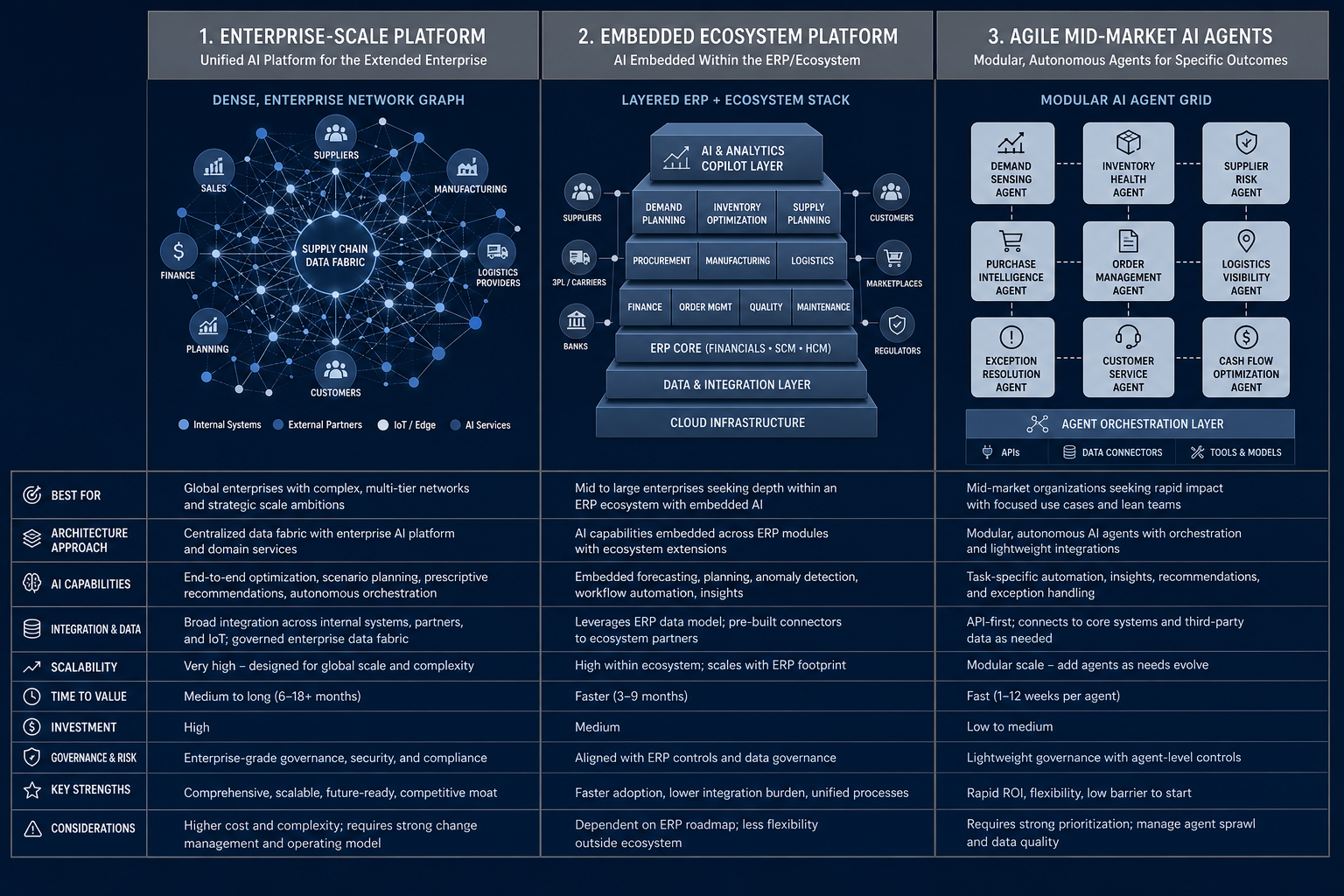
Blue Yonder's S&OP and IBP capabilities are delivered through two interconnected product layers: Luminate Cognitive Demand Planning and the Integrated Business Planning (IBP) module. These are the only Blue Yonder capabilities covered here — WMS, transportation management, and order management are addressed in separate site coverage.
AI Technique Layer
Blue Yonder's supply chain planning platform combines statistical methods, machine learning, and LP (linear programming) optimization. Luminate Cognitive Demand Planning applies ML-based probabilistic forecasting with explainability — the system identifies causal factors behind demand signals rather than producing black-box outputs. Demand sensing is a core differentiator: the platform processes short-cycle demand signals to adjust near-term forecasts, which is particularly valuable in retail and CPG environments where weekly or daily signal refresh matters.
IBP Module Capabilities
The Blue Yonder IBP module includes three capabilities that distinguish it from basic S&OP tools:
- Adaptive Plan Management: Monitors KPI data in real time, identifies deviations from plan, adjusts configurations, and triggers corrective steps using standard process playbooks — reducing the manual exception management burden on planning teams.
- Automated Scenario Planning: Examines external data feeds and influencing factors to generate demand scenarios and analyze supply chain constraints automatically, rather than requiring planners to manually configure each scenario.
- Process Orchestration: Maintains global process compliance across geographies and time zones — relevant for multi-region manufacturers running a single IBP cycle across distributed teams.
Blue Yonder was named a Leader in the 2026 Gartner Magic Quadrant for Supply Chain Planning Solutions: Discrete Industries. Its strongest established verticals are large retailers, CPG manufacturers, and discrete manufacturers with high SKU complexity and multi-echelon distribution networks.
Known Limitations
- Implementation overhead is substantial. Independent categorization by Horizon Solutions places Blue Yonder in the enterprise tier requiring 12–24 months for implementation. User reviews cited by SelectHub describe the platform as taking "a long time to set up and needing constant support" with limited ease of customization.
- Licensing floor is enterprise-grade. SelectHub lists Blue Yonder's starting price at $100,000 annually. This figure is from third-party analyst data, not Blue Yonder's own disclosures.
- Mid-market discrete manufacturers face a fit gap. Horizon Solutions notes Blue Yonder is "less competitive for pure mid-market discrete" — the platform's depth is optimized for retail and CPG scale, and mid-market discrete manufacturers may find the implementation investment disproportionate to the planning complexity they need to solve.
Infor CloudSuite SCM: S&OP AI as an ERP-Embedded Planning Layer
Infor's S&OP AI story is inseparable from its ERP ecosystem. The product branded as Infor Integrated Business Planning provides scenario modeling, cross-enterprise collaboration, and decision-making from industry-standard KPIs — but its AI depth depends on the Infor Industry Cloud Platform and the structured ERP transaction data already present in Infor CloudSuite. This is not a platform that competes on equal terms with Blue Yonder or Logility for organizations that are not already Infor customers.
AI Technique Layer: Two Distinct Capability Types
Infor's AI portfolio — now branded Infor Artificial Intelligence (the Coleman AI brand was retired in April 2024) — contains two meaningfully different capability types that are easy to conflate in vendor materials:
- Augmented Intelligence Service (AIS): Predictive and prescriptive ML models introduced in the April 2025 Infor Industry AI release. For supply chain planning, AIS covers demand analysis, inventory policy scenario analysis, and warehouse slotting optimization. AIS solutions are delivered with the guidance of Infor's in-house data scientists — this is a managed/consulting-assisted model, not pure self-serve configuration.
- GenAI Embedded Experiences: LLM-based workflow productivity features covering ERP tasks — text authoring, summarization, process insights for distribution and manufacturing. These accelerate human tasks within the planning workflow but do not generate supply chain planning outputs. Do not evaluate these as planning AI.
April 2026 Industry AI Release: Agentic Orchestrator and 100+ Agents
The April 2026 Infor Industry AI release expanded the agent library to more than 100 agents and delivered significant enhancements to the Infor Agentic Orchestrator, including supervisor-led multi-agent coordination, native Model Context Protocol (MCP) connectivity to both Infor and non-Infor systems, and new observability capabilities for IT governance.
Known Limitations
- Structural ERP dependency: Infor's S&OP AI value is a function of how mature and complete the underlying Infor CloudSuite deployment is. Organizations with incomplete ERP data or hybrid ERP environments will not realize the AIS predictive model value.
- AIS is consulting-assisted: Unlike Blue Yonder's self-configuring ML models or Logility's self-improving agents, Infor's AIS solutions are delivered with in-house data scientist guidance. This implies a longer activation path and ongoing Infor professional services dependency.
- User satisfaction gap vs. Blue Yonder: SelectHub review data shows Infor SCM at a 63% satisfaction rating from 25 reviews, compared to Blue Yonder's 83% from 42 reviews. Users specifically cite implementation complexity, cost concerns, and reporting limitations.
- Gartner MQ positioning unconfirmed: No Infor-issued 2026 Gartner MQ press release for Supply Chain Planning Solutions was identified in current source materials. Infor's 2026 MQ positioning is not stated in this article.
Logility (Aptean): Agentic AI for Mid-Market S&OP
Logility is now an Aptean company. In vendor press releases, the compound name "Aptean (Logility)" is used, but practitioners and analysts continue to refer to the platform primarily as Logility. This article uses "Logility" as the primary reference for clarity, with "Aptean" noted where relevant to product naming (e.g., Aptean AppCentral).
Logility's Q2 2026 positioning changed materially on April 7, 2026, with the launch of DemandAI+ on Aptean AppCentral. This launch moves Logility from a strong ML-based planning platform into active agentic AI territory — a meaningful step that distinguishes it from most mid-market S&OP competitors.
DemandAI+ Agentic AI: Four Prebuilt Agents
Four prebuilt agents are available at launch, each designed to address a specific planning workflow gap:
- Review Forecast Accuracy: Continuously detects forecast winners and laggards and surfaces bias patterns — replacing the manual exception review cycle that typically consumes planner time in weekly S&OP preparation.
- Retrieve History or Forecast: Provides instant access to demand history and forecast data without requiring system navigation — reducing the friction of ad-hoc data retrieval during planning meetings.
- Detect Trends in Historical Data: Analyzes time-series demand data to surface emerging shifts before they cause disruptions — an early-warning capability that is particularly relevant for mid-market manufacturers with seasonal or trend-sensitive product lines.
- Training Opportunities: Identifies anomalies requiring planner validation to keep forecast models self-improving — closing the human-in-the-loop feedback cycle that ML models depend on for continued accuracy gains.
Each agent can operate autonomously or with human-in-the-loop intervention, depending on organizational governance preferences. DemandAI+'s composable architecture allows organizations to add agents beyond the prebuilt set — either through additional Aptean releases or by working with Logility supply chain experts to build custom agents without replacing existing stack components.
Underlying ML Platform and S&OP Coverage
DemandAI+ sits on top of Logility's existing AI-first planning platform, which uses self-improving ML models that continuously sense, analyze, and update planning parameters in real time. The platform is designed to remove human bias from statistical baseline generation and improve accuracy over time without requiring planners to manually retrain models.
Gartner MQ Recognition and Market Position
Aptean (Logility) was named a Leader in both the 2026 Gartner Magic Quadrant for Supply Chain Planning Solutions: Process Industries (March 17, 2026) and Supply Chain Planning Solutions: Discrete Industries (March 18, 2026) — one of only four vendors to achieve Leader status in both reports simultaneously. This dual recognition is meaningful for mid-market manufacturers that operate across both process and discrete production modes.
Customer Evidence and Performance Claims
The Great Lakes Cheese case study, documented in Logility's blog, reports greater than 80% forecast accuracy, 99% service level stability, and 9–10 days of finished goods inventory after replacing spreadsheet-based planning with Logility's integrated platform. These figures are sourced from Logility and have not been independently verified.
Side-by-Side Comparison Matrix
| Dimension | Blue Yonder | Infor CloudSuite SCM | Logility (Aptean) |
|---|---|---|---|
| Primary AI technique | ML probabilistic forecasting, LP optimization, demand sensing | AIS predictive/prescriptive models (consulting-assisted); GenAI Embedded Experiences for workflows | Self-improving ML forecasting; DemandAI+ agentic agents (April 2026) |
| S&OP / IBP coverage | Full IBP: scenario planning, adaptive plan management, process orchestration, demand sensing | Infor Integrated Business Planning: scenario modeling, cross-enterprise collaboration, KPI-based decisions | Demand planning, inventory optimization, S&OP cycle management; agentic forecast review |
| Agentic AI | Adaptive Plan Management (automated exception triggers and playbooks) | Agentic Orchestrator with 100+ agents (full portfolio scope; supply chain planning subset unspecified) | DemandAI+ four prebuilt agents; composable for additional agents |
| ERP integration prerequisite | Best-of-breed; integrates with major ERPs but requires custom integration work | Structurally dependent on Infor CloudSuite; not viable as standalone for non-Infor customers | Best-of-breed; integrates with major ERPs; relative tolerance for data immaturity at launch |
| Data requirements | Clean, high-volume historical demand data at SKU-location granularity | Structured ERP transaction data already present in Infor CloudSuite | Self-improving ML; more tolerant of data immaturity at launch than Blue Yonder |
| Deployment timeline | 12–24 months (per Horizon Solutions and SelectHub; not Blue Yonder disclosed) | Gated by Infor CloudSuite deployment maturity; not independently benchmarked | 6–12 months for mid-market (per Horizon Solutions categorization) |
| TCO profile | $100K+ annually in licensing (per SelectHub); high customization and support cost | Bundled with Infor CloudSuite licensing; incremental cost for AIS consulting services | Mid-market pricing; lower implementation overhead than Blue Yonder |
| 2026 Gartner MQ | Leader — Discrete Industries | Not confirmed from vendor press release | Leader — Process Industries AND Discrete Industries (one of four vendors in both) |
| Target organizational profile | Large retailers, CPG, upper-mid-market to enterprise discrete manufacturers | Existing Infor CloudSuite customers in manufacturing and distribution | Mid-market to upper-mid-market manufacturers and distributors; multi-mode production |
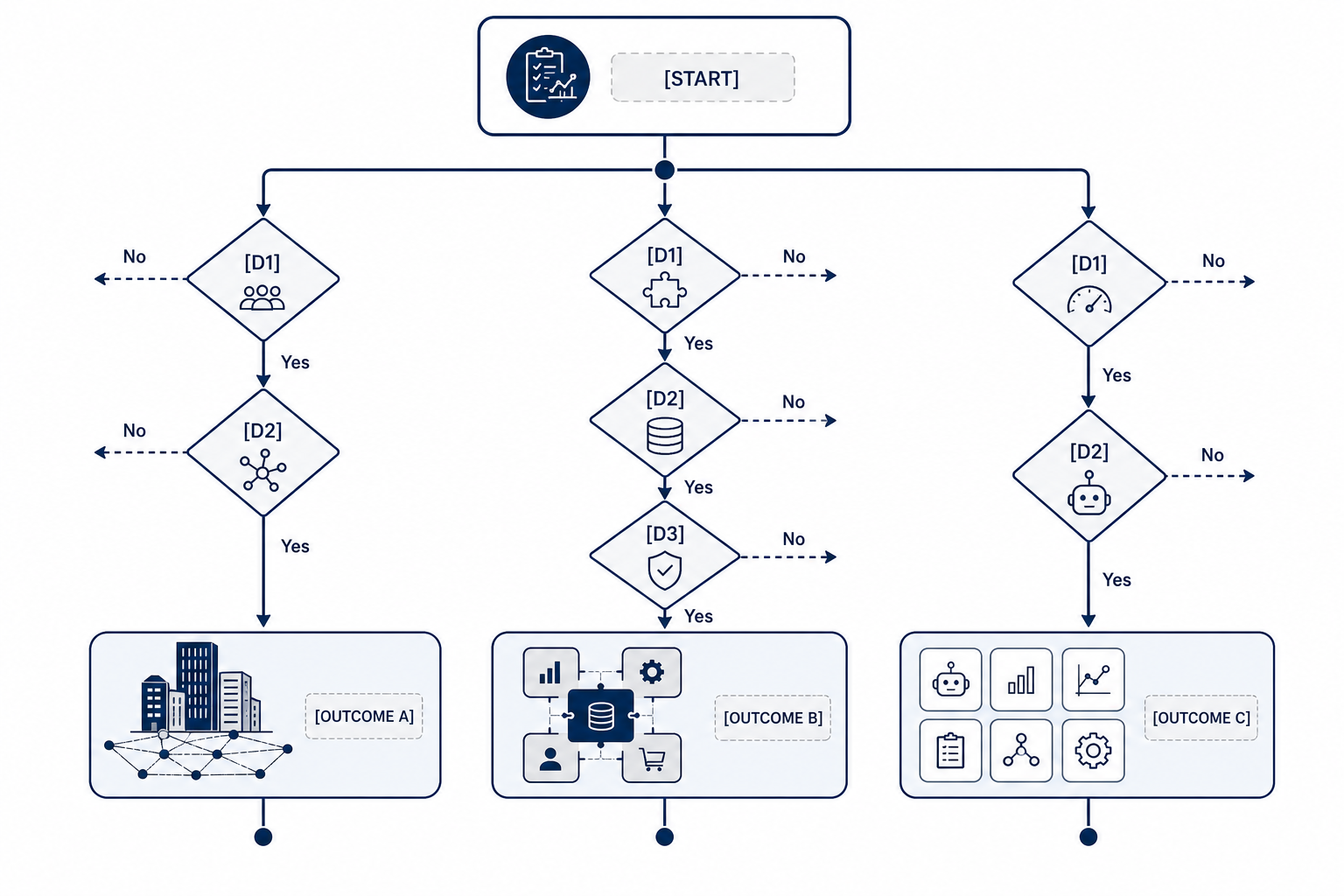
Fit-by-Profile Guidance: Three Buyer Profiles with Decision Logic
The right vendor depends on organizational scale, ERP ecosystem, and what the AI capability needs to accomplish — not on feature list length. Three buyer profiles capture the majority of practitioners evaluating this vendor set.
Profile 1: Upper-Mid-Market Manufacturer or Retailer on a Non-Infor ERP, Evaluating Best-of-Breed S&OP
Organizations in this profile — typically $200M–$1B revenue, running SAP, Oracle, Microsoft D365, or a legacy ERP — need a standalone S&OP platform that can deliver ML-based demand forecasting and scenario planning without requiring an ERP migration.
- Start with Blue Yonder if: your planning complexity is high (thousands of SKUs, multi-echelon distribution, retail or CPG demand patterns), your IT organization can absorb a 12–18 month implementation, and your budget accommodates $100K+ annually in licensing plus professional services.
- Start with Logility if: your planning complexity is moderate (mid-market manufacturer or distributor with manageable SKU counts), you want faster time-to-value (6–12 months), and agentic AI for forecast cycle automation is a near-term priority.
- Exclude Infor CloudSuite SCM from this evaluation. Its S&OP AI value requires the Infor CloudSuite ERP foundation. Evaluating it as a standalone platform will produce a misleading comparison.
Profile 2: Existing Infor CloudSuite Customer Assessing Embedded vs. Best-of-Breed Planning
This is the make-vs-buy decision that Infor CloudSuite customers face when their existing Infor planning capabilities feel insufficient for growing S&OP complexity.
- Stay with Infor Integrated Business Planning + AIS if: your Infor CloudSuite deployment is mature, your ERP transaction data is clean and complete, and your S&OP process needs are met by scenario modeling and KPI-based decision support. The incremental cost and integration risk of a best-of-breed platform may not be justified.
- Evaluate Logility as a best-of-breed alternative if: your Infor planning modules are generating persistent user dissatisfaction, you need agentic AI capabilities that Infor's AIS does not yet provide at the planning layer, or your planning team's exception management workload is growing faster than headcount.
- Evaluate Blue Yonder as a best-of-breed alternative if: your organization is at the upper end of the mid-market or transitioning to enterprise scale, with retail or CPG demand complexity that Infor's planning modules cannot adequately model.
Profile 3: Mid-Market Manufacturer or Distributor Seeking Faster Deployment and Lower Overhead
Organizations in this profile — typically $50M–$300M revenue, running a variety of ERPs, with planning teams of 2–10 people — need S&OP AI that delivers measurable improvement within a single fiscal year without enterprise-scale implementation overhead.
- Logility is the primary fit. Its mid-market positioning, self-improving ML models, and DemandAI+ agentic agents are designed for this profile. The composable agent architecture means you can start with the four prebuilt agents and expand as planning maturity grows.
- Blue Yonder is likely oversized. A 12–24 month implementation timeline and $100K+ licensing floor represent a significant commitment relative to the planning complexity this profile typically faces.
- Infor is only relevant if you are already an Infor CloudSuite customer. If you are, the embedded planning layer may be sufficient for this profile's needs without the cost and disruption of a best-of-breed deployment.
Data and Integration Prerequisites per Vendor
The data readiness conditions required before each vendor can deliver its stated AI value differ substantially. Misreading these prerequisites is one of the most common sources of S&OP AI deployment disappointment. Before shortlisting any of these three vendors, assess your current data state against the conditions below.
For a structured assessment process, the AI Supply Chain ERP Data Readiness Assessment Checklist provides a function-level readiness framework applicable across all three vendors.
| Prerequisite Dimension | Blue Yonder | Infor CloudSuite SCM | Logility (Aptean) |
|---|---|---|---|
| Historical demand data | Clean, high-volume demand history at SKU-location granularity; multi-year history preferred for seasonal pattern detection | Structured transaction data already present in Infor CloudSuite ERP; quality gated by ERP data hygiene | Self-improving ML; more tolerant of data immaturity at launch; accuracy improves over time as models self-correct |
| ERP integration complexity | Best-of-breed; requires custom integration to your ERP; integration effort is a primary implementation cost driver | Native to Infor CloudSuite; no external ERP integration required for Infor customers; non-Infor customers cannot use this path | Best-of-breed; documented integrations with major ERPs; integration complexity is lower than Blue Yonder per third-party categorization |
| Master data quality | High — SKU master, location master, and demand history must be clean before ML models produce reliable outputs | Dependent on Infor CloudSuite master data quality; AIS models inherit ERP data quality issues | Moderate — self-improving models can identify and flag anomalies, partially compensating for master data gaps |
| IT resource requirement | High — significant IT involvement for ERP integration, data pipeline setup, and ongoing platform support | Moderate — Infor customers have existing IT familiarity; AIS requires Infor data scientist engagement | Lower — mid-market platform designed for smaller IT teams; DemandAI+ agents reduce manual configuration burden |
| Planning team readiness | High — platform complexity requires trained super-users and ongoing change management | Moderate — embedded in familiar Infor environment; learning curve is lower for existing Infor users | Moderate — agentic agents reduce manual workload but require planners to validate agent recommendations initially |
What to Verify Before Shortlisting Each Vendor
Vendor demos and RFP responses for S&OP AI platforms tend to emphasize capability breadth over integration specifics. The questions below are designed to surface the information that matters most for shortlisting decisions — and to catch the most common evaluation errors with each vendor.
Blue Yonder Verification Checklist
- Ask for a reference customer in your industry vertical and revenue range who completed a full IBP implementation — not a pilot. Ask specifically about the implementation timeline and what extended it.
- Request a breakdown of total first-year cost: licensing, professional services, data integration, and internal IT resource commitment. The $100K+ licensing figure does not include implementation services.
- Verify which ERP the reference customer is running and what the integration architecture looks like. Blue Yonder's best-of-breed model means integration complexity varies significantly by ERP.
- Ask specifically which AI features in Luminate Cognitive Demand Planning are available at the licensing tier you are evaluating — some ML capabilities may require higher-tier licensing.
- Clarify the Gartner MQ context: Blue Yonder's 2026 Leader recognition is in the Discrete Industries report. If you are a process industry manufacturer, verify whether that report's evaluation criteria apply to your use case.
Infor CloudSuite SCM Verification Checklist
- Confirm which Augmented Intelligence Service (AIS) models are included in your CloudSuite licensing tier versus which require additional professional services engagement. AIS is delivered with Infor data scientist guidance — clarify what that means for ongoing cost.
- Ask Infor to enumerate which of the 100+ Industry AI agents in the April 2026 release are specifically scoped to supply chain planning and S&OP — not ERP-wide or cross-functional agents.
- Distinguish GenAI Embedded Experiences from AIS predictive models in the demo. Ask to see AIS demand analysis and inventory policy scenario analysis specifically, not workflow summarization features.
- If you are evaluating Infor as a best-of-breed alternative (i.e., you are not already an Infor CloudSuite customer), stop the evaluation here. Infor's S&OP AI is not designed to function outside the Infor CloudSuite ecosystem.
- For existing Infor customers: ask for a reference customer who has implemented AIS for demand analysis and can speak to the data readiness requirements and activation timeline.
Logility (Aptean) Verification Checklist
- DemandAI+ launched April 7, 2026. Ask specifically how many production deployments of DemandAI+ agents exist as of your evaluation date. Given the launch timing, expect this number to be small and treat agent performance claims as vendor-announced rather than market-validated.
- Ask for the DemandAI+ agent governance model: how are autonomous agent actions logged, reviewed, and overridden? What is the audit trail for agent-initiated forecast adjustments?
- Confirm which ERP integrations are pre-built versus require custom work for your specific ERP version. Ask for the integration architecture used by the reference customer closest to your ERP environment.
- Verify the composable agent claim: ask what the process and cost structure is for building a custom agent beyond the four prebuilt options. Understand whether this requires Aptean professional services or can be self-configured.
- Logility's dual Gartner MQ Leader recognition (Process Industries and Discrete Industries) is meaningful but covers different evaluation criteria than Blue Yonder's Discrete Industries recognition. Confirm which report's criteria are most relevant to your production environment.
Comments
Join the discussion with an anonymous comment.