
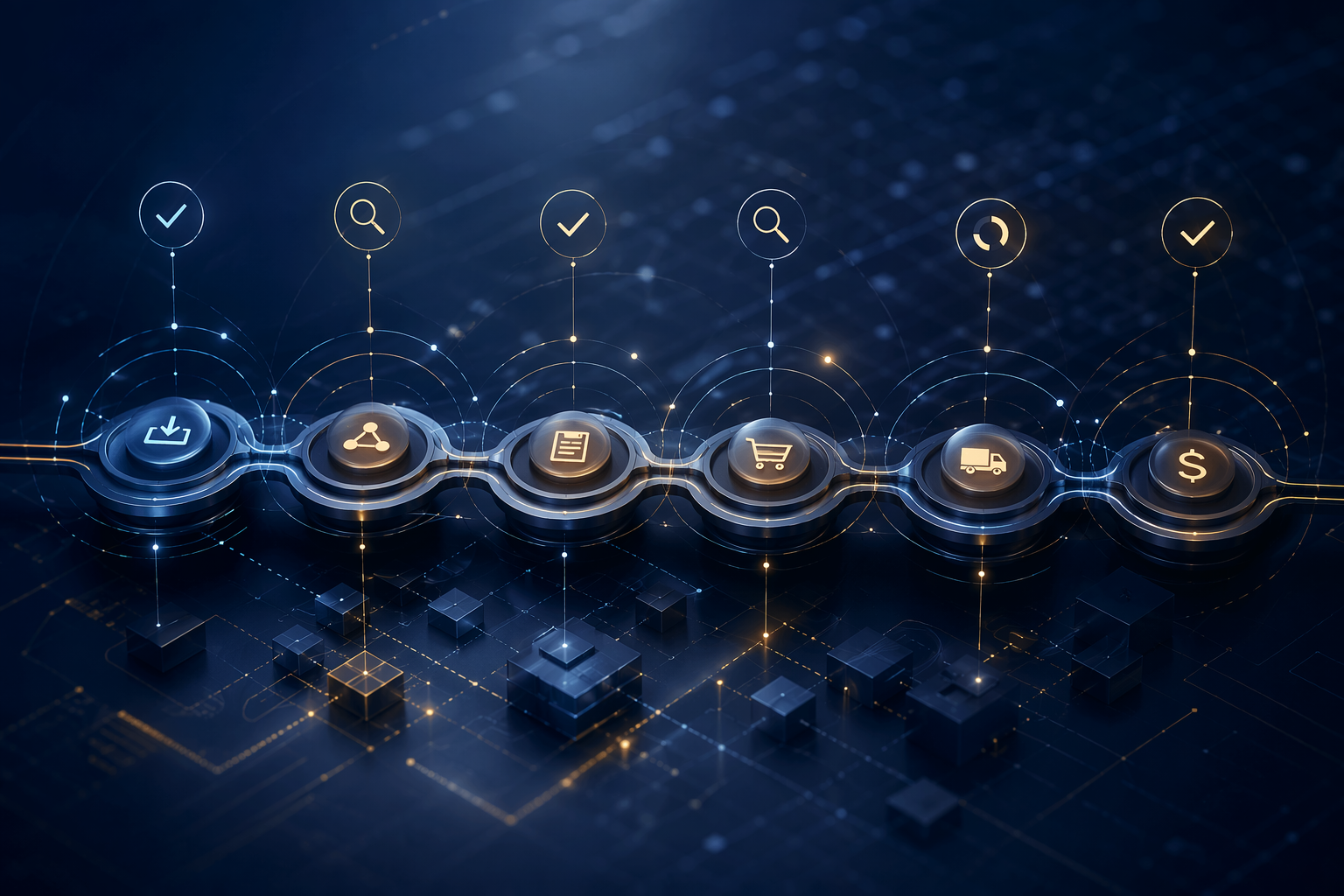
The hard part of buying ai procurement software in 2026 is not finding a demo with a chatbot, a spend dashboard, or a contract summarizer. The hard part is deciding whether the intelligence in that demo will survive contact with your supplier master, approval matrix, contract repository, ERP interfaces, category taxonomy, and the business users who still email procurement after the new system goes live.
That distinction matters because procurement is in an awkward middle period. EY has reported that 94% of procurement leaders use GenAI weekly, while only 36% report meaningful implementations.[1] There is enough usage to create executive pressure, but not enough operating maturity to make vendor claims self-validating. The next failed implementation will not be blamed on “AI hype” in the abstract. It will land on the CPO who approved a platform without proving how it would change intake, sourcing, contracting, risk review, approvals, and data quality.
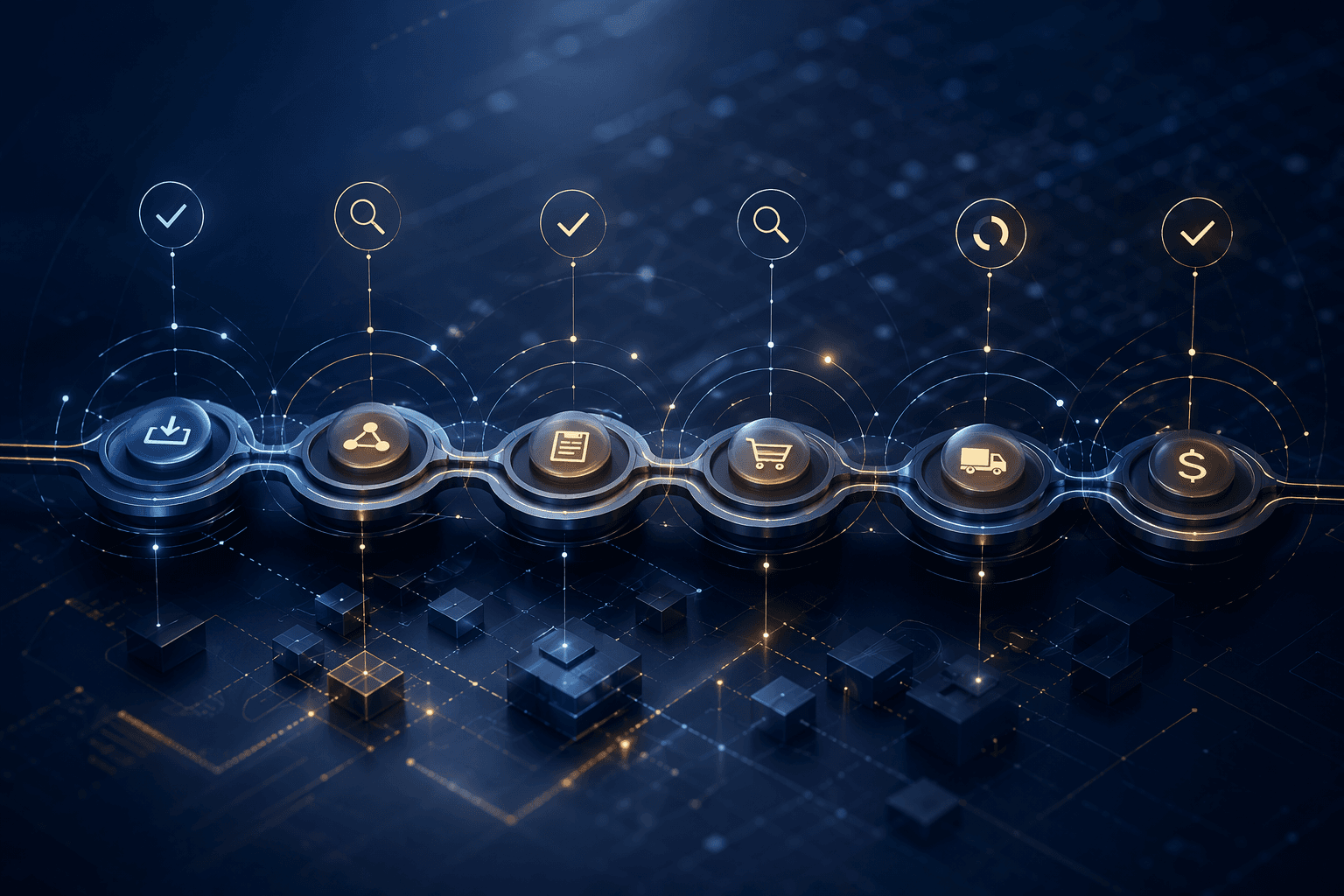
Market-size forecasts are less useful than they look here. Different analysts draw the category boundary differently: some include source-to-pay suites, some include analytics tools, some include procurement orchestration layers, and some count broader supply-chain AI. For a CPO, the better first question is not “How large is the market?” It is: “Which architecture can improve our procurement operating model without creating another reconciliation layer?”
Why feature checklists mislead procurement teams
Most vendor scorecards flatten different products into rows that appear comparable: AI intake, supplier discovery, contract review, spend analytics, risk alerts, autonomous approvals. On paper, two platforms can both receive a checkmark for “AI contract intelligence.” In practice, one may extract clauses from uploaded PDFs while another connects contract obligations to sourcing events, supplier records, purchase orders, renewals, and compliance workflows. Those are not the same capability.
The same problem shows up in spend analytics. A dashboard that classifies historical spend is useful. A platform that detects leakage, recommends category actions, triggers supplier reviews, and updates workflows based on approved decisions is doing something materially different. The first helps procurement see the mess faster. The second starts changing how the organization acts on it.
Deloitte’s 2025 Global CPO Survey gives the architecture question real economic weight: organizations with unified data models and embedded AI achieved approximately 3.2x returns, compared with 1.5x for less mature organizations.[2] That does not prove that any one suite is automatically better than every point solution. It does mean that CPOs should treat data model, workflow depth, and operating integration as buying criteria, not as technical footnotes left for IT after procurement has chosen the interface it likes.
For readers comparing named vendors, a separate Q2 2026 AI procurement software vendor landscape is the better place to look at category positioning. This guide is about the evaluation method that should come before shortlisting.
Start with architecture before discussing AI features
Before sitting through the next assistant demo, ask the vendor to draw the operating architecture. Not the product architecture in generic SaaS language. The procurement architecture: where demand enters, how suppliers are identified, how contracts are linked, where risk signals are consumed, how approvals are routed, how purchase orders and invoices are reconciled, and which system owns each data object.
The answer usually places the product in one of three broad patterns:
- A unified source-to-pay suite with AI embedded across intake, sourcing, contracting, purchasing, supplier management, analytics, and risk workflows.
- A procurement orchestration layer that sits above existing ERP, P2P, sourcing, contract, and supplier systems to coordinate intake and workflow.
- A best-of-breed point solution that goes deep in one area, such as spend classification, supplier discovery, contract analysis, or risk monitoring.
None of these patterns is automatically right. A global enterprise with fragmented ERPs and no appetite for a full S2P replacement may get more near-term value from an orchestration layer than from another suite migration. A company with highly complex direct materials sourcing may need a specialist tool even if it already owns a broad procurement suite. A services-heavy business with poor intake discipline may benefit most from demand orchestration before it buys more analytics.
The mistake is buying a point solution while expecting platform-level transformation, or buying a suite while assuming the unified data model will appear by itself. Deloitte’s survey also found that siloed working structures were the top barrier to AI value delivery, cited by 57% of CPOs.[2] That is exactly where many demos are too tidy: the software appears intelligent because the sample workflow has clean records, clear ownership, and no legal, finance, or business-unit exception path.
If the architecture choice is still open, use a separate procurement AI orchestration versus S2P architecture guide to pressure-test whether your problem is system replacement, cross-system coordination, or capability depth in a narrow domain.
A five-capability framework for evaluating AI procurement software
The evaluation should still cover the full procurement lifecycle. The difference is that each capability should be tested for operational depth, not merely feature availability.
| Capability | What to test | Weak answer | Stronger answer |
|---|---|---|---|
| Intelligent intake and demand orchestration | How business demand becomes a compliant procurement path | A chatbot captures requests and sends them to procurement | The system routes demand by category, policy, supplier status, contract availability, approval rules, and risk |
| AI-driven sourcing and supplier discovery | How the platform identifies, qualifies, and recommends suppliers | Searchable supplier database with AI suggestions | Recommendations tied to spend history, performance, risk, diversity, location, capacity, and sourcing strategy |
| Contract intelligence | How contract data affects sourcing, buying, renewals, and compliance | Clause extraction and summarization | Obligations, terms, renewal dates, pricing, and risk positions linked to procurement workflows |
| Predictive spend analytics and risk management | How analytics turn into decisions and actions | Dashboards, alerts, and spend classification | Continuous classification, leakage detection, category recommendations, risk signals, and workflow triggers |
| Procurement automation | How approvals, POs, invoices, exceptions, and controls are executed | Rules-based workflow with some AI assistance | Automation that uses policy, supplier, contract, budget, risk, and transaction context together |

1. Intelligent intake should reduce downstream cleanup, not just create a nicer front door
Intake is often where the AI demo looks best. A business user types a request in natural language, the assistant asks a few clarifying questions, and the request enters a workflow. That is useful, but it is not enough to justify the platform.
The real test is what the system knows at the moment of demand. Can it identify that the requested service already has an approved supplier? Can it distinguish a renewal from a new purchase? Can it recognize when legal review is required because the requester selected a non-standard supplier or data-processing activity? Can it route a low-risk catalog purchase away from procurement while escalating a high-risk supplier onboarding request before the business has already committed?
A weak intake tool moves the queue from email to a portal. A stronger one changes the quality of demand before sourcing, contracting, or purchasing begins.
2. Supplier discovery must be tied to the supplier record, not treated as external search
AI-driven supplier discovery can be valuable, especially in categories where incumbents have become invisible by default. But a recommendation engine that produces attractive supplier names is only the beginning. Procurement still needs to know whether the supplier can be onboarded, whether the category strategy supports adding them, whether risk screening is complete, whether similar suppliers already exist in the master file, and whether the business has performance history with them.
Ask vendors to show the full loop: discovery, qualification, sourcing-event inclusion, supplier record creation or update, risk review, contract linkage, and performance feedback. If the AI suggestion disappears into a spreadsheet before an event is launched, the software is not yet changing the sourcing operating model.
3. Contract intelligence is only strategic when it connects to buying behavior
Contract summarization is now common enough that it should not impress a steering committee on its own. The harder question is whether extracted contract intelligence affects what people do next.
For example, if a contract contains volume-tier pricing, the platform should be able to expose that pricing where sourcing and purchasing decisions are made. If a renewal window is approaching, the system should trigger the category owner early enough to run a sourcing event or renegotiate. If a supplier has a non-standard liability position, that information should not live only in a legal summary; it should be visible when risk, sourcing, and approval decisions depend on it.
This is where many “AI contract” demos are too narrow. They show that the model can read a document. The CPO needs to know whether the platform can operationalize the obligation.
4. Spend analytics and risk management deserve the most scrutiny
Spend analytics and risk management carry a disproportionate share of the business case because they connect AI to savings, resilience, compliance, and executive reporting. They are also where bad data is most likely to embarrass the implementation.
McKinsey has described procurement functions using AI to improve efficiency by 25–40%, with AI-powered spend analytics and category management associated with savings of up to 20%.[3] Those are not automatic software returns. They are a useful ceiling for business-case conversations only if the platform can classify spend accurately, identify addressable opportunities, connect those opportunities to category actions, and track realized value rather than modeled value.
This is also where CPOs should be careful with vendor-reported ROI claims. A case study showing exceptional payback may be real for that customer, but it may depend on a specific spend profile, implementation scope, baseline maturity, or services effort. Independent benchmarks should carry more weight in the investment case, and vendor claims should be used as prompts for diligence: What was the starting data quality? Which savings were hard-dollar versus avoidance? How much change management was required? What was automated, and what was simply analyzed faster?
Risk management should be evaluated in the same operational way. A risk alert has limited value if it arrives after the purchase order is issued or if no one owns the escalation. Stronger platforms connect external risk signals, supplier records, contract exposure, category criticality, and open transactions. They do not merely warn procurement that something is wrong; they help determine who must act, which purchases are affected, which suppliers are alternatives, and which approvals should pause.
Data readiness is the uncomfortable part of this discussion. The research brief cites Gartner’s finding that 74% of procurement leaders say their data is not AI-ready, and APQC’s finding that eight in ten organizations experienced data-quality improvement after implementation. The two points can coexist: poor data can block AI value, while disciplined AI deployment can expose duplicates, normalize categories, and force ownership of records that were previously tolerated as background noise.
That does not mean a CPO should buy software and hope the data cleans itself. It means the evaluation should ask what the platform does when it encounters dirty records. Does it recommend supplier deduplication? Does it show classification confidence? Does it keep humans in the loop for ambiguous categories? Does it preserve an audit trail of AI-assisted changes? Does it improve the master data process, or merely build a smarter reporting layer over the same defects?
5. Procurement automation should be judged by exception handling
Procurement automation is easiest to oversell when the demo uses clean transactions. The more useful test is the exception path: a supplier with incomplete onboarding, a requester choosing a non-preferred vendor, an invoice that does not match the purchase order, a contract nearing expiration, a category requiring special approval, or a risk alert that changes the buying path midstream.
Ask the vendor to show how the platform decides what can proceed automatically, what needs review, who reviews it, what evidence is presented, and how the decision is written back to the system of record. Automation that cannot explain itself will struggle with finance, legal, audit, and IT. Automation that leaves every exception for procurement to manually reconcile will not deliver the productivity case.
Turn the framework into a defensible shortlisting process
A practical shortlist should not start with a generic RFP asking vendors whether they have AI. It should start with your spend profile, operating pain, and data maturity. A manufacturer with complex direct materials risk, a professional-services firm with uncontrolled statement-of-work spend, and a retail organization with high invoice volumes may all need AI procurement software, but they should not weight the same capabilities equally.
| If your main pressure is... | Weight these capabilities more heavily | Be cautious about... |
|---|---|---|
| Maverick spend and poor request discipline | Intelligent intake, policy-guided routing, approval orchestration | Analytics tools that only diagnose leakage after it occurs |
| Category savings and supplier consolidation | Spend analytics, supplier discovery, sourcing intelligence | Standalone dashboards that do not trigger sourcing action |
| Contract leakage and renewal surprises | Contract intelligence, obligation management, workflow integration | Summarizers that do not connect to purchasing or sourcing |
| Supplier disruption and compliance exposure | Risk analytics, supplier master integration, scenario workflows | Risk feeds without ownership, escalation, or transaction linkage |
| Transaction cost and approval cycle time | Procurement automation, invoice exception handling, PO compliance | Rules engines that break when supplier or contract data is incomplete |
This weighting exercise also protects best-of-breed tools from being dismissed unfairly. A point solution can be the better fit when the organization has a specific, high-value problem and no realistic appetite for a full S2P transformation. The issue is not point solution versus suite as ideology. The issue is whether the selected product’s boundary matches the business outcome being promised.
For CFO-facing business cases, pair the shortlist with independent ROI evidence rather than a stack of vendor slides. A deeper procurement AI ROI evidence review can help separate efficiency, savings, compliance, and working-capital claims before they are combined into one optimistic payback number.
Questions that should make or break the demo
The best demo script is not the one the vendor brings. Give vendors your own scenario, with the kind of messy cross-functional handoffs that actually consume procurement time. Then ask questions that expose whether the AI is embedded in the operating model.
- Which data objects does the platform own, which does it consume, and which remain mastered in ERP, CLM, supplier management, or finance systems?
- How does the platform handle duplicate suppliers, inconsistent category coding, missing contract metadata, and conflicting supplier risk signals?
- Where is AI embedded in the workflow, and where is it only generating recommendations for a human to copy elsewhere?
- Can the system show confidence levels, decision rationale, and audit history for AI-assisted classification, routing, or recommendations?
- How are legal, finance, IT, risk, and business stakeholders included in approval and exception paths?
- Which outcomes are measured inside the platform: cycle time, compliance, savings identified, savings realized, risk avoided, invoice cost, user adoption, or data-quality improvement?
- What implementation work is required before the AI features become useful, and which parts depend on customer data cleanup?
The vendor’s answers should be specific enough for IT to understand integration work, for finance to understand value measurement, for legal to understand governance, and for procurement to understand who will own the exceptions after go-live.
Readiness matters as much as product strength
A capable platform can still disappoint in an organization that has no agreement on category ownership, supplier record governance, contract repository hygiene, approval authority, or savings definitions. That is why the buying process should include a readiness assessment before final vendor selection, not after contract signature.
The assessment does not need to become a year-long transformation program. It does need to answer a few blunt questions: Which systems are authoritative? Which data defects are tolerable, and which will break the use case? Who approves AI-assisted decisions? Which processes will change on day one? Which stakeholders will lose informal workarounds? Which metrics will determine whether the implementation is working?
This is where the current market has a hint of the trough-of-disillusionment pattern. Many procurement teams have experimented enough with GenAI to believe the technology can help, but not enough have redesigned data, governance, and workflow around it. The disappointment usually arrives when an impressive assistant is asked to compensate for unresolved operating decisions.
The shortlisting standard
Reject demos that cannot explain the data model, workflow integration, governance model, and measurable value path. Be wary of products that make AI look effortless by avoiding the supplier master, contract repository, approval workflow, ERP integration, and exception queues where procurement work actually happens.
Advance vendors that can show how intelligence changes the procurement lifecycle end to end: better demand at intake, better supplier choices in sourcing, better use of contract obligations, better spend and risk decisions, cleaner automation, and a data model that improves rather than decays with use. The best AI procurement software is not the one with the longest AI feature list. It is the one whose intelligence is embedded deeply enough across source-to-pay to improve decisions, workflows, and data quality together.
References
- EY procurement GenAI adoption research, EY
- 2025 Global Chief Procurement Officer Survey, Deloitte, 2025
- Transforming procurement functions for an AI-driven world, McKinsey & Company
Comments
Join the discussion with an anonymous comment.