
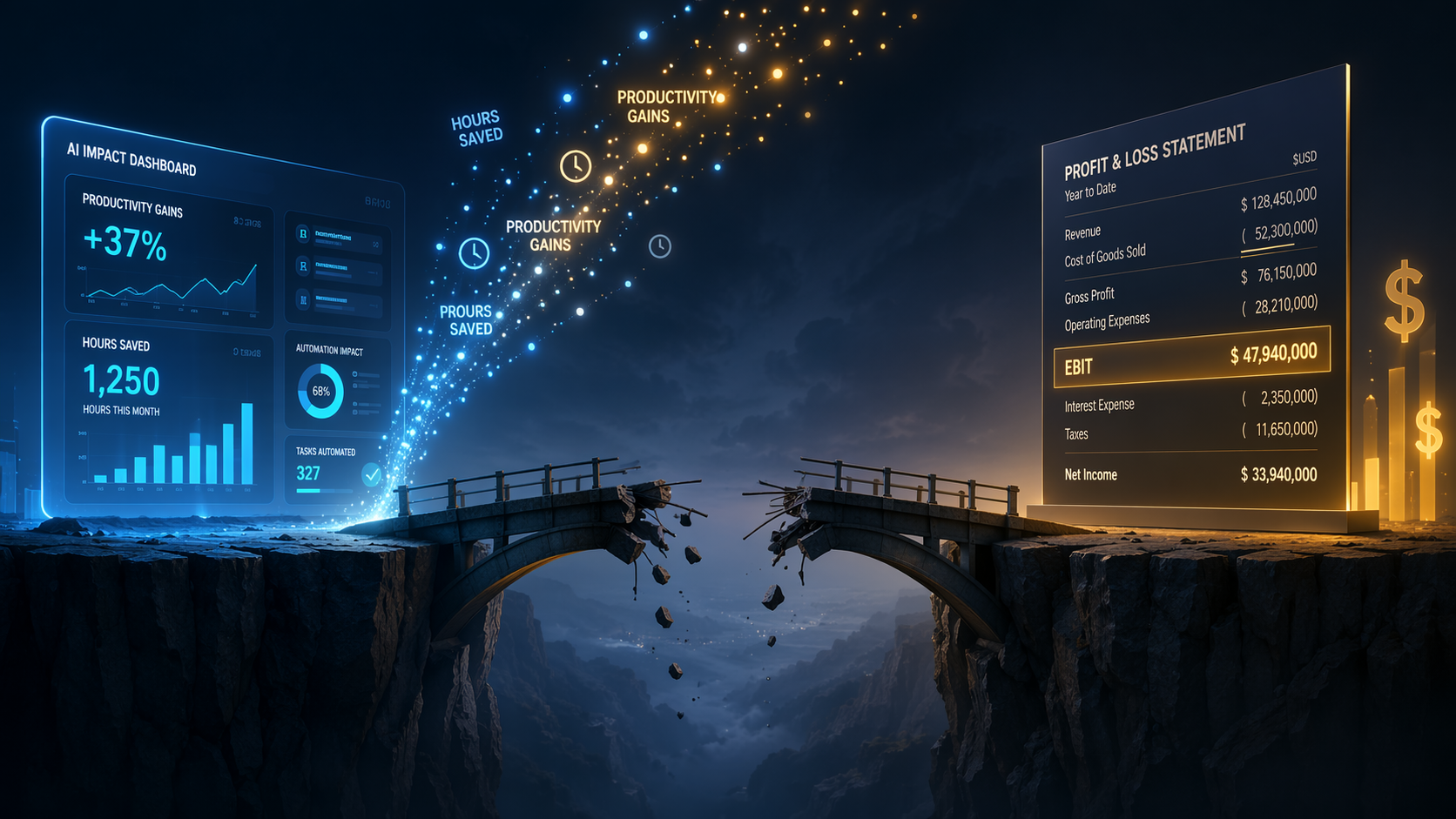
The uncomfortable problem with supply chain and AI in 2026 is no longer adoption. It is conversion. One widely cited McKinsey benchmark, reported through secondary sources, says 88% of organizations use AI, while only 39% report EBIT impact; PwC’s 2026 operations survey of 767 leaders found that 89% say technology investments have not fully delivered the expected results.[1][2] That gap is where most supply chain AI business cases are now being judged.
The easy explanation is that the models are not good enough, or that executives are impatient, or that legacy systems are strangling progress. There is truth in the last point: PwC found that 56% of operations leaders call AI integration with legacy systems a major challenge, and only 27% have fully embedded AI across business units.[2] But even when a pilot works, a planner likes it, and a control tower dashboard looks cleaner, finance still has a fair question: which cost disappeared?
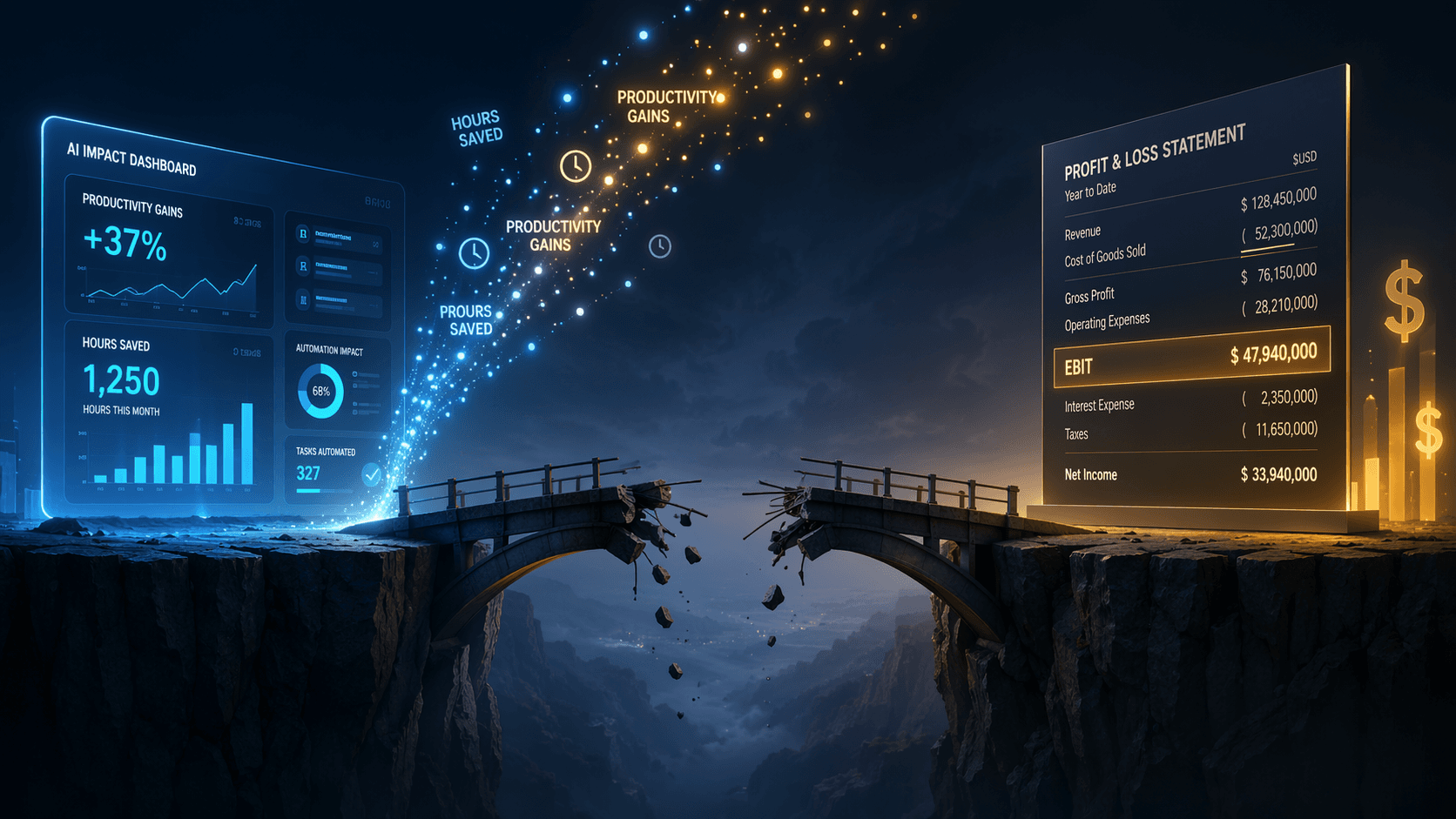
That is the missing layer. Many supply chain AI programs measure activity, adoption, and time saved. Far fewer instrument the operational cost events that did not happen because the AI intervened early enough. The distinction matters because hours saved are often absorbed back into the organization. A detention charge prevented, an expedite avoided, a stockout reduced, or inventory released from safety stock has a clearer path into the P&L, cash flow, or working-capital line.
The productivity metric is usually where the ROI story gets weak
A planner-facing copilot can still be useful. If it summarizes exceptions, drafts supplier emails, cleans up late-order notes, or reduces the time needed to compare scenarios, people will feel the difference. The problem starts when that relief is booked as financial return without proving that labor expense, outside service expense, inventory, freight spend, penalties, or lost sales changed.
This is why “30 minutes saved per planner per day” often fails in a CFO review. Unless headcount is reduced, overtime is eliminated, third-party support is avoided, throughput increases without additional labor, or a service failure is prevented, the time saving may be real and still not become margin. It can improve morale. It can create capacity. It can reduce firefighting. Those are operationally valuable outcomes, but they are not automatically EBIT.
FourKites, from a vendor perspective, frames this as a split between productivity AI and operational AI: productivity AI helps people work faster, while operational AI changes or prevents physical supply chain outcomes.[3] That distinction is useful because it forces a measurement question before the pilot starts. Is the AI only reducing effort, or is it changing a cost event that finance already recognizes?
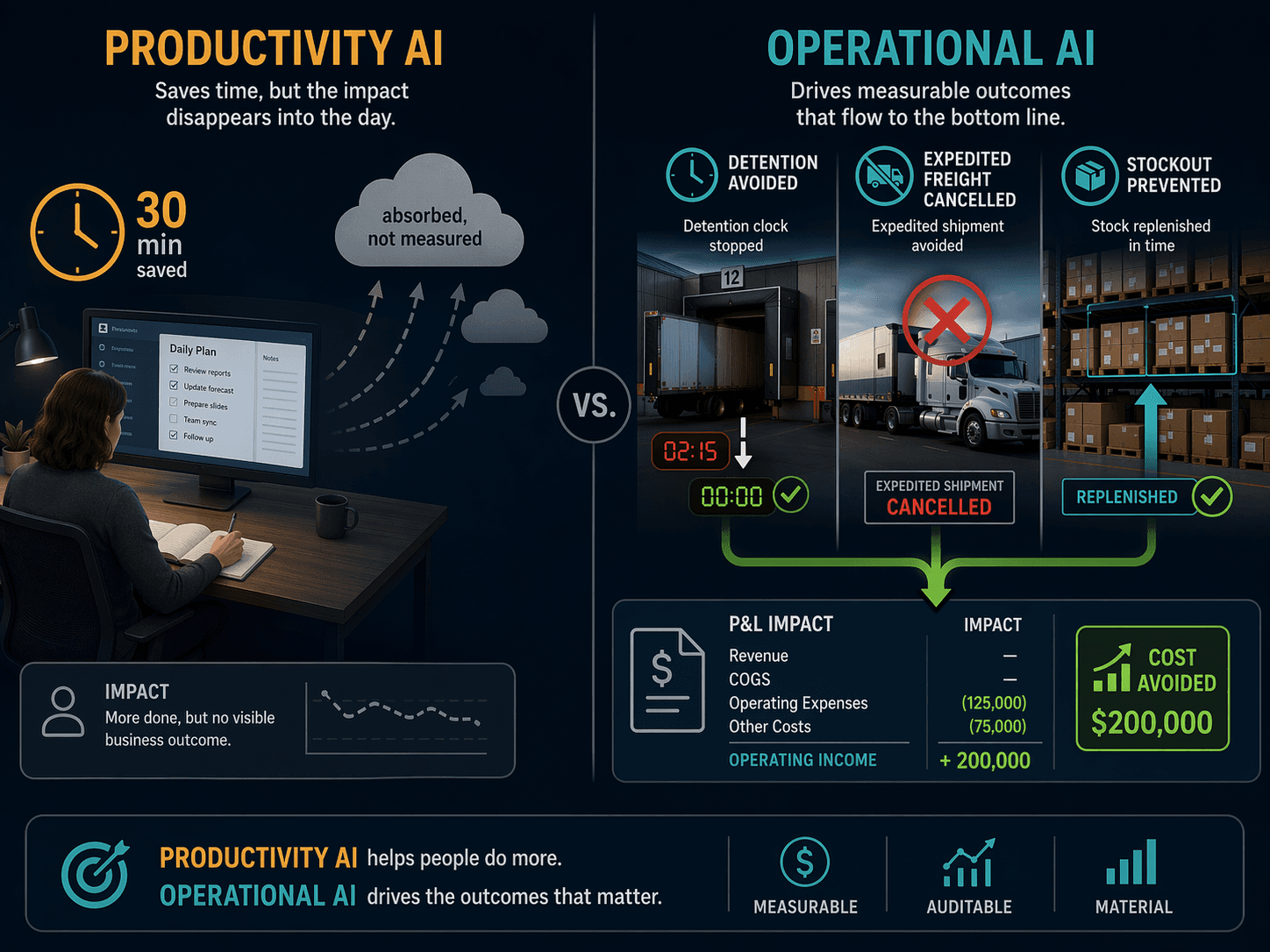
The practical answer is not to abandon productivity AI. Some of those tools are exactly what planners need to stop drowning in alerts and spreadsheets. But a portfolio built only around productivity will struggle to defend itself when the board asks why the transformation budget grew and the cost base did not move.
What a finance-recognizable AI use case looks like
Take detention. It is not an abstract efficiency category. It is a chargeable event with a facility, carrier, appointment, asset, dwell-time threshold, timestamp, invoice, and owner. That makes it one of the cleaner places to prove supply chain AI ROI.
In FourKites’ prevented-detention example, the AI identifies loads at risk of detention before the charge is incurred, recommends or triggers intervention, and lets the team track whether the event was avoided.[3] The important part is not the alert itself. Supply chains already have too many alerts. The important part is the chain of evidence: the model predicted a specific cost exposure, someone or something acted, the operational event changed, and a charge that would otherwise have been expected did not appear.
| Measurement link | What has to be captured |
|---|---|
| AI signal | Which load, order, appointment, lane, facility, or supplier was flagged; when it was flagged; and why it was considered financially exposed |
| Operational intervention | Who acted, what changed, and whether the intervention happened before the cost threshold was crossed |
| Counterfactual rule | How the team decides that the cost was likely enough to count as avoided rather than merely imagined |
| Financial evidence | Invoice avoided, accessorial charge reduced, expedite cancelled, lost sale prevented, inventory released, or cash conversion improved |
| Attribution control | Whether the same outcome would have occurred through an existing manual process, standing rule, or unrelated operational change |
That counterfactual rule is where many AI ROI claims become sloppy. A team cannot count every flagged load as a saving. Some would have recovered without intervention. Some would never have incurred detention. Some are flagged too late to matter. A credible measurement design needs a baseline from prior patterns, comparable unassisted events, or agreed finance rules for what qualifies as “at risk.”
A practical detention ROI log does not need to be elegant. It needs to be auditable. The fields should include the predicted charge exposure, action taken, timestamp, actual outcome, invoice result, and whether finance accepts the event as avoided cost. The moment finance rejects a category, keep it out of the hard-dollar ROI number and track it separately as operational benefit.
Four cost levers that can survive CFO scrutiny
The strongest supply chain AI ROI cases tend to start where the cost object is already visible. That is why detention, expedited freight, stockouts, and working capital deserve more attention than generic productivity totals. They are not the only levers, but they are specific enough to measure without inventing a new finance language.
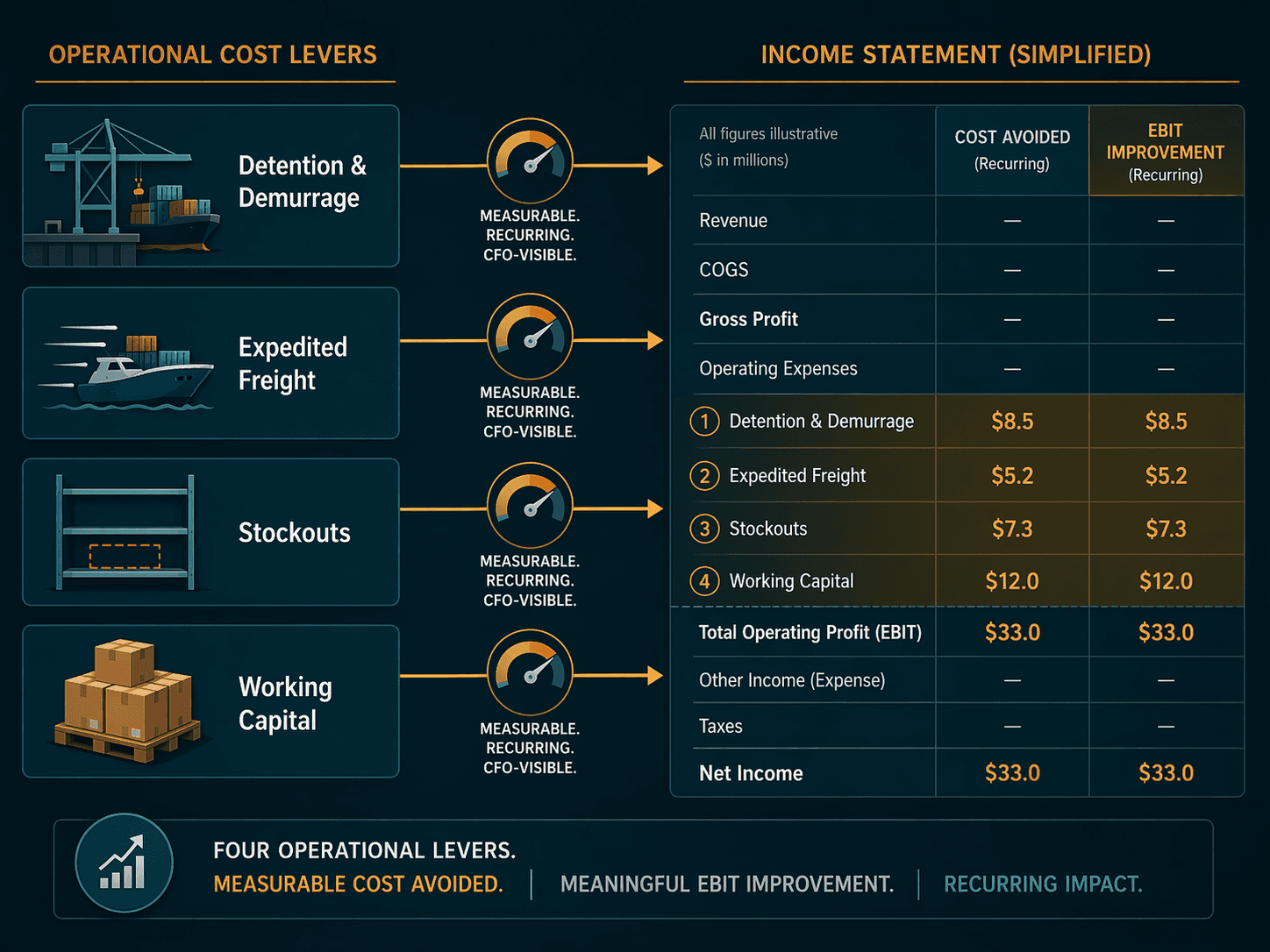
Detention and demurrage
Detention and demurrage are well suited to AI measurement because they have event boundaries. A container, trailer, or load enters a chargeable risk zone. A free-time window or dwell threshold is crossed. A fee appears or does not appear. That gives the AI team a concrete object to monitor.
The AI use case should be framed around preventing specific charge events, not “improving visibility.” Visibility is only the input. The measurable output is a reduction in charge frequency, charge severity, or late interventions. If the model flags 100 at-risk loads and the operations team intervenes on 40, the ROI calculation should not start with all 100. It should start with the subset where intervention happened early enough, the historical baseline suggests a likely charge, and the invoice record confirms that the charge was avoided or reduced.
Expedited freight
Expedited freight is another clean cost object because the decision is usually explicit. Someone approves premium transportation because the normal plan will miss a service, production, or customer requirement. AI can create value by detecting the exception earlier, proposing a lower-cost recovery path, reallocating inventory, resequencing orders, or warning the team before the expedite becomes the only remaining option.
The measurement mistake is to count “expedites recommended against” as savings. The better test is whether an approved or likely premium shipment was cancelled, downgraded, consolidated, or replaced with a lower-cost plan. Finance will usually want the original service requirement, the premium option that would have been used, the alternative chosen, and the actual freight invoice or tender record.
Stockouts
Stockouts are harder than accessorial charges because the financial outcome depends on what the customer does next. A stockout may become a lost sale, a delayed sale, a substitution, a partial shipment, a penalty, or a service-level miss with no immediate invoice consequence. That does not make the lever unusable. It means the measurement rule must be stricter.
For AI-driven replenishment, allocation, or demand-sensing work, the ROI case should separate service metrics from financial metrics. Fill rate, forecast accuracy, and planner response time are useful operating measures. The hard-dollar layer should count avoided lost sales, avoided contractual penalties, reduced substitutions where margin is protected, or lower emergency fulfillment costs. If those cannot be tied to transaction records, keep them out of the CFO-facing return number until the instrumentation improves.
Working capital
Working capital is where the upside can be large and the proof can become politically uncomfortable. Reducing inventory is not the same as improving forecast accuracy. The business has to release cash without damaging service, production continuity, or supplier economics. That requires finance, planning, sales, and operations to agree on which inventory is truly excess, which safety stock is still needed, and which service promise is being protected.
BCG projects that agentic AI in supply chains could reduce working capital by up to 30% and lift EBITDA by 2 to 4 percentage points, while also noting that agentic systems account for 17% of total AI value today and are projected to reach 29% by 2028.[4] Those are forward-looking projections, not proof that a current deployment will deliver that result. Still, they point to why working capital belongs in the ROI conversation: it is one of the few areas where AI decisions can affect both cash and operating performance.
The measurement should track inventory dollars released, days of inventory, service impact, obsolescence, write-offs, and any offsetting freight or production cost created by leaner buffers. A system that cuts inventory but creates more expedites has not produced the clean return the dashboard may claim.
A measurement framework for moving from AI activity to financial evidence
A credible framework starts before procurement signs the AI contract or the pilot charter is approved. The cost object has to be named early. If the business cannot say whether the target is accessorial charges, premium freight, lost sales, spoilage, overtime, inventory, or supplier penalties, the pilot will drift toward activity metrics because activity is easier to count.
| Step | Decision |
|---|---|
| 1. Name the cost object | Choose the P&L, cash, or working-capital item the AI is expected to change. |
| 2. Define the event | Specify what counts as a detention event, expedite, stockout, spoilage event, or inventory release. |
| 3. Establish the baseline | Use historical patterns, comparable flows, or agreed finance assumptions before the AI intervention. |
| 4. Capture the intervention | Record the AI signal, recommendation, human or automated action, timing, and operational owner. |
| 5. Verify the financial result | Match the outcome to invoice, order, inventory, shipment, penalty, or cash records. |
| 6. Separate hard and soft benefits | Report finance-accepted avoided cost separately from productivity, experience, and decision-quality benefits. |
This framework is deliberately plain because the hardest part is not mathematical sophistication. It is discipline. Supply chain teams already know where money leaks. The failure is usually that the AI workstream, the operations owner, and finance do not agree on evidence standards until after the pilot has produced a stack of impressive but financially ambiguous metrics.
The baseline deserves particular care. If expedited freight was already falling because volume declined, an AI tool should not claim the full reduction. If detention improved after a facility changed appointment rules, the AI team needs to isolate its contribution. If inventory dropped because service levels were relaxed, that is not the same result as AI improving replenishment decisions. CFOs are not being difficult when they ask these questions; they are protecting the organization from counting the same benefit twice.
For readers building broader investment cases, deeper benchmark work on AI supply chain ROI timelines and real deployment evidence can help set the outer business-case assumptions. The framework here is narrower: it is the bridge from an AI action to a finance-recognizable cost event.
Why the return window should not be sold as a one-quarter miracle
The pressure to show fast returns is real, but the evidence argues for a more sober timeline. Deloitte data cited by Open Sky Group says 85% of organizations increased AI investment, while only 6% saw ROI in under a year; most satisfactory returns landed in a 2–4 year window.[1] That does not excuse vague benefits. It does mean a serious CFO conversation should distinguish early operational proof from full financial capture.
In the first few months, the right milestone may be that the team can identify cost events, log interventions, and reconcile outcomes with finance records. After that, the target becomes repeatability: the same type of intervention works across lanes, facilities, categories, or regions. Only then does the program have a credible claim to budget-level impact.
This is also where legacy integration becomes more than an IT complaint. PwC’s finding that 56% of operations leaders see legacy integration as a major challenge matters because ROI evidence lives across systems: TMS, WMS, ERP, order management, carrier invoices, demand planning, inventory records, and finance ledgers.[2] A model can be accurate and still fail commercially if the organization cannot connect the signal to the action and the action to the financial record.
The trust problem still caps financial capture
Even a well-measured use case can stall if the organization will not let AI influence the decision that carries the money. RELEX’s 2026 survey of more than 500 supply chain leaders found that 67% are more confident in AI year over year, but only 10% trust AI to make critical decisions without human review.[5] That split is not irrational. A bad replenishment decision, allocation choice, or transportation move can create real service and cost damage.
The implication is that autonomy should be earned by cost object and risk tier. Let AI recommend in high-risk areas until the evidence base is strong. Let it automate narrow, reversible, well-bounded actions sooner. A detention-risk workflow that prompts a dock appointment change may deserve a different autonomy threshold than an AI system reallocating scarce inventory across strategic customers.
Human review is not automatically a failure. It becomes a failure when every recommendation waits in the same queue, with the same approval burden, regardless of value or risk. If the organization measures avoided cost but still delays action until the cost is unavoidable, the ROI loss is not in the model. It is in the operating design.
What to put in front of the CFO
A finance-facing supply chain AI review should be shorter and harder-edged than most transformation updates. It should not lead with model architecture, user enthusiasm, or the total number of recommendations generated. It should lead with the cost events under management.
- The recurring cost pool targeted: detention, demurrage, premium freight, lost sales, spoilage, inventory, overtime, or penalties.
- The baseline period and why it is comparable.
- The number of AI-flagged events, the number acted on, and the number accepted by finance as avoided or reduced.
- The financial records used for verification: invoices, freight tenders, order lines, inventory balances, claims, penalties, or ledger entries.
- The benefits excluded from hard-dollar ROI because they are productivity, experience, or decision-quality improvements rather than recognized cost reduction.
- The control issues still unresolved: attribution, seasonality, volume mix, policy changes, or manual interventions that may have affected the outcome.
That last item is not a weakness. It is what makes the number credible. A CFO is more likely to trust a conservative avoided-cost figure with clear exclusions than a large productivity estimate built on assumed salary conversion. Supply chain leaders do not have to undersell AI; they have to stop asking finance to accept benefits that operations has not instrumented.
Accenture’s 2024 benchmark, cited by Open Sky Group, found that companies with AI-mature supply chains were 23% more profitable and six times as likely to use AI widely.[1] That is a useful prize statement, not a measurement method. The method is still the unglamorous work of tying model actions to cost events, and cost events to accepted financial outcomes.
The practical fix
Supply chain is one of the better places to prove AI ROI because the function is full of repeated, visible, expensive exceptions. Trucks wait. Containers sit. Orders miss. Inventory ages. Expedites get approved. Customers substitute, delay, or leave. These are not vague transformation outcomes; they are operational facts with owners and records.
The fix is to design AI programs around those facts. Start with the recurring cost event. Decide what counts as prevention or reduction. Capture the AI signal and the intervention. Reconcile the outcome against finance records. Keep soft productivity benefits in a separate lane. Then scale the use cases where the same evidence pattern repeats.
Supply chain leaders do not need another AI success story that turns planner time into theoretical margin. They need a measurement system that shows which cost disappeared, which cash was released, and which service failure was avoided—so the operational win can show up where the CFO can see it.
References
- Supply Chain AI Statistics: 18+ Statistics You Should Know for 2026 — Open Sky Group
- 2026 Digital Trends in Operations Survey — PwC
- 2026: The Year Supply Chain AI Must Deliver Real ROI — FourKites
- How AI Agents Are Transforming Supply Chains — BCG
- Supply chain AI in 2026: The numbers behind the hype — RELEX Solutions
Comments
Join the discussion with an anonymous comment.