
Introduction: The AI Adoption Gap in Supply Chain
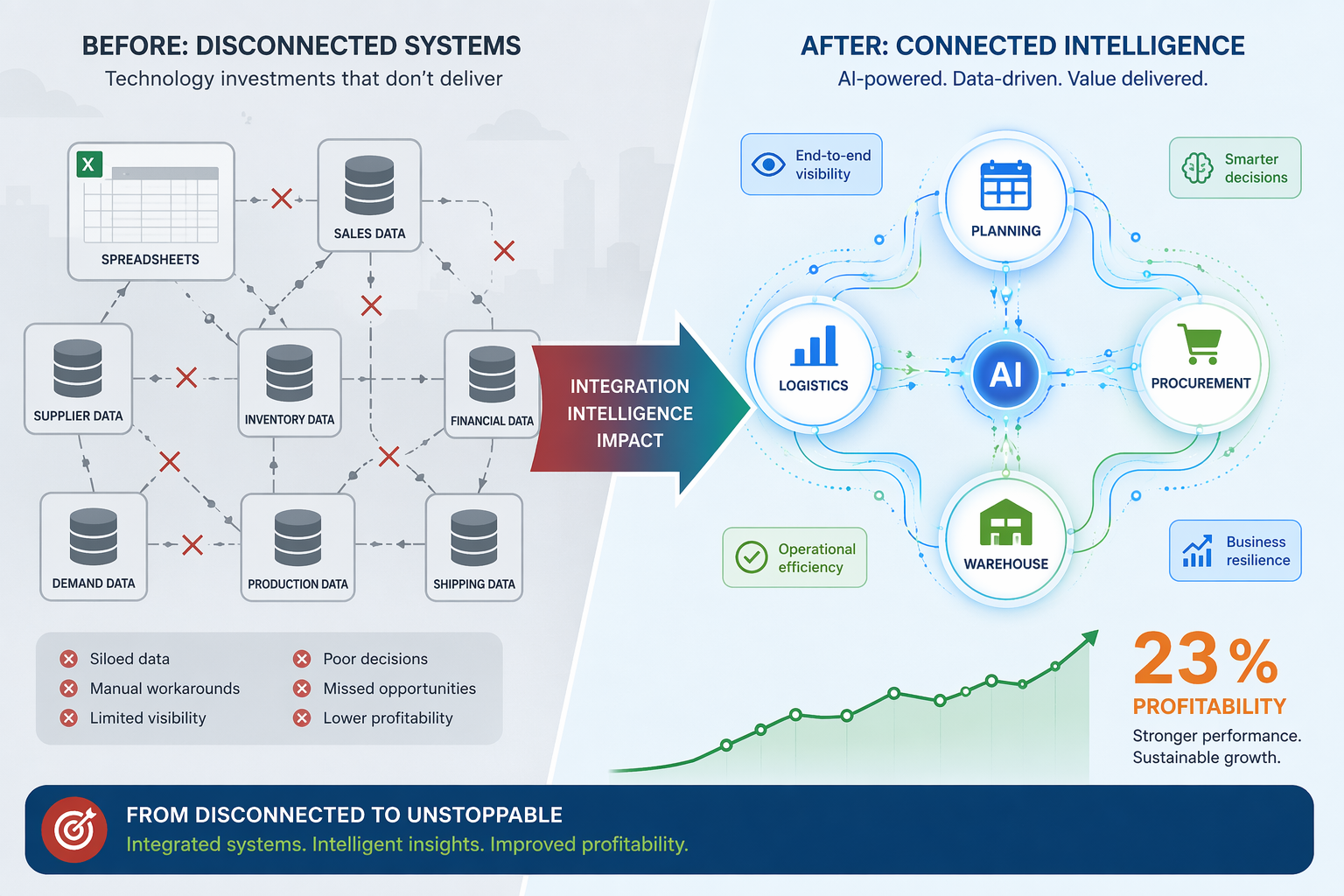
The gap between AI intent and execution in supply chain is wide and well-documented. A 2025 survey by ABI Research found that 94% of supply chain companies plan to deploy AI or generative AI for decision support within two years. Yet a Gartner survey of 120 supply chain leaders who had already deployed AI (conducted December 2024–January 2025) found that only 23% have a formal supply chain AI strategy. The majority are pursuing project-by-project wins, a pattern Gartner warns creates "franken-systems" that hinder scalability.
This gap carries a measurable cost. Accenture's 2024 research found that companies with AI-mature supply chains are 23% more profitable than their peers and six times as likely to use AI and generative AI widely. The AI in supply chain market, valued at $9.94 billion in 2025, is projected to reach $236.42 billion by 2035 (Precedence Research, 2026). The question is no longer whether AI applies to supply chain operations, but which applications deliver first, where the evidence is strongest, and what risks accompany each deployment.
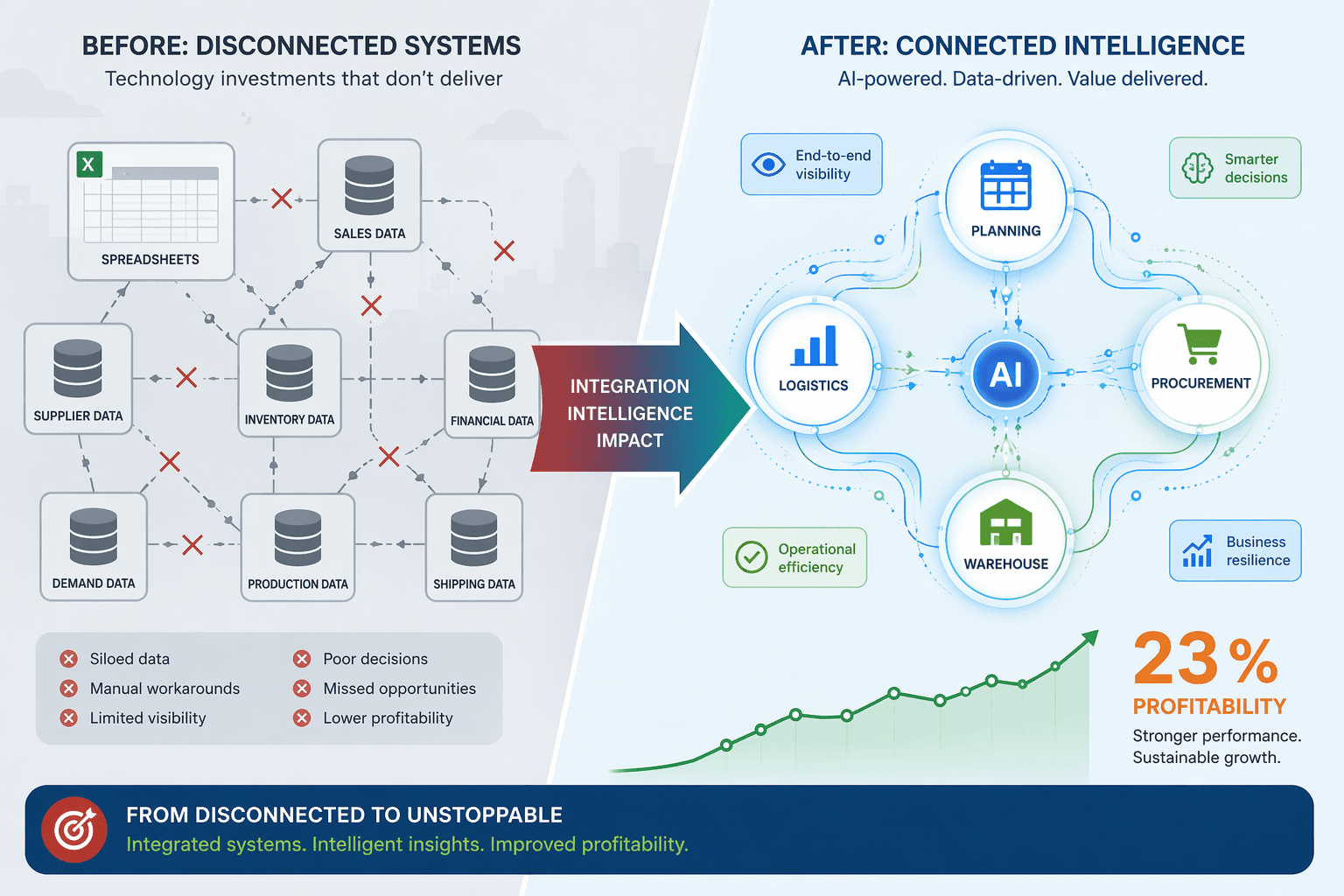
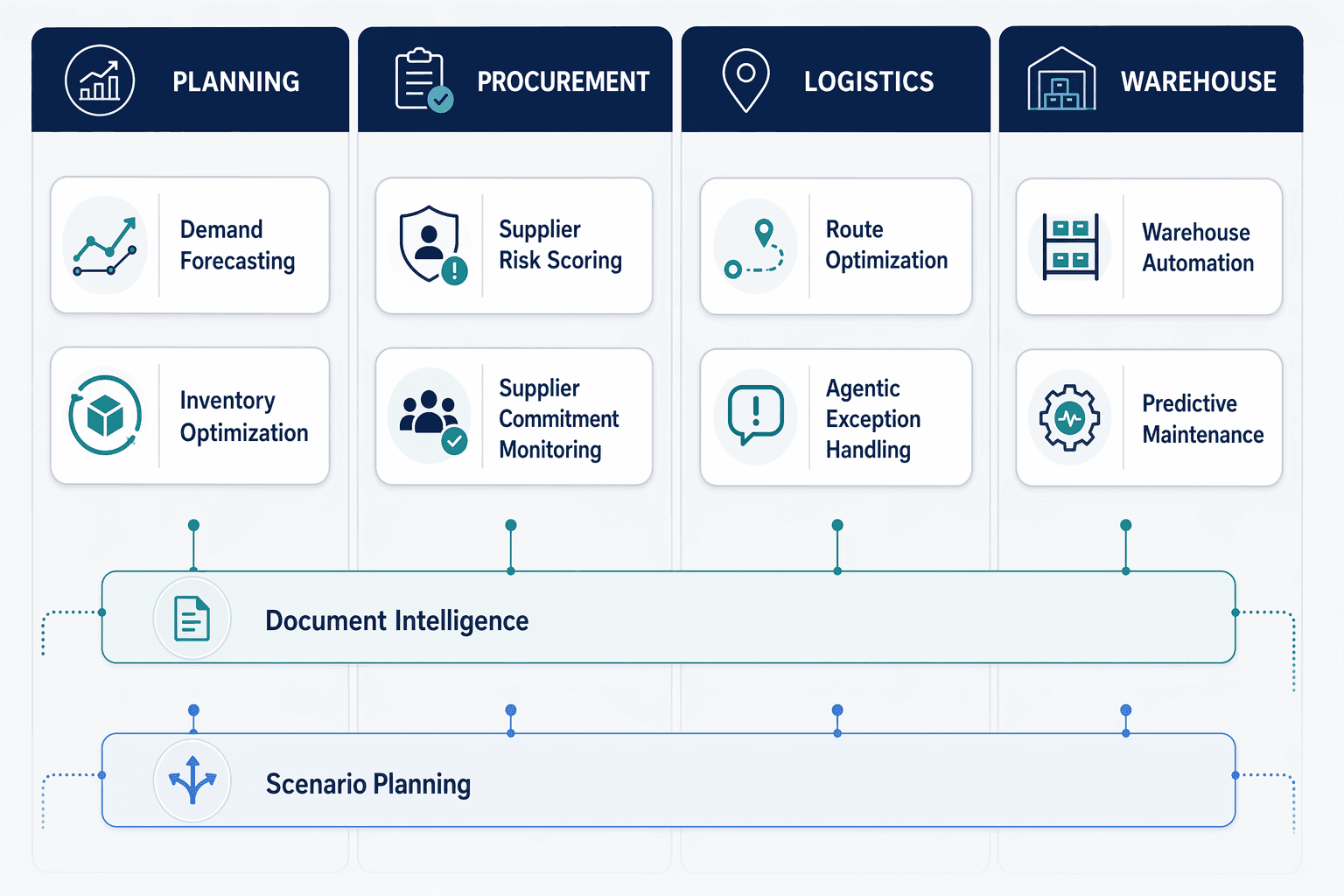
This library covers the ten highest-impact AI use cases across planning, procurement, logistics, and warehouse operations. Each entry follows a consistent schema — function, AI technique, ROI indicators with source attribution, representative vendors, applicable industries, adoption maturity, and key implementation risks — so that supply chain leaders can compare applications directly and prioritize investments with clear-eyed evidence.
1. Demand Forecasting
Demand forecasting is the most established AI use case in supply chain planning. Machine learning models ingest historical sales data, promotion calendars, external signals (weather, economic indicators, social sentiment), and point-of-sale data to generate probabilistic forecasts that adapt to changing patterns without manual recalibration.
- Supply Chain Function: Plan
- AI Technique: Machine learning forecasting (gradient boosting, neural networks, ensemble methods)
- ROI Indicators: McKinsey reports forecast error reductions of 20–50%. Gartner (September 2025) projects that 70% of large-scale organizations will adopt AI-based forecasting by 2030.
- Representative Vendors: Blue Yonder, o9 Solutions, Kinaxis, SAP IBP, Relex, John Galt Solutions
- Applicable Industries: Retail, CPG, Food & Beverage, Pharma, Electronics, Automotive
- Adoption Maturity: Established
- Key Implementation Risks: Data quality and consistency across ERP and POS systems; organizational resistance to algorithm-driven planning; need for demand sensing infrastructure to capture real-time signals; model retraining cadence to prevent drift in volatile markets.
For a deeper dive on demand forecasting in CPG and retail, including deployment patterns and vendor selection criteria, see our dedicated AI Demand Forecasting in CPG and Retail use case guide.
2. Inventory Optimization
AI-driven inventory optimization moves beyond fixed safety stock formulas to dynamic, multi-echelon models that balance service levels against working capital across the entire network — from raw material suppliers to distribution centers to retail shelves. Machine learning algorithms analyze demand variability, lead time volatility, supplier reliability, and promotion impacts to recommend optimal stock positions at each node.
- Supply Chain Function: Inventory Management
- AI Technique: Multi-echelon inventory optimization (MEIO), reinforcement learning, time-series forecasting
- ROI Indicators: McKinsey (2024) reports 20–30% inventory reduction while maintaining or improving service levels. AI-enabled distribution also delivers 5–20% logistics cost reduction through better inventory positioning.
- Representative Vendors: o9 Solutions, Blue Yonder, E2open, ToolsGroup, Slimstock, RELEX
- Applicable Industries: Retail, CPG, Pharma, Automotive, Industrial Manufacturing
- Adoption Maturity: Growing
- Key Implementation Risks: Data fragmentation across ERP, WMS, and supplier systems; model drift when demand patterns shift; organizational resistance to reducing buffer stock; integration complexity with existing planning workflows.
For a detailed explanation of multi-echelon inventory optimization techniques, see our Multi-Echelon Inventory Optimization (MEIO) glossary entry.
3. Supplier Risk Scoring
Supplier risk scoring uses natural language processing and machine learning classification to continuously monitor supplier health across financial stability, geopolitical exposure, ESG compliance, operational performance, and sub-tier dependencies. Rather than periodic manual assessments, AI models ingest news feeds, financial filings, port data, weather reports, and social media to generate dynamic risk scores that trigger alerts when conditions change.
- Supply Chain Function: Procurement
- AI Technique: Natural language processing (NLP), ML classification, knowledge graph analysis
- ROI Indicators: Reduced supply disruptions, improved on-time delivery rates, earlier detection of supplier financial distress. Everstream Analytics rates geopolitical fragmentation at a 97% threat level and extreme weather at 93% for 2026, underscoring the need for continuous monitoring.
- Representative Vendors: Everstream Analytics, Resilinc, Altana, Prewave, Riskmethods (SAP), Coupa
- Applicable Industries: Automotive, Electronics, Pharma, Aerospace, Industrial Manufacturing
- Adoption Maturity: Growing
- Key Implementation Risks: Data availability and quality from sub-tier suppliers; model explainability for procurement teams who need to justify sourcing decisions; false positives from noisy news data; supplier cooperation in sharing operational data.
4. Route Optimization
AI-powered route optimization applies reinforcement learning and graph neural networks to solve the traveling-salesman problem at fleet scale, incorporating real-time traffic, weather, delivery windows, vehicle capacity, driver hours, and fuel costs. Unlike static route planning tools, AI models continuously learn from actual route outcomes to improve future recommendations.
- Supply Chain Function: Logistics
- AI Technique: Reinforcement learning, graph neural networks, constraint optimization
- ROI Indicators: McKinsey (2024) reports AI-enabled distribution delivers 5–20% logistics cost reduction. Gartner notes that AI-enabled route optimization reduces transportation costs and improves on-time delivery performance.
- Representative Vendors: Optym, Descartes, Trimble, ORTEC, PTV Group, project44
- Applicable Industries: Retail, 3PL, Food & Beverage, Parcel & Postal, Field Services
- Adoption Maturity: Established
- Key Implementation Risks: Real-time data integration with TMS and telematics systems; driver adoption and trust in algorithm-recommended routes; handling of exceptions (road closures, customer-specific constraints); model performance degradation in regions with poor traffic data coverage.
Our AI in TMS guide covers route optimization, last-mile delivery, and predictive freight rate analytics in depth, including vendor capability comparisons and integration patterns.
5. Warehouse Automation
AI-driven warehouse automation combines computer vision, robotics, and machine learning to optimize picking, packing, sorting, and inventory putaway. Autonomous mobile robots (AMRs) navigate dynamically using real-time sensor data, while computer vision systems verify item identification and detect damage. Machine learning algorithms optimize slotting — deciding which products should be stored where — based on order velocity, seasonality, and item affinity.
- Supply Chain Function: Warehouse Operations
- AI Technique: Computer vision, reinforcement learning, ML-based slotting optimization
- ROI Indicators: U.S. distribution companies report 30–50% throughput increases with AI and robotics. Ocado handles over 50,000 orders per week through fully automated warehouses. McKinsey reports that predictive maintenance within warehouse automation reduces unplanned downtime by 30–50%.
- Representative Vendors: GreyOrange, Locus Robotics, Symbotic, AutoStore, Körber, Manhattan Associates
- Applicable Industries: Retail, 3PL, E-commerce, Food & Beverage, Pharma
- Adoption Maturity: Growing
- Key Implementation Risks: High capital investment (robotics infrastructure, facility modifications); integration complexity with existing WMS; workforce transition and retraining; throughput variability during peak seasons; maintenance and reliability of robotic fleets.
6. Supplier Commitment Monitoring
Supplier commitment monitoring uses NLP and predictive analytics to track whether suppliers will fulfill purchase orders on time and at the agreed quality. The system ingests order confirmations, production schedules, shipping manifests, port data, and historical performance to generate probabilistic delivery estimates and flag commitments at risk of failure before the supplier misses a deadline.
- Supply Chain Function: Procurement
- AI Technique: Natural language processing, predictive analytics, time-series anomaly detection
- ROI Indicators: A Fortune 500 manufacturer achieved 100% supply chain visibility, three weeks' advance warning of disruptions, and a 30% reduction in supply-driven stockouts (Unframe AI, 2026 — vendor-adjacent source, treat as illustrative).
- Representative Vendors: Altana, Resilinc, Everstream Analytics, SourceDay, Coupa
- Applicable Industries: Automotive, Electronics, Aerospace, Industrial Manufacturing, Pharma
- Adoption Maturity: Emerging
- Key Implementation Risks: Requires suppliers to share production and inventory data; model accuracy depends on data timeliness and completeness; false positives can erode trust in the system; supplier cooperation is not guaranteed, especially for sub-tier visibility.
7. Agentic Exception Handling
Agentic AI represents the most transformative emerging use case in supply chain. Autonomous AI agents monitor supply chain events — delayed shipments, inventory shortages, demand spikes, supplier failures — and take corrective actions without human intervention. An agent might re-route a shipment, adjust a purchase order, or request alternative supplier quotes, then log the action for human review. Per Deloitte (2025), organizations utilizing agentic systems can realize double-digit efficiency gains and reduce decision latency from days to seconds. BCG estimates that agentic systems accounted for 17% of total AI value in 2025, projected to reach 29% by 2028.
- Supply Chain Function: Cross-functional (Planning, Procurement, Logistics)
- AI Technique: Agentic AI, autonomous decision-making, multi-agent systems, large language models
- ROI Indicators: Double-digit efficiency gains; decision latency reduced from days to seconds (Deloitte, 2025). A transportation company uses agents to autonomously request quotes and rank responses; a medical device manufacturer uses agents for automated supplier scoring and quote validation (Dataiku, 2026 — vendor-adjacent source).
- Representative Vendors: Dataiku, Palantir, C3.ai, IBM, Microsoft (Copilot for Supply Chain)
- Applicable Industries: All industries with complex, multi-tier supply chains
- Adoption Maturity: Emerging
- Key Implementation Risks: Governance and accountability frameworks are not yet mature for autonomous decision-making; model drift in agent behavior over time; audit trail requirements for regulated industries; organizational readiness to trust AI with operational decisions; integration with existing ERP and planning systems.
8. Predictive Maintenance
Predictive maintenance applies machine learning to IoT sensor data from warehouse equipment, conveyor systems, automated guided vehicles, and manufacturing machinery to forecast failures before they occur. Models detect anomalies in vibration, temperature, current draw, and cycle times, then generate maintenance alerts with estimated remaining useful life, allowing teams to schedule repairs during planned downtime rather than reacting to breakdowns.
- Supply Chain Function: Warehouse Operations / Manufacturing
- AI Technique: Machine learning, IoT sensor analytics, anomaly detection, time-series forecasting
- ROI Indicators: McKinsey reports 30–50% reduction in unplanned downtime and 10–40% reduction in maintenance costs. 78% of manufacturers allocate over 20% of improvement budgets to smart manufacturing (Deloitte, 2025).
- Representative Vendors: Uptake, Falkonry, SparkCognition, IBM Maximo, Siemens MindSphere, GE Digital
- Applicable Industries: Manufacturing, Warehousing, Logistics, Food & Beverage, Pharma
- Adoption Maturity: Growing
- Key Implementation Risks: Sensor data quality and coverage gaps; integration with existing CMMS (computerized maintenance management systems); need for labeled failure data to train initial models; false positives that lead to unnecessary maintenance; organizational shift from reactive to predictive maintenance culture.
9. Document Intelligence
Document intelligence applies NLP, generative AI, and optical character recognition (OCR) to automate the extraction, classification, and validation of information from unstructured supply chain documents — purchase orders, bills of lading, customs forms, certificates of analysis, and supplier invoices. Rather than manual data entry, AI models read documents, extract key fields, validate against master data, and route exceptions for human review.
- Supply Chain Function: Procurement / Logistics
- AI Technique: Natural language processing, generative AI, OCR, document classification
- ROI Indicators: Reduced manual processing time (hours to minutes per document), improved data accuracy, faster invoice-to-pay cycles. 94% of procurement executives use generative AI tools weekly (AI at Wharton/Hackett Group, 2025).
- Representative Vendors: Hyperscience, Abbyy, Rossum, Kofax, UiPath (with AI), SAP (Document Information Extraction)
- Applicable Industries: All industries with high document volumes: 3PL, Retail, Pharma, Automotive, Food & Beverage
- Adoption Maturity: Growing
- Key Implementation Risks: Document format variability across suppliers and regions; data privacy and compliance requirements (GDPR, HIPAA for pharma); accuracy degradation on low-quality scans or handwritten fields; need for human-in-the-loop validation for high-value documents.
10. Scenario Planning & AI-Powered Simulation
AI-powered scenario planning uses digital twin technology and simulation models to test the impact of disruptions, demand shifts, and strategic decisions before committing resources. A supply chain digital twin — a virtual replica of the physical network — allows planners to run thousands of "what-if" scenarios in minutes: What happens if a key supplier's factory shuts down? How should inventory be repositioned if a port closes? What is the optimal sourcing mix under different tariff regimes?
- Supply Chain Function: Planning
- AI Technique: Digital twin, simulation, generative AI, reinforcement learning
- ROI Indicators: Improved decision speed, reduced planning cycle time, better risk mitigation outcomes. GE Aviation leverages Dataiku for predictive analytics within digital twin environments (Dataiku, 2026 — vendor-adjacent source). 72% of supply chain executives believe automated mitigation is mandatory for managing disruptions (Tradeverifyd, 2026).
- Representative Vendors: AnyLogic, SimWell, Coupa (LLamasoft), o9 Solutions, Kinaxis, IBM (Supply Chain Control Tower)
- Applicable Industries: All industries with complex, multi-echelon supply chains — particularly Automotive, Electronics, Pharma, and Retail
- Adoption Maturity: Emerging
- Key Implementation Risks: Model complexity and data requirements to build accurate digital twins; computational cost of running high-fidelity simulations; need for cross-functional input to define realistic scenarios; risk of false confidence in model outputs if assumptions are not validated; integration with existing S&OP and IBP processes.
AI vs. Traditional Approaches: A Comparative Overview
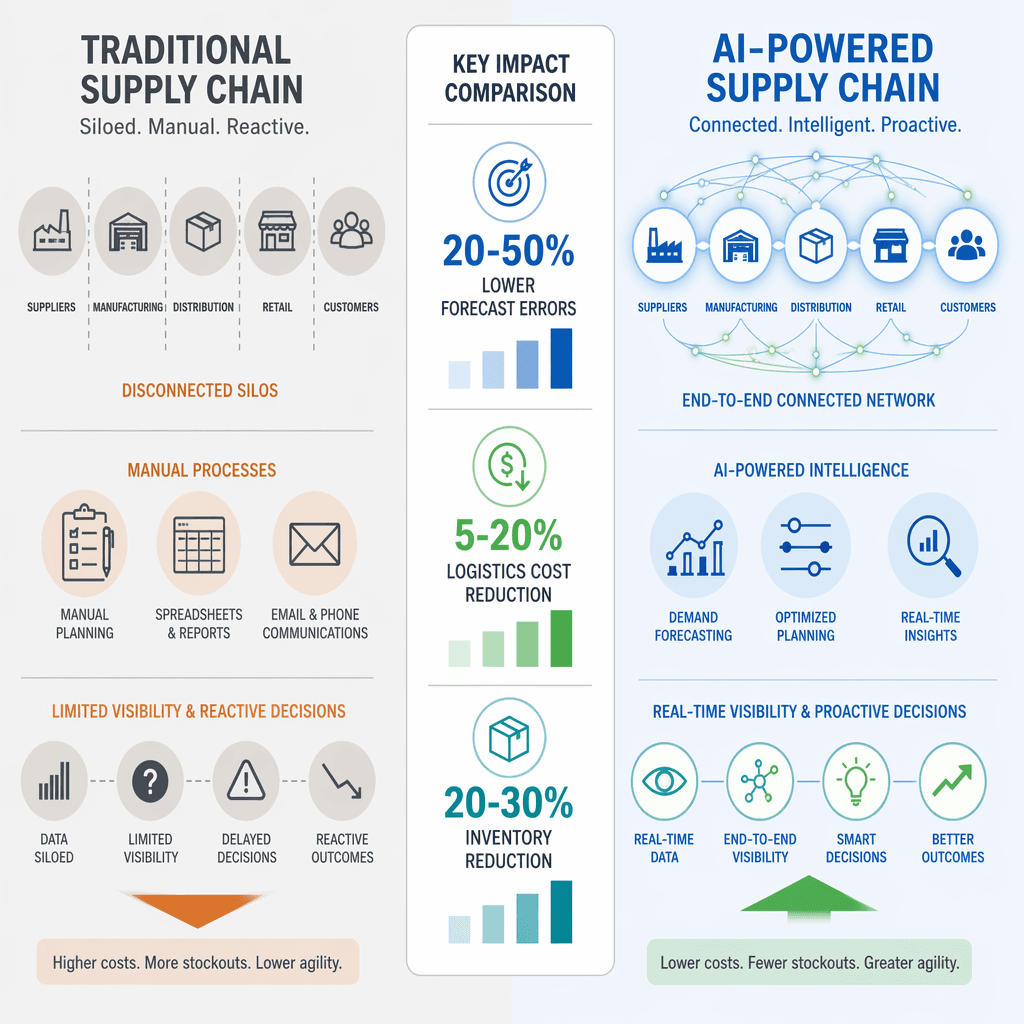
The following table summarizes how AI-powered approaches differ from traditional methods across key dimensions for the ten use cases covered above. The comparison is based on published benchmarks and industry patterns, not vendor-specific claims.
| Use Case | Traditional Approach | AI-Powered Approach | Key Advantage |
|---|---|---|---|
| Demand Forecasting | Statistical models (ARIMA, exponential smoothing) with manual overrides | ML ensemble models with external signal integration | 20–50% lower forecast error (McKinsey) |
| Inventory Optimization | Fixed safety stock formulas (e.g., ROP/EOQ) | Multi-echelon optimization with dynamic parameters | 20–30% inventory reduction (McKinsey 2024) |
| Supplier Risk Scoring | Quarterly manual assessments, credit reports | Continuous NLP monitoring of news, filings, weather | Real-time risk detection vs. periodic snapshots |
| Route Optimization | Static route planning, manual dispatch | Reinforcement learning with real-time traffic/weather | 5–20% logistics cost reduction (McKinsey 2024) |
| Warehouse Automation | Manual picking, fixed storage locations | AMRs, computer vision, dynamic slotting | 30–50% throughput increase |
| Supplier Commitment Monitoring | Manual order tracking, reactive expediting | Predictive analytics with probabilistic delivery estimates | 30% reduction in supply-driven stockouts (illustrative) |
| Agentic Exception Handling | Human-in-the-loop for every exception | Autonomous agents with human oversight for high-value actions | Decision latency from days to seconds (Deloitte 2025) |
| Predictive Maintenance | Time-based or reactive maintenance schedules | IoT sensor anomaly detection with RUL forecasting | 30–50% less unplanned downtime (McKinsey) |
| Document Intelligence | Manual data entry from paper/PDF documents | NLP/OCR extraction with Gen AI validation | Hours to minutes per document |
| Scenario Planning | Spreadsheet-based what-if analysis (limited scenarios) | Digital twin simulation with thousands of scenarios | Faster, more comprehensive risk assessment |
For a broader analysis of how predictive analytics delivers measurable ROI across five supply chain functions, see our dedicated article: Predictive Analytics in Supply Chain: Five Functions Where It Delivers Measurable ROI.
Why Many AI Initiatives Fall Short
Despite the clear ROI potential across all ten use cases, most AI initiatives in supply chain fail to deliver their expected value. PwC's 2026 Digital Trends in Operations Survey of 767 US-based operations and supply chain leaders found that 89% say their technology investments haven't fully delivered expected results, and 87% say poor data quality impacted the value of digital initiatives. Only 27% have fully embedded AI strategy across business units.
The two primary failure modes are consistent across surveys: data fragmentation and lack of formal strategy. Gartner's 2025 survey found that even among organizations already deploying AI, only 23% have a formal supply chain AI strategy — the rest pursue project-by-project wins that create integration challenges later. PwC identifies a 4% "leader cohort" that succeeds across four dimensions: AI fully embedded, no barriers to scaling agents, horizontal operating structure, and tech investments delivering expected results.
Frequently Asked Questions
Which AI use case delivers the fastest ROI in supply chain?
Demand forecasting and route optimization are the most established use cases with the shortest time-to-value. Both have mature vendor ecosystems, clear ROI benchmarks (20–50% forecast error reduction, 5–20% logistics cost reduction), and lower integration complexity compared to warehouse automation or agentic systems. Deloitte's 2025 survey found that only 6% of organizations saw ROI in under a year, but most achieve satisfactory returns within 2–4 years.
How long does it take to see measurable results from AI in supply chain?
Timelines vary significantly by use case and organizational readiness. Demand forecasting pilots can show accuracy improvements within 3–6 months if data quality is adequate. Inventory optimization and route optimization typically require 6–12 months to capture enough data for model training and validation. Warehouse automation and agentic systems are longer-term investments, often requiring 12–24 months for full production deployment. Deloitte (2025) reports that most organizations achieve satisfactory ROI within 2–4 years.
What data readiness is required before deploying AI in supply chain?
PwC's 2026 survey found that 87% of operations leaders say poor data quality impacted the value of digital initiatives. Minimum requirements include: clean, consistent historical data (at least 12–24 months for forecasting models); integrated data from ERP, WMS, and TMS systems; documented data lineage and governance; and API access to external data sources (weather, economic indicators, port data) for use cases like demand sensing and supplier risk scoring. Organizations without a data readiness baseline should start with a data quality assessment before selecting a use case.
How should I prioritize AI investments across planning, procurement, logistics, and warehouse operations?
Prioritization depends on your organization's pain points, data maturity, and strategic objectives. A common pattern is to start with demand forecasting (Plan) because it has the strongest ROI evidence and lowest integration barrier, then expand to inventory optimization and route optimization. Procurement use cases (supplier risk scoring, document intelligence) are good second-wave investments if supplier data quality is adequate. Warehouse automation and agentic systems require higher capital investment and organizational change, making them better suited for organizations that have already built AI capability in planning and logistics. Gartner's Run-Grow-Transform framework can help balance short-term wins against long-term capability building.
What is the difference between demand sensing and demand forecasting?
Demand forecasting uses historical data to predict future demand over a medium-to-long-term horizon (weeks to months). Demand sensing uses real-time signals — point-of-sale data, weather, social media, web traffic — to adjust short-term forecasts (days to weeks). AI-powered demand forecasting platforms increasingly incorporate demand sensing capabilities. For a detailed explanation of these and other AI supply chain terms, see our Machine Learning in Supply Chain Management glossary entry.
Comments
Join the discussion with an anonymous comment.