


The 94-23-4 Gap: Why Most Supply Chain AI Initiatives Stall
The numbers paint a stark picture of an industry caught between ambition and execution. According to the PwC 2026 Digital Trends in Operations Survey of 767 US-based operations and supply chain leaders, 94% of supply chain companies plan to adopt AI or generative AI for decision support within two years. Yet only 23% of organizations have a formal AI strategy in place. And just 4% report full success — meaning AI is fully embedded, no barriers to agent scaling remain, a horizontal structure exists, and technology investments are delivering expected results.
The gap between intent and delivery is not small. It is a chasm. The same PwC survey found that 89% of operations leaders say their technology investments have not fully delivered the expected outcomes. This is not a story about bad technology. It is a story about how organizations approach AI — and the structural, data, and operational failures that prevent even well-funded initiatives from producing results.
This article interrogates why the failure rate is so high. It identifies three root causes — data fragmentation, silo-based pilots, and the absence of an operating model redesign — and then profiles what the 4% of successful organizations do differently. The goal is not to add another aspirational list of AI use cases to the pile. It is to give supply chain leaders a framework for diagnosing why their own initiatives may be underperforming and a concrete path toward joining the 4%.

Root Cause 1: Data Fragmentation — The 87% Barrier
The most frequently cited obstacle to AI value is not algorithm performance, model accuracy, or talent shortage. It is data quality. The PwC 2026 survey reports that 87% of operations leaders say poor data quality has impacted their ability to achieve value from digital initiatives. This is not a minority complaint — it is nearly nine out of ten organizations.
The problem is structural. Most supply chain data is scattered across ERP systems, warehouse management systems (WMS), transportation management systems (TMS), procurement platforms, and spreadsheets that were never designed to share information. As the Unframe AI analysis notes, AI layered on top of fragmented data and disconnected workflows simply accelerates bad decisions. When the underlying data is inconsistent, incomplete, or stale, machine learning models produce outputs that are confidently wrong — and that erodes trust across the organization.
Consider what happens when data is unified. Unframe AI documents a Fortune 500 manufacturer that deployed AI for supplier commitment monitoring. By integrating data across procurement, logistics, and production systems, the company achieved 100% visibility into supplier commitments, gained three weeks' advance warning of potential disruptions, and reduced supply-driven stockouts by 30%. That outcome was not the result of a better forecasting algorithm. It was the result of fixing the data plumbing first.
The data fragmentation problem is compounded by the fact that most organizations underestimate how much work data unification requires. It is not a one-time project. It demands ongoing investment in data governance, common ontologies, and integration infrastructure. The Deloitte analysis on agentic supply chains emphasizes that success requires a data fabric, a common ontology, and a knowledge graph — not perfect data harmonization, but consistent definitions and sufficient semantic structure to allow AI agents to operate across systems.
Root Cause 2: Silo-Based Pilots That Never Scale
The second most common failure pattern is the isolated proof-of-concept. A demand planning team runs a pilot with a new forecasting tool and achieves a 15% improvement in forecast accuracy. A warehouse team tests computer vision for inventory counting and sees promising results. A procurement group experiments with AI-powered supplier scoring. Each pilot generates local success. None of them produce enterprise-wide impact.
The reason is straightforward: supply chain performance is a system property, not a function-level metric. Improving demand forecast accuracy in isolation does not automatically reduce inventory costs if the procurement and logistics systems are still operating on old assumptions. A warehouse automation pilot that speeds up picking does not improve customer delivery times if the transportation management system cannot dynamically reroute shipments.
The data supports this. Among the 4% of leaders in the PwC 2026 survey, 87% have integrated digital capabilities end to end. They do not treat demand planning, procurement, warehouse operations, and logistics as separate AI projects. They build a horizontal AI layer that connects all functions. The remaining 96% of organizations — those that have not achieved full success — are far more likely to have fragmented, function-specific deployments.
The timeline problem reinforces the scaling challenge. Deloitte's research shows that only 6% of organizations see AI ROI in under a year. Most achieve satisfactory returns within two to four years. When pilots are run in isolation, they rarely survive long enough to reach that payoff window. Budget cycles shift. Leadership changes. The pilot team moves on to the next project. The result is a graveyard of proof-of-concepts that never made it to production scale.
- Isolated pilots optimize local metrics but cannot improve system-level outcomes like total inventory cost, on-time delivery, or cash-to-cash cycle time.
- Pilots rarely survive leadership transitions or budget cycles because they lack enterprise-level sponsorship and a clear path to production.
- Without end-to-end integration, AI models trained on one function's data cannot access the cross-functional signals needed for accurate predictions.
- The 2–4 year ROI timeline means pilots need sustained investment and organizational commitment that isolated projects rarely receive.
Root Cause 3: The Missing Operating Model Redesign
The most overlooked failure cause is organizational, not technical. Most companies bolt AI onto existing workflows without redesigning decision rights, governance structures, or cross-functional collaboration mechanisms. The result is that AI tools exist inside the organization but are not embedded in how decisions are actually made.
The PwC 2026 data makes this gap explicit. While 83% of operations leaders agree that AI agents will accelerate the breakdown of traditional silos, only 27% have fully embedded an AI strategy across business units. The vast majority have not redesigned their operating model to accommodate AI-driven decision-making. They have added AI to the existing structure and expected it to work.
This is particularly critical as organizations move toward agentic AI — systems that can autonomously execute decisions within defined parameters. Deloitte's analysis emphasizes that agentic AI requires governance frameworks that specify human-in-the-loop thresholds, audit trails, and zero-trust security models. Without these, organizations either grant AI agents too much autonomy (creating unacceptable risk) or too little (defeating the purpose of automation).
The missing operating model manifests in several ways. Procurement teams deploy AI for supplier negotiations but do not change how sourcing decisions are approved. Demand planners use AI-generated forecasts but still manually override them because the planning process has not been redesigned to trust machine-generated outputs. Warehouse managers install AI-powered slotting optimization but continue to assign labor based on seniority rather than algorithm recommendations. In each case, the technology works. The organization does not.
What the 4% of Leaders Do Differently
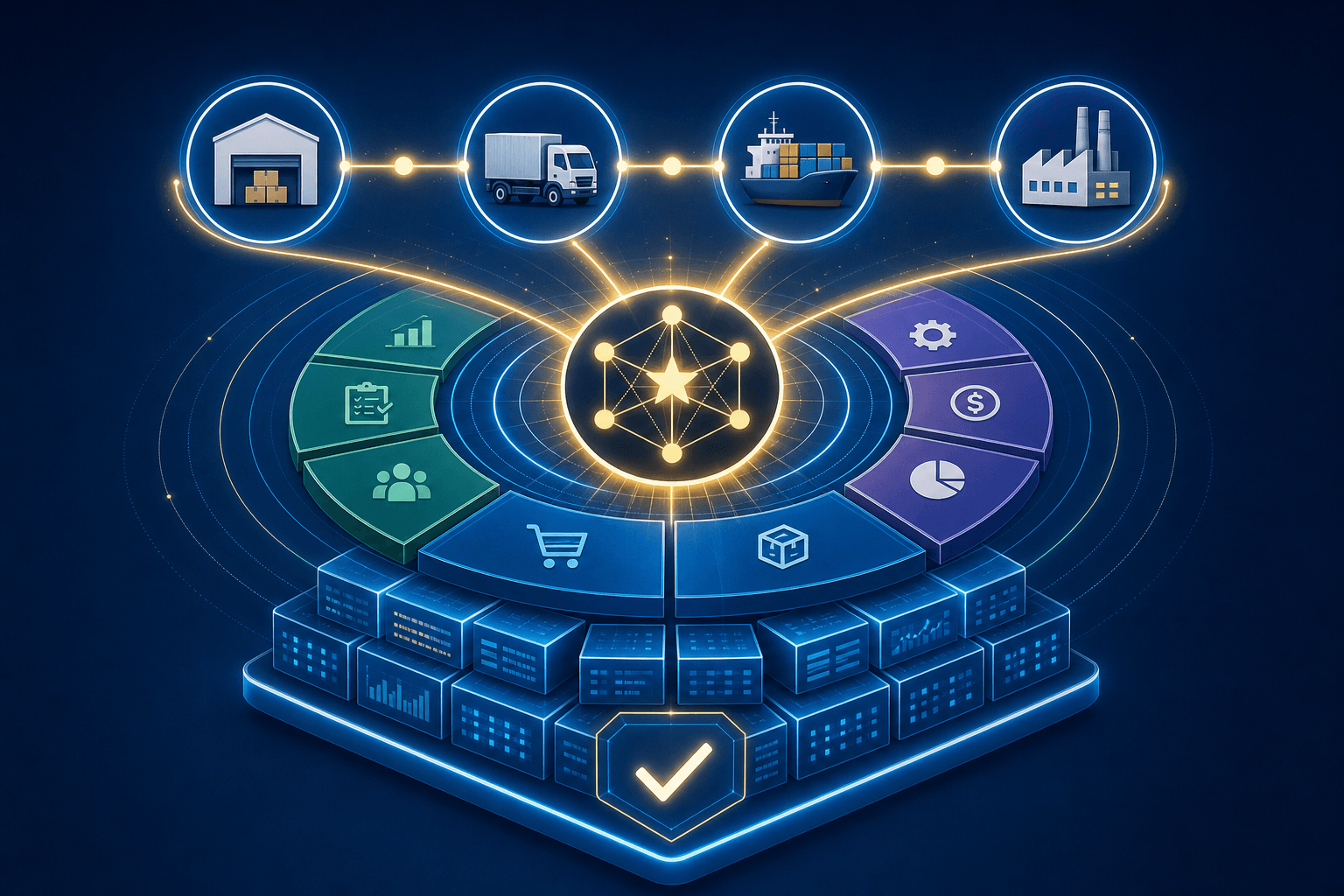
The 4% of organizations that achieve full AI success are not using fundamentally different technology. They are using the same AI tools, platforms, and techniques available to everyone else. What separates them is how they approach deployment. The PwC 2026 survey provides a clear profile of this cohort:
| Characteristic | 4% Leaders | Remaining 96% |
|---|---|---|
| End-to-end integration | 87% have integrated digital capabilities across functions | Majority operate with fragmented, function-specific deployments |
| Broad organizational impact | 73% achieved broad impact across the enterprise | Impact is limited to specific functions or pilot projects |
| Data quality improvement | 63% significantly improved data quality as part of AI initiatives | 87% cite poor data quality as a barrier to value |
| AI strategy embedded across units | 27% have fully embedded AI strategy across business units | Majority have not redesigned operating models for AI |
| Tech investments delivering | Full delivery of expected results from technology investments | 89% say tech investments have not fully delivered |
The contrast between the 4% and the 96% is not subtle. The leaders have invested in data quality, built integrated technology stacks, redesigned their operating models, and committed to multi-year timelines. They have not treated AI as a technology project. They have treated it as a business transformation.
The results are visible in real-world deployments. Amazon's use of machine learning for demand forecasting across more than 400 million products, combined with over 750,000 robots in its fulfillment network, has reduced order fulfillment costs by 25% — a figure projected to save the company $10 billion annually by 2030. Walmart's Route Optimization AI eliminated 30 million driver miles and 94 million pounds of CO2 emissions. GXO's AI-powered inventory counting system scans up to 10,000 pallets per hour, replacing manual counts that took days.
The 5-Step Readiness Framework for Supply Chain AI Success
Moving from the 89% to the 4% requires a structured approach. The following framework is grounded in the research findings and designed to help supply chain leaders diagnose their current state and build a realistic path to AI success.
Step 1: Audit Data Quality and Integration Maturity
Before any AI initiative, conduct a systematic audit of data quality across all supply chain systems. The audit should assess completeness, timeliness, consistency, and accessibility of data in ERP, WMS, TMS, and procurement platforms. Identify the specific data gaps that would prevent AI models from producing reliable outputs. The 87% of leaders who cite poor data quality as a barrier did not discover this after deployment — they knew it beforehand but proceeded anyway.
Use the CSCO's Data Readiness Checklist as a starting point. This checklist covers the specific data quality dimensions that determine whether AI initiatives can deliver value, including data lineage, master data management, and cross-system integration requirements.
Step 2: Define an End-to-End AI Strategy, Not a Pilot List
The 23% of organizations with a formal AI strategy are already ahead of the 77% that lack one. But a strategy is not a list of pilot projects. It must define which supply chain outcomes the organization is targeting — inventory reduction, service level improvement, logistics cost reduction, procurement savings — and map how AI will contribute to each outcome across functions. The strategy should specify the integration points between systems and the data flows required to support cross-functional AI models.
Step 3: Redesign the Operating Model for Cross-Functional Decision-Making
This is the step most organizations skip. Redesigning the operating model means defining new decision rights, establishing cross-functional governance bodies, and creating escalation paths for AI-generated recommendations. It means specifying which decisions can be automated, which require human approval, and how exceptions are handled. The 27% of organizations that have embedded AI strategy across business units did not achieve this by accident — they deliberately restructured how decisions are made.
Step 4: Establish Governance and Human-in-the-Loop Thresholds
As organizations move toward agentic AI, governance becomes a competitive differentiator. Define clear thresholds for autonomous decision-making: which procurement transactions can be executed without human review, which inventory adjustments are automatically approved, and which logistics rerouting decisions require supervisor sign-off. Implement audit trails that track every AI-generated decision and its outcome. Establish model drift monitoring to detect when AI performance degrades over time.
Step 5: Phase for 2–4 Year ROI Expectations
Only 6% of organizations see AI ROI in under a year. The typical timeline is two to four years. Plan for this. Structure AI investments in phases that deliver incremental value while building toward the full vision. Phase 1 might focus on data unification and a single high-impact use case. Phase 2 expands to adjacent functions. Phase 3 introduces cross-functional AI agents. Each phase should have clear success criteria and a go/no-go decision point.
| Phase | Focus | Timeline | Success Criteria |
|---|---|---|---|
| Phase 1: Foundation | Data unification, single use case (e.g., demand forecasting) | 6–12 months | Data quality metrics improve; single-function AI model deployed and trusted |
| Phase 2: Expansion | Adjacent functions (e.g., inventory optimization, procurement) | 12–24 months | Cross-functional data integration; two or more AI models operating in production |
| Phase 3: Integration | Cross-functional AI agents, operating model redesign | 24–48 months | AI agents executing decisions autonomously within defined governance; measurable enterprise-level impact |
From the 89% to the 4%: A Realistic Path Forward
The gap between the 89% of organizations whose AI investments have not fully delivered and the 4% who have achieved full success is bridgeable. But bridging it requires honest assessment — of data quality, organizational silos, and operating model readiness. The 4% did not succeed by buying better AI. They succeeded by fixing what was broken before AI.
The path forward is not glamorous. It involves data audits, integration projects, governance frameworks, and organizational change management. It requires patience — the 2–4 year ROI timeline is real, and organizations that expect quick wins will be disappointed. But the evidence is clear: the organizations that invest in the foundations — data quality, end-to-end integration, and operating model redesign — are the ones that achieve enterprise-wide AI impact.
The first step is the data readiness assessment. The CSCO's Data Readiness Checklist provides a structured starting point for evaluating where your organization stands. From there, the five-step framework offers a roadmap for moving from the 89% to the 4% — not by chasing the latest AI trend, but by building the organizational and data infrastructure that makes AI work at scale.
Comments
Join the discussion with an anonymous comment.