

AI in procurement use cases are no longer hard to find. The harder question in 2026 is which ones can survive the move from enthusiastic usage to funded, governed, production deployment. That distinction matters because procurement is already living with a strange split-screen reality: Hackett reported that 94% of procurement professionals used GenAI weekly, while 49% of procurement teams had piloted GenAI in 2024 and only 4% had achieved large-scale deployment.[1]
The market story is moving in the opposite direction. Precedence Research estimated the AI in procurement market at $3.32 billion in 2025 and projected it to reach $39.20 billion by 2035, a 28% CAGR.[2] That is useful context for budget pressure, but it is not a deployment plan. The more defensible answer is narrower: eight use cases now deserve structured investment, but they do not deserve equal confidence, equal funding, or equal governance.

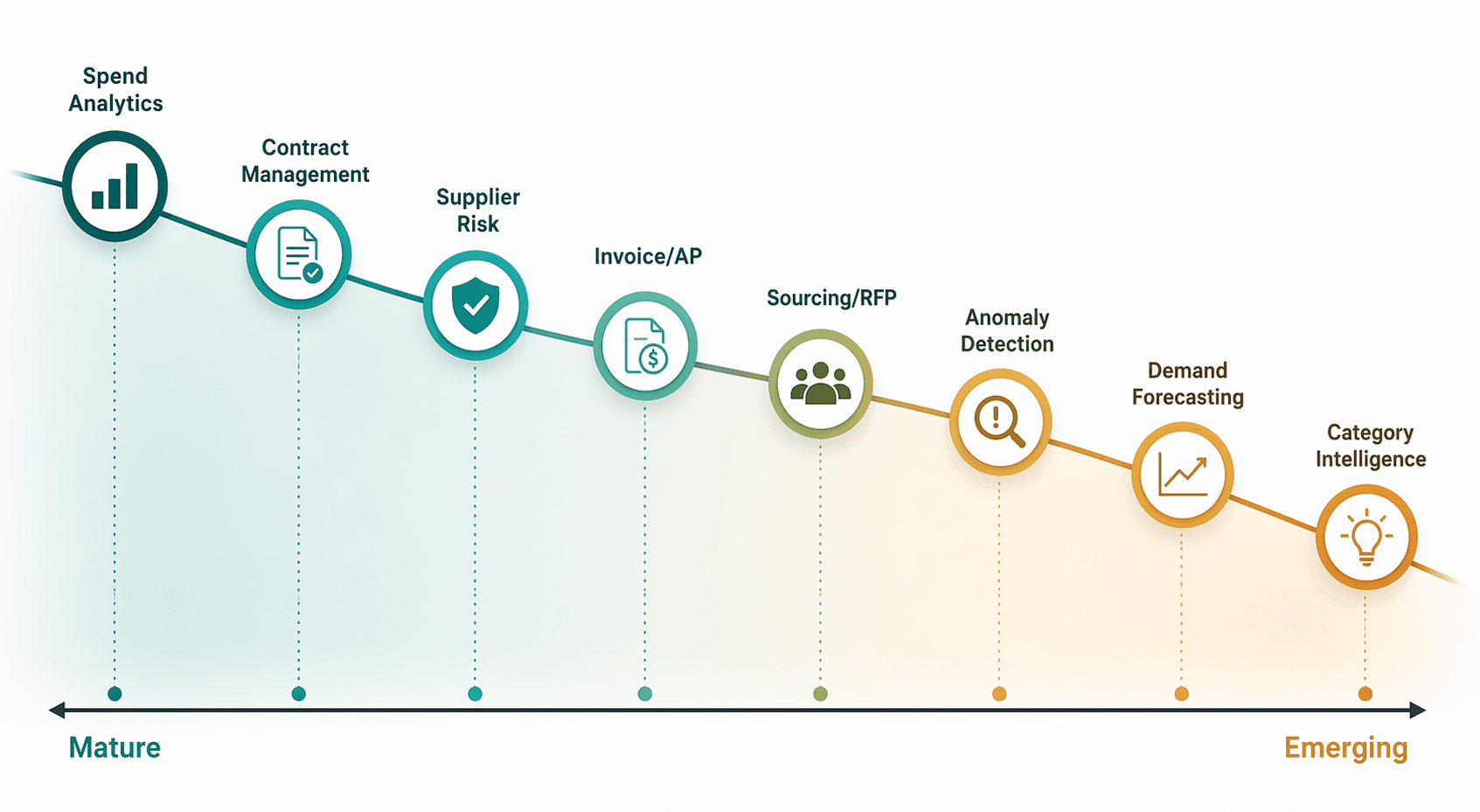
The 2026 maturity benchmark: eight AI procurement use cases
| Use case | 2026 maturity | Adoption or evidence signal | Realistic ROI indicator | Primary implementation risk |
|---|---|---|---|---|
| Spend analytics and classification | Mature | 53.44% of CPOs prioritize spend analytics; vendor case evidence shows approximately 97% classification accuracy with human review | Working-capital, savings pipeline, compliance, and category visibility; Oracle cited $15M in addressable working-capital improvement in one enterprise example | Supplier normalization, taxonomy design, invoice and PO data quality, and over-trusting automated classification |
| Contract management and clause intelligence | Strong / scaling | AI-assisted review and key-term extraction increasingly embedded in CLM workflows | Vendor-attributed secondary data cites 65% faster contracting efficiency | Poor repository quality, inconsistent templates, weak metadata, and legal/procurement ownership gaps |
| Supplier risk monitoring | Strong / scaling | Vendor-attributed secondary data cites a 58% production rate among procurement-adjacent AI use cases | Avoided disruption, faster risk triage, and reduced manual monitoring; average implementation investment cited at $2.0M | False confidence from weak external signals, fragmented supplier hierarchies, and unclear escalation workflows |
| Invoice processing and AP automation | Strong / scaling | Automation of manual data capture, validation, and exception routing is already operationally familiar | Vendor-attributed secondary data cites 92% time savings on manual capture and validation and 60% faster financial process cycles | Exception handling, ERP integration, duplicate supplier records, tax and payment controls |
| Strategic sourcing and RFP/RFQ automation | Moderate / scaling | 42.33% of CPOs use GenAI for RFP/RFQ generation | Deloitte-linked materials cite 3% hard cost savings | Template sprawl, weak category context, evaluator bias, and lack of audit trail |
| Anomaly detection for compliance and leakage | Moderate | Pattern detection is technically mature, but procurement-specific deployment evidence is thinner than AP or spend analytics | Vendor-attributed secondary data cites 80% reduction in non-compliance costs | Noisy alerts, incomplete policy mapping, and lack of investigation capacity |
| Demand forecasting for procurement inputs | Moderate / emerging | Supported by broader supply chain AI capabilities, but procurement-specific production evidence is uneven | Potential reductions in spot buys, expediting, inventory imbalance, and poor supplier commitments | Forecast ownership, demand signal quality, and integration with planning and sourcing calendars |
| Category intelligence and agentic category support | Emerging | Promising for autonomous research, should-cost synthesis, supplier discovery, and category plan drafting | ROI is plausible but not yet as production-proven as analytics, AP, or risk monitoring | Hallucinated market intelligence, unclear decision rights, weak knowledge base, and immature agent governance |
The table is deliberately uneven. Spend analytics sits in a different confidence band from agentic category support. Invoice processing has a different risk profile from supplier risk monitoring. RFP drafting may feel easy to demo, but that does not make sourcing decisions autonomous. A funding request that treats all eight as one AI program will usually blur the exact differences finance and IT need to see.
The guardrail is the pilot-to-production chasm. MIT’s 2025 State of AI in Business study found that 95% of enterprise AI pilots delivered no measurable ROI despite $30 billion to $40 billion in recent investments.[3] In procurement, that failure pattern usually shows up less dramatically: a promising demo, a short pilot on a clean data extract, a steering committee deck, and then months of unresolved questions about master data, workflow ownership, ERP integration, information security, and who is supposed to maintain the model once the vendor team leaves.
Why spend analytics is the anchor use case
Spend analytics deserves the deepest treatment because it is where the evidence base is strongest and where the dirty work is hardest to hide. Deloitte’s 2025 CPO Survey materials reported that 53.44% of CPOs prioritize spend analytics, making it one of the clearest procurement AI investment areas rather than an experimental side bet.[4]
The practical value is not that a model can create a prettier dashboard. It is that machine learning can reduce the manual burden of classifying suppliers, mapping transactions to categories, identifying tail spend, and finding duplicate or fragmented buying patterns. For a procurement team that has spent quarters arguing about whether a supplier belongs under facilities, professional services, IT, or marketing operations, classification quality is not a technical detail. It determines whether the category strategy is built on reality.
The Sievo/Pentair case is useful because it shows what good looks like without pretending that every company can copy the result by buying a model. The case reported approximately 97% spend classification accuracy with human-in-the-loop review.[5] That should be treated as a strong case example, not a guaranteed median. High classification accuracy depends on prepared data, a workable taxonomy, clean enough supplier and invoice fields, and human review where confidence is low.
Oracle’s cited example adds a different kind of proof point: AI-driven spend classification identified $15 million in addressable working-capital improvement at a large enterprise.[6] The important word is “addressable.” AI did not magically release cash. It surfaced opportunities that finance, procurement, and the business could then pursue through payment-term changes, supplier negotiations, policy changes, or working-capital governance.
That is the right standard for this use case. Spend analytics is mature because it improves the map procurement uses to act. It does not remove the need for category managers, sourcing councils, supplier conversations, or finance validation. It gives those teams a better starting point. For readers who need the implementation mechanics behind classification accuracy, the companion deep dive on machine learning in spend analytics is the more technical reference.
Contract management: valuable, but only if the repository is real
Contract AI has an obvious procurement appeal: summarize obligations, extract renewal dates, flag unusual clauses, compare supplier terms, and speed up first-pass review. The business case becomes especially credible when procurement is dealing with thousands of legacy documents, scattered addenda, and a CLM system that contains PDFs but not consistently structured terms.
Automation Anywhere’s 2026 guide cites 65% faster contracting efficiency through AI-assisted first-pass review and automated key-term extraction, attributed in the guide to external sources such as BCG and SCMR.[7] That figure should be treated as secondary, vendor-attributed benchmark data unless verified against the original studies before publication. It is still directionally useful because the workflow itself is credible: AI reduces the time spent locating, reading, and comparing standard contract information.
The implementation boundary is equally clear. AI cannot compensate for a contract estate that procurement and legal do not trust. If executed agreements, amendments, statements of work, and pricing exhibits sit in different repositories with inconsistent naming conventions, the first investment may need to be document consolidation and metadata cleanup. The model can extract clauses; it cannot decide which unsigned draft represents the binding supplier obligation.
Supplier risk monitoring belongs close to the operating rhythm
Supplier risk monitoring is one of the strongest AI procurement use cases because it connects directly to work procurement teams already do badly under time pressure: checking sanctions, financial distress, geopolitical exposure, operational disruption, cyber signals, ESG alerts, and concentration risk across a changing supplier base. The value is not in producing another risk score. The value is in getting the right exception to the right owner before a sourcing event, renewal, payment hold, or business continuity review depends on it.
Automation Anywhere’s guide cites supplier risk monitoring as having the highest production rate among procurement-adjacent AI use cases at 58%, with an average investment of $2.0 million per implementation, attributed to ISG via the guide.[7] Because this is vendor-attributed secondary data, it should not be read as an independent market census. It does, however, match what many procurement teams experience operationally: risk monitoring has a clear pain point, visible executive sponsorship, and a natural workflow for escalation.
This is also where data model design matters. A supplier risk platform that monitors legal entities but procurement buys through regional subsidiaries will miss the relationships that matter. A risk alert that lands in a shared inbox without category ownership will create noise, not mitigation. The better deployments tie alerts to supplier hierarchies, category criticality, contract status, spend exposure, and explicit escalation rules. For a fuller treatment of this intersection, see the related analysis of AI supplier risk scoring and spend analysis.
Invoice processing and AP automation: mature work, messy exceptions
Invoice processing is not always owned by procurement, but procurement lives with the consequences: duplicate invoice disputes, supplier complaints, blocked payments, mismatched purchase orders, and working-capital friction. AI-assisted AP automation has a clear operating target. Extract invoice data, match it against POs and receipts, validate tax and supplier details, route exceptions, and reduce manual touchpoints.
Automation Anywhere’s guide cites 92% time savings on manual data capture and validation and 60% faster financial process cycles, attributed through the guide to sources including IBM.[7] As with the contracting and risk figures, this should be caveated as vendor-attributed secondary benchmark data unless the original evidence is verified. The shape of the value case is nevertheless practical: the benefit comes from reducing repetitive capture and validation work, not from handing payment control to an ungoverned model.
The hard part usually sits in exceptions. No-PO invoices, partial receipts, duplicate suppliers, tax mismatches, currency inconsistencies, and disputed goods receipt data can consume the savings if the process design is weak. Mature AP automation does not mean every invoice goes straight through. It means the organization knows which invoices can be handled automatically, which require approval, and which should be blocked or investigated.
Strategic sourcing and RFP automation: useful acceleration, not autonomous sourcing
RFP and RFQ generation is one of the easiest GenAI use cases for category teams to try because the starting material is familiar: prior events, templates, scope language, supplier questions, evaluation criteria, and award summaries. Deloitte-linked materials report that 42.33% of CPOs use GenAI for RFP/RFQ generation, and Deloitte’s 2025 survey materials cite 3% hard cost savings for strategic sourcing/RFP automation.[4]
That adoption signal is meaningful, but it should not be confused with full sourcing autonomy. Drafting an RFP is only one slice of the sourcing process. The higher-risk decisions still involve scope definition, supplier inclusion, commercial model design, incumbent strategy, bid normalization, conflict management, stakeholder alignment, and award governance. AI can accelerate the drafting and analysis burden; procurement still owns the sourcing judgment.
The best near-term use is controlled augmentation: generating a first draft from approved templates, checking completeness against category-specific requirements, summarizing supplier responses, identifying missing answers, and preparing evaluation packs. The worst use is letting a model create event content from thin context and then treating fluent language as category expertise.
Anomaly detection, forecasting, and category intelligence sit in the middle-to-emerging band
Anomaly detection is technically attractive because procurement leakage often hides in patterns humans do not review systematically: off-contract spend, split purchases, unusual price movement, repeated low-value exceptions, duplicate payments, supplier bank-detail changes, or policy violations. Automation Anywhere’s guide cites an 80% reduction in non-compliance costs, attributed through the guide to external sources.[7] That is a strong claim and should be verified before it anchors a business case. A safer working assumption is that anomaly detection can improve compliance monitoring where policies, controls, and investigation ownership are already defined.
Demand forecasting for procurement inputs is more mixed. It can help sourcing teams anticipate demand, avoid last-minute spot buys, align supplier capacity, and reduce expediting. But the relevant signals often sit outside procurement in sales, operations, production planning, inventory, maintenance, or project management systems. If no one owns the forecast, the AI output becomes another number procurement is blamed for not acting on.
Category intelligence is the most intriguing and the easiest to overstate. GenAI can summarize market reports, draft category plans, compare supplier capabilities, monitor news, and prepare negotiation briefs. Agentic workflows may eventually orchestrate supplier discovery, intake clarification, market research, event preparation, and recommendation drafting. But that places category intelligence in the emerging tier, not beside spend analytics. The evidence base is still thinner, and governance questions are unresolved: which sources are trusted, which recommendations need human approval, and how the organization detects hallucinated or stale market intelligence.
For teams actively exploring that frontier, the right comparison is not with a fully manual process. It is with a governed assistant that works inside approved sources, shows its evidence, logs its recommendations, and leaves decision rights visible. The more speculative agentic use cases belong in a separate investment lane, as covered in the forward-looking piece on agentic AI in procurement.
The constraint is data readiness, not model ambition
The fastest way to weaken an AI procurement business case is to pretend the data problem is a preliminary IT task. Gartner-linked materials report that 74% of procurement leaders say their data is not AI-ready, and only 23% of supply chain organizations have a formal AI strategy.[8] Those numbers explain why strong demos stall. The pilot uses a cleaned extract. Production uses the real supplier master, the real contract repository, the real ERP fields, the real category taxonomy, and the real exception queue.
Data readiness is not one cleanup sprint. It is a set of operating decisions: who owns supplier hierarchy maintenance, how categories are governed, which contract metadata is mandatory, how invoice exceptions are coded, which risk sources are approved, how often taxonomies are refreshed, and how AI outputs are audited. Without those decisions, the model may still produce answers. The organization just will not know whether to trust them.
This is why mature use cases are still data-dependent. Spend analytics needs normalized suppliers and a usable taxonomy. Contract intelligence needs authoritative documents. Supplier risk monitoring needs linked supplier entities and escalation paths. AP automation needs clean vendor records and matching logic. RFP automation needs approved templates and category context. Anomaly detection needs policy definitions and investigation ownership. Forecasting needs agreed demand signals. Category intelligence needs governed knowledge sources.
A practical data-readiness review should happen before vendor shortlisting, not after selection. The review does not need to be academic, but it does need to be honest. Which systems hold the relevant data? Which fields are mandatory? Which records are duplicated? Which documents are authoritative? Which users will correct model outputs? Which controls must be auditable? The data readiness assessment for AI procurement automation and the procurement data AI-readiness roadmap are useful companions for turning that review into a staged program.
How to sequence investment across the eight use cases
The sequencing logic is straightforward: fund mature, data-dependent use cases first; expand into adjacent workflows where the operating model is ready; keep agentic workflows in a stricter pilot lane until the evidence and governance catch up.
- Start with spend analytics if category visibility, supplier fragmentation, savings pipeline credibility, or working-capital opportunity is weak. It creates the fact base other procurement AI use cases need.
- Prioritize invoice processing/AP automation when manual capture, matching exceptions, duplicate payments, or supplier payment disputes consume measurable operational capacity.
- Move supplier risk monitoring forward when the organization can define critical suppliers, assign escalation owners, and connect risk signals to sourcing, renewal, and continuity decisions.
- Fund contract intelligence when the repository is consolidated enough for extraction and review to matter, or when the first phase of the project can clean the repository as part of implementation.
- Use RFP/RFQ automation to reduce sourcing cycle effort, but keep commercial strategy, supplier selection, and award recommendations under visible human governance.
- Deploy anomaly detection where policies are codified and someone is accountable for investigating alerts; otherwise, alert volume will become another unmanaged queue.
- Pilot demand forecasting only where procurement can access planning signals and influence sourcing or supplier commitments early enough to change outcomes.
- Treat category intelligence and agentic category management as emerging capabilities: useful for research and drafting, not yet a replacement for category ownership.
EY’s 2025 Global CPO Survey adds another useful reality check: 80% of CPOs planned to deploy GenAI within three years, while 36% had meaningful implementations.[9] That gap is not an argument against investment. It is an argument for funding AI procurement use cases the same way procurement funds any serious transformation: with a baseline, an owner, a process change, a data plan, a control model, and a benefits case that finance can inspect.
For a broader inventory beyond the eight benchmarked here, the companion AI procurement use-case catalog can help map adjacent opportunities. For the business-case layer, see the deeper work on AI procurement ROI and procurement AI ROI in 2026.
The useful answer for 2026 is neither “wait” nor “automate procurement.” It is more specific: invest now in the use cases with production evidence and measurable operating consequences, especially spend analytics, supplier risk, AP automation, contract intelligence, and controlled sourcing support. Keep anomaly detection, forecasting, and category intelligence on the roadmap with sharper proof requirements. And treat data readiness as the scaling program itself, not the cleanup work someone else should have finished before AI arrived.
References
- Hackett Group 2025 CPO Agenda, Hackett Group / Art of Procurement.
- AI in Procurement Market Size Projections, Precedence Research.
- The State of AI in Business 2025, MIT.
- 2025 Global CPO Survey, Deloitte.
- Pentair Spend Classification Case Study, Sievo / Pentair.
- AI-Driven Spend Classification Working Capital Example, Oracle.
- Automation Anywhere 2026 Guide, Automation Anywhere, 2026.
- Procurement Data and AI Readiness Findings, Gartner / Open Sky Group / Automation Anywhere.
- 2025 Global CPO Survey, EY, 2025.
Comments
Join the discussion with an anonymous comment.