
Procurement has a familiar AI problem in 2026: plenty of pilots, not much production gravity. In 2024, 49% of procurement teams had piloted generative AI, but only 4% had reached large-scale deployment, according to Hackett Group figures cited by Art of Procurement.[1] That gap matters more than the demo reel. A chatbot that drafts a supplier email is useful; an agent that notices a stalled intake request, classifies it, checks policy, routes it, and keeps the process moving without another calendar nudge is a different operating model.
The useful question behind AI in procurement use cases is therefore not whether agents will eventually change procurement. Some already are. The better question is where autonomous agents have crossed from assisted work into measurable production work, and where the evidence is still too narrow to justify broad claims.
PwC has projected that agentic AI could transform 75% of procurement activities and deliver up to 70% productivity gains in agent-driven tasks, but that should be read as a directional estimate, not proof that most procurement organizations have already captured those gains.[1] The production record is more uneven and more interesting: accounts payable has the deepest footprint, autonomous negotiation has one of the clearest named cases, strategic sourcing shows high-value early evidence, and orchestration is where the economics start to compound.
From procurement copilots to operators
The practical dividing line is simple: a copilot waits; an agent proceeds. A copilot summarizes a contract clause when asked. An agent monitors an approval queue, identifies the missing reviewer, checks the delegation policy, escalates the exception, and records the handoff. That does not make it fully independent in every decision, and it certainly does not remove accountability. It changes where the waiting happens.
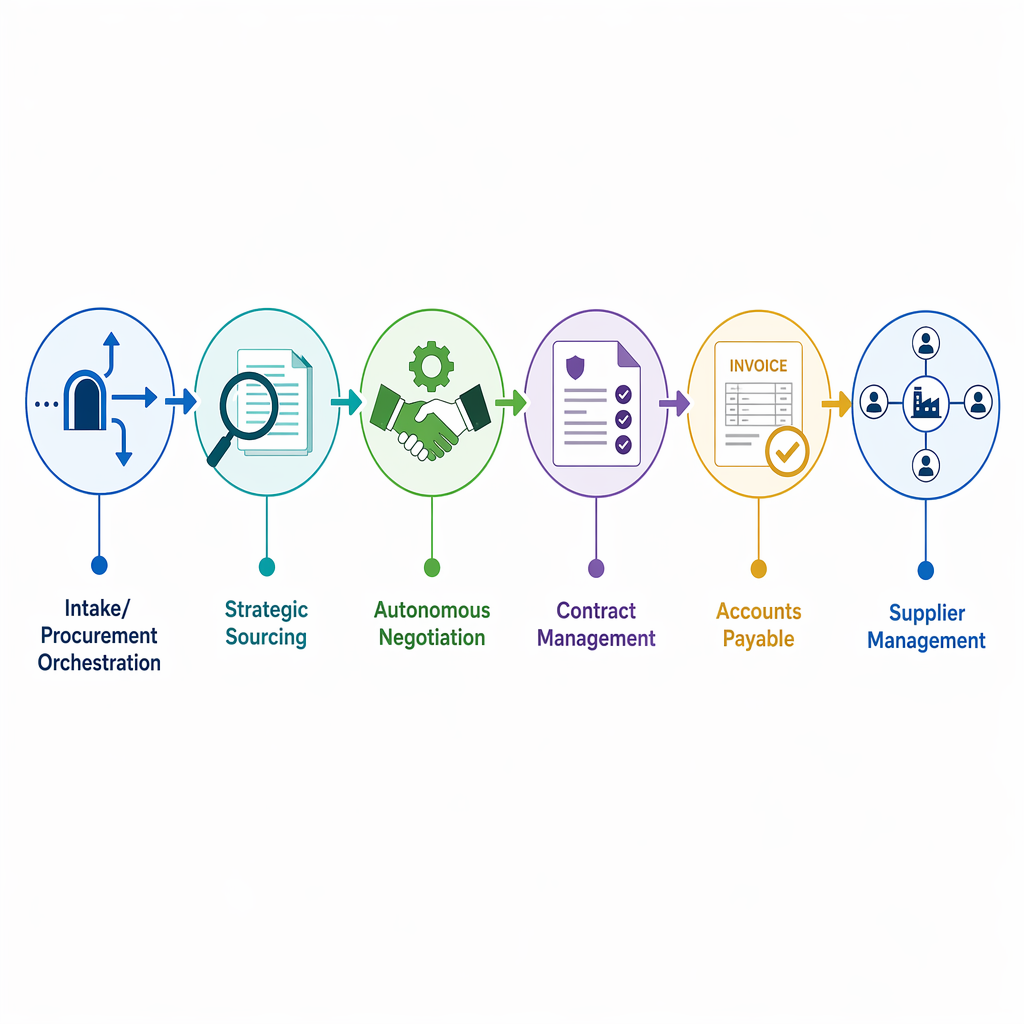
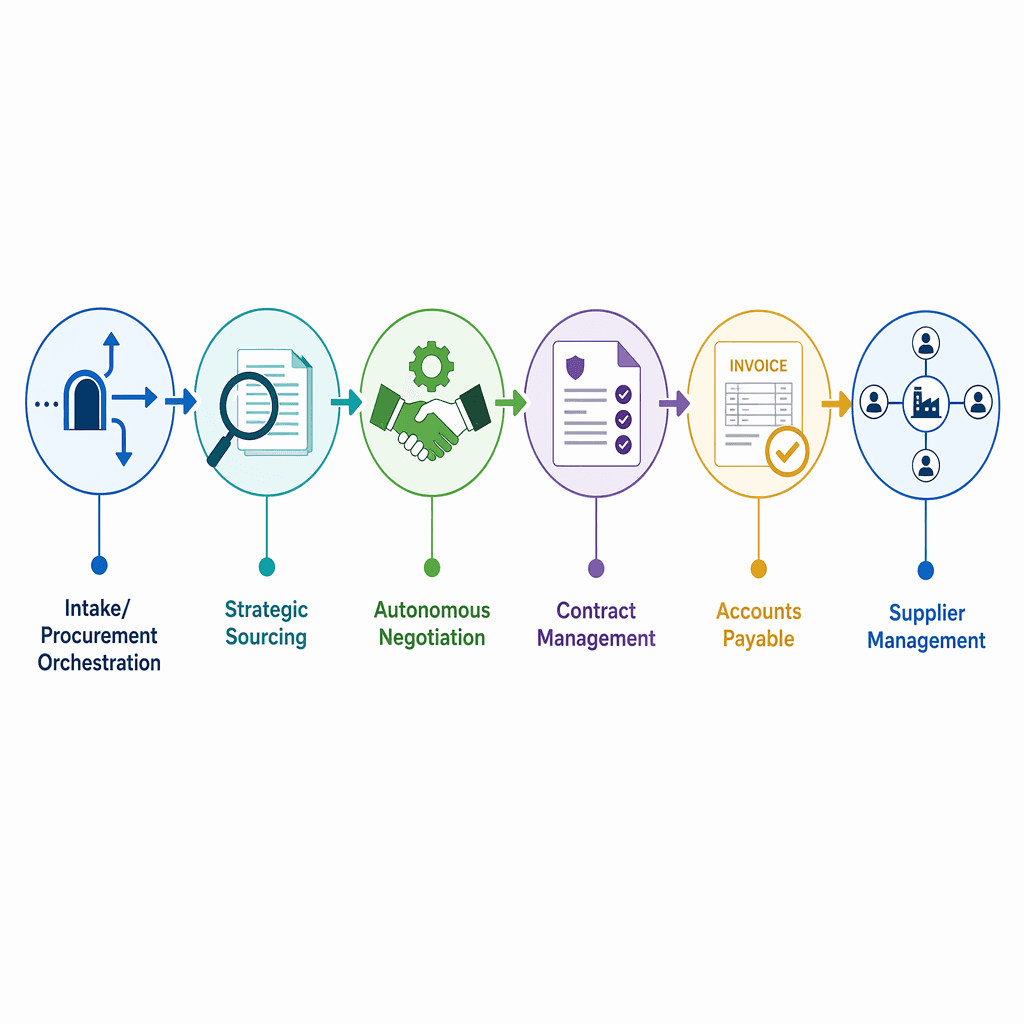
In source-to-pay work, that distinction shows up in six places: intake and procurement orchestration, strategic sourcing, autonomous negotiation, contract management, accounts payable, and supplier management. The boundaries are not always clean. Many platforms bundle several of these capabilities, and one deployed workflow may call multiple agents behind the scenes. Still, the taxonomy is useful because the maturity, risk, and evidence differ sharply by workflow.
| Agent type | What it autonomously does | 2026 maturity signal |
|---|---|---|
| Intake / procurement orchestration | Classifies requests, routes work, applies policy, triggers downstream workflows | Production deployments exist; evidence is often vendor-attributed |
| Strategic sourcing | Builds sourcing strategy from linked research, spend, supplier, and category tasks | High-value early evidence; limited public generalizability |
| Autonomous negotiation | Runs bounded supplier negotiations within approved commercial parameters | Strong named case evidence; scope matters |
| Contract management | Reviews clauses, flags deviations, accelerates redlining and obligation workflows | Useful but evidence is more generalized |
| Accounts payable | Resolves invoice exceptions, matches documents, routes approvals, clears payments | Deepest production footprint |
| Supplier management | Automates onboarding, data collection, risk checks, and supplier follow-ups | Promising operational gains; narrower public evidence |
Intake and procurement orchestration: the agent that reduces queue debt
Intake is where procurement transformation programs often become honest. The business wants a simple buying front door. Procurement wants complete information, compliant routing, usable spend data, and fewer status-check messages. The orchestration agent sits in that tension. It interprets a request, asks for missing information, applies policy, routes the work, and initiates the right downstream process instead of leaving a buyer or coordinator to manually shepherd the ticket.
Zycus reports an agentic procurement deployment serving more than 1,000 users and 4,500 suppliers, with a 40% improvement in NPS and a 20% increase in spend under management.[2] Those figures are useful, but they should be treated as vendor-attributed customer benchmarks rather than independent market averages. The important point is not that every intake program should expect the same lift. It is that intake orchestration has moved beyond the conceptual stage: agents are being used to change request routing, supplier interaction, and spend capture at operating scale.
The payoff is usually less glamorous than the phrase “agentic AI” suggests. A request does not sit untouched because nobody knows whether it is a catalog buy, sourcing event, legal review, or exception. A category manager gets a cleaner intake package. A procurement operations team sees fewer orphaned requests. That kind of friction removal is exactly where early autonomy can be valuable, because the agent is acting inside a defined workflow with visible escalation points.
Strategic sourcing agents: early evidence, high-value work, narrow proof
Strategic sourcing is harder to automate responsibly because the work blends spend analysis, market intelligence, supplier constraints, stakeholder politics, and commercial judgment. That is also why the upside is meaningful. If an agent can coordinate research, opportunity identification, strategy development, and event preparation, it attacks the category manager’s most expensive bottleneck: the weeks of synthesis before a sourcing event is even ready to launch.
McKinsey documented an unnamed technology company using linked AI agents to compress what had been 6–12 weeks of category manager work for sourcing strategy. The engagement reported 12–20% savings in contact-center spend and 20–29% savings in BPO and financial-services spend.[3] That is serious evidence, but it is bounded evidence. The company is not named, the figures come from McKinsey’s consulting engagement data, and the results likely reflect a mature environment with enough spend, supplier, and category data for agents to work with.
This is where procurement leaders should be careful about copying the headline and missing the operating conditions. A sourcing agent can assemble scenarios, identify suppliers, draft event structures, and prepare negotiation levers. It should not silently decide the sourcing strategy for a politically sensitive, supply-constrained, or business-critical category. For more on how governance changes the procurement operating model, see How Agentic AI Is Reshaping the Procurement Operating Model.
Autonomous negotiation: Walmart shows what bounded autonomy can do
Autonomous negotiation is the use case that tends to make procurement teams either lean in or tense up. The anxiety is understandable. Negotiation is not just a sequence of offers; it carries relationship, fairness, compliance, and reputational risk. But the Walmart case is difficult to dismiss because it was not merely a drafting assistant helping a buyer write better emails.
In the HBR-documented Walmart deployment, the autonomous negotiation system reached agreements with 68% of suppliers, far above a 20% target. Walmart reported 3% savings on tail spend, a 35-day payment-term extension, and 4× ROI. Just as striking, 75% of suppliers preferred negotiating with the AI system rather than with a human negotiator.[4]
The supplier preference figure is the part that procurement teams should sit with. Tail-spend negotiation is often too low-value for category managers to prioritize and too repetitive for suppliers to enjoy. A well-bounded agent can be available, consistent, and fast. It can negotiate inside approved parameters without waiting for a buyer to clear time between strategic events.
That does not mean autonomous negotiation is ready for every supplier conversation. Walmart is a single, famous deployment, and tail spend is a more contained arena than strategic supplier negotiation. The lesson is narrower and more useful: when negotiation scope is bounded, commercial guardrails are explicit, and escalation rules are clear, agents can do more than assist. They can complete work that previously sat below the human team’s attention threshold.
Contract management agents: acceleration is real, but autonomy should stay bounded
Contract work is a natural home for AI because so much of it is document-heavy, comparison-heavy, and policy-heavy. Agents can review supplier paper against playbooks, identify nonstandard clauses, suggest fallback language, route exceptions to legal, and track obligations after signature. Industry reporting cited in the procurement AI discussion points to 45–90% cycle-time reductions in contract review and management.[5]
Those cycle-time ranges are broad, and the breadth matters. Reviewing a low-risk NDA is not the same as handling a complex services agreement with liability, data protection, audit, termination, and regulatory exposure. Contract agents are best treated as accelerators with strong audit trails: let them compare, flag, draft, and route; require human approval when risk crosses defined thresholds.
The governance issue is not theoretical. If an agent changes a limitation-of-liability clause or misses a data-processing obligation, the cleanup will not land on the demo team. It will land on legal, procurement, the business owner, or the supplier manager trying to enforce the contract later. Contracting autonomy therefore needs clause-level permissions, version history, and clear ownership for exceptions.
Accounts payable agents have the strongest production footprint
Accounts payable is where agentic AI looks least like science fiction and most like overdue process relief. AP teams already live with structured documents, repetitive exceptions, supplier follow-ups, matching rules, approval paths, and measurable cycle times. The work is not easy, but it is observable. That makes it a better production environment for autonomy than many higher-judgment procurement workflows.
Hackett Group figures cited by Art of Procurement show that 21% of companies were already running agentic AI in AP production. Best-in-class touchless invoice processing reached 52.8%, and reported productivity improvement was 3.5×.[1] Among the six use cases, AP has the clearest adoption depth because the process is mature enough to expose where agents are actually reducing manual work: invoice capture, purchase-order matching, exception classification, approval routing, supplier inquiry response, and payment-status resolution.
This is also where “autonomous” should be interpreted carefully. An AP agent may clear a clean three-way match without human touch, chase a missing receipt, or classify a tax discrepancy. It should not be allowed to normalize every exception into a payable event simply to improve touchless rates. The metric that matters is not automation volume alone; it is clean throughput without pushing risk into downstream reconciliation, supplier disputes, or audit findings.
For organizations still trying to decide where to start, AP deserves serious consideration because the workflow has enough transaction density to learn from, enough controls to govern, and enough pain to make productivity gains visible. Broader ROI benchmarks are covered in AI Procurement Tools: What the ROI Data Actually Shows.
Supplier management agents: onboarding is the cleanest entry point
Supplier management is broad, so the most credible early agent use cases are the ones with defined handoffs: onboarding, document collection, profile completion, compliance checks, risk-data refreshes, and follow-up reminders. These are the workflows where supplier portals often break down because nobody enjoys chasing tax forms, certificates, bank details, ESG questionnaires, or missing risk documents.
Industry sources cited in 2026 procurement AI coverage report an 88% reduction in supplier onboarding time from supplier management automation.[5] That is a strong operational signal, though it should not be stretched into a claim that all supplier management judgment can be automated. Onboarding is different from deciding whether to exit a supplier, approve a remediation plan, or accept geopolitical exposure in a constrained category.
The near-term value is follow-through. The agent notices that a supplier has not completed a required field, asks for the missing document, checks whether the submission satisfies policy, and routes exceptions to the right owner. Supplier managers then spend less time acting as administrative traffic controllers and more time on performance, risk, and relationship decisions.

The maturity map is uneven, and that is the point
A procurement leader does not need to treat all six agent types as equally ready. In fact, doing so is one of the easiest ways to overbuy and under-govern. AP and intake orchestration are closer to the process-control end of the spectrum. Strategic sourcing and negotiation can produce higher-value outcomes, but they require tighter scoping, cleaner data, and more explicit human checkpoints. Contract and supplier management agents sit between those poles, depending heavily on risk tier, document complexity, and the quality of the underlying playbooks.
| Use case | Evidence strength in 2026 | Practical adoption posture |
|---|---|---|
| Accounts payable | Strongest production footprint, including 21% production adoption in cited Hackett figures | Prioritize where invoice volume, matching rules, and exception controls are mature |
| Intake / procurement orchestration | Production benchmarks exist, including vendor-attributed Zycus metrics | Use to reduce queue debt and improve spend capture before expanding autonomy |
| Autonomous negotiation | Strong named Walmart case, especially for tail spend | Start with bounded categories, approved negotiation ranges, and escalation rules |
| Strategic sourcing | Compelling McKinsey-documented engagement, but unnamed company | Apply to category research and strategy assembly before autonomous sourcing decisions |
| Contract management | Broad cycle-time reduction claims, less precise public deployment evidence | Permit review, comparison, routing, and drafting with clause-level approvals |
| Supplier management | Promising onboarding-time reduction evidence | Begin with onboarding and data refresh before higher-risk supplier decisions |
The pattern is familiar from earlier procurement technology waves: the workflows with the clearest rules and highest transaction density mature first. That does not make them strategically superior. It makes them easier to govern, easier to measure, and easier to defend when the CFO asks whether the automation reduced work or just moved it somewhere else.
Why orchestration changes the ROI conversation
The larger ROI case does not come from six isolated automations running in six corners of the procurement stack. It comes when agents coordinate. An intake agent classifies a request and triggers a sourcing agent. The sourcing agent prepares the strategy, identifies suppliers, and hands bounded commercial levers to a negotiation agent. The result flows into contract review. Contract terms inform AP tolerances. Supplier onboarding and risk checks happen without someone manually rekeying the same information into another queue.
Hackett Group figures cited by Art of Procurement point to 30% process-efficiency gains from orchestration, with 25% of cost reduction attributed to orchestration.[1] Those numbers explain why procurement teams are moving beyond single-point AI tools. The real waste in source-to-pay is often between steps: waiting for the next owner, translating context from one system to another, reopening decisions that should have traveled with the workflow.
This is also where governance becomes harder. A single AP agent can be monitored against invoice exceptions and payment controls. A multi-agent chain can create decisions that no single owner feels they made. If the intake classification was wrong, the sourcing path was inappropriate, the negotiation range was too loose, and the contract fallback was accepted automatically, the failure is not one bad prompt. It is an operating model failure.
Governance has to be designed before autonomy spreads
The trust data is a useful restraint. In ChainSignal’s prior coverage of agentic AI in supply chain, leaders showed confidence in the technology but only a small share trusted AI for solo critical decisions: 67% were confident, while only 10% trusted AI to make critical decisions alone. That distinction belongs in procurement governance as well. See Agentic AI in Supply Chain — When AI Agents Become Digital Colleagues for the broader trust framing.
Good governance is not a ceremonial approval board added after the pilot. It is a set of operating permissions: what the agent may decide, what it may recommend, what it may draft, what it may execute, and when it must stop. The thresholds should vary by workflow. A clean invoice match can have a different autonomy level than a disputed payment. Tail-spend negotiation can have a different approval path than a strategic supplier renewal. A low-risk clause can be handled differently from a liability change.
- Define decision rights by workflow, not by technology label.
- Set human-in-the-loop thresholds for spend, risk, supplier tier, contract clause type, and exception class.
- Require audit trails that show which agent acted, which data it used, which policy it applied, and who approved exceptions.
- Measure downstream cleanup, not only front-end automation rates.
- Review cross-agent handoffs before connecting agents into end-to-end workflows.
The workforce side also cannot be separated from the control model. Category managers, AP leads, supplier managers, and legal reviewers need to know when they are supervising an agent, when they are approving an exception, and when they are accountable for a decision the system prepared. For capability-building and adoption planning, see The People Side of AI Procurement Transformation and the Change Management Guide for Autonomous Procurement AI.
Where to prioritize in 2026
The sensible adoption sequence starts where production evidence and process control are strongest. For many organizations, that means AP, intake orchestration, or supplier onboarding before strategic sourcing autonomy. These areas have visible queues, repeatable rules, measurable cycle times, and clearer exception paths. They also expose whether the organization’s master data, policy structure, and workflow ownership are strong enough for agents to operate without creating hidden rework.
From there, expand toward higher-judgment use cases with narrower scopes: tail-spend negotiation before strategic negotiation, sourcing strategy assembly before autonomous sourcing decisions, contract review support before unsupervised clause acceptance. The early Walmart and McKinsey-documented results are encouraging because they show agents performing commercially meaningful work, not just administrative assistance. They are not permission to remove human judgment from every high-value procurement decision.
The organizations that get the most from agentic AI in procurement will probably not be the ones with the longest list of standalone agents. They will be the ones that design the handoffs: intake to sourcing, sourcing to negotiation, negotiation to contract, contract to AP, AP back to supplier management. That is where the queue time disappears. It is also where accountability can disappear if nobody designs it deliberately.
References
- State of AI in Procurement in 2026, Art of Procurement.
- Agentic AI Procurement Use Cases, Zycus.
- Redefining procurement performance in the era of agentic AI, McKinsey, February 2026.
- Walmart autonomous negotiation case study, HBR.
- Why 2026 Is the Year of AI Agents for Autonomous Procurement, SupplyChainBrain.
Comments
Join the discussion with an anonymous comment.