
The CFO’s question is not whether procurement AI software can produce an attractive return. It can. The more useful question is which return number belongs in the business case before the purchase order is signed.
The broad answer in 2026 looks encouraging: AI-driven procurement is being reported at a 2×–5× ROI range, with a median return around 2.6× and 58% faster cycle times in Hackett Group’s analysis.[1] That is enough to justify serious attention. It is not enough to justify using the median as a planning assumption.
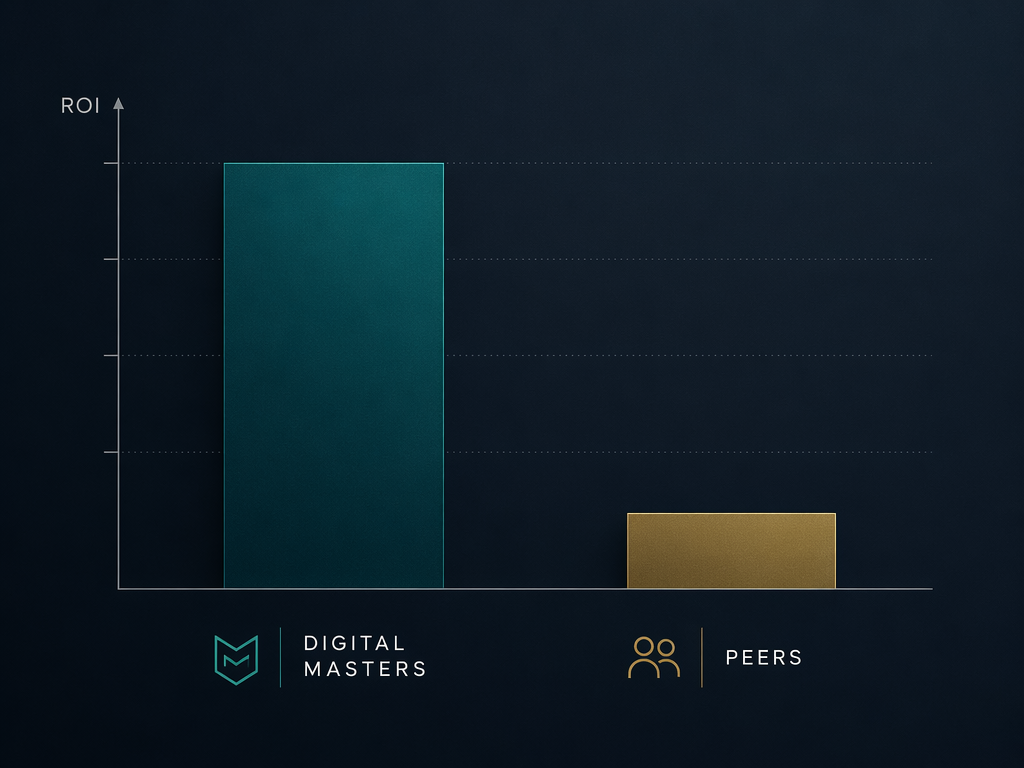
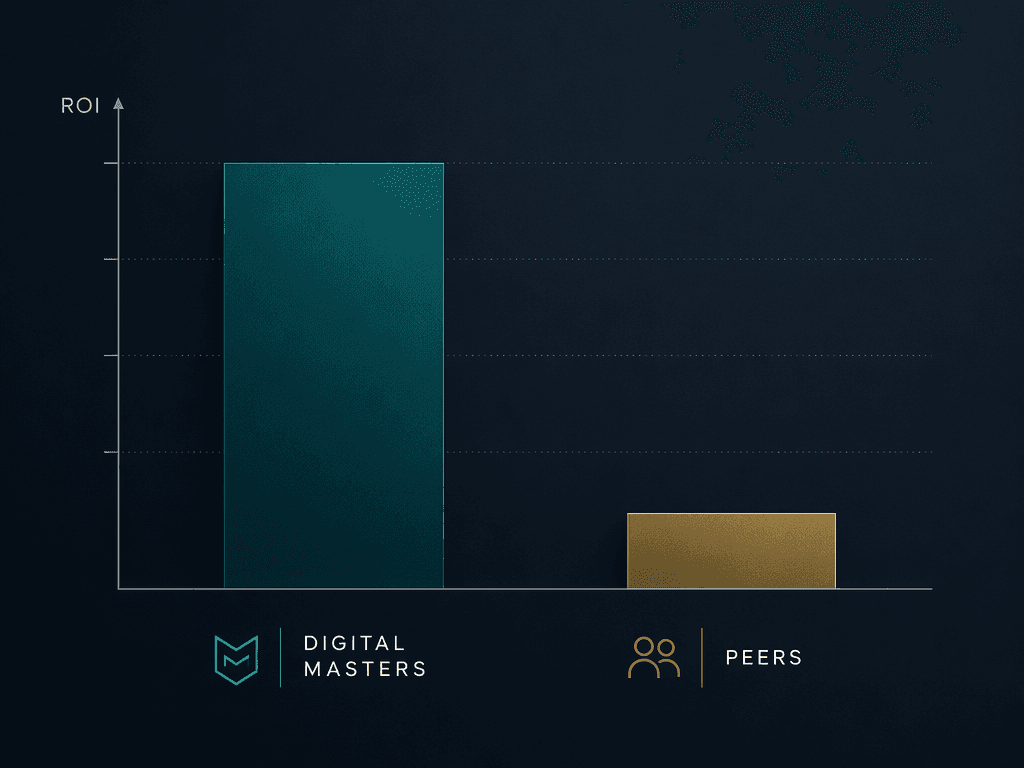
The number that matters more is the spread. Deloitte’s 2025 Global CPO Survey found “Digital Masters” achieving 3.2× ROI on GenAI investments, while peers averaged 1.5×.[2] That difference is the business-case problem. Two companies can buy similar tools, describe similar use cases, and still end up with materially different financial outcomes. The software category is not the whole variable.
The median ROI is where the business case can get lazy
A median return is useful for understanding the market. It is dangerous as a budget promise. If a CPO tells finance that procurement AI software should return roughly 2.6× because that is the reported median, the next questions should be immediate: Which workflows? Which spend categories? Which data sets? Which savings line? Which month does the benefit start? Who signs off that the baseline was real?
This is not pedantry. ROI in procurement can come from very different places. Some of it is measurable savings from better sourcing decisions. Some of it is cycle-time reduction that may or may not convert into cash. Some of it is avoided labor, which only becomes financial return if work is actually removed, capacity is redeployed, or hiring is avoided. Some of it is working-capital improvement. Some of it is risk reduction that matters deeply but is harder to book as ROI without disciplined assumptions.
That is why the 3.2× versus 1.5× gap deserves more weight than the headline 2×–5× range. It says the procurement AI ROI question is less “Does the category work?” and more “Is this organization ready to turn AI output into governed decisions and recognized benefits?”
Readiness is not a footnote; it is the constraint
The readiness numbers are hard to square with confident ROI decks. Gartner reported in 2025 that 74% of procurement leaders said their data was not AI-ready. ProcureCon’s 2026 CPO Report found that only 11% described themselves as fully ready to leverage AI.[2]

Those figures do not mean three-quarters of procurement teams should avoid AI. They mean a large share should stop treating data cleanup, taxonomy alignment, supplier normalization, contract metadata, and workflow ownership as implementation chores. They are ROI assumptions. If they are weak, the return does not merely arrive late; it may never become measurable.
This is where many business cases blur the line between adoption and effectiveness. A team can deploy a spend analytics module, connect it to ERP and P2P data, and still fail to generate recognized savings if category managers do not trust the classifications, if supplier hierarchies are broken, or if identified opportunities never enter sourcing plans. The dashboard exists. The benefit does not.
For readers still building the pre-investment case, a data-readiness review should come before vendor scoring. A practical companion step is a structured data readiness assessment for AI procurement automation, because the strongest ROI claim in the world is still hostage to master data, contract coverage, approval workflows, and benefit tracking.
Where returns actually show up
Procurement AI ROI is usually more defensible when it attaches to a specific decision or transaction. The more abstract the benefit, the harder it is to defend six months later.
| Workflow | What can be measured | What needs caution |
|---|---|---|
| Spend analytics | Opportunity identification, supplier consolidation, category leakage, compliance gaps | Identified savings are not realized savings until sourced, negotiated, implemented, and tracked |
| AP automation | Touchless invoice processing, exception reduction, approval cycle time, avoided manual work | Labor savings require a clear capacity or headcount assumption |
| Contract intelligence | Obligation extraction, renewal visibility, clause risk, missed rebate or pricing terms | Risk visibility is valuable, but not always easy to translate into booked ROI |
| Strategic sourcing | Event cycle time, bid analysis, supplier comparison, negotiated savings | Savings baselines must be controlled or the tool will get credit for normal market movement |
| Sourcing optimization | Scenario analysis, award optimization, cost-service tradeoffs | The model only pays off if stakeholders accept optimized award decisions |
| Agentic workflows | Task completion, intake routing, document review, follow-up automation | Efficiency potential is not the same thing as financial return |
Spend analytics is a natural starting point because it gives procurement a map of addressable value. It also shows why AI benefit language needs discipline. A model may identify fragmented supplier spend or off-contract buying, but the cash value comes only when category teams convert that insight into sourcing events, compliance action, or demand changes. The analytical finding is the beginning of the benefit chain, not the end.
Sourcing and optimization have a cleaner route to measurable impact. Research cited in procurement use-case coverage points to 2%–8% additional sourcing savings through optimization approaches associated with tools such as Keelvar-type sourcing optimization, and 50%–70% cycle-time reductions in sourcing events.[3][4] Those are attractive numbers, but they measure different things. Incremental sourcing savings can flow into a savings ledger. Cycle-time reduction may improve throughput and stakeholder satisfaction, but it becomes ROI only if the organization monetizes faster events, redeployed capacity, earlier contract effective dates, or avoided external support.
AP automation is usually easier to measure operationally than strategically. Invoice exceptions, manual touches, approval delays, and duplicate-payment controls can be tracked. The financial case still needs a decision about labor. If the same number of people process less work but no capacity is redeployed and no future hiring is avoided, the result may be operational improvement rather than financial ROI.
Contract intelligence sits in a different category. It can surface renewal dates, pricing obligations, indexation clauses, rebates, service credits, and unfavorable terms. Some of those findings can be tied directly to cash recovery or cost avoidance. Others are better described as control improvements. Finance will usually accept the former faster than the latter.
Agentic AI deserves attention, but the wording matters. McKinsey has pointed to 25%–40% efficiency improvement potential through agentic AI in procurement.[2] Potential is not booked return. An agent that drafts supplier emails, routes intake requests, or prepares event summaries may save time. The business case has to say whose time, how much of it, whether quality holds, what controls remain, and how the released capacity changes cost, throughput, or service levels.
The pilot-failure context belongs inside the ROI discussion
The optimistic ROI evidence should be read alongside a harsher enterprise AI finding. MIT’s 2025 State of AI in Business study found that 95% of enterprise AI pilots delivered no measurable ROI despite $30 billion to $40 billion in investment.[2] That does not disprove procurement AI returns. It does warn against taking ROI data from successful deployments and applying it to every pilot with a signed software contract.
Selection bias matters. ROI numbers from organizations that actively deployed and scaled AI are not the same as ROI numbers from everyone who experimented. Deployed-success data can also exclude organizations that piloted without scaling. That is exactly the population a finance leader worries about: the teams that spent money, proved technical feasibility, and still could not convert the pilot into operating performance.
Adoption momentum adds pressure but not certainty. Hackett Group’s 2026 market context, as cited in procurement AI coverage, says 43% of organizations are actively pursuing AI-enabled technology deployment in procurement, nearly double 2025 levels.[5] That helps explain why CPOs are being asked for plans. It does not answer whether a specific organization’s savings ledger will move.
A defensible 2026 ROI framework
The cleanest way to build the business case is not to pick one ROI number. It is to show scenarios tied to readiness and deployment assumptions. The following framework is illustrative, not predictive. It uses the evidence above as boundary conditions, then forces the organization to declare which conditions it can actually meet.
| Scenario | Likely profile | Reasonable ROI posture | What finance should require |
|---|---|---|---|
| Low-readiness deployment | Fragmented data, unclear ownership, broad use-case scope, weak benefit tracking | Plan near minimal return or around the lower peer benchmark rather than the median | Treat ROI as unproven until a narrow workflow produces measured benefit |
| Mature deployment | Clean priority data sets, executive ownership, focused workflows, governed adoption, savings validation | A case above 3× is more defensible if tied to specific savings and cycle-time assumptions | Require named benefit owners, baselines, timing, and post-implementation measurement |
| Upper-range case | Strong data readiness, narrow high-value use cases, successful scaling beyond pilot, high stakeholder adoption | The 2×–5× upper range may be plausible, but should be staged rather than promised upfront | Release funding or benefit credit by milestone, not by vendor projection |
A low-readiness case should not borrow the median. If supplier data is inconsistent, contract metadata is incomplete, spend categories are unreliable, and the team has no agreed method for validating savings, the business case should assume a slower path and a lower return. In that environment, the first valuable outcome may be proving that one workflow can produce a measurable result at all.
A mature-deployment case can be more ambitious. If procurement can identify the first use cases, connect them to baselines, assign benefit owners, and secure stakeholder adoption, the Deloitte Digital Masters benchmark above 3× becomes relevant.[2] It still should not be copied mechanically. The business case should show which portion comes from negotiated savings, which portion from cycle-time improvement, which portion from avoided work, and which portion from risk or control benefits.
The upper-range case needs the most restraint. A 5× outcome may be possible in the reported range, but it should depend on strong use-case selection and successful scaling, not on category enthusiasm.[1] If the model assumes rapid expansion from spend analytics into sourcing, AP, contracts, and agentic workflows, the funding plan should probably be staged. Let the first wave earn permission for the second.
Teams that are moving from business case into evaluation can use a CPO buyer’s guide to AI procurement software to test vendor capabilities against these assumptions. For use-case evidence, real-world AI in procurement examples with measurable outcomes can help separate concrete workflow returns from generalized productivity claims.
What to put in front of the CFO
A credible procurement AI business case in 2026 should start with the market evidence, then narrow quickly. The headline can say that independently cited procurement AI returns sit in a 2×–5× range with a median around 2.6×.[1] The next line should say the organization is not assuming that median until readiness and deployment conditions are proven.
- State the first two or three workflows, not the full transformation vision.
- Separate hard savings, working-capital effects, cycle-time improvements, avoided labor, and risk/control benefits.
- Name the baseline source for each benefit.
- Assign a benefit owner outside the software implementation team.
- Show a low-readiness case, a mature-deployment case, and an upper-range case.
- Treat pilot success as insufficient unless there is a scaling path and measurement plan.
The strongest business case is not the one with the biggest ROI multiple. It is the one that can survive the follow-up meeting after implementation, when finance asks which line moved and procurement can point to the baseline, the owner, the workflow change, and the measured result.
Procurement AI software is not a bad bet in 2026. The evidence supports real returns, especially for organizations with mature data, focused use cases, and disciplined deployment. But vendor choice is secondary to readiness. The practical expectation is not “AI returns 2.6×.” It is this: low-readiness organizations should plan near the bottom of the range or prove value in a narrow pilot; mature teams can defend a case above 3×; upper-range outcomes require strong data, tight use-case selection, and scaling discipline.
References
- Show Me the Money: Hard-Hitting ROI from AI-Driven Procurement, Raindrop.
- State of AI in Procurement in 2026, Art of Procurement.
- AI Procurement: Real-World Use Cases Delivering Measurable ROI, CASME.
- AI in Procurement, Sievo.
- AI in Procurement Explained, Suplari.
Comments
Join the discussion with an anonymous comment.