
The Visibility-to-Execution Gap
A container ship reroutes due to Red Sea instability. A tier-2 supplier in Malaysia files a force majeure notice. A warehouse management system flags a picking backlog that will cascade into a missed customer commit. In 2025, the typical supply chain control tower would surface all three events on a dashboard within minutes. The planner would see the alerts, open three browser tabs, cross-reference inventory positions in the ERP, check carrier capacity in the TMS, and begin a chain of emails that might produce a decision by end of day — if the escalation chain is short.
That gap between seeing a disruption and acting on it — the decision-latency gap — is the single largest unaddressed cost in modern supply chain operations. Visibility tools have matured rapidly. Execution tools have not. The result is a system that tells you exactly what is breaking but leaves the repair work to humans operating at human speed.
Agentic AI closes that gap. Instead of stopping at prediction — "there is a 78% probability of a stockout at DC-4 in 48 hours" — these systems sense the disruption, reason across enterprise systems to evaluate options, and execute corrective actions within predefined governance guardrails. The decision-latency compression is not incremental. It moves from hours or days to seconds for routine, reversible decisions. For supply chain leaders who have already invested in dashboards and predictive models, this is the next capability leap — and the one that separates early adopters from legacy operators in 2026.
What Agentic AI Is — and Isn't
The term "agentic AI" has accumulated enough marketing dust to warrant a clear operational definition. In a supply chain context, an agentic AI system is one that senses a state change, reasons about it using models and business rules, and executes an action — all without a human in the loop for that specific decision cycle. The key differentiator is not the sophistication of the model but the presence of an action loop.
This is distinct from the three generations of tools most supply chain organizations already operate:
| Capability | How It Works | Decision Latency | Human Role |
|---|---|---|---|
| Predictive Dashboard | ML model generates forecast or alert; displayed on screen | Hours to days (human must interpret and act) | Planner sees alert, investigates, decides, executes |
| Copilot / Recommendation Engine | Model suggests an action (e.g., "rebalance inventory from DC-2 to DC-4") | Minutes to hours (human reviews and approves) | Planner evaluates recommendation, approves or overrides |
| Autonomous Agent | Agent senses disruption, evaluates options against guardrails, executes corrective action | Seconds (for routine, bounded decisions) | Planner sets guardrails and monitors exceptions; agent handles standard cases |
The critical distinction is execution. A copilot can recommend rerouting a shipment, but if the planner is in a meeting or off shift, the recommendation sits idle. An agent, operating within defined boundaries, can execute the reroute, update the TMS, notify the warehouse, and log the decision for audit — all without waiting for human attention. That is the difference between a decision-support tool and a decision-execution system.
The Data Behind the Shift: Adoption, Investment, and Early Returns
The shift from prediction to autonomous execution is not hypothetical. Multiple data points from 2025 and early 2026 indicate that agentic AI is moving from vendor slide decks into production environments — and that early deployers are already separating from the pack.
- Gartner projects that 40% of enterprise applications will be integrated with task-specific AI agents by the end of 2026, up from less than 5% today (cited by Deloitte, March 2026).
- By 2030, 50% of cross-functional supply chain management solutions will use intelligent agents to autonomously execute decisions in the ecosystem, per Gartner.
- 80% of manufacturing executives plan to invest in agentic AI in 2026, according to industry surveys cited by Körber Stellium.
- Early production deployers report a 34% average increase in supply chain efficiency and +19% ROI over traditional automation approaches (Körber Stellium survey data).
- 76% of supply chain professionals see potential for autonomous AI agents in supplier relationship management — including automatic reordering and shipment rerouting — based on an ABI Research survey of 490 professionals across four countries.
- Gartner forecasts that 15% of daily logistics decisions will be made autonomously by AI agents by 2028.
These figures should be read with appropriate caveats. The Körber Stellium survey data on efficiency gains and ROI comes from industry surveys where the full methodology is not publicly transparent. The Gartner projections for 2028 and 2030 are forward-looking estimates, not current-state measurements. What they indicate, collectively, is direction of travel: the infrastructure, vendor investment, and early production evidence all point toward a rapid acceleration of agentic deployment through 2027.
The broader context reinforces the urgency. Only 23% of supply chain organizations have a formal AI strategy (Gartner, 2025), while 94% plan to use AI or generative AI for decision support within two years (ABI Research, 2025). That gap between intent and strategy is where the decision-latency problem lives — organizations that invest in visibility without execution capability will find themselves with faster alerts but no faster responses.
Five High-ROI Domains for Agentic AI in Supply Chain
Agentic AI is not a single application. It is a capability pattern that applies across multiple supply chain functions. The five domains below represent the highest-ROI opportunities identified by early production deployments and analyst research. Each domain shares a common structure: high-frequency decisions, clear success criteria, and reversible outcomes — the conditions under which autonomous execution delivers maximum value with minimum risk.
- Logistics Exception Management: The highest-frequency, most rule-bound domain. Agents monitor shipment status, carrier performance, and route conditions in real time. When a shipment is delayed, the agent evaluates alternative carriers, checks capacity, and rebooks — all within seconds. This is the recommended entry point for most organizations (see final section).
- Inventory Replenishment: Traditional min-max or reorder-point systems generate orders based on static thresholds. Agentic systems incorporate real-time demand signals, supplier lead-time variability, and network-level inventory positions to dynamically adjust replenishment quantities and timing. The agent executes the order within guardrails defined by the planning team.
- Procurement Automation: Agents handle tactical procurement tasks — purchase order creation, invoice matching, supplier communication for standard items — freeing procurement teams for strategic sourcing and supplier relationship management. For a deeper look at this domain, see our dedicated article: Agentic AI in Procurement: How Autonomous Sourcing, Contract Intelligence, and Risk Agents Are Reshaping Procurement Operations.
- Predictive Maintenance: Agents monitor equipment sensor data, compare against failure patterns, and schedule maintenance interventions before breakdowns occur. The autonomous element is critical here: the agent not only predicts the failure but books the maintenance slot, orders the replacement part, and updates the production schedule.
- Demand Forecasting and Replenishment: While demand forecasting itself remains a prediction task, the downstream execution — adjusting safety stock levels, reallocating inventory across the network, triggering production changeovers — is where agentic AI adds value. The agent takes the forecast output and executes the inventory actions that follow from it.
These five domains share a common characteristic: they involve decisions that are frequent, bounded, and governed by clear rules. They are not the domains where strategic judgment, negotiation, or relationship management is primary — those remain human-led. But they represent a substantial portion of the daily decisions that currently consume planner time and introduce latency.
The Three-Tier Autonomy Governance Model
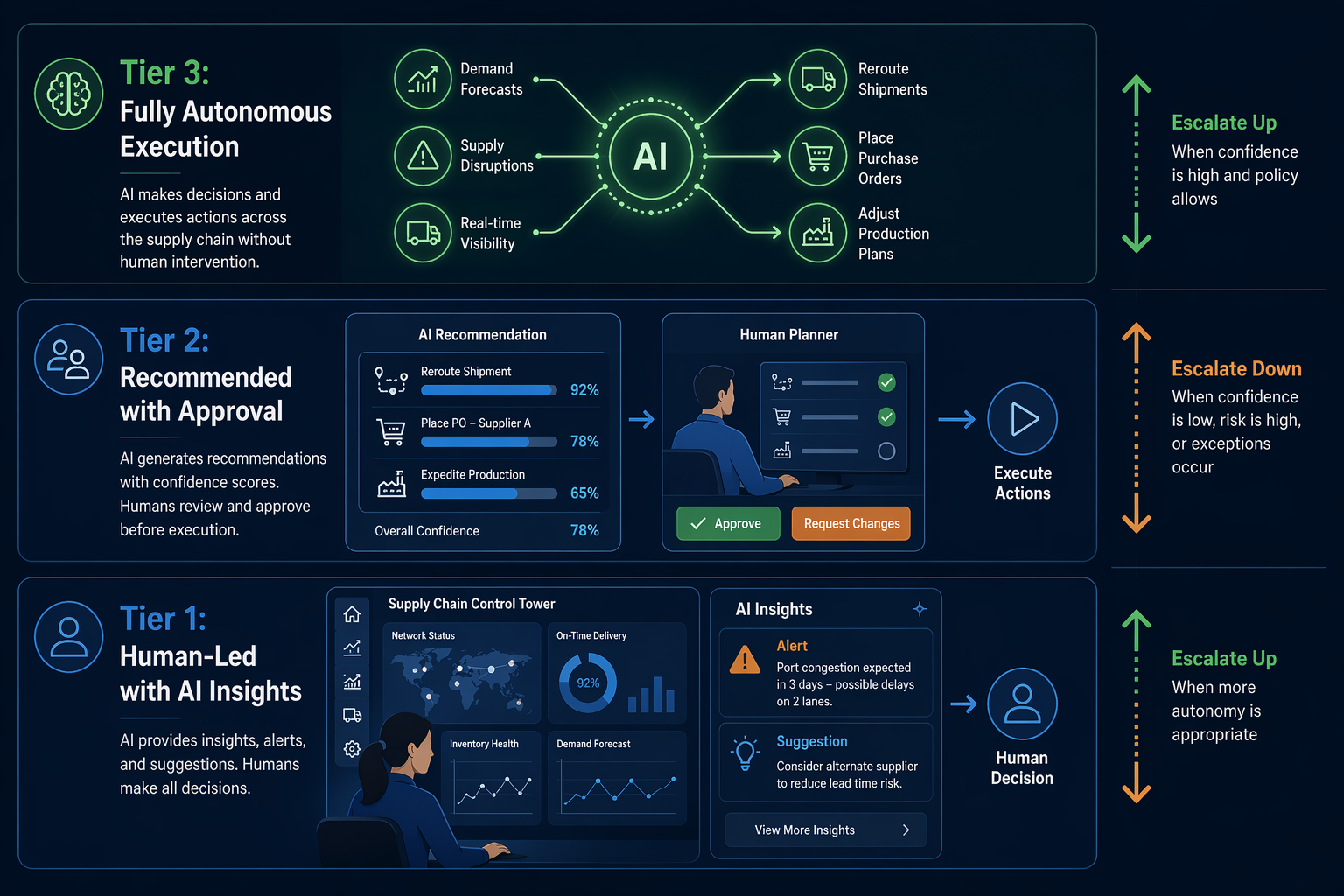
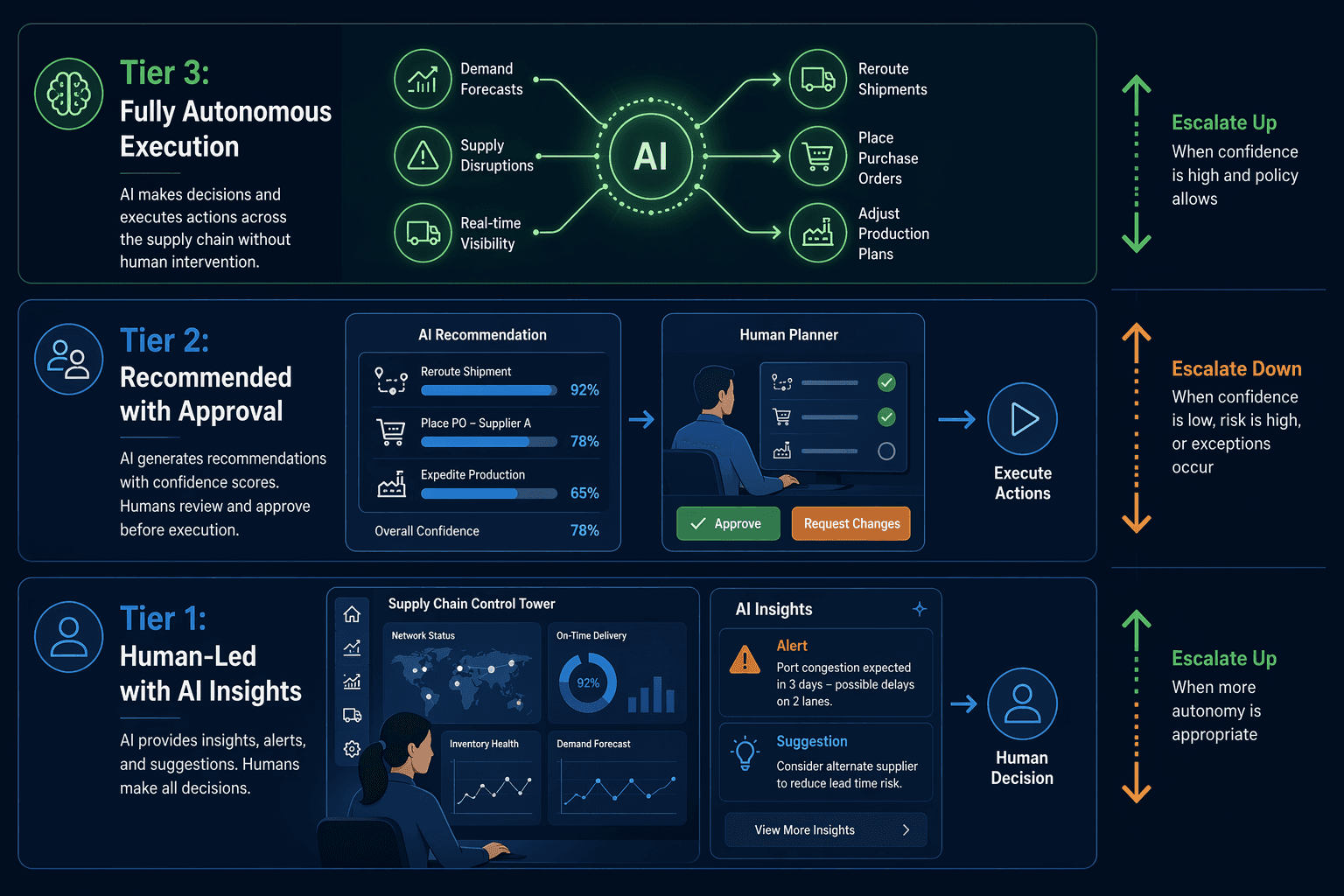
The most common question from supply chain leaders evaluating agentic AI is not "can it work?" but "how do we trust it?" The answer lies in a graduated autonomy framework that matches the level of decision authority to the risk profile of the decision. The three-tier model, described by Körber Stellium and echoed across multiple analyst frameworks, provides a practical structure for deployment.
| Tier | Decision Authority | Examples | Guardrails Required | Human Role |
|---|---|---|---|---|
| Tier 3: Fully Autonomous | Agent executes without human approval | Reroute a standard LTL shipment to an alternative carrier; adjust safety stock within ±10% of target; reorder MRO supplies from approved vendors | Clear decision boundaries, dollar-value caps, audit trail, automatic escalation on exceptions | Monitor exception logs; review periodic performance reports; update guardrails as conditions change |
| Tier 2: Recommended with Approval | Agent proposes action; human must approve before execution | Change a supplier for a critical component; adjust safety stock beyond the ±10% band; rebalance inventory across regions | Confidence score display, time-bound approval windows, escalation path if approval is delayed | Review recommendations during daily standup or via mobile approval; override or adjust as needed |
| Tier 1: Human-Led with AI Insights | Agent provides analysis and options; human decides and executes | Strategic sourcing decisions; new product launch inventory planning; supplier contract renegotiation | Data quality checks, scenario modeling, explanation of reasoning | Full decision ownership; agent serves as an analytical assistant |
The model serves two purposes. First, it allows organizations to start with low-risk, high-frequency decisions at Tier 3 — building confidence and data before expanding scope. Second, it provides a clear escalation path: when an agent encounters a situation that falls outside its guardrails, it escalates to Tier 2 or Tier 1 rather than failing or making an out-of-bounds decision.
Governance is not an afterthought in agentic deployments — it is the enabling condition. Without clear guardrails, audit trails, and escalation paths, autonomous agents introduce operational risk that outweighs their efficiency gains. For a comprehensive treatment of these risks, see AI-Powered Supply Chain: The Hidden Risks — What Every Leader Should Know Before Deploying AI at Scale.
Real-World Deployments: General Mills and JPMorgan
Two publicly referenced deployments illustrate how agentic AI moves from concept to production in different operational contexts.
General Mills has deployed AI to assess more than 5,000 shipments daily, evaluating carrier performance, route adherence, and delivery windows. The system does not simply flag exceptions — it executes corrective actions within defined parameters. The company reports more than $20 million in cumulative supply chain savings since fiscal year 2024, according to Körber Stellium's analysis. This is a Tier 3 deployment: high-frequency, rule-bound logistics decisions handled autonomously, with human oversight focused on exception monitoring and guardrail updates.
JPMorgan Chase has deployed more than 450 agentic AI use cases in production across its operations, including supply chain finance and trade logistics workflows. While the bank's deployments span multiple domains beyond supply chain, the scale — 450 production agents — demonstrates that agentic AI is not a pilot-stage technology. The operational requirements for production deployment at that scale — data quality, integration depth, governance frameworks, and change management — are substantial and have been addressed systematically.
Barriers to Adoption: Data Quality, Integration Depth, and Trust
The barriers to agentic AI adoption are not primarily technological. The models exist. The platforms exist. The governance frameworks exist. The barriers are organizational and architectural — and they are significant.
- Data Quality: PwC's 2026 Digital Trends in Operations survey of 767 US-based operations leaders found that 87% say poor data quality has impacted the value of their digital initiatives. Agentic AI systems are more sensitive to data quality than predictive models because they act on the data rather than simply displaying it. A bad prediction is a missed forecast. A bad autonomous decision is a misrouted shipment, a duplicate order, or a stockout.
- Integration Depth: 67% of enterprises report that ROI from visibility tools has stalled due to fragmented legacy systems (Tradeverifyd, 2026). Agentic workflows require bidirectional integration with ERP, TMS, WMS, and supplier systems — not just read access but write access. Organizations running on legacy platforms with limited APIs or batch-data architectures cannot support agentic execution. For a detailed comparison of platform readiness, see AI-Native vs. Legacy Supply Chain Platforms: The Real Performance Gap in 2026.
- Trust and Adoption: Only 23% of supply chain organizations have a formal AI strategy (Gartner, 2025). Without a strategy, trust is built ad hoc — and planners who have spent years developing judgment are unlikely to cede decision authority to a system they do not understand. Accenture's 2026 research found that 43% of employees say clear, comprehensive training would be the single most effective factor in increasing their confidence using AI tools.
- Organizational Readiness: PwC found that only 27% of organizations have fully embedded AI strategy across business units, and just 37% are comfortable assigning AI agents to full end-to-end processes. Only 4% of companies report success across all four key dimensions: AI fully embedded, no barriers to scaling agents, horizontal organizational structure, and technology delivering expected results.
These barriers are not reasons to delay. They are reasons to start small, build governance alongside technology, and invest in data quality and integration as prerequisites — not afterthoughts.
Where to Start: Logistics Exception Management as an Entry Point
For most supply chain organizations, logistics exception management is the ideal entry point for agentic AI. It meets all the criteria for a successful first deployment: high frequency, clear rules, reversible decisions, and measurable outcomes.
A staged approach reduces risk while building organizational confidence:
- Identify a bounded, high-volume exception type. Start with one — for example, "LTL shipment delayed by more than 2 hours at a specific distribution center." Do not try to cover all exceptions at once.
- Deploy a guardrail agent. Define the decision boundaries: maximum dollar value per reroute, approved alternative carriers, notification requirements. The agent operates within these boundaries and escalates anything outside them.
- Measure decision-latency compression. Before deployment, measure the average time from exception detection to decision execution. After deployment, measure the same metric. The gap is your ROI baseline.
- Expand scope incrementally. Add exception types one at a time. Each addition builds the data infrastructure and organizational trust needed for the next.
The widening gap between early adopters and legacy operators is not hypothetical. Organizations that deploy agentic AI for logistics exception management in 2026 will have 18–24 months of learning, data, and process refinement before their competitors begin. By 2028, when Gartner projects 15% of daily logistics decisions will be autonomous, the early adopters will already be operating at Tier 3 scale while late movers are still building their first guardrail agent.
For a detailed deployment framework covering data readiness, pilot design, and production rollout, see our Implementation Guides section, which provides structured checklists and decision frameworks for each stage of the journey.
Comments
Join the discussion with an anonymous comment.