
The Strategy Gap in AI Inventory Optimization
The numbers are hard to ignore. A 2025 survey of 490 supply chain professionals conducted by ABI Research found that 94% of companies plan to deploy AI or generative AI for decision support within two years. Yet a separate Gartner survey of 120 supply chain leaders in the same year revealed that only 23% of organizations have a formal AI strategy — even among those already running AI in production. This 71-point gap between intent and structured execution is not a minor planning oversight. It is the primary reason the majority of AI inventory optimization investments fail to deliver on their promised returns.
The technology to optimize inventory with machine learning — probabilistic demand forecasting, multi-echelon optimization, dynamic safety stock calculation — is mature and commercially available. The bottleneck is organizational. Without a strategy that explicitly addresses use case selection, data readiness, integration architecture, change management, governance, and ROI measurement, even the most sophisticated AI platform becomes an expensive source of recommendations that planners override.
Below, we examine the data behind the strategy gap, explain why the override rate is the single most revealing metric of strategic failure, and provide a six-element framework that supply chain leaders can use to close the gap between intent and execution.
The Data: Intent vs. Execution in AI Inventory Optimization
The strategy gap is not a single statistic but a pattern visible across multiple independent studies. When stacked together, the data reveals a consistent story: high intent, low strategic preparedness, and middling project outcomes.
| Metric | Source | Year | Finding |
|---|---|---|---|
| Deployment intent | ABI Research | 2025 | 94% of supply chain companies plan to use AI/Gen AI for decision support within two years (n=490) |
| Formal AI strategy | Gartner | 2025 | Only 23% of supply chain organizations have a documented AI strategy (n=120 leaders) |
| Project success rate | Gartner | 2025 | 58% of enterprise supply chain AI projects meet their primary objectives |
| Projects missing goals | Gartner | 2025 | 42% of enterprise supply chain AI projects miss at least two of three primary goals |
| AI-driven replenishment | Gartner | 2025 | Only 44% of organizations say AI recommendations drive replenishment decisions without manual override |
| Data infrastructure readiness | Deloitte | 2025 | Only 31% of organizations have data infrastructure ready for AI without significant remediation |
| ROI within one year | Deloitte | 2025 | Only 6% of organizations see ROI in under a year; most achieve satisfactory returns within 2–4 years |
The pattern is consistent across multiple analyst firms. High intent (94%) does not translate into high success (58% project success rate). And even when projects are technically successful, only 44% of organizations trust AI recommendations enough to let them drive replenishment decisions without manual override. The remaining 56% are paying for AI but not using it.
Why Strategy Matters: The Override Rate Problem
The override rate — the percentage of AI-generated inventory recommendations that a human planner changes or rejects before execution — is the most direct measure of whether an AI inventory optimization investment is working. It is also the metric most directly tied to the absence of a formal strategy.
Gartner's 2025 data draws a sharp line: organizations without a documented AI strategy are three times more likely to have manual override rates exceeding 40%. At that threshold, the financial consequences are severe. Organizations with override rates above 40% achieve less than half the ROI of those with override rates below 15%. The AI is generating recommendations, but the organization lacks the trust, governance, and workflow integration to act on them.
| Override Rate | Relative ROI | Likely Root Causes |
|---|---|---|
| < 15% | Baseline (highest) | Strong data quality, integrated workflows, planner trust, clear governance |
| 15% – 40% | Moderate | Partial data readiness, some workflow friction, moderate governance gaps |
| > 40% | Less than half of baseline | No formal AI strategy, poor data quality, weak change management, low trust |
The override rate problem is compounded by the fact that most organizations do not measure it systematically. They track forecast accuracy, service levels, and inventory turns, but they do not track how often planners reject AI recommendations or why. Without that data, the strategy gap remains invisible until the quarterly business review reveals disappointing ROI.
The Six Elements of an Effective AI Inventory Strategy
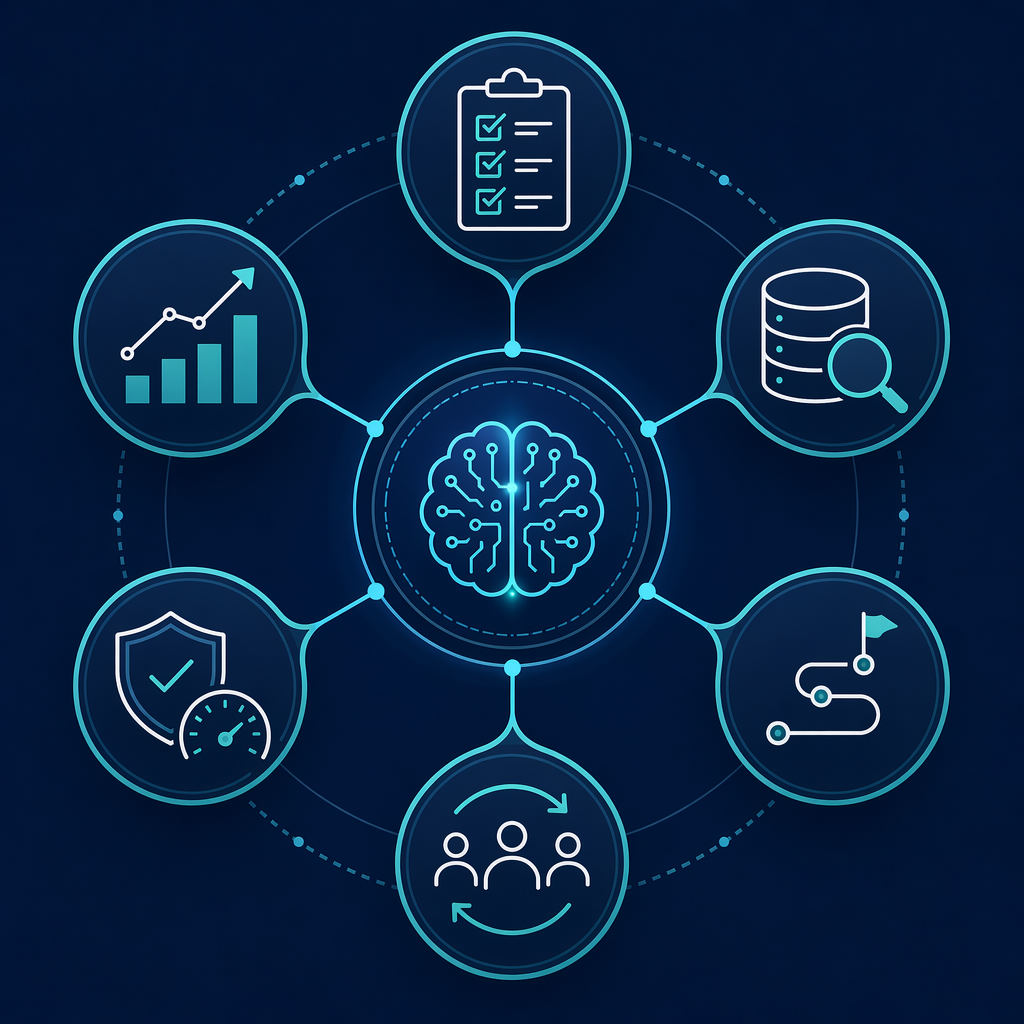
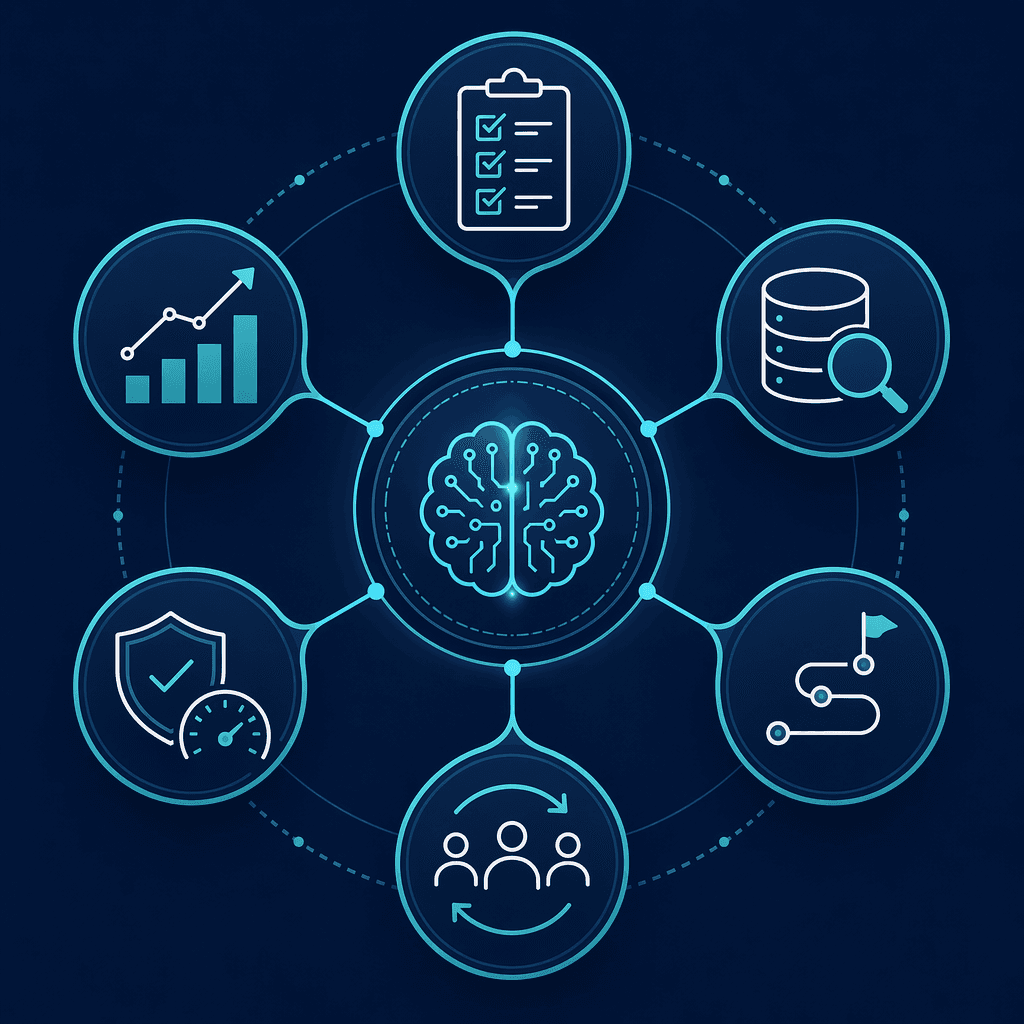
Closing the strategy gap requires more than a slide deck titled "AI Vision 2027." It requires a structured approach across six interdependent elements. Organizations that invest in all six — not just the technology components — are the ones that achieve override rates below 15% and capture the full ROI of their AI investment.
1. Use Case Prioritization
Not every inventory problem benefits equally from AI. Organizations must prioritize use cases based on three criteria: value potential (inventory reduction, service level improvement, write-off reduction), data availability (do you have the historical data needed to train a model?), and organizational readiness (is the team prepared to act on AI recommendations?).
Common high-value starting points include demand forecasting for seasonal or promotional products, safety stock optimization for high-SKU-count environments, and multi-echelon inventory optimization (MEIO) for complex distribution networks. Each has different data requirements and different change management implications.
2. Data Readiness Assessment
Deloitte's 2025 CPO survey found that only 31% of organizations have data infrastructure ready for AI without significant remediation. The most commonly cited barriers are data quality (67% of organizations), integration with legacy ERP and WMS systems (63%), and organizational resistance to AI recommendations (54%).
A data readiness assessment should evaluate: completeness and accuracy of historical transaction data, availability of demand drivers (promotions, weather, economic indicators), integration maturity between ERP, WMS, and the AI platform, and data freshness — how quickly can new data be ingested and reflected in recommendations?
For a practical tool to evaluate your organization's data infrastructure, see our AI Supply Chain Integration: ERP Data Readiness Assessment Checklist.
3. Integration Roadmap
AI inventory optimization does not operate in isolation. It must ingest data from ERP, WMS, demand planning systems, and external sources (weather, economic indicators, supplier lead times). It must output recommendations that feed into replenishment systems, procurement workflows, and S&OP processes.
An integration roadmap should specify: which systems will be connected and in what sequence, the data pipeline architecture (batch vs. real-time, API vs. ETL), exception handling workflows for when the AI cannot generate a recommendation, and fallback procedures for system outages. For a deeper technical guide on selecting the right replenishment policy to pair with AI recommendations, see AI-Driven Replenishment Policy Selection: When to Use Min-Max, Statistical, or ML-Based Approaches.
4. Change Management Plan
The most technically sound AI implementation will fail if planners do not trust the recommendations. Organizational resistance is cited by 54% of organizations as a significant barrier to AI adoption. A change management plan must address: how planners are trained to interpret AI recommendations, what decision authority they retain, how the system handles exceptions and edge cases, and how trust is built through transparent model explanations and gradual rollout.
Organizations that succeed in driving override rates below 15% typically start with a parallel-run phase where AI recommendations are compared against human decisions without forcing adoption, then gradually increase automation as trust builds. For more on common failure patterns and how to avoid them, see Predictive Analytics in Supply Chain: Why 73% of Projects Fail and How to Avoid the 5 Root Causes.
5. Governance and Model Monitoring
AI models drift. Demand patterns change. New products launch. Suppliers fail. A governance framework must define: who is responsible for monitoring model performance, what metrics trigger a model retrain (forecast accuracy degradation, bias drift, unexpected override patterns), how frequently models are retrained and validated, and what audit trail exists for AI-driven inventory decisions.
McKinsey's supply chain transformation research identifies integration depth, data freshness, exception workflow design, and model governance as the four factors that separate top-quartile from median AI implementations. Governance is not an afterthought — it is a structural requirement for sustained performance.
6. ROI Measurement Framework
Without a clear ROI framework, organizations cannot distinguish between a successful AI deployment and an expensive experiment. A robust framework should track: inventory value reduction, stockout frequency and cost, write-off reduction, service level improvement, and planner productivity (time saved per week).
ToolsGroup provides a concrete example: a company with $10M in inventory, $500K in stockout-related lost sales, and $300K in write-offs deployed an AI inventory optimization solution. The results were a reduction in inventory to $7.5M ($2.5M gain), stockout losses reduced to $200K ($300K gain), and write-offs reduced to $150K ($150K gain) — a total annual benefit of $2.95M against a $750K solution cost, yielding a 293% ROI with a 6–12 month payback period.
The Data Infrastructure Reality: Only 31% Are Ready
The six-element strategy framework assumes a foundation of adequate data infrastructure. Deloitte's 2025 survey of CPOs found that only 31% of organizations have data infrastructure ready for AI without significant remediation. The remaining 69% face a remediation effort that can take 6–18 months depending on the complexity of their legacy systems.
| Barrier | Percentage of Organizations Citing | Source |
|---|---|---|
| Data quality issues | 67% | Gartner 2025 |
| Legacy ERP/WMS integration | 63% | Gartner 2025 |
| Organizational resistance to AI | 54% | Gartner 2025 |
| Data infrastructure not ready | 69% | Deloitte 2025 |
The data infrastructure gap is not evenly distributed. Organizations with modern cloud-based ERP and WMS systems (SAP S/4HANA, Oracle Cloud, Microsoft Dynamics 365) typically have cleaner, more accessible data than those running on-premise legacy systems. But even cloud-native organizations struggle with data quality — particularly master data consistency across business units and regions.
For a broader view of readiness gaps across all supply chain functions, see AI/ML in Supply Chain: The ROI Benchmarks and Readiness Gaps Every Operations Leader Should Know in 2026.
The ROI Timeline: What Realistic Returns Look Like
One of the most dangerous narratives in the AI inventory optimization market is the promise of quick returns. Deloitte's 2025 data is sobering: only 6% of organizations see ROI in under a year. The majority achieve satisfactory returns within 2–4 years. This timeline is not a failure of the technology — it reflects the time required to remediate data, integrate systems, train teams, and build trust in AI recommendations.
| ROI Timeline | Percentage of Organizations | Source |
|---|---|---|
| Under 1 year | 6% | Deloitte 2025 |
| 1–2 years | ~25% (estimated) | Deloitte 2025 |
| 2–4 years | Majority | Deloitte 2025 |
| Over 4 years or never | Significant minority | Deloitte 2025 |
The 2–4 year timeline is consistent with the strategy gap data. Organizations that invest in all six elements of the strategy framework — particularly data readiness and change management — compress the timeline toward the 2-year end. Those that skip strategy elements and focus only on technology selection find themselves at the 4-year end or beyond.
The ToolsGroup example of a 293% ROI with a 6–12 month payback is an outlier, not the norm. It likely reflects an organization with strong pre-existing data infrastructure, a well-defined use case, and a mature change management culture. For most organizations, a more realistic expectation is a 50–100% ROI over 2–3 years, with the compounding advantage growing as model accuracy improves and override rates decline.
Assessing Your Organization's AI Strategy Maturity
The following self-assessment framework allows supply chain leaders to evaluate where their organization stands on each of the six strategy elements. For each element, identify which maturity level best describes your current state.
| Strategy Element | Emerging | Developing | Established |
|---|---|---|---|
| Use Case Prioritization | No formal prioritization; AI applied opportunistically | Use cases prioritized by value potential only | Use cases prioritized by value, data readiness, and organizational readiness |
| Data Readiness Assessment | No assessment completed; data quality unknown | Partial assessment completed; major gaps identified | Full assessment completed; remediation plan in place and funded |
| Integration Roadmap | No integration roadmap; AI operates in silo | Roadmap exists but lacks sequencing or fallback procedures | Detailed roadmap with sequencing, exception workflows, and fallback procedures |
| Change Management Plan | No plan; planners expected to adopt AI without support | Training provided but no parallel-run or trust-building phase | Structured plan with parallel-run, gradual automation, and transparent model explanations |
| Governance and Model Monitoring | No governance; models deployed without monitoring | Basic monitoring in place (forecast accuracy only) | Full governance with drift detection, retrain triggers, and audit trails |
| ROI Measurement Framework | No formal ROI tracking; success measured anecdotally | Basic tracking of inventory reduction and service levels | Comprehensive framework tracking inventory value, stockouts, write-offs, and planner productivity |
Organizations that score 'Established' on at least four of the six elements are typically those with override rates below 15% and ROI in the top quartile. Those scoring 'Emerging' on three or more elements should expect override rates above 40% and ROI below the median.
From Intent to Execution: Closing the Strategy Gap
The gap between 94% intent and 23% strategy is not a technology problem. It is a leadership problem. The organizations that will capture the compounding advantage of AI inventory optimization are those whose leaders recognize that strategy — not software selection — is the binding constraint.
Accenture's 2024 study of 1,148 companies found that organizations with AI-mature supply chains are 23% more profitable and six times as likely to use AI and generative AI widely. The advantage is real, but it accrues to organizations that invest in the full strategy stack — not just the AI platform.
The next step is straightforward: use the maturity assessment above to identify your organization's weakest strategy elements. For each gap, assign an owner, a remediation timeline, and a budget. Treat the strategy as a living document that evolves as your data infrastructure improves, your team's trust in AI grows, and your use cases expand.
The 77% of organizations without a formal AI strategy are not doomed to fail. But they are leaving the outcome to chance. In a domain where the difference between top-quartile and median ROI is determined by strategy maturity, leaving the outcome to chance is an expensive decision.
Comments
Join the discussion with an anonymous comment.