
What AI Demand Forecasting Is (and Isn't)
For a supply chain director evaluating technology investments, the first question is rarely "does AI work?" — it's "what does AI actually do differently from what we already have?" The distinction matters because the wrong framing leads to the wrong vendor selection, the wrong data preparation, and ultimately the wrong outcomes.
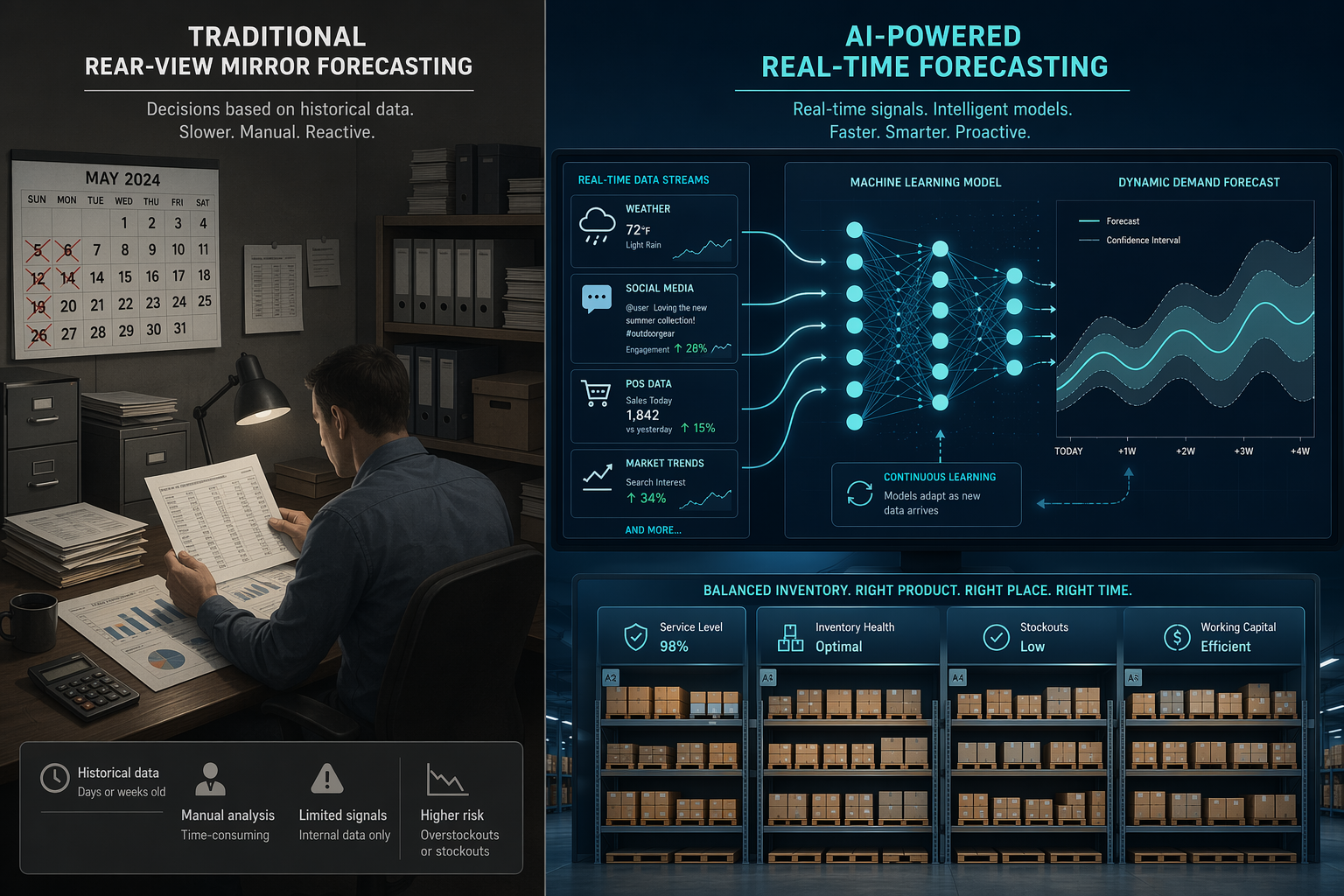
Traditional demand forecasting relies on statistical methods — ARIMA, exponential smoothing, and Holt-Winters — that extrapolate historical patterns forward under the assumption that the past is a reliable guide to the future. These models work well in stable environments with clear seasonality and minimal external disruption. They fail when demand drivers shift: a competitor launches a promotion, a weather event changes buying behavior, or a raw material shortage alters production schedules.
AI demand forecasting replaces the assumption of historical stability with a data-driven learning process. Instead of fitting a single equation to past sales, machine learning models ingest dozens or hundreds of variables — point-of-sale data, weather patterns, social media sentiment, economic indicators, promotional calendars, and supplier lead times — and learn the non-linear relationships between those inputs and future demand. The result is a forecast that adapts as new data arrives, rather than one that waits for a planner to manually adjust a baseline.
This is also not the same as demand sensing, though the terms are often conflated. Demand sensing uses real-time point-of-sale or IoT data to detect short-term shifts in demand over a horizon of days to weeks. AI demand forecasting typically covers a broader planning horizon — weeks to months — and incorporates both historical patterns and forward-looking signals. The two approaches complement each other: sensing catches the immediate signal, while forecasting provides the structural view.
Core AI/ML Techniques Deployed Today
The production forecasting systems deployed at scale today rely on a small set of proven techniques. Understanding the broad strokes helps leaders ask better questions during vendor evaluations — not to become data scientists, but to distinguish genuine capability from marketing claims.
- Gradient boosting machines (XGBoost, LightGBM, CatBoost). These are the workhorses of production forecasting. They build ensembles of decision trees, each correcting the errors of the previous one, and handle mixed data types (numeric, categorical, missing values) without extensive preprocessing. Most enterprise forecasting platforms use gradient boosting as their primary engine because it delivers high accuracy with reasonable training time and interpretability.
- LSTM (Long Short-Term Memory) networks. A type of recurrent neural network designed to learn long-range dependencies in sequential data. LSTMs excel at capturing complex seasonal patterns and trend changes over time, but they require more data and computational resources than gradient boosting. They are often used for sub-daily or hourly forecasting in energy and logistics contexts.
- Transformer architectures. Originally developed for natural language processing, transformers have been adapted for time-series forecasting. They use self-attention mechanisms to weigh the importance of different time steps, making them effective for long-horizon forecasts with complex dependencies. Adoption in supply chain is still early, but several vendors are incorporating transformer-based models for multi-step forecasting.
- Hybrid models. Many production systems combine multiple techniques — using gradient boosting for baseline forecasts, LSTM for short-term corrections, and rule-based logic for promotional lifts or new product introductions. The hybrid approach mitigates the weaknesses of any single method and tends to outperform pure models in real-world deployments.
For supply chain leaders who want a deeper technical walkthrough — including how these models handle seasonality, trend decomposition, and confidence intervals — the article How AI Demand Planning Software Actually Works: Techniques, Models, and Implementation Patterns provides a full technical breakdown.
Industry by Industry: Where AI Forecasting Delivers in Production
The most persuasive evidence for AI demand forecasting is not a benchmark study — it's a named company with a specific problem and a measurable outcome. Below are six industries with documented production deployments, the forecasting problem each company faced, the AI approach applied, and the results achieved.
Retail: Walmart
Walmart operates more than 4,600 stores in the U.S. alone, each carrying tens of thousands of SKUs with demand patterns that vary by location, season, and local events. The company deployed AI-powered demand sensing that ingests weather data, local event calendars, and customer purchasing trends to generate store-level forecasts. According to IBM, 88% of retail executives identify demand forecasting as a key area for AI improvement, and Walmart's deployment represents one of the largest-scale production examples of AI forecasting in retail.
CPG: Unilever and P&G
Unilever connected weather data to its ice cream demand models and achieved a 10% improvement in forecast accuracy, which translated into a 30% sales increase in key markets during peak seasons, as reported by McKinsey and cited by APPWRK. The insight was straightforward but impossible for a traditional statistical model to capture: ice cream demand spikes when temperatures rise, but the relationship is non-linear and varies by region. The AI model learned those regional temperature-demand curves and adjusted production plans accordingly.
Procter & Gamble took a different approach with its "touchless" supply chain initiative. The company deployed AI to automate routine planning decisions, reducing operator alerts by 42% and generating $30 million in savings, per Thoughtworks data cited by APPWRK. The system handles the majority of forecast adjustments without human intervention, with planners only stepping in for exceptions — a model that many CPG companies are now working toward.
Manufacturing: Novolex and Idaho Forest Group
Novolex, a packaging manufacturer, used IBM's AI to address a common manufacturing forecasting problem: demand variability across hundreds of product SKUs with different raw material lead times. The AI system reduced excess inventory by 16% and compressed planning cycles from weeks to days, according to IBM. For a manufacturer where inventory carrying costs directly impact margin, that 16% reduction represents a direct bottom-line improvement.
Idaho Forest Group, a lumber producer, faced a different constraint: its forecasting process required more than 80 hours of manual work per cycle, pulling data from multiple spreadsheets and ERP reports. AI automation reduced that time to under 15 hours, freeing planners to focus on analysis rather than data wrangling. The same IBM case study notes that the company achieved this without a large data science team — the AI platform handled the model training and deployment.
Pharmaceuticals: The $60–110 Billion Opportunity
Pharma demand forecasting presents unique challenges: long product lifecycles, regulatory constraints on production changes, and demand that is driven by prescription patterns rather than consumer behavior. The McKinsey Global Institute estimates that generative AI adoption in pharmaceuticals could generate $60–110 billion in annual economic impact, with demand forecasting contributing through improved planning efficiency and accelerated drug discovery, as reported by GroupBWT. While specific named-company outcomes in pharma are less publicly documented than in retail or CPG, several top-20 pharma companies are piloting AI forecasting for production planning and inventory optimization.
Automotive: Tesla and Production Planning
Automotive demand forecasting must account for long lead times, complex bill-of-materials dependencies, and demand that is heavily influenced by macroeconomic conditions and consumer financing rates. Tesla has deployed AI forecasting across its production planning operations, though specific accuracy benchmarks are not publicly disclosed. The broader automotive industry is adopting AI forecasting to manage the transition to electric vehicles, where historical sales data is a poor predictor of future demand because the product mix is fundamentally changing.
Energy and Utilities: Workforce Automation
In energy and utilities, AI forecasting is applied less to product demand and more to workforce and maintenance planning. McKinsey reports that companies in telecommunications, electric power, natural gas, and healthcare have found that AI forecasting engines can automate up to 50% of workforce-management tasks, leading to cost reductions of 10–15%. The forecasting problem here is predicting when and where maintenance crews will be needed based on equipment sensor data, weather forecasts, and historical failure patterns — a demand-forecasting problem in everything but name.
Accuracy Benchmarks: What Improvement Looks Like by Industry
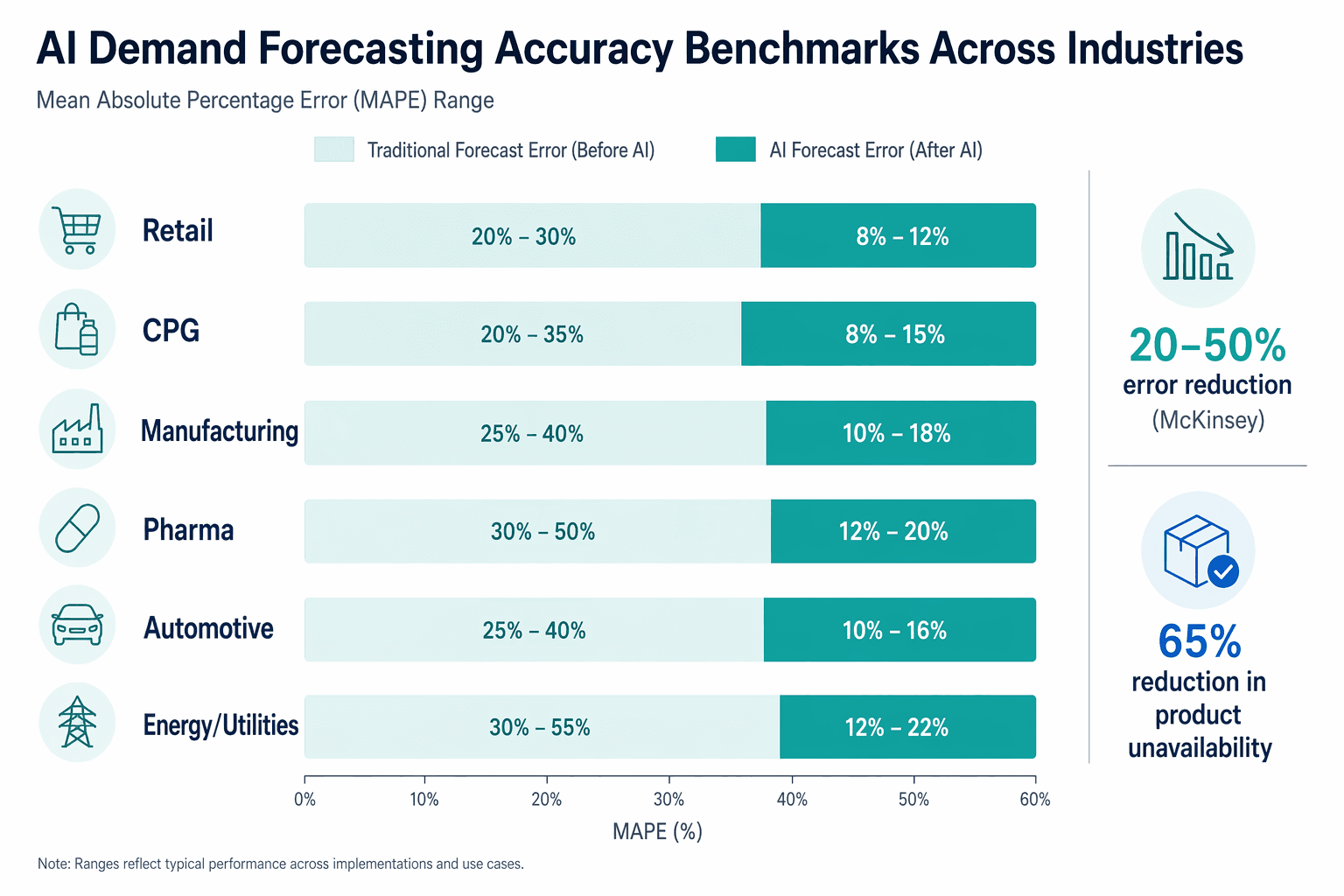
The headline figure — a 20–50% reduction in forecast error — comes from McKinsey research cited by Oracle and is consistent across multiple studies. But the range is wide because industry context matters. A 20% error reduction in a stable CPG category is a different achievement than a 50% reduction in a volatile electronics segment. The table below breaks down the accuracy improvements by industry, drawing on the sources cited throughout this article.
| Industry | Traditional MAPE Range | AI MAPE Range | Error Reduction | Key Source |
|---|---|---|---|---|
| Retail (general) | 20–35% | 8–12% | 40–65% | McKinsey / Oracle |
| CPG | 25–40% | 8–15% | 50–70% | APPWRK field benchmarks |
| Manufacturing | 15–30% | 10–18% | 30–50% | IBM case studies |
| Pharmaceuticals | 20–35% | 12–20% | 30–45% | GroupBWT / McKinsey |
| Automotive | 15–25% | 10–16% | 20–40% | Industry estimates |
| Energy / Utilities | 18–30% | 12–22% | 25–40% | McKinsey |
Comments
Join the discussion with an anonymous comment.