
The Procurement AI Paradox: High Usage, Low Readiness
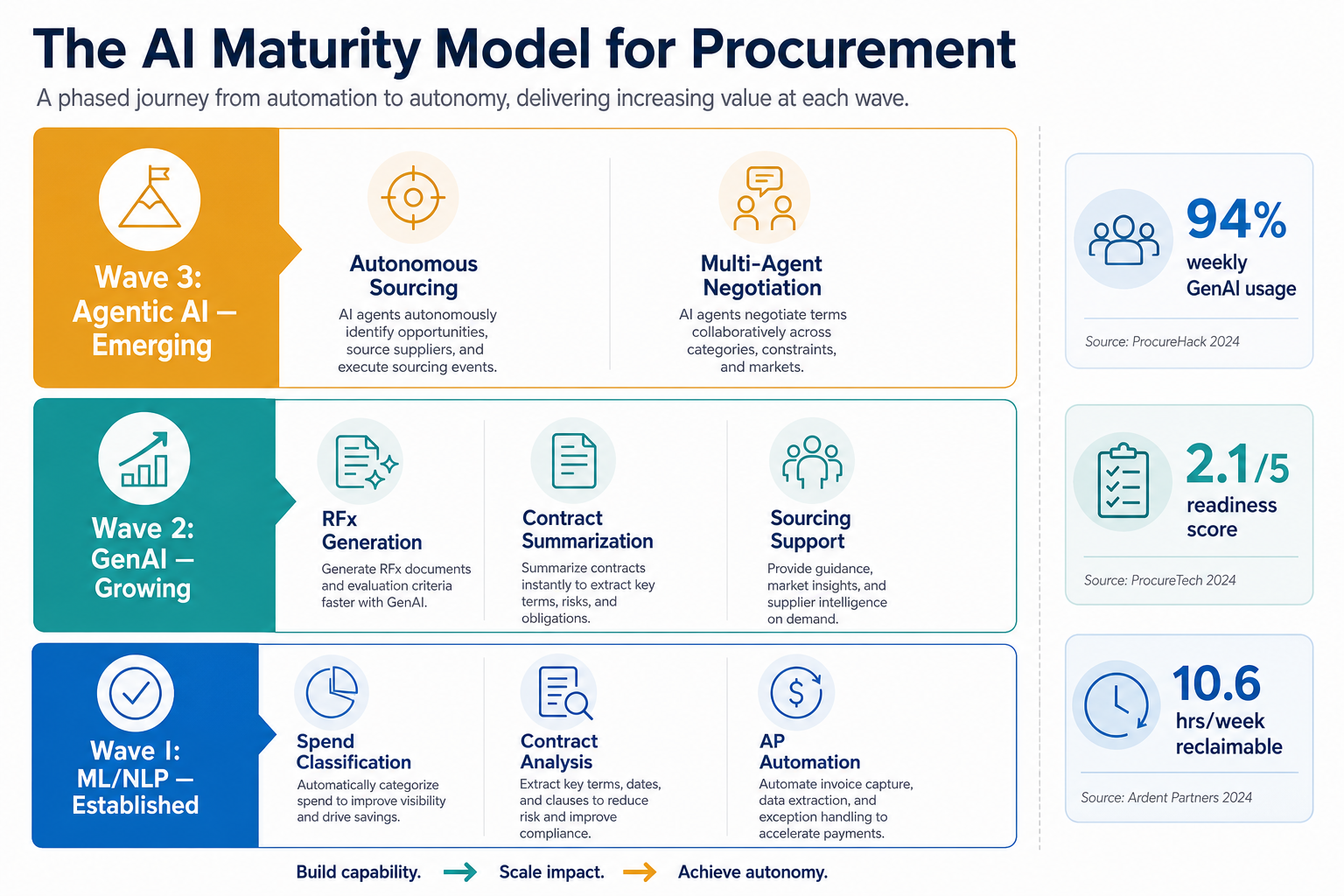
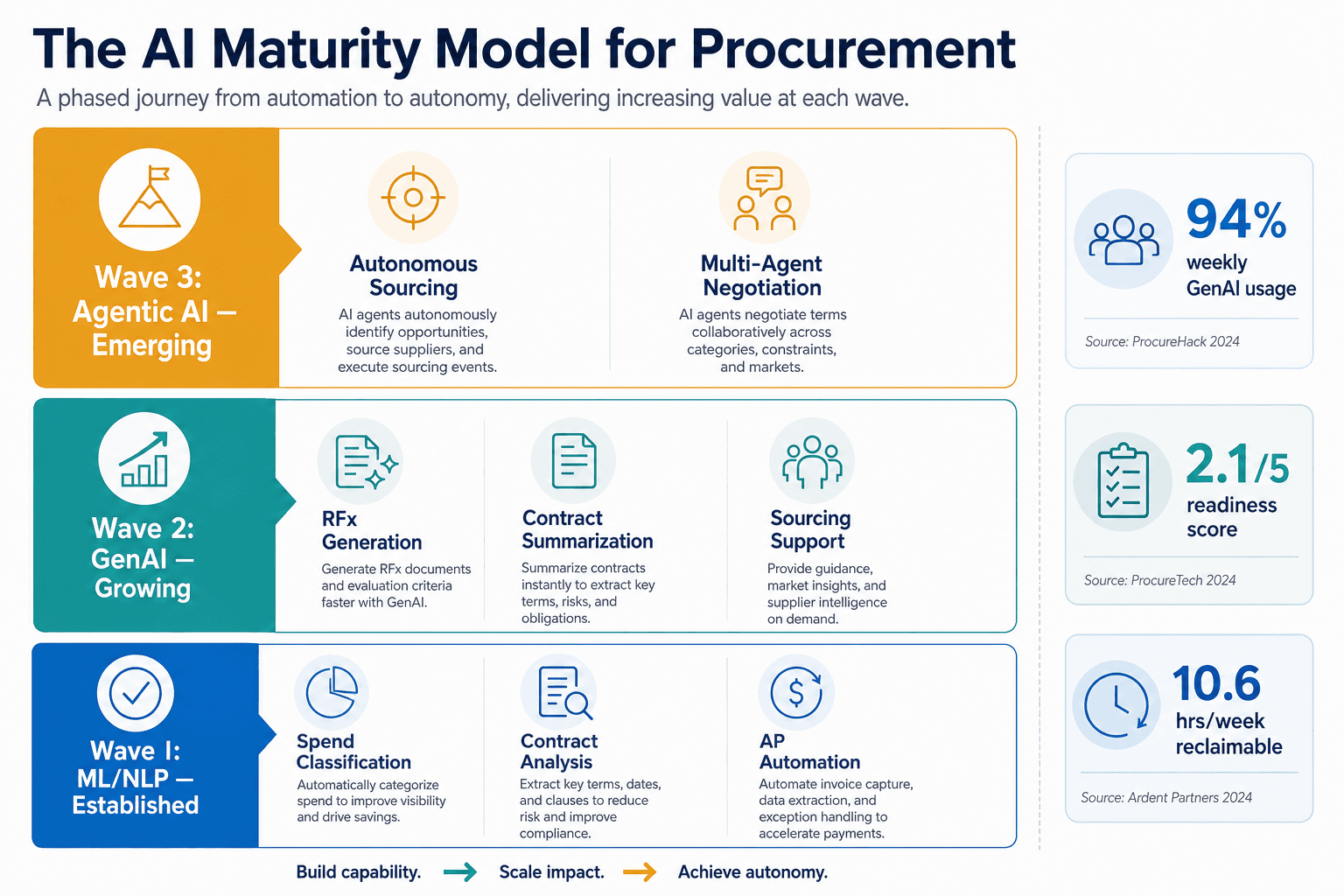
Procurement teams are adopting AI tools at a pace that would have seemed improbable three years ago. According to the Suplari 2026 Procurement Benchmarks report, 58% of procurement professionals now use AI at least four days per week. Generative AI usage among procurement executives has climbed to 94% weekly adoption, up 44 percentage points from 2023 to 2024, per research from AI at Wharton cited by the Art of Procurement. On the surface, these numbers suggest a profession that has embraced artificial intelligence.
Beneath the surface, a different picture emerges. The same Suplari study, which surveyed 121 procurement teams across six continents and more than 30 industries, found that the industry's average AI readiness score sits at just 2.1 out of 5. Only 17% of organizations have an actively enforced AI governance policy. The remaining 83% are operating without guardrails, despite handling confidential pricing data, supplier contracts, and strategic sourcing decisions that carry significant financial and reputational risk.
This paradox — high individual usage paired with low organizational readiness — is the central challenge facing chief procurement officers and transformation leads in 2026. The tools are here, the efficiency potential is real, but the infrastructure of policy, data quality, integration, and skills needed to deploy AI safely at scale has not kept pace. This article diagnoses the readiness gap across eight dimensions, explains why daily AI use does not automatically build organizational capability, and provides a governance framework for procurement leaders who need to move from fragmented tool usage to safe, scalable deployment.
The Eight Dimensions of AI Readiness in Procurement
The Suplari 2026 report breaks AI readiness into eight distinct dimensions, each scored on a 5-point scale. The framework separates what the study calls "intent dimensions" — areas where organizations have strategic ambition — from "capability dimensions," which measure actual operational infrastructure. The gap between the two is revealing.
| Readiness Dimension | Score (out of 5) | Type | What It Measures |
|---|---|---|---|
| Strategic Priority | 2.4 | Intent | How clearly AI is embedded in procurement strategy and leadership agenda |
| Insight Actionability | 2.3 | Intent | Whether AI-generated insights can be acted upon in decision-making |
| Operating Model | 2.3 | Intent | How well the procurement org structure supports AI-driven workflows |
| System Integration | 2.2 | Capability | Degree of connectivity between AI tools and existing procurement systems |
| P&L Impact Visibility | 2.2 | Capability | Ability to trace AI-driven decisions to financial outcomes |
| Data Foundation | 2.1 | Capability | Quality, accessibility, and readiness of procurement data for AI |
| Operational Efficiency | 1.9 | Capability | How effectively AI is reducing manual effort in procurement processes |
| AI Maturity | 1.8 | Capability | Depth of AI deployment beyond pilots into production |
The pattern is clear: procurement organizations are better at declaring AI a priority (2.4) than they are at building the data foundation (2.1) and system integration (2.2) required to execute. The lowest scores cluster in capability dimensions — Operational Efficiency (1.9) and AI Maturity (1.8) — indicating that most teams are still in pilot phases. Only 8% of organizations have moved past pilots into deployment, a figure consistent with the Hackett Group 2025 CPO Agenda report, which found that 49% of procurement teams piloted generative AI in 2024 but only 4% achieved large-scale deployment.
For CPOs evaluating their own organizations, these eight dimensions provide a diagnostic framework. A score below 2.5 on any capability dimension — particularly Data Foundation or System Integration — signals that the organization is not yet ready to scale AI beyond isolated use cases. The Data Readiness Assessment for AI Procurement Automation guide provides a practical next step for teams that need to evaluate their data foundation before proceeding.
The Frequency Paradox: Why Daily AI Use Doesn't Build Readiness
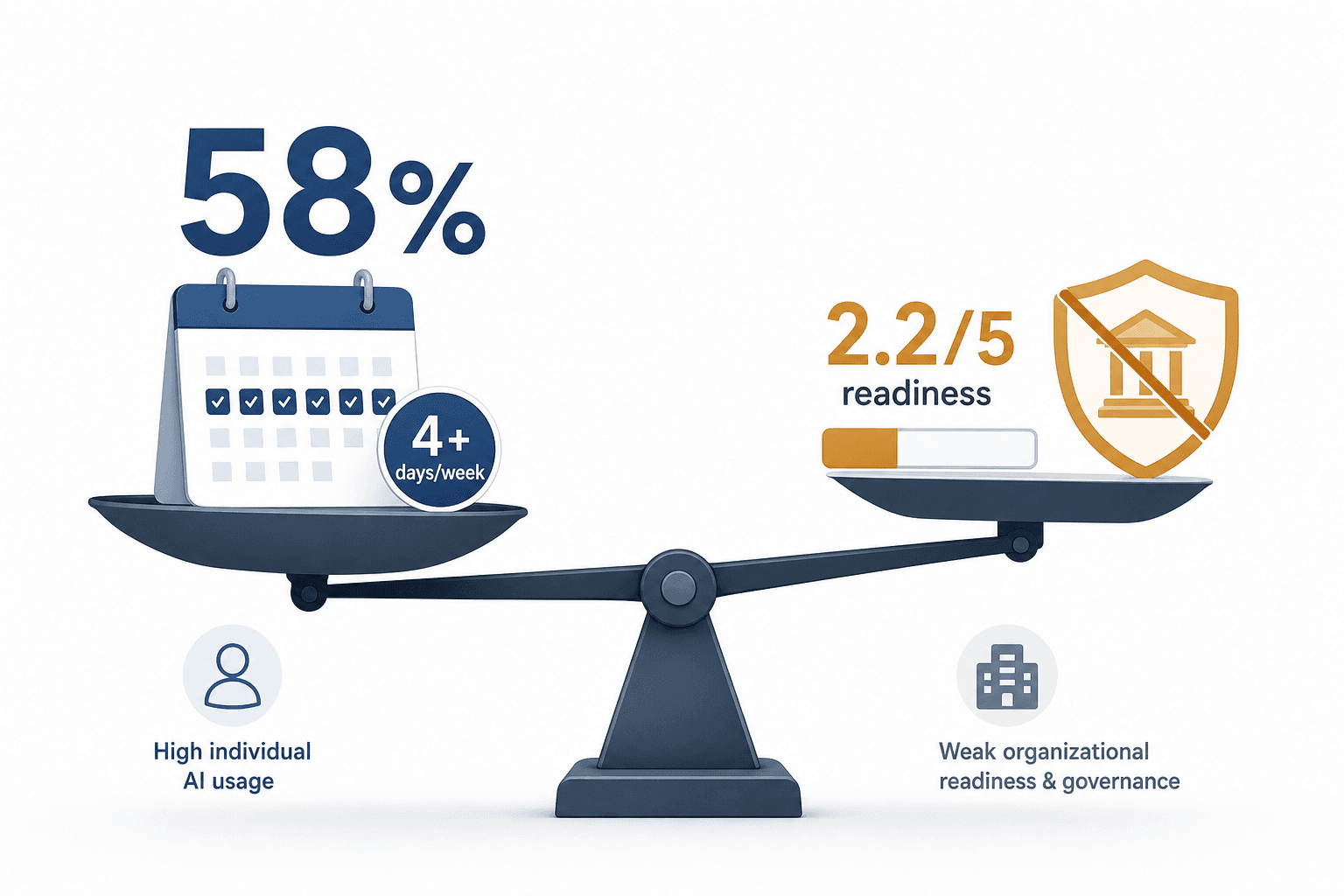
One of the most counterintuitive findings in the Suplari 2026 data is what the report calls the "Frequency Paradox." Procurement professionals who use AI every day — five days per week — score only 2.2 out of 5 on organizational readiness. That is statistically indistinguishable from the 2.1 score of professionals who use AI infrequently. Daily usage does not predict organizational readiness.
This finding challenges a common assumption among procurement leaders: that encouraging individual tool adoption will naturally build organizational capability. The data suggests otherwise. When professionals use AI tools independently — for spend classification, contract summarization, or RFP generation — without an underlying governance framework, integrated data pipeline, or standardized operating model, the organization as a whole does not become more ready. It becomes more fragmented.
The mechanism is straightforward. A procurement analyst using a generative AI tool to summarize supplier contracts gains personal efficiency, but if the tool is not connected to the organization's contract management system, if the outputs are not reviewed under a consistent policy, and if the data feeding the tool has not been validated for accuracy, the organization has not improved its AI readiness. It has simply introduced an ungoverned tool into a critical workflow.
For CPOs, the implication is clear: measuring AI adoption by usage frequency alone is misleading. The more relevant metric is whether AI usage is governed, integrated, and built on a reliable data foundation. Organizations that skip these prerequisites may achieve high usage rates but will remain stuck at low readiness levels — exposed to the risks that come with ungoverned AI deployment.
The Cost-Pressure Trap: Short-Term Savings Undermine Long-Term Readiness
Procurement has always been measured on cost savings. That pressure does not disappear when AI enters the picture — it intensifies. But the Suplari 2026 data reveals a troubling correlation: teams that prioritize cost savings as their primary AI objective score the lowest on organizational readiness, at just 1.8 out of 5.
This is the Cost-Pressure Trap. When procurement leaders are under pressure to demonstrate quick ROI from AI investments, they tend to deploy tools in narrow, tactical use cases that produce immediate savings — automating a specific category of spend analysis, for example, or generating RFx documents faster. These deployments are typically fragmented, under-integrated, and governed by ad hoc policies, if any. They deliver short-term wins but do not build the data infrastructure, system integration, or governance frameworks needed for scaled deployment.
The trap is self-reinforcing. A team that deploys a standalone AI tool for spend classification and achieves a 5% cost reduction in one category will be incentivized to repeat the pattern in other categories, rather than pausing to build the data foundation and governance structure that would enable more ambitious use cases. Over time, the organization accumulates a patchwork of unconnected AI tools, each delivering marginal savings, while the readiness score stagnates.
Breaking the Cost-Pressure Trap requires procurement leaders to reframe how they measure AI success. Instead of evaluating AI tools solely on immediate cost reduction, organizations should track readiness metrics — data quality scores, integration coverage, governance policy adoption rates — as leading indicators of sustainable value. The Open Sky Group notes that companies with AI-mature supply chains are 23% more profitable than peers and six times as likely to use AI and generative AI widely, per Accenture research. The payoff for readiness is real — but it requires patience that cost-focused procurement cultures often lack.
Three Governance Models for Procurement AI
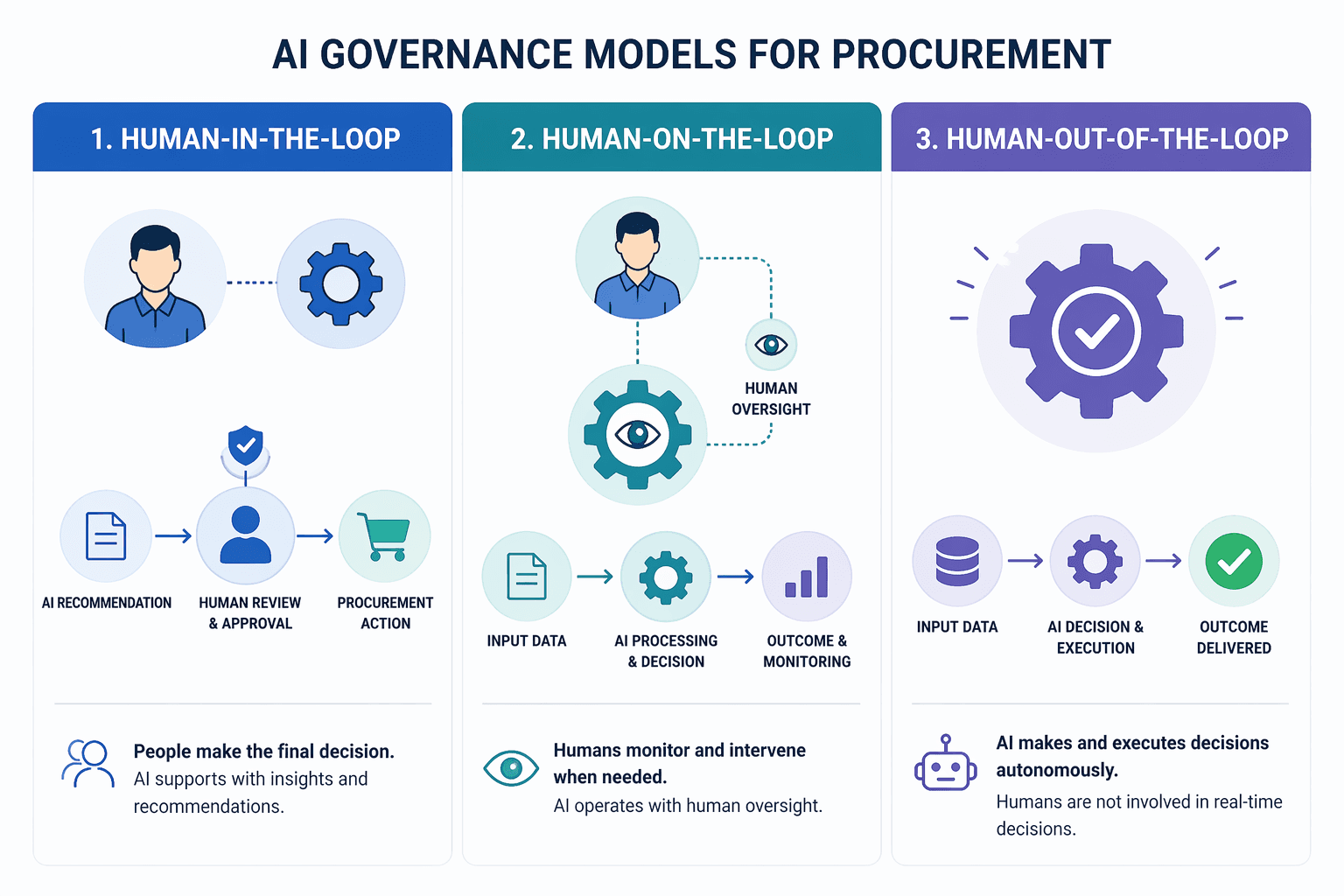
For procurement organizations building governance frameworks, the Sievo guide on AI in procurement defines three common governance models that map to different levels of risk, decision frequency, and organizational maturity. Understanding these models is essential for CPOs who need to decide how much autonomy to grant AI systems in procurement workflows.
| Model | How It Works | Best Suited For | Risk Profile | Readiness Required |
|---|---|---|---|---|
| Human-in-the-Loop | Every AI output is reviewed by a human before any action is taken | High-risk, low-volume decisions (e.g., supplier selection, contract terms, price negotiations) | Low — human oversight provides a safety net | Low to moderate — can be implemented with basic governance |
| Human-on-the-Loop | AI operates autonomously for routine tasks; humans monitor and intervene only when exceptions occur | Repetitive, high-volume processes (e.g., PO matching, invoice classification, spend categorization) | Moderate — requires clear escalation rules and monitoring | Moderate — needs integrated systems and defined thresholds |
| Human-out-of-the-Loop | AI operates without real-time human intervention, executing decisions autonomously | High-speed, low-risk decisions where speed outweighs oversight (rare in procurement today) | High — requires extensive testing, validation, and fallback mechanisms | High — demands mature data foundation, integration, and governance |
For most procurement organizations today, the human-in-the-loop model is the most appropriate starting point. It allows teams to gain experience with AI outputs while maintaining control over high-stakes decisions. As readiness improves — particularly in data foundation and system integration — organizations can begin transitioning routine, low-risk processes to a human-on-the-loop model.
Human-out-of-the-loop remains rare in procurement for good reason. The consequences of an autonomous AI decision in sourcing, contracting, or supplier management can be severe — a misclassified supplier, an incorrectly applied contract term, or a pricing error that cascades across multiple purchase orders. No organization with a readiness score below 3.0 should be operating in this model.
A Practical Roadmap: From Policy to Deployment
Moving from the current state — 2.1/5 readiness, 83% without enforced policy — to a governed, scalable AI deployment requires a structured approach. The following roadmap is designed for CPOs and transformation leads who need to sequence investments in policy, data, skills, integration, and deployment.
Step 1: Create an Enforced AI Governance Policy
The single most impactful action a procurement organization can take is to establish an enforced AI governance policy. The Suplari data is unambiguous: only 17% of organizations have one, and those that do score higher across every readiness dimension. The policy should define which AI use cases are permitted, which governance model applies to each decision type, how AI outputs are reviewed and validated, and what happens when an AI system produces an error.
Step 2: Assess and Improve Data Readiness
According to Gartner 2025 research, 74% of procurement leaders say their data is not AI-ready. The Data Foundation dimension scores just 2.1/5 industry-wide. Before deploying AI at scale, organizations must audit their data for completeness, accuracy, consistency, and accessibility. The Data Readiness Assessment for AI Procurement Automation provides a structured framework for this evaluation.
Step 3: Close the Knowledge and Skills Gap
Knowledge and skills gaps are the #1 barrier to AI adoption in procurement, cited by 41% of respondents in the Suplari study — nearly 3.4 times the rate of budget constraints (12%). This is not a training budget problem; it is a capability-building problem. Organizations need to invest in AI literacy programs for procurement professionals, covering not just how to use AI tools but how to evaluate AI outputs, identify errors, and apply governance policies.
Step 4: Integrate AI into Existing Procurement Systems
System Integration scores 2.2/5, reflecting the reality that many AI tools operate as standalone applications rather than integrated components of the procurement technology stack. Integration is not just a technical requirement — it is a governance requirement. When AI tools are integrated with procurement systems, outputs can be traced, validated, and audited. When they operate in isolation, governance becomes impossible.
Step 5: Move from Pilot to Scaled Deployment
Only 8% of procurement organizations have moved past pilots into deployment. The leap from pilot to scale requires all of the preceding steps to be in place: governance, data readiness, skills, and integration. Organizations that attempt to scale without these foundations will replicate the Cost-Pressure Trap at a larger scale — more tools, more fragmentation, more risk.
| Organization Size (Employees) | Average AI Readiness Score |
|---|---|
| Less than 500 | 2.0 |
| 500 – 2,500 | 2.1 |
| 2,500 – 10,000 | 2.1 |
| 10,000 – 50,000 | 2.2 |
| 50,000+ | 2.6 |
Regional benchmarks show a narrower spread: Europe and Asia-Pacific lead at 2.2, followed by North America and Latin America at 2.1, and the Middle East and Africa at 2.0. Only 0.26 points separate the highest and lowest regions, indicating that the readiness gap is a global procurement challenge, not a regional one.
The Cost of Inaction: What the Governance Gap Costs Procurement Teams
The risks of maintaining the status quo — high AI usage, low readiness, no enforced governance — are not theoretical. They fall into three categories.
- Data exposure and compliance risk. Ungoverned AI tools process confidential pricing data, supplier contracts, and strategic sourcing plans. Without an enforced policy governing how AI handles this data, organizations are exposed to breaches, regulatory penalties, and loss of supplier trust. The 83% of teams without enforced policy are operating without a safety net.
- Missed efficiency gains. The average procurement professional estimates 10.6 hours per week of work could be automated. At scale, that represents a significant productivity dividend. But organizations that deploy AI without governance, data readiness, and integration will not capture these gains — they will spend their time managing tool fragmentation and correcting errors.
- Competitive disadvantage. Companies with AI-mature supply chains are 23% more profitable than peers, per Accenture research cited by Open Sky Group. Organizations that remain in the 83% without enforced governance will find themselves unable to scale AI safely, while competitors with higher readiness scores capture the efficiency and cost advantages that come with governed, integrated AI deployment.
The path forward requires procurement leaders to reframe AI readiness as a strategic priority, not a technical detail. The eight-dimension framework provides a diagnostic tool. The three governance models provide an operational framework. The roadmap provides a sequence. What remains is the organizational commitment to close the gap between the 58% who use AI daily and the 17% who have the governance to manage it safely.
Comments
Join the discussion with an anonymous comment.