

The uncomfortable question in ai order management is not whether a model can read an email, extract a PO number, suggest a ship date, or draft a reply. Many systems can now do that. The harder question is whether the customer service team still has to stop, inspect, approve, correct, and release the order before anything meaningful happens.
That is where many 2026 deployments stall. The interface looks more intelligent, the queue moves faster, and the user has better recommendations. But the work still lands on a human desk. The person who used to key the order now validates the AI’s interpretation. The planner still checks the exception. The order management manager still gets the escalation when the promise date is wrong. The system has accelerated the decision without removing the decision from the critical path.
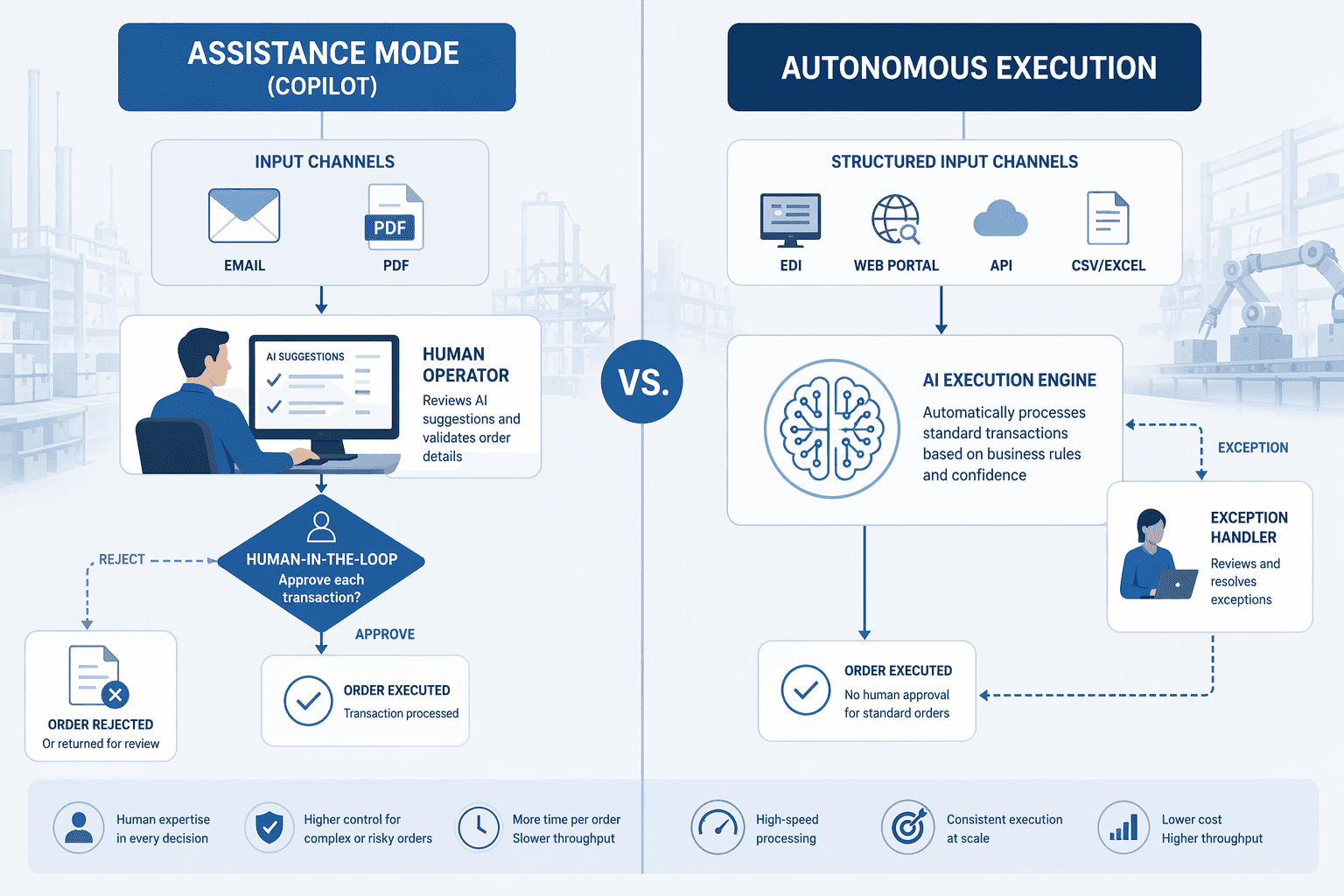
The execution gap is the distance between an AI assistant that prepares work for approval and an autonomous order process that executes a bounded class of transactions without human touch. In B2B order management, that distinction is not semantic. It decides whether AI trims task time at the edge or changes the cost structure of the function.

Assistance improves the queue; execution changes the queue
A copilot deployment usually leaves the transaction boundary where it was. Orders still arrive through email or PDF. AI extracts fields, flags mismatches, proposes confirmations, and maybe drafts ERP updates. A human remains the release valve for every transaction. If volume rises, the team may survive with less overtime, but staffing still scales with review load.
Autonomous execution moves that boundary. For standard repeat orders, the system does not merely recommend the next action. It checks the order against rules and master data, creates or updates the transaction, confirms what can be confirmed, and routes only the true exceptions to people. The human role shifts from approving the routine to governing the boundary and resolving the non-routine.
Go Autonomous describes most marketed “agentic” order management tools in 2026 as still operating in assistance mode, where humans approve every transaction. The same analysis uses the Human Dependency Ratio as a practical way to look past interface claims: how much of the process still depends on human decision or approval before the order can move? [1]
That ratio matters because order management teams rarely drown in the unusual order alone. They drown in the repeat order that is almost clean, the PDF that needs translation, the contract customer whose usual ship-to address is right unless one field has drifted, and the email thread that looks routine until one line changes the requested delivery date.
The best evidence is operational, not theatrical
Danfoss is the kind of case that deserves attention because the reported result changes the shape of the job. In a Go Autonomous case study, the company reduced order confirmation time from 42 hours to under 1 minute across 26 countries, with 80% of transactional decisions described as autonomous. Those figures come from a vendor-adjacent source, so they should be read as directional rather than independently audited. Still, the operating implication is clear: the claim is not that users clicked faster; it is that a large share of decisions no longer waited for a person. [1]
Mediq, in healthcare distribution, points in the same direction. The reported result was a 75% reduction in handling time on the largest orders without adding headcount. Again, the source is vendor-adjacent, but the metric is the right kind of metric. It ties AI to handling burden and staffing leverage, not to a vague improvement in user experience. [1]
Those examples do not prove that every manufacturer can hand 80% of decisions to AI next quarter. They do show what to look for. A meaningful deployment should be able to say which steps disappeared, which approvals were removed, which exceptions still reached people, and whether rising order volume required more staff.
| Question to ask | Copilot-style answer | Autonomous-execution answer |
|---|---|---|
| Who releases the standard order? | A human reviews the recommendation and approves it. | The system executes within a defined transaction boundary. |
| What happens when volume increases? | The team reviews more AI-prepared work. | Routine volume absorbs into the automated flow; exceptions grow only where conditions fall outside the boundary. |
| Where does labor remain? | Validation, approval, correction, ERP update, customer response. | Exception handling, rule governance, master-data improvement, boundary monitoring. |
| What metric matters most? | Time saved per screen or per task. | Share of transactions completed without human intervention. |
Why the gap persists in B2B orders
The stubborn bottleneck is not that manufacturers lack systems of record. It is that customers keep sending demand in forms that systems of record do not naturally understand. Go Autonomous reports that 50–70% of B2B order volume still arrives through email and PDF, the channel where traditional order management systems and brittle automation depend on humans to translate unstructured content into ERP-ready transactions. [1]
This is why “we already automated order entry” can mean several very different things. A customer portal may automate the small share of customers willing to use it. EDI may work for large accounts with stable formats. RPA may move fields when documents look the same. But the order desk still becomes middleware when a customer emails a PDF, changes a quantity in the note, attaches an outdated template, or asks for a delivery promise that conflicts with availability.
Benchmark data points in the same direction. StealthAgents’ 2026 aggregation cites manual order accuracy at 85–92% compared with 99.5%+ for automated order processing, and manual processing costs of $30–60 per order compared with $5–10 per order for automated processing. The same source reports that top-quartile operations process 94% of orders without human intervention. [2]
Those numbers should not be flattened into a universal business case. Order complexity, customer behavior, ERP constraints, and product configuration all matter. But the spread between manual and automated performance explains why assistance-only deployments often disappoint operations leaders. If the human still approves every order, the company has not crossed into the benchmark category that matters most: orders processed without human intervention.
Redesign starts with the transaction boundary
The practical work begins by deciding which transactions are standard enough to leave the approval path. That decision cannot be outsourced to a model. It belongs to operations, customer service, supply chain, finance, and IT together because the boundary touches customer promises, credit rules, inventory allocation, pricing, and ERP posting.
A useful starting point is the repeat-order base. The research brief’s scenario is a manufacturer where 70% of orders are standard repeat transactions. In that environment, a copilot can make many screens faster, but it still leaves humans reviewing the majority of daily volume. Autonomous execution has a different effect: it removes whole categories of routine decisions from the desk and reserves attention for the remaining transactions that actually need judgment.
A standard transaction boundary might include conditions such as:
- The customer, ship-to location, payer, and contract terms match approved master data.
- The requested products are known SKUs with no configuration ambiguity.
- Pricing falls within an approved agreement or tolerance.
- Quantity, unit of measure, and delivery request are consistent with historical patterns or explicit rules.
- Credit, compliance, inventory, and allocation checks return a clear pass.
- The customer communication can be generated from approved templates without negotiation.
The exact boundary will differ by business. A chemicals manufacturer may care heavily about compliance and transportation constraints. A distributor may care more about substitution rules and delivery windows. A make-to-order manufacturer may need tighter limits around configuration and promise dates. The important part is not copying another company’s threshold; it is making the threshold explicit enough that routine work can pass without a human signature.
Data readiness is not a cleanup slogan
Order teams know where weak data hides. It hides in customer aliases that differ by email domain, ship-to records that look duplicated but are not, pricing agreements maintained outside the ERP, minimum-order rules remembered by one senior representative, and product substitutions that depend on customer preference rather than a universal rule.
For assistance mode, poor data is annoying. For autonomous execution, it is a hard stop. If the AI cannot reliably determine whether the customer, product, price, quantity, requested date, and fulfillment constraints are within policy, then the approval step stays in place. The organization may still gain extraction speed, but it should not expect structural labor reduction.
This is where an implementation guide such as Agentic AI in Supply Chain: A Practitioner’s Guide to Graduated Autonomy in 2026 becomes relevant. Order management is a good candidate for graduated autonomy precisely because not every decision deserves the same level of freedom. A clean repeat order can be executed. A price mismatch can be routed. A strategic allocation conflict can remain human-led.
Exception handling must be separated from routine flow
Many teams automate the front of the process and then leave exceptions inside the same queue. That is how a better extraction tool becomes a faster way to create clutter. The routine order, the ambiguous order, the pricing dispute, the blocked customer, and the shortage case all sit together, waiting for the same people.
Crossing the execution gap requires a separate exception design. The system should identify why a transaction left the autonomous path, what evidence triggered the stop, who owns that exception type, and what resolution updates the rule base or master data. Otherwise, exceptions become permanent manual work rather than feedback into the operating model.
The useful distinction is not “human in the loop” versus “no human.” It is whether humans are in the loop for every order or only for orders that breach a defined boundary. A team that touches every transaction remains the throughput constraint. A team that touches exceptions can spend its time where judgment is actually needed.
Roles have to move with the workflow
The organizational change is often understated. If AI executes standard orders, customer service representatives do less transcription and more exception resolution. Order management managers spend less time balancing queue backlog and more time tuning policies, reviewing automation performance, and deciding whether a recurring exception should become a new standard rule. Planners get cleaner escalation points instead of inheriting partially processed orders with unclear assumptions.
Finance and compliance also need to be designed into the boundary. If every credit, pricing, tax, or compliance concern reintroduces blanket approval, autonomy collapses back into assistance. If the rules are explicit and auditable, many checks can happen inside the transaction flow, with only failed or uncertain cases routed out.
This is also where architecture becomes more than an IT preference. An ERP-overlay tool that prepares recommendations but cannot safely execute updates will leave people in the release path. An execution-layer design with controlled write-back, audit trails, and exception routing has a different ceiling. The distinction is explored more broadly in AI-Native vs. Incumbent Supply Chain Platforms, but order management is where the consequences show up quickly because every approval delay is visible to the customer.
What to measure before calling it autonomous
The wrong scorecard will make a copilot look like a transformation. Time saved per order-entry screen, extraction accuracy, and user adoption can all be useful implementation metrics. They are not enough to prove autonomous order management.
The better measures are closer to the operating burden:
- Percentage of total order volume completed without human approval.
- Percentage of standard repeat orders completed without human approval.
- Order confirmation cycle time for autonomous versus exception orders.
- Exception rate by cause, customer, product family, and data defect.
- Manual touches per order before and after deployment.
- Order volume per full-time equivalent in customer service or order management.
- Share of exceptions resolved permanently through rule, data, or process changes.
APQC benchmarks cited by StealthAgents show why these measures matter. Organizations without automation spend $1.64 per $1,000 in revenue managing sales orders, compared with $1.11 for organizations with automation. The same benchmark set contrasts top performers processing 94% of orders without human intervention with bottom performers that have more than 20% manual handling. [2]
A team can improve screen productivity and still remain trapped in the bottom logic if every order requires inspection. Conversely, a narrower deployment that autonomously handles a well-defined repeat-order segment may create more structural value than a broad copilot rollout that touches everything but owns nothing.
Cost reduction claims need a boundary attached
The market now has no shortage of attractive numbers. Artsyl’s 2026 guide cites AI order management cost reduction benchmarks of 35–50% and customer satisfaction improvements of 30–40% within the first year. Those figures are useful as context, but they are not a substitute for understanding which orders are actually leaving the manual path. [3]
Customer satisfaction is especially easy to overstate. Faster confirmations can improve the customer experience. So can fewer errors, cleaner acknowledgments, and better promise-date discipline. But if the underlying workflow still depends on a human review queue, the customer benefit will be capped by the same afternoon backlog that existed before the AI layer arrived.
Market forecasts should be treated the same way. StealthAgents cites a Gartner forecast that supply chain management software with agentic AI will grow from under $2 billion in 2025 to $53 billion by 2030, with 60% of enterprises expected to adopt agentic AI features by 2030. That says the category is expanding. It does not say that most adopters will remove human approval from standard orders. [2]
The adoption-versus-effectiveness distinction matters because supply chain leaders are already navigating a trust gap. Broader AI confidence does not automatically translate into permission for systems to execute critical transactions. The practical issue is covered in The Confidence–Autonomy Gap: organizations may believe AI can help while still hesitating to let it act.
A practical path across the gap
A manufacturer does not need to begin with full autonomy across all order types. That is usually the wrong target. The better path is to isolate the transaction class where volume is high, variation is low, data is reliable enough, and policy exceptions are already well understood.
| Implementation move | What it proves |
|---|---|
| Map order volume by channel, customer, product, and repeat pattern. | Where autonomous execution would remove the most routine labor. |
| Define the standard-order boundary in operational terms. | Which transactions can move without approval and which cannot. |
| Test historical orders against the boundary. | How many orders would have executed cleanly and why the rest failed. |
| Route exceptions by cause and owner. | Whether the team can prevent a shared backlog from swallowing the benefit. |
| Enable controlled execution for the bounded segment. | Whether AI can create, update, confirm, or release orders without human approval. |
| Review exception patterns weekly. | Which data, rule, or process fixes expand the autonomous boundary safely. |
The historical test is often the most sobering step. It reveals that some orders are not “AI problems” at all. They are pricing governance problems, customer master problems, contract maintenance problems, or promise-date policy problems. A model can surface the defect faster; it cannot make an unsafe transaction safe by enthusiasm.
Once the first boundary is working, expansion should be earned. Add another customer group, product family, document type, or decision rule only when exception data supports it. This is how autonomy becomes an operating capability rather than a pilot label. For leaders comparing examples across supply chain domains, 6 Companies Already Using Autonomous AI Agents in Supply Chain provides broader context, but order management needs its own discipline because customer commitments are created one transaction at a time.
The minority that gets structural savings redraws the line
The teams that get real leverage from AI order management are not simply buying a smarter approval screen. They are deciding where approval no longer belongs. That decision is narrow at first, and it should be. Standard repeat transactions, clean master data, clear policies, auditable execution, and disciplined exception routing are what make autonomy safe enough to matter.
This is why two deployments with similar AI features can produce very different operating results. One speeds up the human who must still touch every order. The other removes human touch from a defined share of orders and uses exceptions to improve the boundary over time. Only the second changes the labor equation in a durable way.
Autonomy is not a software feature to toggle on. It is a transaction boundary to redraw deliberately. In order management, that boundary determines what happens at 4:30 p.m.: whether the team is still clearing AI-prepared approvals, or whether the routine work has already moved and people are spending their judgment where it is actually needed.
Comments
Join the discussion with an anonymous comment.