
Why Logistics AI ROI Is Structurally Different
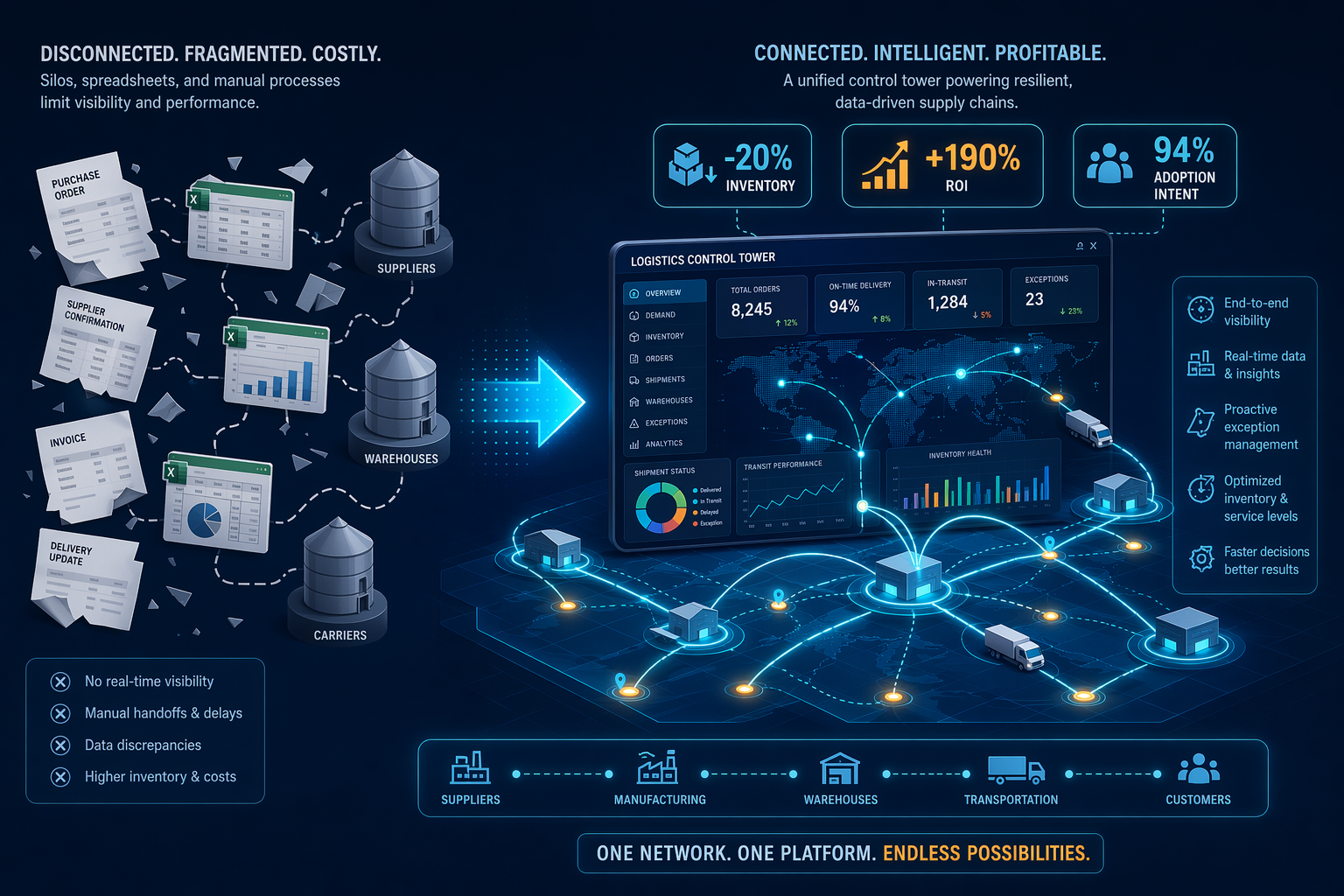
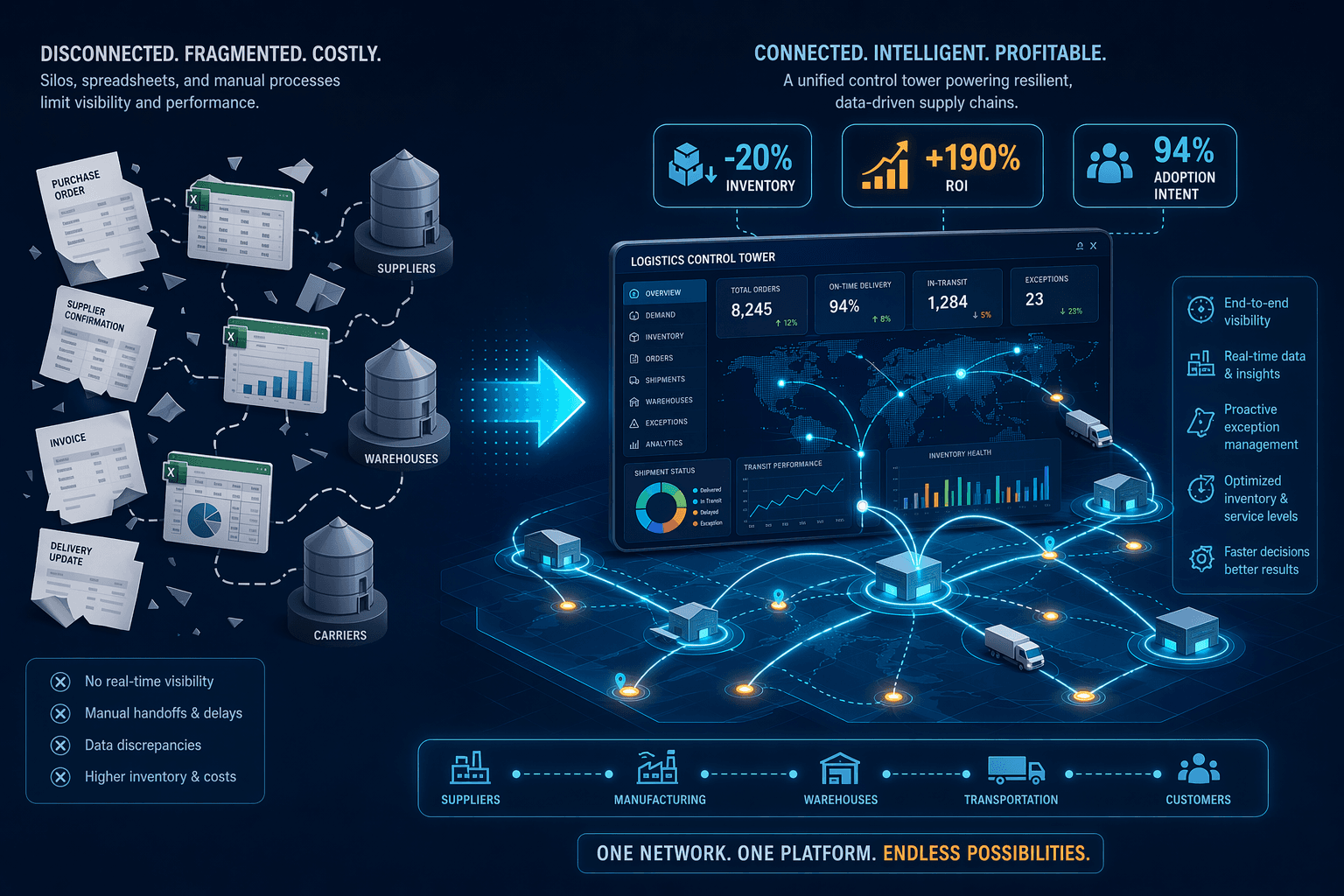
Most supply chain functions generate linear returns from AI: a 5% improvement in procurement spend yields a 5% cost reduction. Logistics is different. A single percentage point of improvement in route efficiency, warehouse picking accuracy, or fleet utilization multiplies across every vehicle, facility, and shift in the network. That compounding effect is the structural reason logistics AI investments average 190% ROI across all use cases, with top performers reaching multiples far beyond that baseline.
Consider the arithmetic of a 1% warehouse picking improvement. Applied across 50 facilities, 500 pickers, and 250 working days, that single percentage point produces approximately 6.25 million improved pick events annually. Each event represents a fraction of a second saved, a mis-pick avoided, or a step eliminated. Aggregated, those fractions become hours of labor, thousands of error corrections, and measurable cost reduction. No other supply chain domain offers this kind of leverage from a marginal gain.
Three additional dynamics make logistics AI ROI structurally distinct:
- Low marginal scaling cost. Once a predictive model is trained and integrated with a TMS or WMS, deploying it across an additional vehicle or warehouse carries near-zero incremental software cost. The fixed-cost nature of AI infrastructure means that returns scale super-linearly with network size.
- Dual cost and carbon savings channels. Route optimization that reduces fuel consumption by 22% also cuts emissions by a comparable margin. Under the EU ETS, a fleet-wide reduction of 10,000 tonnes of CO₂ generates EUR 450,000 to EUR 900,000 in carbon value at Q1 2026 prices of EUR 45–90 per tonne, layered on top of direct fuel savings. This dual channel effectively lowers the net investment threshold.
- High measurability accelerates payback. Logistics metrics — miles driven, fuel consumed, on-time delivery rate, picks per hour — are already tracked in operational systems. Unlike demand forecasting or supplier risk scoring, where attribution is debated, logistics AI improvements show up in the next month's P&L. That measurability shortens the time to stakeholder confidence.
These structural characteristics explain why logistics AI consistently outperforms other supply chain AI investments in realized returns. They also explain why the business case must be built differently — using network-wide baselines, not single-site pilots, and accounting for both direct operational savings and secondary value streams like carbon credits.
ROI by Use Case: Investment Ranges, Payback Periods, and Realized Returns
Not all predictive analytics use cases in logistics deliver the same returns. The distribution is wide, and the variance is driven by network size, data maturity, and the specific operational lever being pulled. Below are granular benchmarks for the four most commonly deployed use cases, drawn from industry data and verified against multiple sources.
| Use Case | Typical Investment | Annual Savings (500+ Vehicle Fleet) | Payback Period | 3-Year ROI Range | Primary Source |
|---|---|---|---|---|---|
| Route Optimization | EUR 80,000 – 150,000 | EUR 1.5M – 3M | 2 – 4 months | 800 – 1,200% | The Thinking Company (2026) |
| Predictive Maintenance | EUR 100,000 – 250,000 | 30 – 50% downtime reduction | 6 – 12 months | 200 – 350% | FreightAmigo / Industry benchmarks |
| Warehouse AI (Computer Vision, Robotics) | EUR 200,000 – 500,000 | Processing speed +45% YoY; accuracy 99.8% | 6 – 12 months | 150 – 250% | FreightAmigo (2025) |
| Demand Sensing / Inventory Optimization | EUR 150,000 – 300,000 | 20 – 30% inventory reduction | 12 – 18 months | 100 – 180% | McKinsey (2024) |
Route optimization stands apart. The 800–1,200% three-year ROI for fleets of 500+ vehicles reflects the compounding effect at scale: each percentage point of fuel savings, mileage reduction, and on-time delivery improvement multiplies across thousands of daily trips. A major European freight operator's deployment of AI route optimization, for example, delivered 22% fuel savings, a 28% improvement in on-time delivery, and a 35% reduction in emissions, according to a 2025 case study.
Predictive maintenance and warehouse AI offer strong but less dramatic returns. The 200–350% ROI range for predictive maintenance is driven by the high cost of unplanned downtime in logistics operations — a single fleet breakdown can cascade into missed delivery windows, penalty fees, and customer churn. Warehouse AI, including computer vision for inventory accuracy and robotic pickers, shows a 150–250% ROI with payback typically achieved within 6 to 12 months. In one deployment, AI-powered warehouse automation increased processing speed by 45% year-over-year and achieved 99.8% inventory accuracy, with robotic pickers handling 50% of orders.
Demand sensing and inventory optimization, while delivering lower headline ROI (100–180%), address a different cost base. McKinsey reports that AI-driven forecasting can reduce errors by 20–50%, cut lost sales by up to 65%, and reduce warehousing costs by 5–10%. The 20–30% inventory reduction figure is particularly significant for capital-constrained mid-market logistics operators where inventory carrying costs — defined by APQC at a median of 10% of inventory value — directly impact working capital.
The Deloitte 2025 survey provides important context for these benchmarks: 85% of organizations increased AI investment in the past year, yet only 6% saw ROI in under one year. Most organizations achieve satisfactory returns within 2 to 4 years. This distribution underscores the importance of setting realistic payback expectations, particularly for use cases like demand sensing where the data integration and model training phase can extend the time to value.
Building the Business Case: A Four-Step Framework
Approval-stage readers — CFOs, supply chain VPs, and procurement leaders — need a business case that survives scrutiny from finance, IT, and operations. The following four-step framework is designed to produce a risk-adjusted, defensible ROI model.
Step 1: Quantify Baseline Logistics Costs per Lane, Warehouse, and Fleet
Before any AI investment can be justified, the current cost structure must be granularly understood. This means breaking down logistics costs by lane (fuel, driver time, tolls, maintenance per mile), by warehouse (labor cost per pick, error rate, space utilization), and by fleet vehicle (downtime hours, maintenance cost per mile, utilization rate). The baseline should cover at least 12 months of operational data to account for seasonality. Without this baseline, every ROI projection is an estimate built on sand.
Step 2: Model Conservative Assumptions Using the Lower End of Benchmark Ranges
Vendor-provided ROI projections are typically based on best-case scenarios. A defensible business case uses the lower end of published benchmark ranges. For route optimization, model 800% three-year ROI rather than 1,200%. For warehouse AI, assume 150% rather than 250%. Apply a further 20–30% discount if the organization has limited experience with AI deployments or if data quality is known to be inconsistent. This conservative approach builds credibility with finance stakeholders and creates room for upside surprise.
Step 3: Account for Total Investment Cost, Including the 30–40% Data Integration Surcharge
The single most common error in logistics AI business cases is underestimating the cost of data integration. Legacy TMS and WMS systems were not designed to feed machine learning models. Data must be extracted, cleaned, normalized, and piped into the AI platform — a process that typically consumes 30–40% of total project cost. For a EUR 150,000 route optimization project, that means EUR 45,000 to EUR 60,000 in integration costs that must be budgeted upfront. McKinsey notes that 60% of supply-chain-planning IT implementations take longer or cost more than expected, and data integration is the primary driver of overruns.
Step 4: Factor Risk-Adjusted Returns and Intangible Benefits
A complete business case accounts for both tangible and intangible value streams. Tangible savings include fuel, labor, maintenance, and inventory carrying cost reductions. Intangible benefits include improved customer retention from higher on-time delivery rates, reduced carbon compliance risk, and the option value of having an AI-ready data infrastructure for future use cases. For organizations subject to the EU's CSRD or similar carbon reporting requirements, the carbon value of emissions reductions should be explicitly modeled. At EUR 45–90 per tonne under the EU ETS, a 10,000-tonne reduction generates EUR 450,000 to EUR 900,000 in carbon value — a material line item that can shift the payback calculation by several months.
Data readiness is a critical prerequisite for all four steps. Organizations that lack clean, accessible operational data will face higher integration costs and longer timelines. The CSCO's Data Readiness Checklist for Supply Chain AI Implementation provides a detailed framework for assessing data quality, accessibility, and governance before committing to an AI investment.
Common ROI Pitfalls That Undermine Business Cases
Even well-constructed business cases fail when they overlook structural risks. The following pitfalls are the most frequently cited by logistics leaders who have gone through the AI procurement process.
- Ignoring integration costs. As noted above, data integration with legacy TMS/WMS consumes 30–40% of total project cost. Business cases that omit this line item understate the true investment by nearly half, leading to unrealistic payback projections and stakeholder distrust when the actual costs emerge.
- Assuming full-fleet scaling from single-region pilots. A successful pilot in one warehouse or on one delivery route does not guarantee equivalent results across the entire network. Regional variations in traffic patterns, labor markets, facility layouts, and data quality mean that pilot results typically degrade by 20–40% when scaled. Business cases should model a scaling discount rather than assuming linear extrapolation.
- Omitting workforce transition costs. AI-driven route optimization and warehouse automation change the nature of logistics work. Dispatchers who previously built routes manually need retraining. Warehouse pickers whose roles shift from manual picking to exception handling require new skills. These transition costs — training, change management, and potential severance — are real and should be included in the total cost of ownership.
- Using vendor-reported outcomes without independent verification. Vendor case studies consistently report best-case results. The FreightAmigo data showing 22% fuel savings and 35% emissions reduction, for example, lacks named company attribution and precise methodology. A defensible business case relies on independently verified benchmarks or, at minimum, applies a 30–50% discount to vendor-reported figures.
The 94% intent versus 23% strategy gap, documented by ABI Research and Gartner in 2025, is the single largest risk factor for logistics AI investments. Organizations that skip the strategy phase — defining which use cases to pursue, in what sequence, with what data prerequisites — end up with fragmented deployments that fail to deliver compounding returns. For a deeper analysis of this strategy execution problem, see The Gartner AI Strategy Paradox: 94% Intent, 23% Strategy.
Key ROI Benchmarks at a Glance
The following table consolidates the most important ROI benchmarks for logistics predictive analytics, organized by use case. All figures are sourced from published industry data and should be treated as directional ranges. The mid-market 3PL margin leverage point is included as a separate reference because it illustrates the outsized impact of even modest cost reductions in a low-margin industry.
| Use Case | Investment Range | Annual Savings / Impact | Payback Period | 3-Year ROI | Source |
|---|---|---|---|---|---|
| Route Optimization | EUR 80K – 150K | EUR 1.5M – 3M | 2 – 4 months | 800 – 1,200% | The Thinking Company (2026) |
| Predictive Maintenance | EUR 100K – 250K | 30 – 50% downtime reduction | 6 – 12 months | 200 – 350% | FreightAmigo / Industry benchmarks |
| Warehouse AI | EUR 200K – 500K | Processing speed +45% YoY; accuracy 99.8% | 6 – 12 months | 150 – 250% | FreightAmigo (2025) |
| Demand Sensing / Inventory | EUR 150K – 300K | 20 – 30% inventory reduction | 12 – 18 months | 100 – 180% | McKinsey (2024) |
| 3PL Margin Leverage (Mid-Market) | N/A | 2 – 3% cost reduction = 30 – 75% margin improvement | N/A | N/A | European Logistics Association (2025) |
The mid-market 3PL margin leverage point deserves particular attention. The average mid-market 3PL operates on 4–7% net margins, according to the European Logistics Association (2025). A 2–3% total cost reduction through AI — well within the range of achievable savings from route optimization and warehouse AI — translates to a 30–75% improvement in net margin. For a 3PL with EUR 50 million in revenue and 5% net margins (EUR 2.5 million profit), a 2.5% cost reduction (EUR 1.25 million) increases profit by 50%. This is the kind of arithmetic that gets a CFO's attention.
Getting Started: Portfolio Business Cases Deliver Higher Returns
The most common mistake in logistics AI investment is pursuing use cases in isolation. Route optimization is approved by the transportation director. Warehouse AI is championed by the operations VP. Demand sensing is driven by the planning team. Each business case stands alone, and each bears the full cost of data integration, platform licensing, and organizational change management.
A portfolio approach changes the economics. When shared infrastructure costs — data pipelines, cloud compute, model monitoring, and governance frameworks — are allocated across multiple use cases, the effective investment per use case drops significantly. The Thinking Company reports that allocating shared infrastructure costs across a portfolio of use cases typically improves portfolio ROI by 40–60%. A route optimization project that delivers 800% ROI on its own might deliver 1,200% when combined with predictive maintenance and warehouse AI on a shared platform.
The practical path to a portfolio approach is a focused pilot. If source systems are accessible, a pilot can be accomplished within 4 to 8 weeks, according to implementation data from McKinsey. Production scale typically takes 3 to 6 months. The pilot should be designed to validate three things: data accessibility and quality, model accuracy against baseline performance, and the organization's capacity to act on AI-generated recommendations. A pilot that fails on any of these dimensions provides critical learning before significant capital is committed.
For a broader view of how predictive analytics ROI varies across the full supply chain — from procurement to last-mile delivery — see AI Use Cases in Supply Chain by Function: Where the ROI Is Real in 2026. That article provides a functional breakdown of ROI across demand planning, inventory management, procurement, warehouse operations, and logistics, serving as a companion resource for organizations building a multi-function AI investment roadmap.
Comments
Join the discussion with an anonymous comment.