
The AI Expectations-Reality Gap in Supply Chain
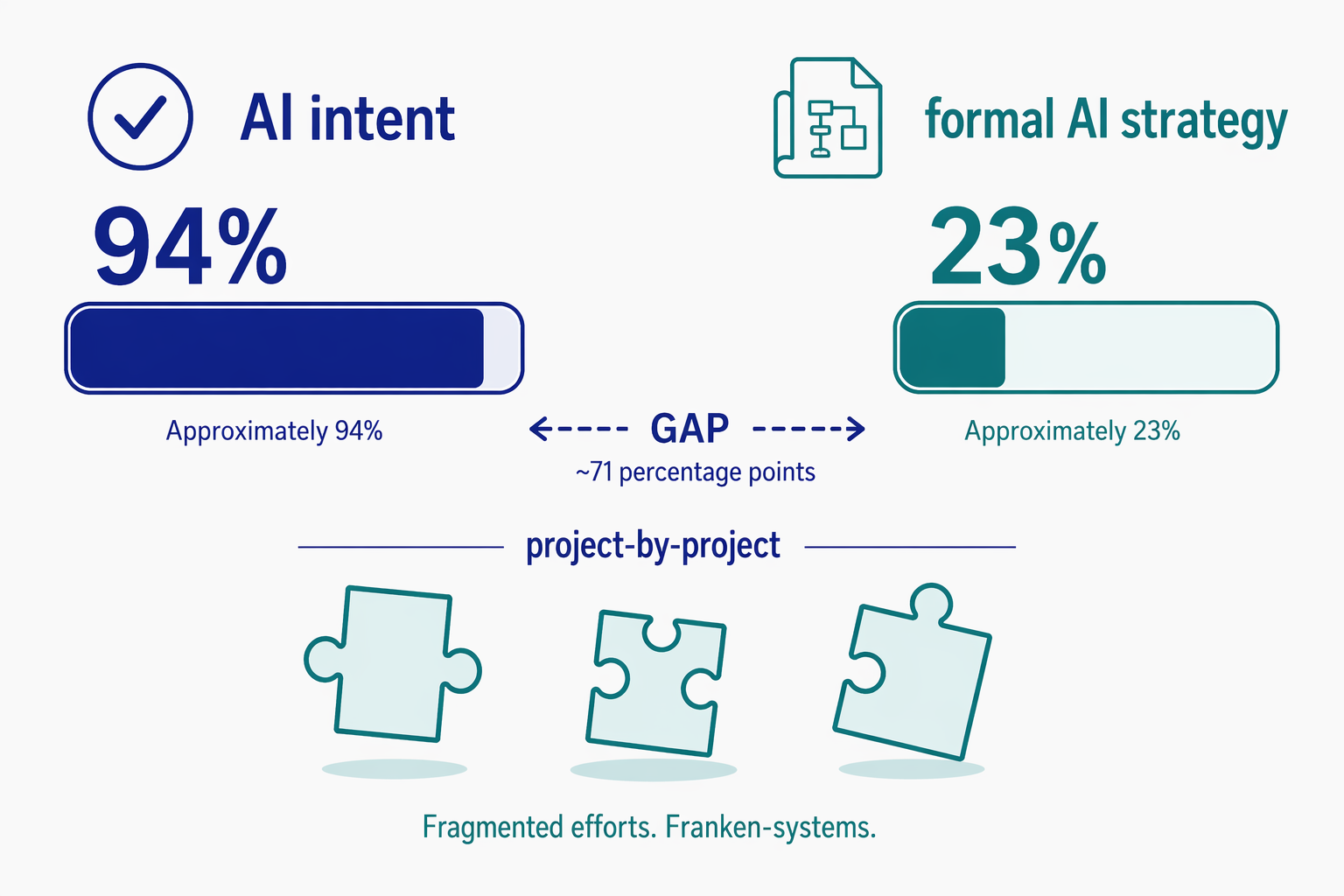
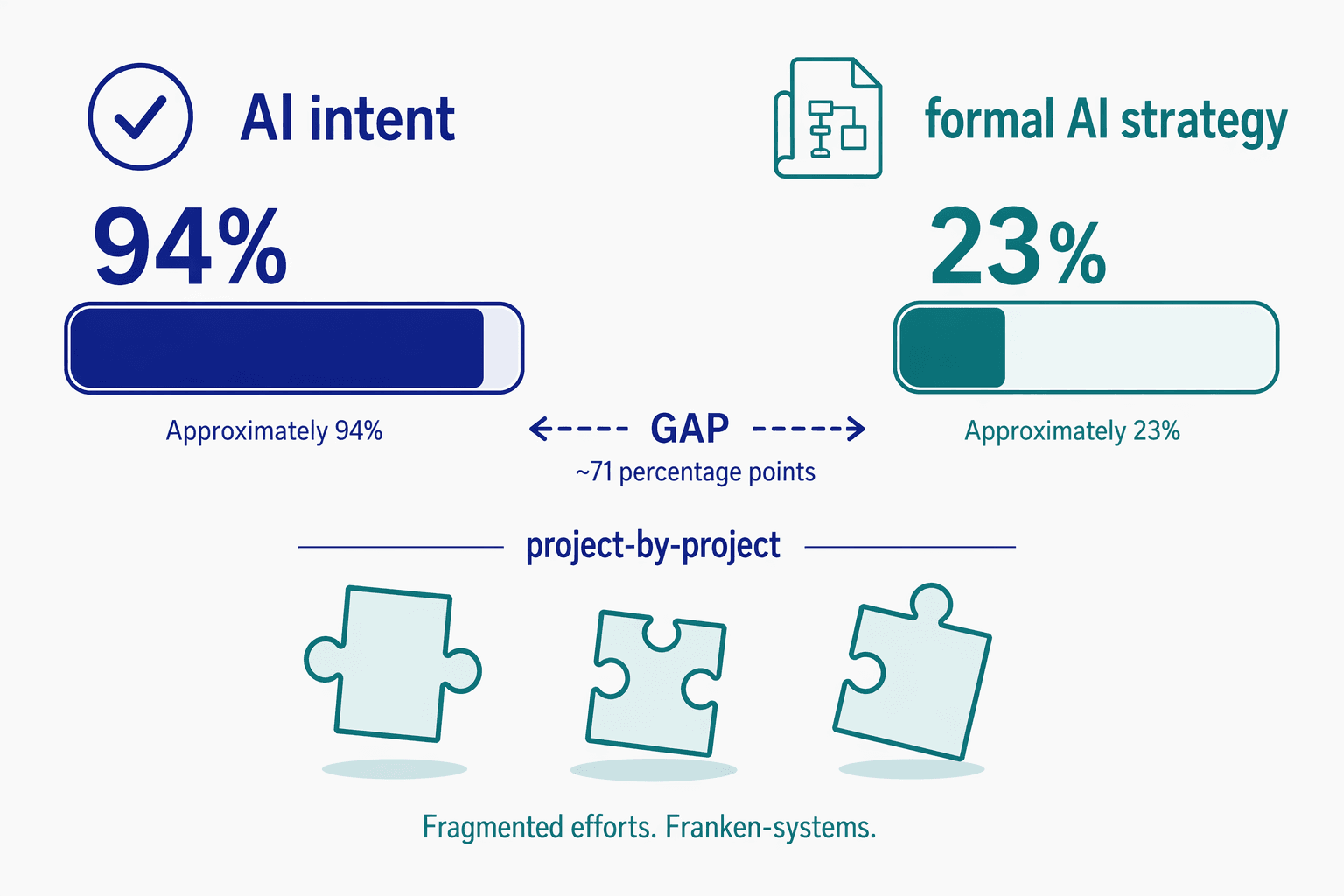
The numbers paint a picture of near-universal intent. According to ABI Research, 94% of supply chain companies plan to deploy AI or generative AI for decision support within two years. Yet when Gartner surveyed 120 supply chain leaders who had already deployed AI between December 2024 and January 2025, only 23% reported having a formal supply chain AI strategy. That gap — between what organizations intend to do and what they have actually structured themselves to execute — is the single most consequential risk in supply chain AI adoption today.
This is not a technology problem. The models work. The platforms are mature enough for production deployment across demand forecasting, inventory optimization, logistics routing, and procurement. The barrier is strategic: most organizations are investing in AI project by project, without a portfolio-level view of how these investments connect, scale, and compound over time.
Why Project-by-Project AI Investment Creates Franken-Systems That Don’t Scale
When a demand planning team deploys a machine learning model to improve forecast accuracy, and a logistics team separately implements a route optimization algorithm, and a procurement group pilots a supplier risk scoring tool — each on its own timeline, with its own data pipeline, its own integration approach, and its own vendor relationship — the organization ends up with what Gartner calls “franken-systems.” These are complex, layered architectures where each component works in isolation but the whole resists scaling, integration, and governance.
The consequences are measurable. PwC’s 2026 Digital Trends in Operations survey of 767 US operations and supply chain leaders found that 89% say their technology investments have not fully delivered expected results. The top reason cited was integration complexity. When AI deployments are planned in isolation, the cost of connecting them later — both in technical debt and organizational friction — often exceeds the initial implementation cost.
The project-by-project approach also creates a distorted view of ROI. A standalone demand forecasting pilot might show a 15% improvement in forecast accuracy, but if the data feeding that model is unreliable, or if the output cannot be consumed by the inventory planning system, the enterprise value is capped. The pilot succeeds; the program stalls.
Introducing the Run-Grow-Transform Framework for AI Portfolio Building
Gartner’s Run-Grow-Transform framework, developed for CSCO advisory, provides a structured alternative to project-by-project investing. Rather than treating every AI initiative as a standalone experiment, the framework categorizes investments into three horizons, each with distinct objectives, timelines, and risk profiles.
| Phase | Primary Objective | Typical Timeline | Investment Level | Example Use Cases |
|---|---|---|---|---|
| Run | Operational efficiency, cost optimization, quick ROI | 3–12 months | Moderate, departmental budgets | Demand sensing, route optimization, warehouse slotting |
| Grow | Cross-functional alignment, S&OP integration, scalability | 12–36 months | Significant, cross-functional funding | Integrated business planning, inventory optimization, supplier risk scoring |
| Transform | Business model change, competitive differentiation | 24–48+ months | Strategic, executive-sponsored | Autonomous planning, agentic AI for procurement, digital twin |
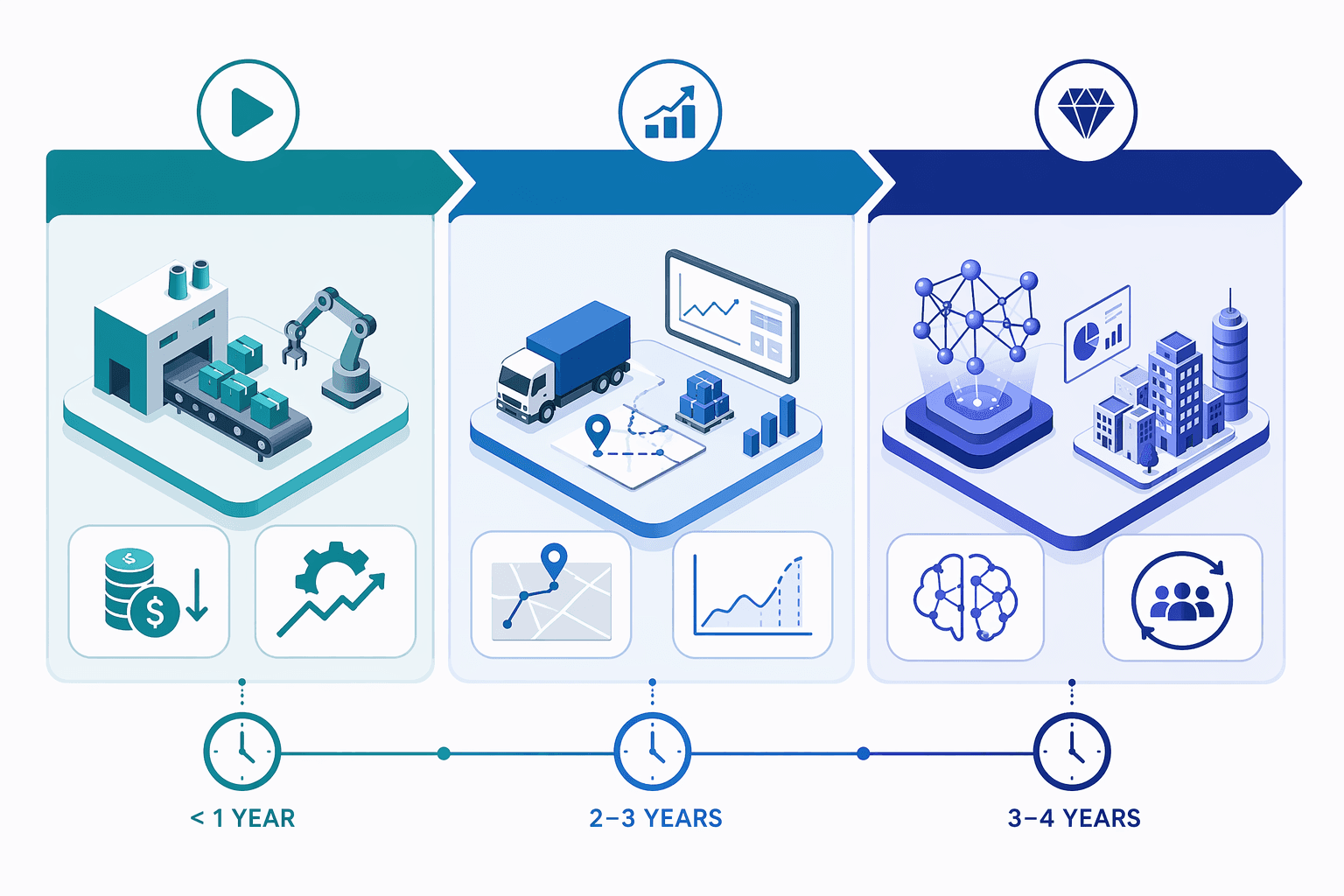
The Run phase addresses the immediate need for operational efficiency. These are the projects that deliver measurable returns within a year, build organizational confidence in AI, and generate the data infrastructure that later phases depend on. Route optimization for a 500-vehicle fleet, for example, typically requires an investment of EUR 80,000 to 150,000 and delivers annual savings of EUR 1.5 million to 3 million, with a payback period of 2 to 4 months and a three-year ROI of 800% to 1,200%, according to The Thinking Company.
The Grow phase shifts focus from departmental efficiency to cross-functional integration. These investments connect demand planning with inventory optimization, procurement with supplier risk, and logistics with warehouse operations. They require shared data platforms, cross-functional governance, and typically take 1 to 3 years to deliver full value.
The Transform phase represents principled bets on business model change. These are the investments that, if successful, redefine how the supply chain operates — autonomous planning systems that manage inventory without human intervention, agentic AI that negotiates with suppliers, or digital twins that simulate the entire supply chain. They carry higher risk, longer timelines, and the potential for outsized competitive advantage.
Data Readiness: The Foundation That 87% of Organizations Are Missing
Every AI investment, regardless of which phase it belongs to, depends on one non-negotiable prerequisite: data readiness. PwC’s 2026 survey found that 87% of operations and supply chain leaders say poor data quality has impacted their ability to achieve value from digital initiatives. Only 30% report significant improvement in data quality. These are not edge cases; they are the dominant experience.
The data readiness challenge has three dimensions that organizations must address before building an AI portfolio:
- Data quality and consistency: Historical sales data with missing SKUs, inconsistent customer hierarchies, or unrecorded promotions will produce unreliable forecasts regardless of model sophistication. Organizations need a systematic data quality assessment before any AI deployment.
- Integration architecture: The Thinking Company notes that integration with legacy TMS and WMS systems consumes 30–40% of total project cost. Organizations that invest in a shared data infrastructure layer — rather than point-to-point integrations for each AI tool — reduce this cost and accelerate deployment of subsequent use cases.
- Data governance and access: AI models need timely access to data from multiple functions. Without cross-functional data governance, demand planners may not have access to promotion data, and procurement teams may not see inventory levels. This is an organizational problem, not a technical one.
ROI Timeline Reality: Why Most AI Investments Take 2–4 Years to Deliver
One of the most dangerous assumptions in supply chain AI strategy is that ROI will arrive quickly. Deloitte’s 2025 research found that while 85% of organizations increased AI investment, only 6% saw ROI in under a year. The majority achieve satisfactory returns within 2 to 4 years. This timeline mismatch — between executive expectations of rapid payback and the actual pace of value realization — is a primary cause of stalled programs and abandoned initiatives.
Different use case categories have fundamentally different ROI profiles. Understanding these differences is essential for building a portfolio that balances quick wins with longer-term investments.
| Use Case Category | Typical Investment | Payback Period | 3-Year ROI Range | Portfolio Phase |
|---|---|---|---|---|
| Route optimization (500+ vehicles) | EUR 80K–150K | 2–4 months | 800–1,200% | Run |
| Predictive fleet maintenance | EUR 100K–250K | 6–12 months | 300–500% | Run / Grow |
| Demand sensing | EUR 150K–400K | 6–18 months | 200–350% | Grow |
| Integrated business planning (IBP) | EUR 500K–2M | 18–36 months | 150–300% | Grow / Transform |
| Autonomous planning / agentic AI | EUR 1M–5M+ | 24–48+ months | Variable, high-risk | Transform |
The portfolio approach directly addresses this timeline challenge. By including Run-phase investments with rapid payback, organizations generate early wins that fund and justify the longer-term Grow and Transform investments. The Thinking Company reports that a portfolio approach sharing data infrastructure across 3 to 5 use cases improves overall ROI by 40% to 60%.
The Workforce and Change Management Imperative
AI strategy is inseparable from talent strategy. A KPMG-authored article in Supply Chain Management Review emphasizes that the shift to AI-driven supply chains requires comprehensive upskilling programs to evolve the skill sets of supply chain team members. The same article stresses the need for robust change management to build trust in AI-driven decisions — a factor that is often underestimated in technology-focused investment plans.
- Planners and analysts need to understand how AI models generate recommendations, what data they depend on, and how to intervene when model outputs conflict with operational reality. This is not about turning supply chain professionals into data scientists; it is about building AI literacy at every level of the planning organization.
- Managers and directors need to shift from managing by intuition to managing by exception — trusting AI to handle routine decisions while focusing human judgment on edge cases, strategic trade-offs, and supplier relationships.
- Executive sponsors need to understand the 2- to 4-year ROI timeline and resist the temptation to pull funding when quick returns do not materialize. This requires clear communication of the portfolio logic and realistic milestone setting.
The KPMG article also highlights a strategic shift toward “local for local” manufacturing as organizations build resilience into their supply chains. AI plays a dual role here: it enables the complexity of managing distributed, localized production networks, and it requires a workforce that can operate effectively in a more decentralized decision-making environment.
Practical Steps for Building Your AI Investment Portfolio
Moving from the 77% of organizations without a formal AI strategy to the 23% that have one requires a structured approach. The following steps provide a practical roadmap for CSCOs and digital transformation leaders.
- Conduct a strategy audit. Assess your current AI investments against the Run-Grow-Transform framework. Which phase do they belong to? Are you over-invested in one phase at the expense of others? Most organizations are heavily weighted toward Run-phase projects with no clear path to Grow or Transform.
- Assess data readiness systematically. Use the three dimensions — data quality, integration architecture, and governance — to identify the gaps that will most constrain your AI portfolio. Prioritize investments in shared data infrastructure over point solutions.
- Map use cases to portfolio phases. For each potential AI investment, determine which phase it belongs to and what dependencies it has on other investments. A demand sensing tool (Grow) may depend on data pipelines built for a route optimization tool (Run).
- Establish cross-functional governance. AI in supply chain touches demand planning, procurement, logistics, warehouse operations, and finance. A single-function governance structure will produce franken-systems. Create a cross-functional AI steering committee with representation from each domain.
- Plan for 2- to 4-year ROI horizons. Set realistic expectations with executive stakeholders. Use the ROI timeline data from Deloitte and The Thinking Company to build a phased business case that shows when each investment is expected to deliver value.
- Invest in change management and upskilling. Budget for training programs, change management resources, and the organizational capacity to support AI adoption. The KPMG article makes clear that this is not a soft cost — it is a prerequisite for value realization.
| Step | Key Question | Success Indicator |
|---|---|---|
| Strategy audit | What phase are our current AI investments in? | Portfolio map showing distribution across Run, Grow, Transform |
| Data readiness assessment | Which data gaps will constrain our AI portfolio? | Prioritized list of data quality and integration investments |
| Use case mapping | Which investments depend on each other? | Dependency graph showing sequencing requirements |
| Governance structure | Who owns cross-functional AI decisions? | Chartered AI steering committee with defined decision rights |
| ROI planning | What is the expected value timeline for each investment? | Phased business case with 1-year, 2-year, and 4-year milestones |
| Change management | What training and support does the workforce need? | Upskilling program with measurable adoption targets |
The Compounding Advantage of Starting Now
Accenture’s 2024 research, based on a survey of 1,148 companies, found that organizations with AI-mature supply chains are 23% more profitable and 6 times more likely to use AI and generative AI widely. These are not marginal advantages. They compound over time as data infrastructure improves, models become more accurate, and organizational capability deepens.
The strategy gap is an opportunity. The 77% of organizations without a formal AI strategy are not failing because AI technology is immature or unproven. They are failing because they have not yet made the strategic shift from project-by-project investment to portfolio-based planning. Those that make this shift now will build data infrastructure, organizational capability, and governance structures that create a compounding advantage over the next 3 to 5 years.
The question for CSCOs is not whether to invest in AI. The data is clear: 94% of companies plan to, and the competitive pressure will only increase. The question is whether those investments will be guided by a formal strategy that balances quick wins with long-term transformation, or whether they will accumulate into franken-systems that resist scaling and fail to deliver enterprise value.
Comments
Join the discussion with an anonymous comment.