
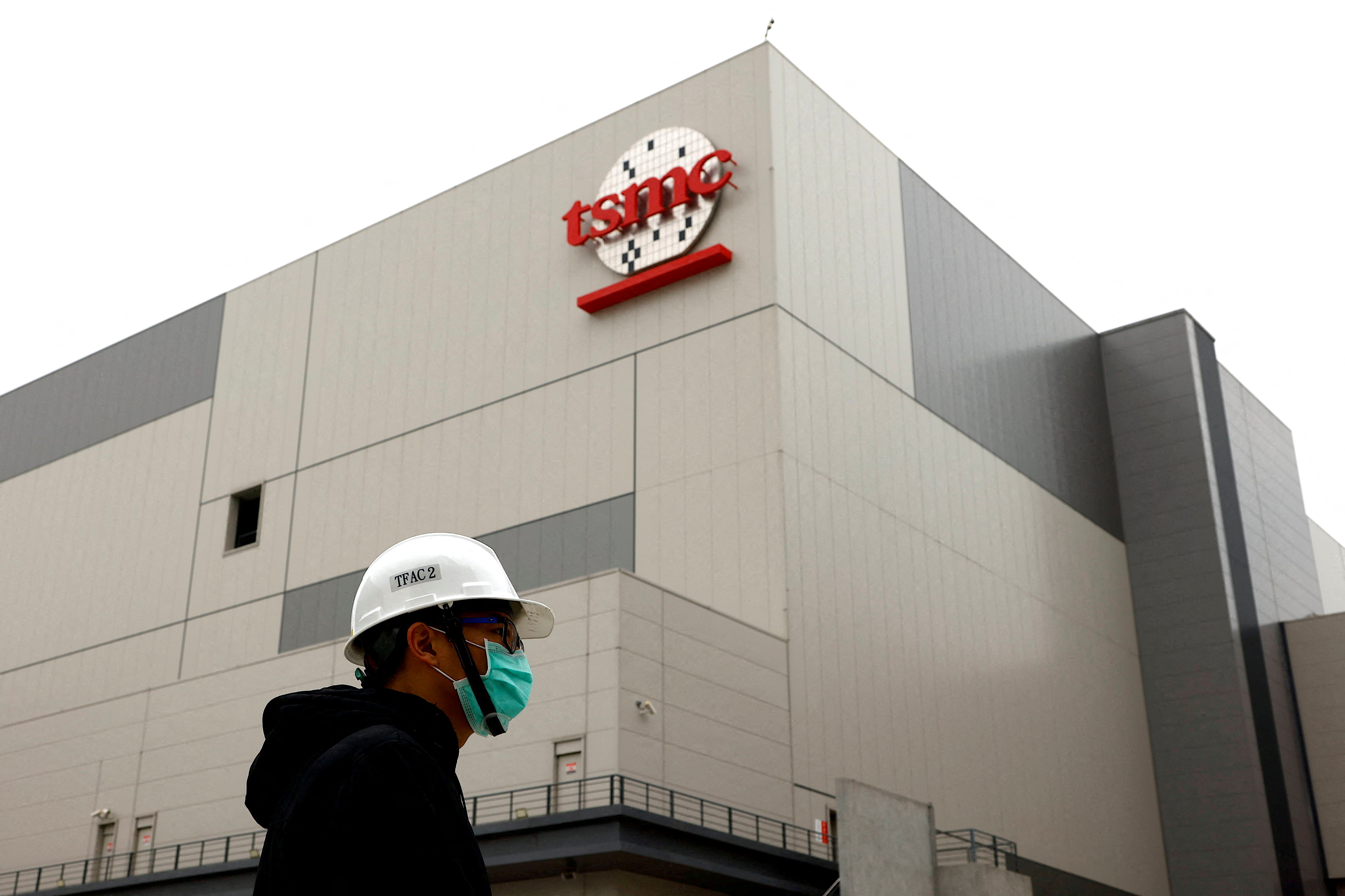
The April 2024 Taiwan earthquake was the kind of event that exposes the weakness in a clean-looking continuity plan. The quake measured 7.4 in magnitude, TSMC evacuated fabrication plants, and the company recovered about 70% of its tools within 10 hours, according to Reuters reporting at the time.[1] That is a fast operational recovery by any normal standard. It still left supply chain teams with an uncomfortable question: which products, components, orders, and customers were exposed before everyone knew the final factory-level impact?
That question matters because Taiwan is not just another manufacturing node. Interos cited Taiwan as producing about 60% of global semiconductors and about 90% of advanced-node chips, while Barclays estimated the earthquake could create a roughly $60 million Q2 impact for TSMC.[2] The business problem was not simply “an earthquake happened.” It was that a single regional shock touched a concentrated semiconductor ecosystem whose dependencies are buried several tiers deep.
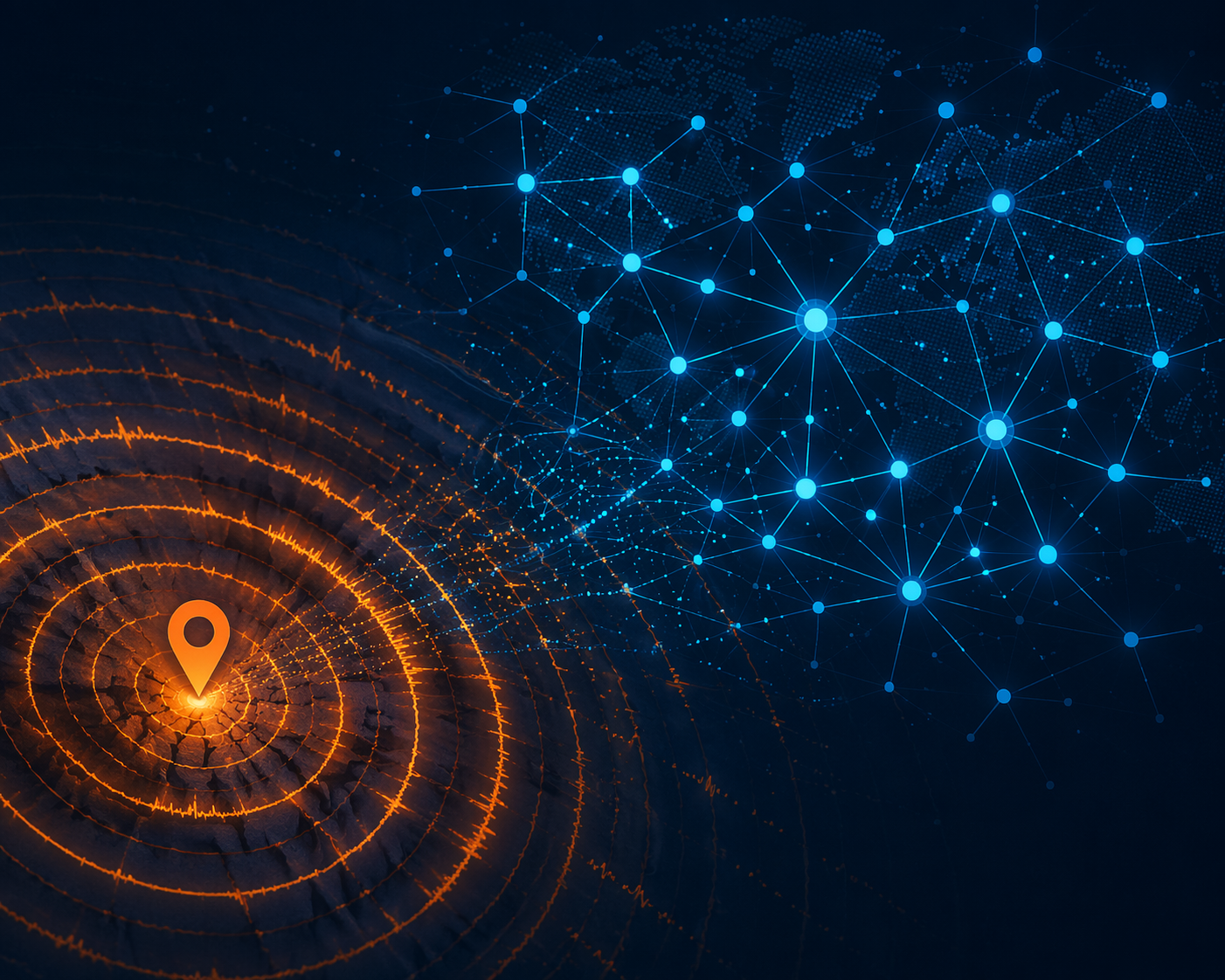
This is where AI-based earthquake disruption planning becomes a practical supply chain use case rather than a technology category. The useful question is not whether AI can “predict earthquakes” in a broad sense. It is whether AI can move earthquake disruption planning from post-event discovery toward near-real-time exposure detection and decision support: which suppliers are inside the impact zone, which sub-tier dependencies matter, which materials could be affected, and which decisions can be made before the first customer escalation arrives.
The hard hour after the quake
After a major earthquake, most companies do not lose time because nobody cares. They lose time because the first facts arrive in fragments. A geological agency publishes magnitude and location. Local news reports damage in one district and normal operations in another. Tier-1 suppliers send cautious statements. Procurement asks whether alternate capacity is available. Operations wants to know whether to expedite. Finance asks for revenue exposure. The spreadsheet that looked authoritative yesterday suddenly depends on missing sub-tier data.
Traditional disruption assessment often starts with supplier outreach and manual cross-checking: identify known suppliers in the affected geography, wait for confirmations, search internal part lists, and escalate the most visible constraints. That approach can work for direct suppliers with mature account teams. It is much weaker when the exposure sits in a materials supplier, outsourced process, logistics node, or contract manufacturer several tiers away.
The Taiwan case is useful because it does not require an imagined catastrophe. TSMC’s partial tool recovery within 10 hours shows that the event was not a simple “factory down” story.[1] Some operations recovered quickly; analysts still expected output and supply chain effects.[1] That mixed signal is exactly what supply chain risk teams have to work with: serious enough to act, incomplete enough to make every recommendation contestable.
What AI changes, if the pieces are connected
The credible AI story has two sides. One side improves the speed and structure of earthquake intelligence: aftershock forecasting, event classification, bulletin parsing, and geospatial impact estimation. The other side improves the supply chain view: supplier graphs, entity resolution, multi-tier dependency mapping, and material-level impact assessment. The value appears when those two sides meet.
| Workflow point | Traditional problem | AI-supported change |
|---|---|---|
| Event detection | Teams monitor alerts, news, and agency bulletins manually or through generic feeds. | NLP and event engines classify earthquake bulletins, extract locations and severity signals, and route the event to affected networks. |
| Exposure mapping | Supplier lists often stop at tier 1 or depend on outdated self-reported data. | Supplier graph analysis links corporate entities, sites, products, and sub-tier relationships. |
| Impact assessment | Procurement waits for confirmations before knowing which materials or customers may be exposed. | Risk systems compare the impact area with mapped suppliers and parts to prioritize outreach and mitigation. |
| Decision support | Operations debates whether to expedite or reallocate inventory with incomplete evidence. | The system can rank likely exposure and show where human confirmation is still needed. |
This table is a useful model of the workflow, not proof that one deployed platform currently performs the entire earthquake-specific sequence end to end. The evidence available today comes from adjacent but relevant capabilities: seismic science that can accelerate aftershock risk forecasts, and supply chain risk platforms that can identify exposed suppliers and assess disruption impacts faster than manual methods.
Seismic intelligence is getting faster, but it is not the whole workflow
A 2025 study associated with the British Geological Survey, the University of Edinburgh, and the University of Padua is important because it addresses one of the most awkward post-earthquake timing problems: aftershock risk. PreventionWeb reported that the AI model could forecast aftershock risk in seconds, compared with hours for traditional ETAS models.[3] For continuity teams, that time difference is not academic. If a supplier site is inside an affected region, aftershock risk can influence whether workers return, whether inspections proceed, whether logistics lanes reopen, and whether inventory should be moved preemptively.
The boundary is just as important. An aftershock model does not know which customer program depends on a substrate supplier, which product has no approved alternate, or which procurement manager has authority to release premium freight. It produces a seismic risk signal. A supply chain system would still need to ingest that signal, match it to supplier sites, connect those sites to parts and revenue, and present the result in a form a business team can defend.
Natural-language processing can help with the messy middle layer. Earthquake information arrives through geological bulletins, agency updates, local emergency notices, news reports, and supplier statements. NLP systems can extract place names, facility names, reported closures, transport interruptions, and severity language. That does not eliminate verification. It does reduce the time spent reading the same fragmented updates across multiple desks.
The supplier graph is where the earthquake becomes a business exposure
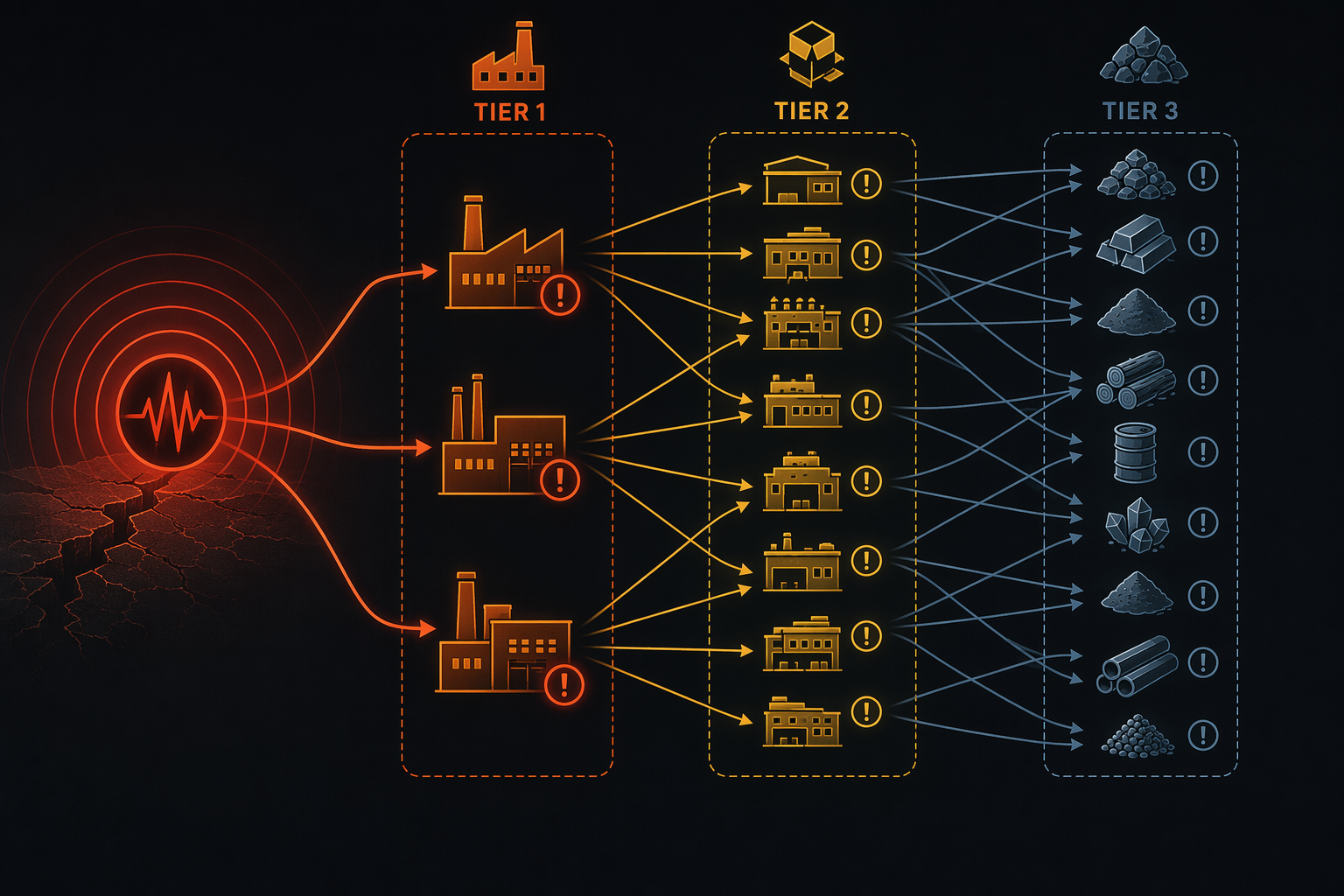
A fast earthquake signal is useful only if the company can answer “so what?” quickly. Interos’s Taiwan earthquake analysis reported that U.S. companies had about 70,000 direct tier-1 connections to Taiwanese firms and about 750,000 tier-3 connections.[2] That gap is the operating problem in one pair of numbers. If the direct supplier list is the only map, most of the exposure is likely to stay invisible during the first assessment.
Interos has also said its platform maps more than 250 million entities and that its catastrophic risk model addresses earthquake exposure across multiple tiers.[4] Those are vendor disclosures, not an independent audit of earthquake response performance. They still describe the type of infrastructure a risk team would need: entity resolution to know that different names point to the same company, graph relationships to surface sub-tier dependencies, and geospatial matching to connect a physical event with supplier locations.
This is also where the distinction between supplier mapping and supplier monitoring matters. A company can receive a good earthquake alert and still fail operationally if its supplier data stops at direct vendors. Conversely, a rich supplier graph without timely event intelligence can become a static research asset. The use case depends on joining both capabilities in the first assessment window.
For readers evaluating the mechanics of graph construction, the relevant techniques overlap with AI-powered multi-tier supplier mapping: extracting relationships from public records and trade data, resolving entities across naming variations, inferring likely dependencies, and scoring confidence rather than pretending every link is equally certain. That work is not earthquake-specific, but it becomes critical when a regional shock forces the team to ask which hidden dependencies sit inside an impact radius.
How AI-powered multi-tier supplier mapping works is the deeper companion topic for that part of the workflow.
What faster impact assessment could change
Everstream describes a related operational capability through its context engine, which filters 1,000 to 1,500 daily disruptions and applies AI to identify relevant supply chain impacts.[5] The company says client data shows AI reduces the time to identify and assess disruption impact by 50% to 70%, reduces expedited freight costs by 5%, and reduces revenue losses from disruption by 30%.[5] Those figures are not earthquake-specific results, and they should not be read as guaranteed outcomes for a seismic event. They are still directly relevant to the buyer’s question because they measure the part of the process where companies usually lose time.
Everstream also states that 41% of organizations take a week to identify impacted materials after a disruption.[5] In an earthquake scenario, a week is a long time to discover that a constrained component, specialty material, or outsourced process sits under the affected region. By then, the customer-facing conversation may already have moved from prevention to explanation.
The practical change is not that AI makes the decision automatically. It changes the first meeting. Instead of asking every function to bring whatever it has found, the risk team can start with a ranked exposure view: known suppliers in the impact radius, likely sub-tier dependencies, affected materials, open purchase orders, customer programs, inventory positions, alternate sources, and the confidence level behind each link. People still call suppliers. They call in a better order.
- Procurement can prioritize outreach to suppliers with mapped material or revenue exposure, not just those with the largest contracts.
- Operations can decide which parts deserve inventory checks or expedite review before disruption is confirmed.
- Finance can estimate exposure using linked supplier, part, and customer data rather than waiting for a fully reconciled incident report.
- Business continuity teams can separate confirmed impact from plausible exposure and update stakeholders without overstating certainty.
The workflow that is credible today
A realistic earthquake disruption workflow would begin when an earthquake or aftershock-risk signal enters the monitoring system. The system classifies the event, geocodes the affected area, and compares it with mapped supplier sites. It then expands from direct suppliers to sub-tier relationships where confidence is high enough to support action. The output is not a final loss estimate. It is a triage view.
For a semiconductor-heavy company, that triage view might flag suppliers in Taiwan, linked fabrication or packaging dependencies, constrained components, and customer programs using those parts. For an automotive or industrial manufacturer, it might identify electronics modules, specialty chemicals, precision tooling, or logistics lanes tied to the affected region. These are illustrative examples of how the workflow could apply; they are not documented company cases from the available evidence.
The strongest version of the workflow keeps uncertainty visible. A confirmed supplier shutdown should not look the same as an inferred tier-3 relationship. A supplier inside the shake area should not automatically be marked disrupted. An aftershock risk forecast should influence inspection and continuity decisions, but it should not be translated into a procurement action without business context. The system earns trust by showing why something is ranked, what is known, and what still needs human confirmation.
This is the same broad risk-monitoring pattern that appears in other disruption categories: ingest an external hazard signal, enrich it with network context, rank exposure, and route decisions to the right owners. Earthquake planning has its own physics and data constraints, but the operating logic resembles AI flood disruption planning and AI monitoring for security-related supply chain threats.
How AI Predicts Flood Disruptions Before They Hit Supply Chains and How AI Risk Monitoring Detects Drone Threats to Supply Chains show the same pattern applied to different external shocks.
What should stay in the watch category
Japan’s Nankai Trough risk is a useful reminder that earthquake exposure is not confined to Taiwan. SupplyChain247 reported concerns that a major Nankai Trough earthquake could disrupt global supply chains, and cited a potential GDP exposure figure above $1.6 trillion that it attributed through Interos to a U.S.-Taiwan Business Council report.[6] Because the underlying report was not independently verified in the available research, that number should be treated as a watch item rather than a foundation for business-case math.
The same caution applies to broad claims that AI-enabled earthquake early warning can reduce damage by a large percentage when connected to automated responses. A sensor network that can trigger machinery shutdowns, elevator controls, or facility alerts is relevant to resilience. A vendor-sourced damage-reduction claim without independent attribution is not proof that supply chain losses will fall by the same amount. Facility protection, worker safety, and supply continuity overlap, but they are not the same outcome.
There is also a market-architecture issue. Early-warning vendors, risk-intelligence platforms, supplier mapping providers, planning systems, and execution systems do different jobs. A company validating this use case should not ask only whether a vendor has “AI.” It should ask where the vendor sits in the planning-versus-execution stack, what data it can ingest, which supplier tiers it can resolve, and how its outputs enter existing incident management.
AI Supply Chain Companies: Planning vs. Execution — Which Vendors Do What is a useful taxonomy when separating event detection, supplier intelligence, planning recommendations, and operational execution.
Deployment readiness
The evidence supports a cautious yes for stakeholder validation or a monitored pilot. AI can plausibly compress earthquake impact detection from days to minutes when a company already has mapped supplier relationships, clean part-to-supplier links, and an event-intelligence feed that can classify seismic information quickly. It can also extend visibility beyond tier 1, which is the difference between checking the obvious suppliers and identifying the dependencies that actually constrain production.
The evidence does not support presenting AI earthquake disruption planning as a proven, fully integrated production system with documented end-to-end results. The strongest facts come from separate places: Taiwan’s real semiconductor exposure, ML aftershock forecasting speed, multi-tier supplier graph capabilities, and general disruption impact-assessment reductions. Those pieces fit a credible use case. They do not yet amount to a verified category benchmark.
For a risk manager or procurement lead, that distinction is enough to shape the next decision. Do not buy the grand claim. Do not dismiss the signal feed either. Validate whether the system can answer the first operational questions after an earthquake: which suppliers are exposed, which materials are at risk, what confidence supports the ranking, who needs to call whom, and what action is justified before the disruption is fully confirmed.
References
- Taiwan quake to hit some chip output, disrupt supply chain, analysts say, Reuters, April 3, 2024
- Navigating Semiconductor Supply Chain Disruptions: Insights from Taiwan's Earthquake, Interos
- Research shows AI earthquake tools forecast aftershock risk in seconds, PreventionWeb, 2025
- Interos Launches Multi-tier Catastrophic Risk Visibility, Interos
- Artificial intelligence's role in supply chain risk management, Everstream
- Imminent Megaquake in Japan Could Disrupt Global Supply Chains, SupplyChain247
Comments
Join the discussion with an anonymous comment.