
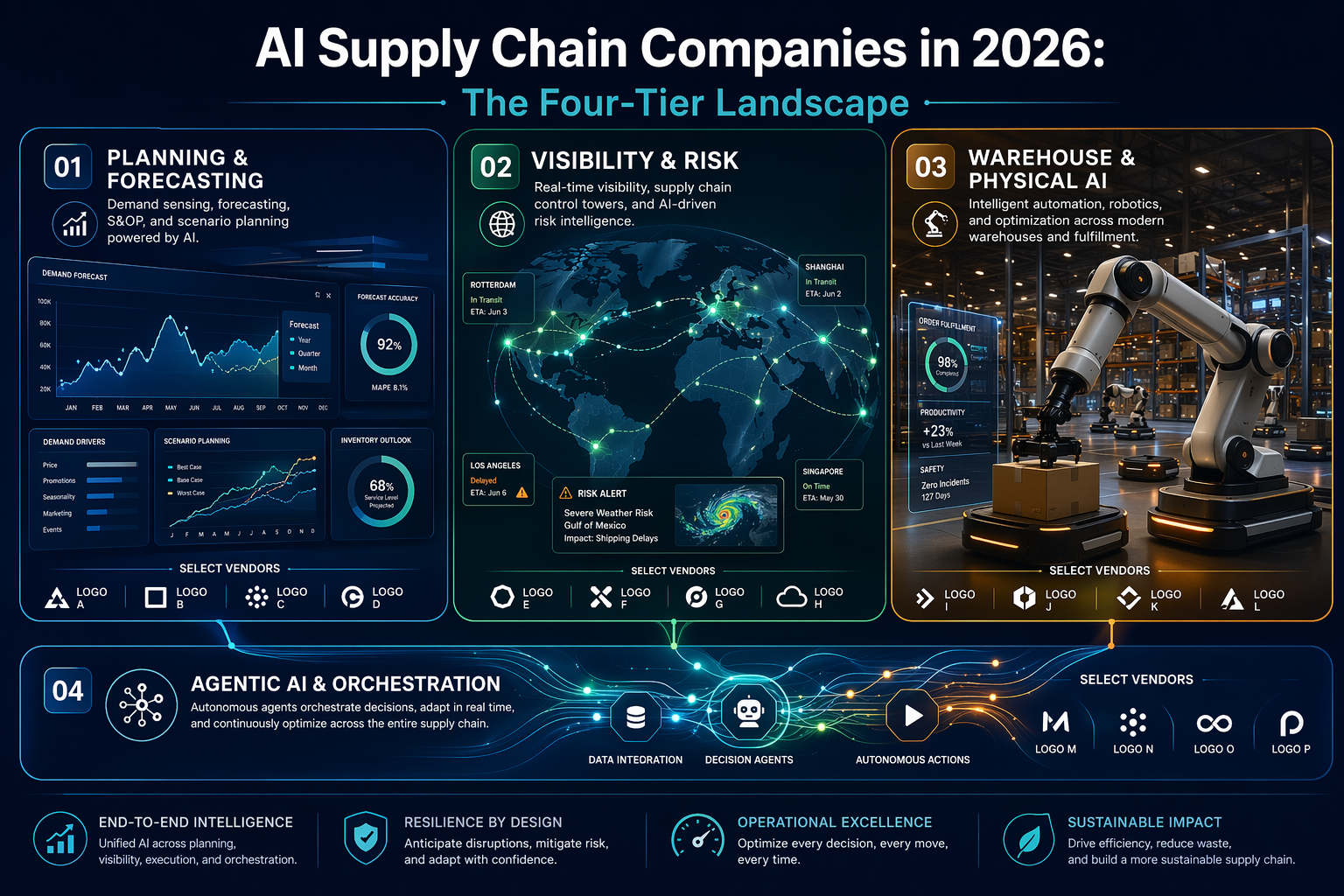
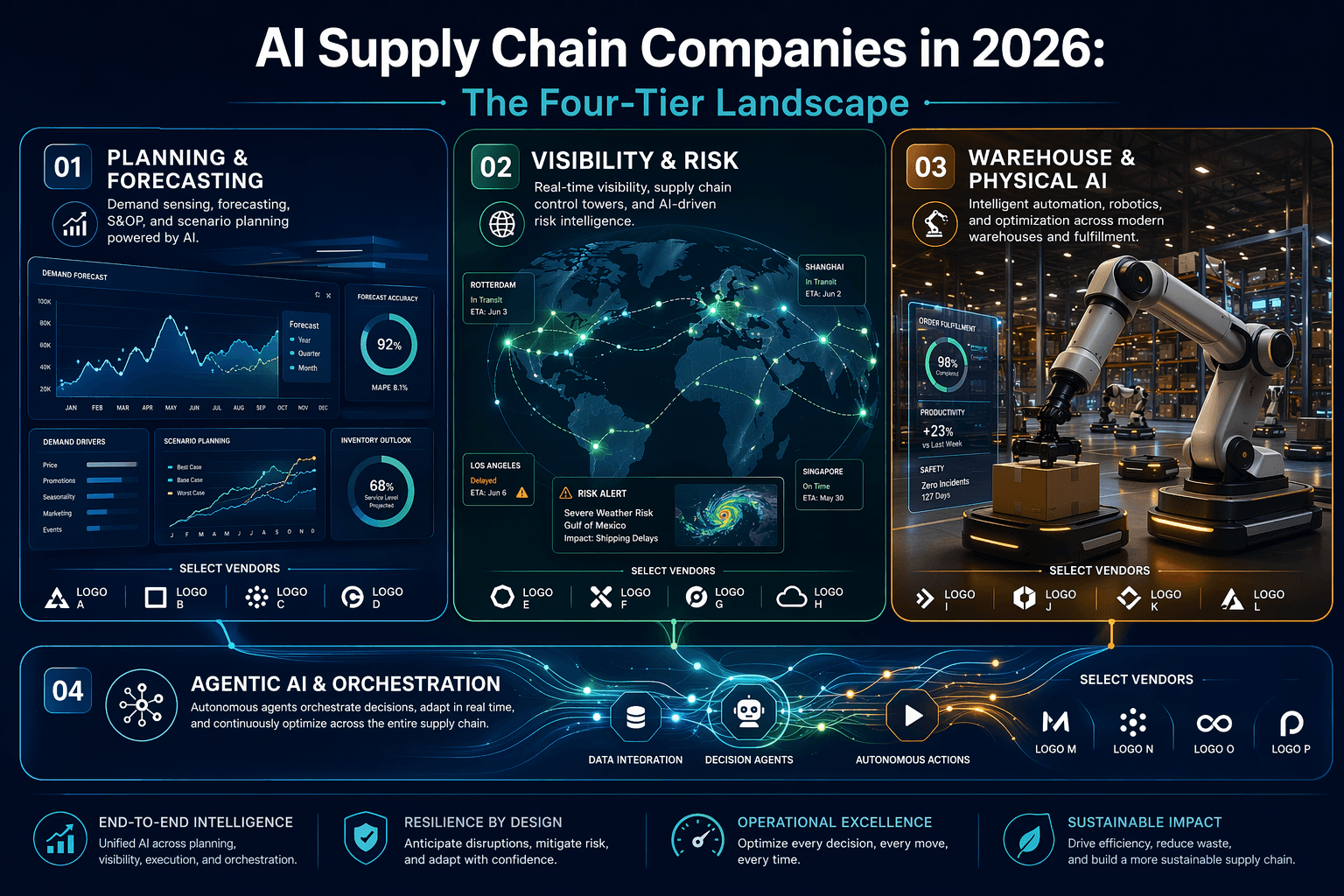
Why the Planning vs. Execution Distinction Matters
Every supply chain leader evaluating AI software faces a decision that no vendor deck will help them make: do you need a planning platform or an execution system? The two categories solve fundamentally different problems, require different data foundations, and — critically — are rarely interchangeable. Choosing the wrong one first is the most expensive mistake in the procurement cycle.
Planning-first platforms — o9 Solutions, Kinaxis, Blue Yonder (in its planning incarnation), SAP IBP, Relex, ToolsGroup, and Flowlity — focus on demand forecasting, inventory optimization, sales and operations planning (S&OP), and what-if scenario analysis. They consume historical transaction data, market signals, and promotion calendars to produce probabilistic recommendations about what to buy, make, and stock. They do not, however, move a single pallet, route a single truck, or direct a single robotic picker.
Execution-first systems — Manhattan Associates, Oracle WMS, Blue Yonder WMS, Zebra Technologies, Covariant, Vecna Robotics, and Nimble — manage physical operations: warehouse receiving and putaway, pick-and-pack workflows, yard management, transportation routing, and last-mile delivery. Their AI capabilities optimize throughput, labor allocation, and asset utilization in real time. They operate in the world of discrete events — a picker's next location, a truck's loading sequence, a conveyor belt's speed — not in the world of aggregate probability distributions.
Between these two tiers sits a growing visibility and orchestration layer — Altana, FourKites, Project44, Aera Technology, and E2open — that connects planning intent with execution reality without replacing either. These platforms provide multi-tier supplier mapping, real-time shipment tracking, risk monitoring, and decision augmentation across disconnected systems.
Planning-First AI Vendors: Capabilities, Customer Profiles, and Documented Outcomes
Planning-first platforms are the most visible category in the AI supply chain market, and they receive the bulk of analyst attention. But visibility does not equal interchangeability. These vendors differ significantly in AI maturity, target customer profile, and the depth of their planning capabilities.
The AI-Native Planning Specialists
o9 Solutions and Kinaxis are widely regarded as the leading AI-native planning platforms for complex enterprise environments. Both are pure planning layers — organizations deploying them still need separate warehouse management, order management, and transportation execution systems. According to a comparative analysis by Flowlity, o9 and Kinaxis are positioned as "AI-native platforms offering deep planning functionality for complex enterprise environments," but neither provides execution capabilities natively.
Kinaxis's Maestro platform, built on its concurrent planning engine, has demonstrated strong outcomes in complex manufacturing environments with multi-tier supplier networks. A documented case study from a pharmacy services company showed that after adopting Maestro, the organization achieved a 47% increase in forecast accuracy, a 14% reduction in on-hand inventory, and a 34% improvement in inventory turns within three months — shifting from a one-week to an 18-month planning horizon. These figures come from a vendor-reported case study and should be evaluated as such, but they represent the scale of improvement possible when planning AI is applied to an organization with clean data and a clear use case.
o9 Solutions focuses on integrated business planning (IBP) and demand sensing across retail, CPG, and manufacturing verticals. Its platform is designed for enterprises with complex product hierarchies and multi-echelon inventory optimization (MEIO) requirements. Like Kinaxis, o9 is a pure planning layer — users must integrate it with separate WMS, OMS, and execution systems to close the loop between plan and action.
The Legacy Suite Vendors
Blue Yonder, SAP IBP, and Oracle represent the legacy suite approach — planning capabilities embedded within broader ERP or supply chain suites. The Flowlity comparison analysis notes that these vendors "advertise AI capabilities but tend to have far fewer real AI-driven use cases in practice." Blue Yonder's customers reportedly "stick to traditional forecasting methods" and its "AI/ML promises often come with no technical detail or clear adoption." SAP IBP users expressed a desire that the platform "would be adaptable to emerging AI technologies," suggesting it has not integrated AI to the extent users expect.
G2 ratings from the same analysis provide directional indicators of user satisfaction: Flowlity leads at 4.9/5, followed by ToolsGroup at approximately 4.7/5, SAP IBP at 4.3/5, o9 at 4.2/5, Blue Yonder at 4.1/5, and Kinaxis at 4.0/5. These ratings should be treated as directional — G2 reviews can be incentivized — but the pattern is consistent: AI-native specialists score higher on user satisfaction than legacy suite vendors.
The AI-Niche Planning Vendors
Flowlity, ToolsGroup, Relex, and Lokad occupy the AI-niche segment — smaller, specialized platforms that focus on specific planning problems with deep AI integration. Relex is particularly strong in retail demand forecasting and promotion planning, while ToolsGroup and Flowlity target mid-market and enterprise organizations that need probabilistic forecasting without the complexity of a full-suite deployment. These vendors typically offer faster time-to-value and lower total cost of ownership than the enterprise suite players, but they lack the breadth of functionality that large, multi-national organizations may require.
| Vendor | Category | Target Customer | G2 Rating (Directional) | Key Differentiator |
|---|---|---|---|---|
| o9 Solutions | AI-Native Planning | Enterprise (Retail, CPG, Manufacturing) | 4.2/5 | Integrated business planning with MEIO; pure planning layer |
| Kinaxis | AI-Native Planning | Enterprise (Complex Manufacturing) | 4.0/5 | Concurrent planning engine; multi-tier supplier networks |
| Blue Yonder (Planning) | Legacy Suite | Enterprise (Multi-Industry) | 4.1/5 | Broad planning suite; acquisition-based architecture |
| SAP IBP | Legacy Suite | Enterprise (SAP Ecosystem) | 4.3/5 | Deep SAP integration; limited AI adaptability per users |
| Relex | AI-Niche | Mid-Market / Enterprise (Retail) | N/A | Retail demand forecasting and promotion optimization |
| ToolsGroup | AI-Niche | Mid-Market / Enterprise | ~4.7/5 | Probabilistic forecasting; faster time-to-value |
| Flowlity | AI-Niche | Mid-Market | 4.9/5 | AI-native demand planning; high user satisfaction |
For a deeper comparison of two leading planning platforms, see our Blue Yonder vs. Kinaxis comparison, which contrasts Blue Yonder's broad suite with Kinaxis's concurrent planning engine for enterprise buyers.
Execution-First AI Vendors: WMS, TMS, Robotics, and Last-Mile
Execution-first vendors address a fundamentally different problem: how to move physical goods through a facility or network with maximum efficiency. Their AI capabilities are embedded in warehouse management systems (WMS), transportation management systems (TMS), autonomous robots, and last-mile delivery optimization engines. These systems operate on real-time data — sensor feeds, location signals, order queues — and their outputs are discrete actions, not planning recommendations.
Warehouse Management and Fulfillment
Manhattan Associates is the most prominent example of a traditional WMS vendor that has evolved into an AI-powered execution platform. According to Viewpoint Analysis's independent buyer guide, Manhattan has "moved away from the traditional monolithic WMS model" toward "continuous, AI-assisted optimisation across the fulfilment network." The Landbase report describes Manhattan as offering "self-optimizing systems with agentic AI that act without human intervention." With $1 billion in annual revenue, Manhattan is the largest pure-play execution vendor in the market.
Nimble represents the autonomous fulfillment end of the execution spectrum. The company achieved a $1 billion valuation after a $106 million Series C round, and its fully autonomous warehouses have reduced fulfillment costs by 40%. Nimble's robots handle the entire pick-and-pack process without human intervention — a fundamentally different approach from the human-robot collaboration models used by most warehouse robotics vendors.
Covariant and Vecna Robotics focus on AI-powered robotic picking and material handling. Covariant's AI models learn from real-world picking data to handle diverse item types — a capability that traditional fixed-automation systems cannot match. Vecna Robotics provides autonomous mobile robots (AMRs) for pallet movement and case picking in distribution centers.
Transportation and Last-Mile
Transportation management is where AI has delivered some of the most measurable execution outcomes. According to the Deposco analysis, companies using AI in transportation have reported cost reductions of 5-10%, delivery reliability improvements of up to 20%, and logistics cost reductions of 15%. These figures come from aggregated industry data and should be treated as directional benchmarks rather than guaranteed outcomes.
Walmart's route optimization deployment provides a concrete example: the company eliminated 30 million driver miles and saved 94 million pounds of CO2 through AI-powered routing. This is a vendor-reported outcome from a named company, making it one of the more credible execution-side case studies available.
For a broader set of execution-side examples, see our article on AI logistics companies in action, which documents 10 real-world deployments with measured outcomes across transportation, warehousing, and last-mile delivery.
| Vendor | Execution Domain | AI Capability | Documented Outcome | Source Type |
|---|---|---|---|---|
| Manhattan Associates | WMS / Fulfillment | Agentic AI for self-optimizing fulfillment networks | $1B annual revenue; evolved from monolithic WMS | Independent analysis (Landbase, Viewpoint Analysis) |
| Nimble | Autonomous Fulfillment | Fully autonomous pick-and-pack robotics | 40% reduction in fulfillment costs | Vendor-reported (Landbase) |
| Covariant | Robotic Picking | AI models for diverse item handling | N/A (production deployments at scale) | Industry coverage |
| Vecna Robotics | Material Handling | Autonomous mobile robots for pallet/case movement | N/A | Industry coverage |
| Walmart (Route Optimization) | Transportation | AI-powered routing and load optimization | 30M driver miles eliminated; 94M lbs CO2 saved | Vendor-reported (Intellias) |
| Zebra Technologies | Warehouse Operations | Real-time tracking and workforce optimization | N/A | Industry coverage (monday.com) |
The Visibility & Orchestration Layer: A Third Category
Between planning and execution sits a growing category of platforms that neither forecast demand nor move goods — they connect, monitor, and augment decisions across the systems that do. These visibility and orchestration tools address a pain point that pure planning and pure execution vendors cannot solve: the gap between what was planned and what is actually happening in the supply chain.
Aera Technology is the clearest example of this category. According to Viewpoint Analysis, Aera is a "Decision Intelligence platform" that "sits on top of existing ERP and supply chain systems and uses AI to augment and automate decisions" without replacing existing tools. This is a fundamentally different value proposition from either planning or execution vendors — Aera does not compete with o9 or Manhattan; it complements them by providing a cross-system decision layer that can detect anomalies, recommend actions, and, in some configurations, execute those actions autonomously.
Altana has built the most ambitious supply chain mapping platform in the market. With a $322 million Series C that gave it unicorn status, Altana has mapped 2.8 billion shipments and 500 million companies to create a multi-tier visibility graph that spans raw material suppliers through to end customers. For organizations that cannot see beyond their direct suppliers, Altana provides the upstream visibility that planning and execution systems lack.
FourKites and Project44 compete in the real-time shipment tracking space. FourKites tracks more than 3 million shipments per day across 6,000-plus data points and 18 million ETAs. Project44 tracks 1.5 billion-plus shipments annually over 1,400-plus carrier integrations. Both platforms provide the execution visibility that planning systems need to validate their assumptions — if a shipment is delayed, the planning system needs to know in time to adjust inventory policies, not after the fact.
E2open rounds out this category with a broader orchestration platform that connects planning, procurement, logistics, and channel data across trading partner networks. Unlike Aera, which positions itself as a decision intelligence overlay, E2open provides a more traditional multi-enterprise supply chain network with AI-powered analytics and exception management.
| Vendor | Core Capability | Scale / Funding | Differentiator |
|---|---|---|---|
| Aera Technology | Decision intelligence overlay on existing systems | N/A (private) | Augments decisions without replacing planning or execution tools |
| Altana | Multi-tier supply chain mapping and visibility | $322M Series C (unicorn) | 2.8B shipments mapped; 500M companies in graph |
| FourKites | Real-time shipment tracking and ETAs | N/A (private) | 3M+ shipments/day; 18M ETAs; 6,000+ data points |
| Project44 | Real-time shipment visibility and carrier integration | N/A (private) | 1.5B+ shipments/year; 1,400+ carrier integrations |
| E2open | Multi-enterprise supply chain orchestration | Public (NYSE: ETWO) | Broad network connecting planning, procurement, logistics |
How the Lines Are Blurring: Vendors That Span Multiple Categories
The clean three-category framework has one complication: some vendors operate in multiple categories. Blue Yonder is the most prominent example. The company offers both planning capabilities (demand forecasting, inventory optimization, S&OP) and execution capabilities (WMS, TMS, warehouse labor management). According to the Deposco analysis, Blue Yonder's platform "reflects its acquisition history" with "multiple codebases acquired over years." This architectural reality means that while Blue Yonder can theoretically provide an end-to-end planning-to-execution stack, the integration between its planning and execution modules may not be as seamless as a unified platform would suggest.
Manhattan Associates has moved in the opposite direction — from execution-only to execution-plus-intelligence. Its traditional WMS strength has been augmented with AI-powered optimization across the fulfillment network, and the company now describes its platform as offering "agentic AI" capabilities that can act without human intervention. However, Manhattan does not provide planning capabilities in the o9 or Kinaxis sense; its AI is focused on execution optimization, not demand forecasting or inventory policy optimization.
Oracle and SAP also span categories through their broader ERP suites. Oracle offers more than 50 embedded generative AI capabilities within its Fusion Cloud Applications, including item description support and supplier recommendations. SAP is integrating its Joule AI assistant throughout its cloud solutions, with availability in spend management software. However, both companies' supply chain AI capabilities are embedded within much larger ERP ecosystems, which means the depth of AI functionality in any specific planning or execution domain may be less than what a specialized vendor provides.
Decision Framework: Which Category Do You Need First?
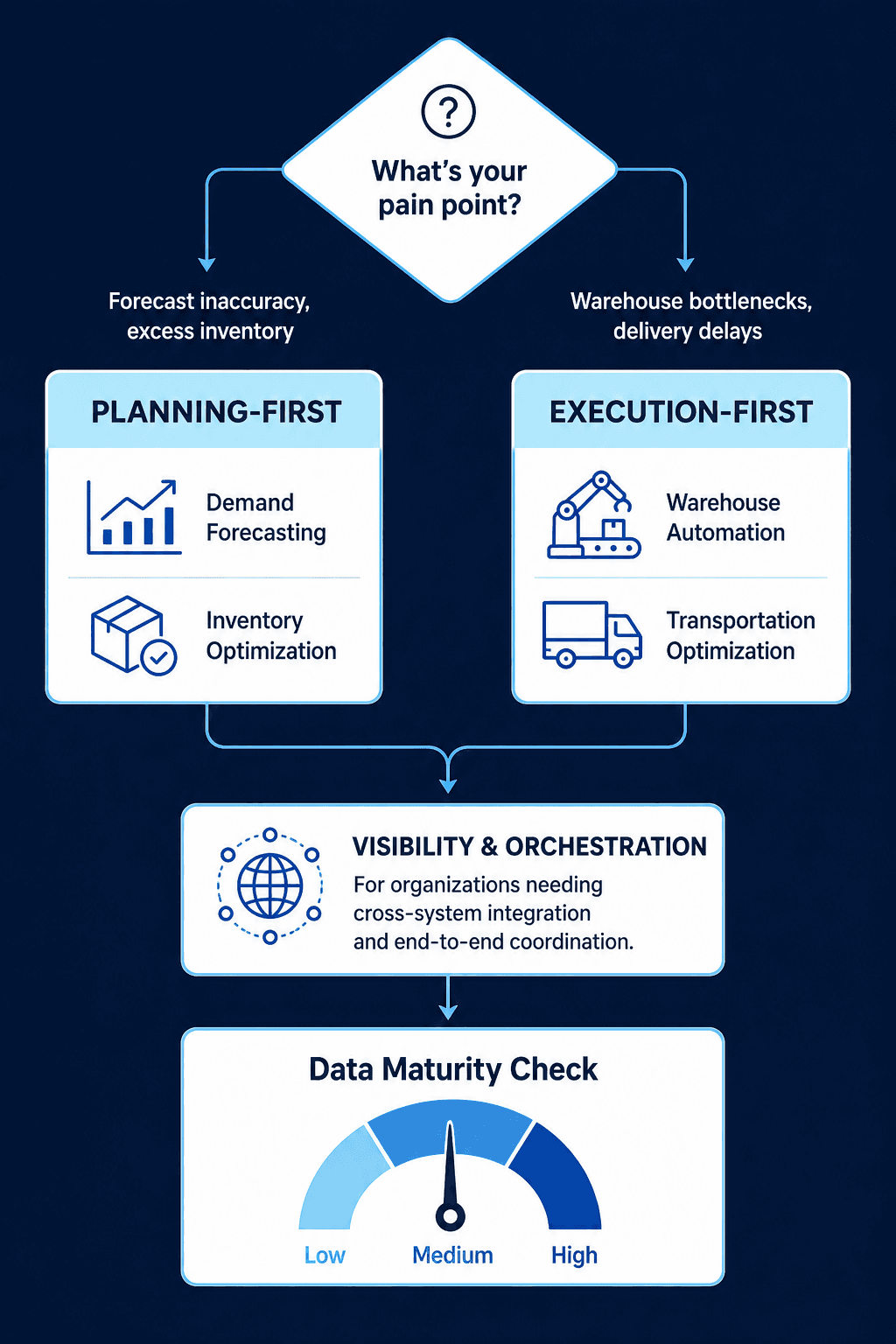
The choice between planning-first, execution-first, and visibility-first depends on two factors: your primary operational pain point and your organization's data maturity. Gartner's 2026 CSCO Roadmap emphasizes that "most supply chain organizations lack a clear foundation" for AI and that "building a supply chain AI foundation is not about deploying tools, it's about shaping the operating model, upskilling teams and governing data for scale and trust." This is not a trivial prerequisite — it determines which category of AI investment will actually deliver measurable value.
Use the following questions to self-diagnose your starting point:
- Is your core problem forecast accuracy and inventory turns? If your primary metric is forecast error, inventory carrying cost, or working capital efficiency, start with a planning-first platform. These metrics are driven by demand signal processing, not by warehouse throughput.
- Is your core problem warehouse throughput and delivery reliability? If your primary metric is orders shipped on time, labor productivity, or freight cost per unit, start with an execution-first system. No planning platform can fix a slow warehouse or an inefficient route network.
- Do you lack visibility beyond your direct suppliers or customers? If you cannot see upstream disruptions or downstream inventory positions, a visibility platform may deliver faster ROI than either planning or execution investments. Altana, FourKites, or Project44 can provide the data foundation that planning and execution systems need to operate effectively.
- What is your data maturity level? Gartner's roadmap recommends assessing AI maturity using frameworks like Gartner's AI Maturity Model before making any category decision. Organizations with fragmented master data, manual data entry, or limited data governance should invest in data foundation work before deploying AI in any category.
- What is your tolerance for implementation complexity? Planning platform implementations typically run 6-18 months, according to the Deposco analysis, and license fees represent just 20-30% of true total cost of ownership (TCO). Execution system deployments can be faster but require physical infrastructure changes. Visibility platforms generally offer the fastest time-to-value.
McKinsey research cited in the Deposco analysis found that companies with integrated data foundations spanning planning, execution, and analytics deliver 2-3 times greater ROI than disconnected solutions. This suggests that the ideal sequence is not planning-first or execution-first in isolation, but rather a deliberate path that builds data maturity before layering AI capabilities across both categories.
For a deeper understanding of where your organization stands on the AI maturity curve, see our analysis of Gartner's 2025 supply chain AI maturity data, which breaks down where enterprises actually stand on deployment maturity and what that means for vendor selection.
Vendor Summary Table by Category
The following table provides a quick-reference summary of all vendors covered in this article, grouped by architectural category. Use it as a starting point for building your shortlist, but always validate current capabilities against vendor documentation and peer references before making procurement decisions.
| Category | Vendor | Primary Function | Target Company Size | Deployment Model | Key Differentiator |
|---|---|---|---|---|---|
| Planning-First | o9 Solutions | Integrated business planning, MEIO, demand sensing | Enterprise | Cloud SaaS | AI-native planning; pure planning layer |
| Planning-First | Kinaxis | Concurrent planning, what-if analysis, S&OP | Enterprise | Cloud SaaS | Multi-tier supplier network planning |
| Planning-First | Blue Yonder (Planning) | Demand forecasting, inventory optimization, S&OP | Enterprise | Cloud SaaS / Hybrid | Broad planning suite; acquisition-based architecture |
| Planning-First | SAP IBP | Integrated business planning | Enterprise | Cloud SaaS | Deep SAP ecosystem integration |
| Planning-First | Relex | Retail demand forecasting, promotion planning | Mid-Market / Enterprise | Cloud SaaS | Retail-specialized AI forecasting |
| Planning-First | ToolsGroup | Probabilistic forecasting, inventory optimization | Mid-Market / Enterprise | Cloud SaaS | Faster time-to-value; AI-native |
| Planning-First | Flowlity | AI-native demand planning | Mid-Market | Cloud SaaS | High user satisfaction (4.9 G2) |
| Execution-First | Manhattan Associates | WMS, fulfillment optimization, agentic AI | Enterprise | Cloud SaaS / On-Premise | Evolved from WMS to AI-powered execution |
| Execution-First | Nimble | Autonomous fulfillment robotics | Enterprise | Hardware + SaaS | 40% fulfillment cost reduction |
| Execution-First | Covariant | AI robotic picking | Enterprise | Hardware + SaaS | Diverse item handling via AI models |
| Execution-First | Vecna Robotics | Autonomous mobile robots | Enterprise | Hardware + SaaS | Pallet and case movement AMRs |
| Execution-First | Zebra Technologies | Real-time tracking, workforce optimization | Mid-Market / Enterprise | Hardware + SaaS | Warehouse operations visibility |
| Visibility / Orchestration | Aera Technology | Decision intelligence overlay | Enterprise | Cloud SaaS | Sits atop existing systems; no replacement |
| Visibility / Orchestration | Altana | Multi-tier supply chain mapping | Enterprise | Cloud SaaS | 2.8B shipments mapped; unicorn status |
| Visibility / Orchestration | FourKites | Real-time shipment tracking | Enterprise | Cloud SaaS | 3M+ shipments/day; 18M ETAs |
| Visibility / Orchestration | Project44 | Real-time shipment visibility | Enterprise | Cloud SaaS | 1.5B+ shipments/year; 1,400+ carriers |
| Visibility / Orchestration | E2open | Multi-enterprise supply chain orchestration | Enterprise | Cloud SaaS | Broad trading partner network |
| Hybrid (Planning + Execution) | Blue Yonder (Full Suite) | Planning + WMS + TMS | Enterprise | Cloud SaaS / Hybrid | Spans categories; acquisition-based architecture |
| Hybrid (Execution + Intelligence) | Oracle | WMS + TMS + 50+ GenAI capabilities | Enterprise | Cloud SaaS / On-Premise | Embedded in broader ERP suite |
| Hybrid (Execution + Intelligence) | SAP | WMS + TMS + Joule AI assistant | Enterprise | Cloud SaaS / On-Premise | Embedded in broader ERP suite |
Comments
Join the discussion with an anonymous comment.