
Once Cape of Good Hope routing becomes the planning lane instead of the exception lane, an ocean shipment stops being a milestone-tracking problem. The container is not just late. It is carrying a new transit-time assumption, a different freight-cost base, a higher probability of bunching at downstream ports, and a routing decision that may need an insurance signoff before anyone can act on it.
For Asia-Europe cargo, the Bab al-Mandab disruption has added 10–14 days to transit times, while freight rates have sat 25–40% above pre-crisis baselines, according to Suaid Global’s 2026 Red Sea shipping analysis.[1] That is enough time to miss a promotion window, trigger safety-stock drawdowns, push detention and demurrage risk into a different week, and turn a standard exception call into a negotiation between transportation, inventory planning, customer service, finance, and insurance.

That is the practical entry point for using AI to manage supply chain disruption from a Bab al-Mandab Strait closure: not whether AI can make the Red Sea safe, and not whether a dashboard can show another vessel icon. The useful question is whether a team can identify an at-risk shipment two or three weeks before its original ETA and decide, with enough confidence, whether to absorb the delay, split the order, expedite part of it, reroute future bookings, or reset the customer promise before the customer discovers the problem first.
Why standard tracking breaks down
Traditional ocean visibility usually answers the last-known-status question. It tells a coordinator that a container departed, transshipped, rolled, arrived, gated out, or missed a milestone. During normal volatility, that is annoying but workable. During a sustained Bab al-Mandab closure, it is too slow because the important decision sits upstream of the event record.
The shipment that matters is often still afloat, still outside the destination port’s appointment window, and still far enough from the customer promise date that a choice exists. The question is not “Where is it?” in isolation. It is: “Given the Cape route, weather, vessel behavior, downstream port congestion, carrier schedule changes, available alternatives, and insurance constraints, which shipments are likely to become expensive exceptions if we do nothing?”
Siloed status feeds make that question painful. A transportation manager may have AIS position data in one place, carrier notices in another, purchase-order criticality in the TMS or ERP, yard appointment risk in a terminal or drayage feed, and insurance guidance sitting in email. If four systems disagree before the weekly exception call, the team spends the first half of the meeting reconciling data and the second half choosing from options that may already be stale.
What AI visibility adds when the lane is unstable
The better AI visibility platforms do not create value by adding more dots to a map. They create value by fusing different signals into a forward ETA and then ranking the exceptions that deserve human attention.
Portcast describes its predictive ocean visibility model as combining satellite data with more than 200 data sources, including vessel-positioning signals, port and carrier data, and other logistics indicators used to forecast ocean ETAs.[2] Sensos likewise frames geopolitical supply chain stabilization around the use of signals such as satellite positioning, weather, port conditions, carrier movement, and risk-related feeds to support more adaptive routing decisions.[3]
| Signal | What it changes operationally |
|---|---|
| Satellite AIS positioning | Shows whether the vessel is actually following the expected Cape routing, slowing, waiting, or deviating from the assumed path. |
| Marine weather | Adjusts transit assumptions when weather around the Cape or onward lanes makes schedule padding too optimistic. |
| Port congestion indicators | Moves the ETA beyond vessel arrival by estimating the practical risk of waiting, berthing delay, discharge delay, or appointment compression. |
| Carrier schedule changes | Catches blank sailings, skipped calls, transshipment changes, and rolled cargo before they appear as late milestones. |
| War-risk insurance and routing constraints | Filters out options that look good on transit time but may not be acceptable for the carrier, cargo type, policy, or customer contract. |
The fusion matters because no single feed is reliable enough on its own. AIS can show vessel behavior, but it does not tell a planner whether the receiving DC can absorb the new arrival week. A carrier schedule can show a planned call, but not whether port congestion has made that call operationally useful. A port-congestion signal can warn of delay, but not whether the inventory behind that container is critical enough to justify intervention. The AI layer is useful only when it connects these signals to the shipment record and the business rule that says whether anyone should act.
Portcast’s Red Sea disruption material gives a concrete benchmark: the company reported achieving ETA accuracy within +1.5 days for a prediction made three weeks ahead by combining satellite, weather, port-congestion, and carrier-schedule data.[2] That is the kind of number that can change behavior. A three-week-ahead signal does not need to be perfect; it needs to be good enough to move a shipment from “watch” to “decide” while there is still room to change the plan.
The shipment-level decision workflow
A predictive ETA is not the decision. It is the trigger. The decision has to survive cost, capacity, criticality, and insurance checks. Otherwise, AI simply produces faster anxiety.
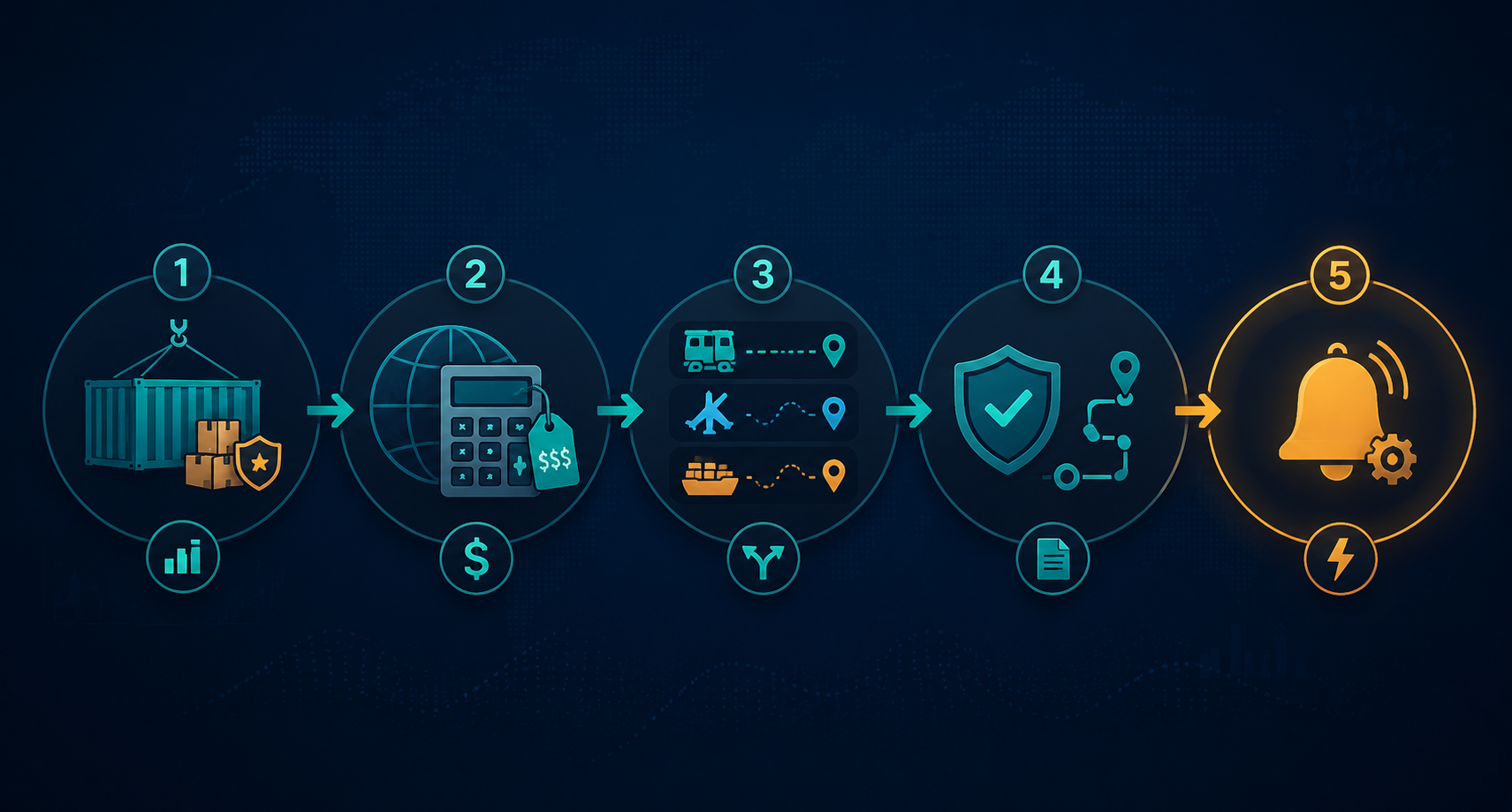
The useful workflow for an at-risk container is compact:
- Classify shipment criticality.
- Re-run landed cost using the Cape delay and premium.
- Compare feasible alternatives, not theoretical ones.
- Check insurance, routing, and carrier constraints.
- Trigger the exception response and update the customer promise.
Classify criticality before talking about expediting
The first split should be business criticality, not lateness. A shipment can be late and still not deserve intervention. Another shipment can be only moderately delayed and still matter because it feeds a production line, a launch, a contractual delivery window, or a customer account with penalties.
The AI platform can flag the ETA risk, but the company has to supply the criticality rules. Typical inputs include order priority, inventory on hand, available substitutes, margin, customer commitment, penalty exposure, and whether the SKU is replenishable within the new lead time. Without those rules, the exception queue becomes a ranked list of late freight rather than a ranked list of business risk.
Re-run landed cost with the Cape premium
The Cape routing premium should be pushed into the shipment economics before anyone approves a rescue move. The extra 10–14 transit days and 25–40% freight-rate increase are not abstract network averages once they touch a specific purchase order.[1] They affect inventory carrying cost, working-capital timing, detention and demurrage exposure, customer penalties, and the threshold at which air, sea-air, or transpacific-plus-rail starts to make sense.
This is where many teams lose time. They know the shipment is late, but the cost model still reflects the booking assumption made before the diversion. A useful visibility workflow recalculates the expected landed-cost picture as the ETA changes, so the exception owner is not making an expedite decision against a stale baseline.
Compare alternatives that can actually move
Alternative routing has to be treated as a constrained choice, not a menu. Sea-air may work for selected high-margin or time-sensitive cargo, but not for broad volume. Transpacific routing with inland rail may protect some US East Coast commitments, but capacity, handoff reliability, customs timing, and domestic congestion can erase the advantage. Air freight may protect a launch quantity, while the balance of the order stays on the water.
A good AI recommendation should therefore separate the shipment into practical outcomes: leave as planned, monitor, split, expedite a partial quantity, reroute future bookings, or renegotiate the delivery promise. The recommendation is stronger when it includes the reason an option was rejected. “No viable sea-air capacity” is more useful than a ranked route that no forwarder can execute.
Treat insurance as routing logic
War-risk insurance is not an after-the-fact compliance note. Coverage can vary by carrier, route, cargo type, and policy terms, and it can invalidate a routing option that looks attractive in a transit-time comparison. If the insurance condition sits outside the decision workflow, the team may spend hours building a recovery plan that legal, risk, or the carrier will not approve.
The practical standard is simple: no recommended route should reach execution until the insurance and routing constraints have been checked against the actual shipment profile. That includes the cargo, the carrier, the lane, the customer contract, and any route-specific exclusions or premiums known at the time of decision.
Trigger the exception response
The final output should not be a red icon. It should be a work instruction: hold, monitor, split, expedite, reroute the next booking, update the ETA promise, or escalate to customer service and commercial leadership. The owner should know what changed, when the recommendation expires, which assumption would flip the decision, and who needs to approve the cost.
That is where elapsed decision time becomes the real KPI. If the platform identifies a likely delay three weeks ahead but the organization spends ten days debating whether the shipment is important, the model did its job and the process failed.
Where the savings actually come from
The strongest savings case is usually not that AI finds a magical cheap route around a closed chokepoint. The savings come from earlier exception selection, fewer manual status reconciliations, fewer avoidable terminal charges, and fewer panic expedites approved after the useful decision window has closed.
Portcast reports that shippers using predictive visibility during Red Sea disruption reduced detention and demurrage charges by 15% and lowered expedited freight costs by 5%.[2] Siemens’ digital logistics material also cites an 80% reduction in manual data-update hours in the context of smarter sea-freight visibility and AI-supported logistics operations.[4] These are vendor-reported outcomes, not independently audited cross-market benchmarks, so they should be read as evidence of what a well-integrated deployment can produce rather than a guaranteed result for every shipper.
| Reported outcome | Operational interpretation | Important caveat |
|---|---|---|
| 15% lower detention and demurrage charges | Earlier ETA and congestion signals give teams more time to adjust appointments, drayage, documentation, and exception handling. | Vendor-reported by Portcast; results depend on terminal, drayage, and internal execution quality. |
| 80% fewer manual data-update hours | Coordinators spend less time reconciling carrier notices, vessel positions, and shipment records by hand. | Cited in Siemens digital logistics material; not a universal labor benchmark. |
| 5% lower expedited freight costs | Earlier classification can prevent unnecessary expedites and reserve premium moves for shipments with real business exposure. | Vendor-reported by Portcast; savings depend on criticality rules and available alternatives. |
The manual-hours reduction matters more than it may look on an executive slide. During a disruption, transportation teams often burn scarce time validating whether a shipment is truly late, whether the carrier notice is current, whether the vessel has already changed behavior, and whether the customer-facing ETA is still defensible. Compressing that work does not just save labor; it moves the decision earlier.
How the vendor landscape fits the use case
The useful comparison is not which vendor has the broadest crisis vocabulary. It is which capability anchors the decision process.
- Portcast is most relevant here for predictive ocean visibility and the reported +1.5-day ETA accuracy on a three-week-ahead Red Sea disruption prediction.[2]
- project44 positions its Disruption Management Agent around broad disruption identification, citing 8B+ data sources, 120+ risk categories, 75% faster disruption identification, and 40% disruption-related cost savings.[5]
- Everstream Analytics emphasizes a model that combines AI signals with human expert validation for maritime and geopolitical risk monitoring.[6]
Those claims are not interchangeable. Predictive ocean ETA accuracy helps the coordinator decide which containers are moving into exception status. Broad disruption identification helps a control tower detect that a lane, supplier, port, or risk category is changing. Human validation helps when geopolitical signals are ambiguous or when automated alerts need judgment before they reach operations. The Bab al-Mandab use case often needs all three layers, but the shipment-level decision still depends on whether the platform connects to the company’s orders, inventory, carrier data, and cost rules.
Conditions that determine whether AI helps
The difference between a useful AI visibility deployment and another noisy control-tower screen usually comes down to four conditions.
- Data integrations have to reach the shipment and order level, not stop at vessel tracking.
- Criticality rules have to be explicit enough to separate late freight from business-critical freight.
- Alternative modes have to be checked against capacity, cost, cargo suitability, and realistic execution windows.
- Insurance and routing constraints have to be part of the recommendation logic before approval.
If those conditions are weak, the platform may still improve visibility, but it will struggle to improve decisions. A better ETA without a criticality rule creates a longer exception list. A routing suggestion without capacity validation creates false options. A cost comparison without insurance review can collapse at approval. A disruption alert that does not update the customer promise simply leaves customer service to absorb the surprise later.
AI visibility tools cannot remove the Bab al-Mandab risk, and they cannot make Cape of Good Hope routing cheap. Their value is narrower and more useful: they compress the time between signal and decision, reduce avoidable charges, and help teams spend intervention money on the shipments that justify it. In Q3 2026, with the situation around Red Sea and adjacent maritime risk still fluid, that narrower promise is the one worth testing.
References
- Red Sea Shipping Crisis 2026: Impact on Your Supply Chain, Suaid Global
- Shippers' Relief: How Predictive Visibility Has Helped Tackle Red Sea Shipment Delays, Portcast
- Navigating Geopolitics and AI | Stabilizing Supply Chains in Turbulent Times, Sensos.io
- When sea freight gets smarter: How AI is turning supply chain chaos into competitive advantage, Siemens
- Disruption Management Agent, project44
- Are You Prepared for the Supply Chain Disruptions of 2026?, Everstream Analytics
Comments
Join the discussion with an anonymous comment.