
A drone threat near a shipping lane, port, warehouse, or logistics corridor is not yet a supply chain decision. It becomes one only when someone can connect the threat to a vessel, a lane, a shipment, a facility, an allocation, or a customer promise. That is where AI supply chain risk management for drone attacks becomes a practical question rather than a security headline: can the system tell the planning team what is exposed early enough to change the plan?
The answer is qualified. Predictive AI risk monitoring can create useful warning time when it ingests external threat intelligence, scores risk against specific supply chain assets, pushes alerts into the workflows operators already use, and models how a disruption will propagate through inventory, routing, and service commitments. It does not stop a drone. It does not replace physical counter-drone systems. Its value is narrower and more operational: it gives the logistics organization a better chance to act before a security event hardens into a missed sailing, a closed lane, a stockout, or a customer escalation.
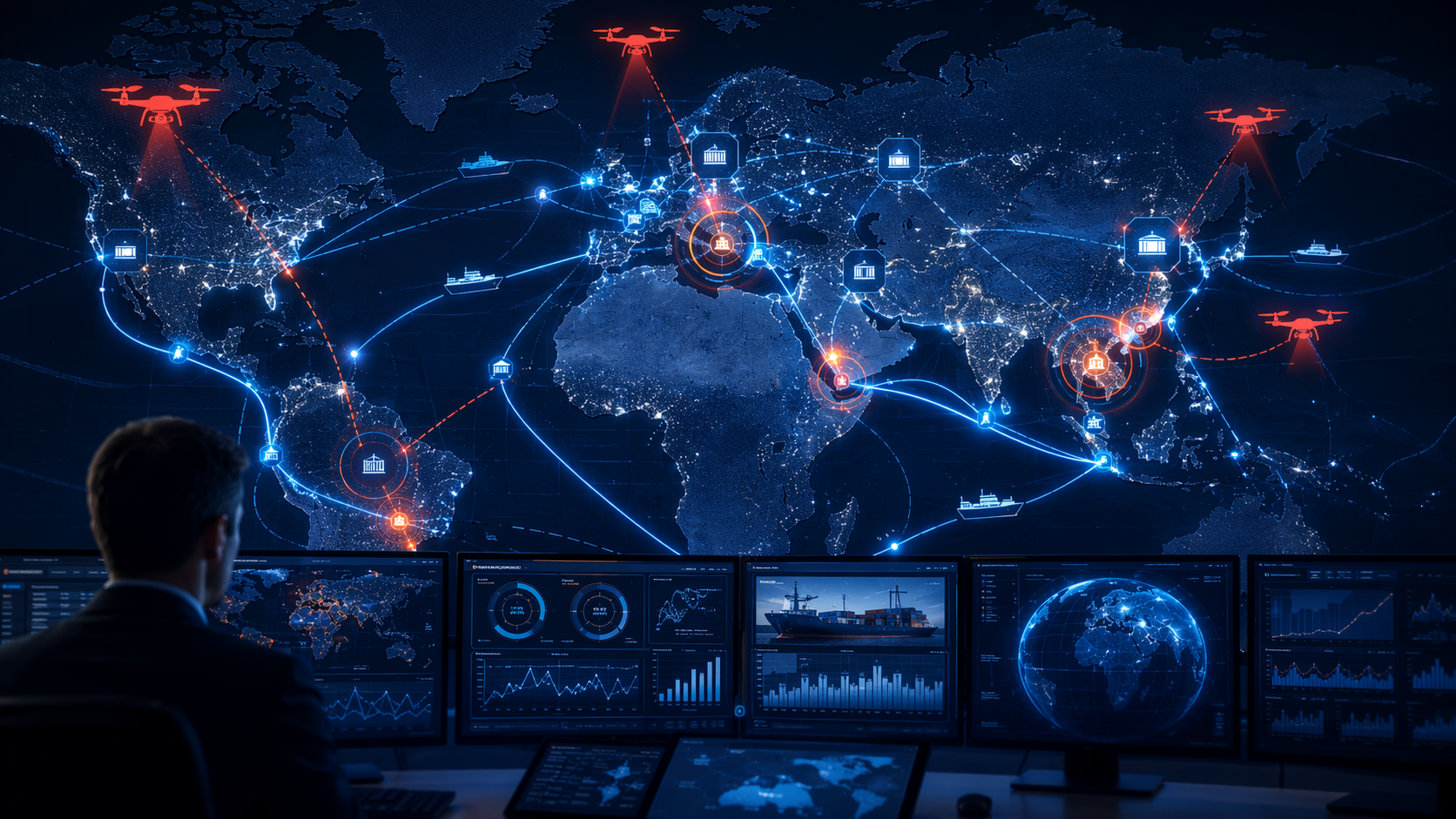
The Red Sea turned drone risk into a network problem
The Red Sea crisis is the cleanest recent example because it removed any comfortable boundary between security monitoring and supply chain planning. By October 2024, Houthi forces had carried out more than 190 drone and missile attacks on commercial shipping, according to the Atlas Institute. The same source reports that Suez Canal transit volume fell 57.5%, while the affected chokepoint normally carried about 12% of global trade.[1]
Those figures matter less as geopolitical color than as operating proof. A route that many networks had treated as available by default suddenly became conditional. Carriers, forwarders, importers, and manufacturers had to decide whether to keep using a threatened corridor, accept longer diversions, rebook freight, adjust production plans, or explain to customers why goods were late. Atlas Institute also describes production halts cascading across automotive, electronics, and agriculture sectors as the disruption spread beyond the immediate maritime theater.[1]
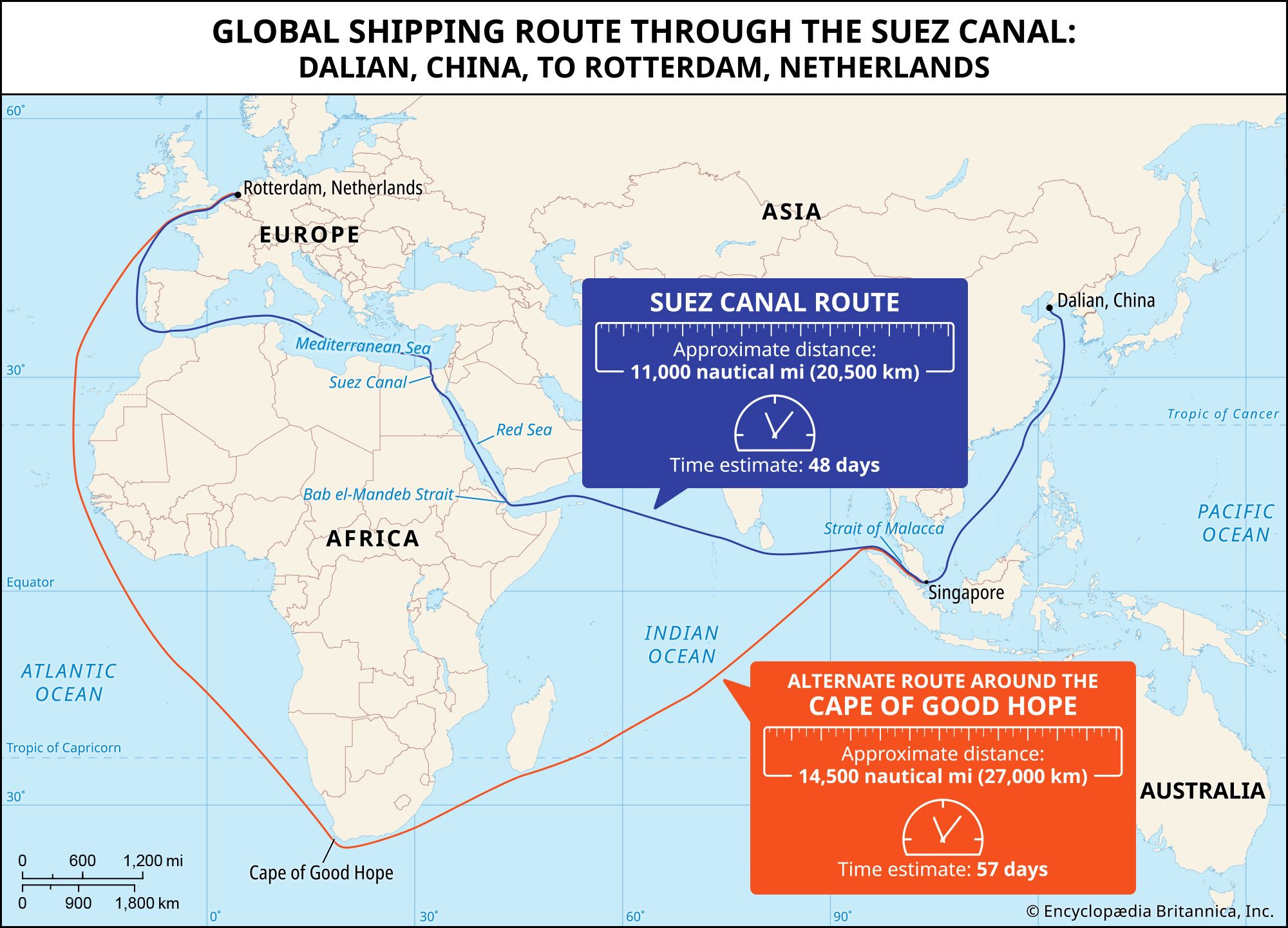
The hard part was not knowing that attacks had occurred. By the time a carrier advisory, news alert, or port notice reached a control tower, everyone could see that the threat existed. The harder question was which orders, SKUs, suppliers, distribution centers, and customer commitments were now inside the blast radius of delay. A warning that says “heightened Red Sea risk” may be accurate, but it leaves the planner holding the actual decision.
That is why the Red Sea case belongs at the center of any serious discussion of AI risk monitoring for drone attacks. The attacks were physical, but the consequence was systemic. Once a chokepoint is stressed, the disruption travels through booking queues, transit times, container availability, production schedules, safety stock assumptions, and customer-service dates. Monitoring that stops at incident awareness is too late for many of the decisions that matter.
Why traditional monitoring leaves planners with too much interpretation
Traditional supply chain risk monitoring tends to be site-bound and reactive. A company may have good security controls at a plant, solid carrier milestone visibility, and a team watching alerts from insurers, governments, news feeds, or logistics providers. Those inputs are useful, but they often arrive as separate signals. A maritime alert sits in one place, shipment ETAs in another, inventory projections in another, and customer commitments somewhere else.
That fragmentation creates a familiar failure mode. The alert is circulated. People agree the risk is real. Then someone still has to manually determine which lanes are affected, whether the inventory buffer is enough, whether a supplier shipment can be accelerated, whether a customer order should be protected, and whether the cost of rerouting is justified. The organization has information, but not yet a decision path.
TraxTech frames the economic case sharply, estimating $420 billion in annual avoidable supply chain losses from outdated detection methods. That is a vendor-sourced figure, so it should not be treated as a neutral industry benchmark. Still, it points to the right operational problem: losses accumulate when companies detect disruptions after the feasible response window has narrowed.[2]
Drone threats make this gap more visible because they can affect infrastructure without starting inside the company’s own fence line. A warehouse may be secure, but its inbound lane may depend on a port under threat. A plant may be operating normally, but its critical component may be on a vessel whose route is about to change. A carrier may still show a shipment as moving, even while the risk environment around the next chokepoint has changed.
What AI risk monitoring has to do before it deserves attention
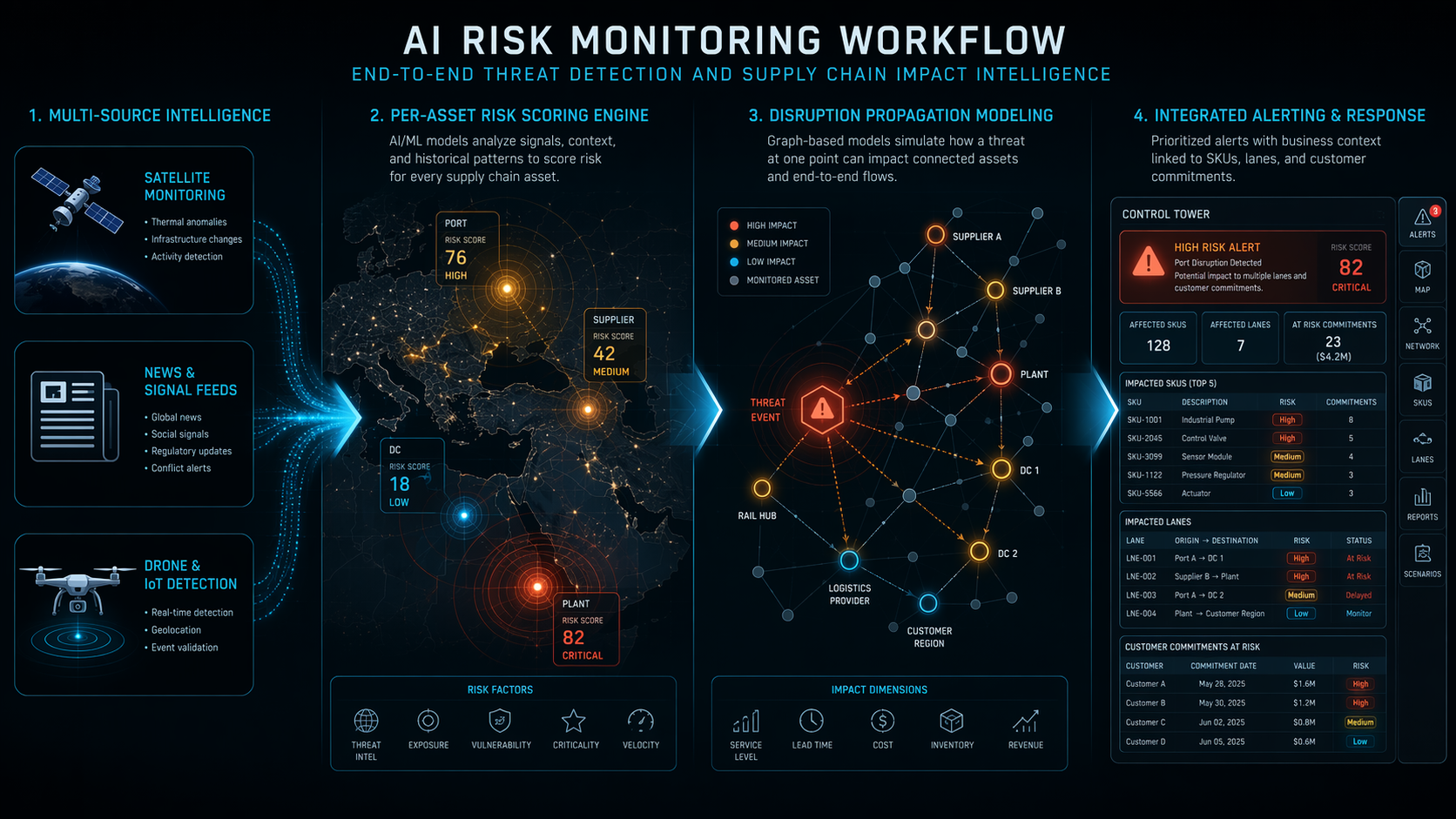
The useful version of AI risk monitoring is not a dramatic map with red icons. It is a workflow that turns external threat signals into ranked operational exposure. For drone-related supply chain risk, that workflow has four jobs: ingest threat intelligence, map it to assets and lanes, score exposure fast enough to act, and model the downstream consequences.
1. Ingest threat intelligence without making the operator hunt for it
Drone risk signals can come from conflict reporting, maritime advisories, airspace violations, port notices, government warnings, media reports, and specialized intelligence feeds. AI does not make those sources automatically true. Its first practical role is to normalize the signals, remove duplication, classify the event type, locate it, and keep it close enough to live operations that it can be used.
This is where vague early warning starts to become usable. An alert that says a drone incident occurred near a port is less valuable than an alert that recognizes the affected geography, identifies the nearby lanes or facilities, and checks whether the company has freight, inventory, suppliers, or customer commitments connected to that area.
2. Score risk against assets, not headlines
Per-asset scoring is the architectural shift that separates a general threat feed from supply chain risk management. TraxTech describes models that apply real-time risk scoring to individual assets within defined geographic radiuses, moving away from legacy site-by-site assessments that it says can cost more than $100,000 per year per site. The same source claims per-asset AI pricing can reduce cost by up to 90%.[2]
Those cost claims come from a vendor and should be evaluated in procurement against actual scope, integration effort, data readiness, and operating coverage. The more important design point is the unit of analysis. A port-level risk score is useful. A shipment-level or facility-level exposure score is more useful. A score tied to an SKU, a customer order, and an alternate route is where the alert begins to affect work.
| Monitoring question | Weak answer | Operationally useful answer |
|---|---|---|
| Where is the drone threat? | Near a conflict zone or maritime corridor | Inside a defined radius of a lane, port, vessel, supplier, facility, or warehouse used by the network |
| What is exposed? | A region or trade route | Specific shipments, SKUs, facilities, purchase orders, and customer commitments |
| Who needs the alert? | Security or risk team only | Control tower, transportation, inventory planning, procurement, customer service, and executive escalation owners |
| What can change? | General awareness | Rerouting, booking changes, inventory pulls, supplier expediting, allocation decisions, and customer communication |
3. Push alerts into the systems where decisions are made
An alert that stays inside a standalone risk portal often becomes another tab that someone checks after the problem has matured. For supply chain teams, the stronger design is embedded alerting inside a control tower, transportation management system, shipment visibility platform, supplier portal, or planning workflow. The person who can act should not have to translate a security map into an order list by hand.
Good alert routing is also a governance issue. A maritime team may need to evaluate alternate sailings. Inventory planning may need to pull forward supply for constrained SKUs. Procurement may need to check alternate suppliers or expedite open purchase orders. Customer service may need to protect high-priority commitments or set expectations before the promised date is missed. The same drone signal can trigger different actions depending on which asset is exposed.
4. Model propagation, not just proximity
Proximity is only the first layer. A shipment near a threatened corridor may be low consequence if inventory is abundant and demand is soft. A different shipment on the same lane may be critical if it feeds a production line with little buffer or a committed launch. TraxTech describes next-generation supply chain network models that calculate disruption propagation, including which SKUs may face stockouts and which customer commitments are at risk when a port or logistics corridor is compromised.[2]
That is the point where AI monitoring becomes more than early warning. It can rank consequences. It can show that two vessels exposed to the same regional threat do not deserve the same response. It can separate freight that should be watched from freight that should be rerouted, expedited, substituted, or allocated differently. The decision still belongs to people, but the list they work from is no longer built from scratch during the disruption.
The 3–5 day warning window is valuable, but it needs careful handling
TraxTech says predictive AI can identify threats three to five days before materialization.[2] If that window holds for a given network and threat type, it is operationally meaningful. Three days can be enough to rebook some freight, reposition inventory, adjust production sequencing, protect constrained customer orders, or at least stop promising dates that the network can no longer support.
It should not be inflated into a universal claim that AI predicts every drone attack days in advance. The cited window comes from a vendor source, and the research available here does not independently validate that exact performance for drone-related threats across all geographies, modes, or asset classes. A procurement team should ask where the platform has demonstrated the window, which event categories were included, what counted as “materialization,” and how false positives and missed events were measured.
The right test is not whether the model sounds predictive. The test is whether the warning arrives before the last practical decision point. If a company can still change routing, secure capacity, pull inventory forward, adjust allocations, or notify customers with options rather than apologies, the warning has value. If the alert arrives after carriers have already diverted and stockout risk is locked in, it is just a better incident report.
Drone risk is becoming part of a wider physical-digital threat picture
Drone attacks are not the only external shock supply chain teams are being asked to monitor. Everstream Analytics’ 2026 outlook reports a 61% surge in cyber-attacks on logistics, alongside drone airspace violations across Europe in 2025.[3] That combination matters because modern logistics networks are exposed through both physical corridors and digital coordination layers.
A cyber event can slow bookings, customs, terminal operations, or carrier communications. A drone-related security event can close airspace, disrupt a port approach, threaten a vessel route, or force a site-level security response. The planner does not experience these as separate categories. The planner sees late inbound supply, uncertain ETAs, constrained transport options, and customers waiting for answers.
That is why AI risk monitoring should not be evaluated only as a drone-threat detector. Its stronger role is as a convergence layer: external intelligence comes in from multiple risk domains, then the platform asks the same practical questions each time. Which assets are exposed? Which commitments are at risk? Which decisions are still available?
Risk monitoring is not counter-drone defense
AI supply chain risk monitoring and counter-drone systems belong in the same conversation, but they do different jobs. Risk monitoring predicts, prioritizes, alerts, and coordinates business response. Counter-drone, or C-UAS, systems detect, track, disable, or intercept drones at or near a physical site. One helps the supply chain organization decide what to do. The other is part of the site or airspace security posture.
For a warehouse operator, airport cargo facility, port terminal, or critical manufacturing site, physical counter-drone capability may be necessary. But even a strong on-site defense does not answer all supply chain questions. It does not tell procurement which supplier shipment is now exposed to a regional corridor closure. It does not tell inventory planning which SKUs will be short if a vessel diverts. It does not tell customer service which orders need proactive communication.
The inverse is also true. A predictive risk platform cannot neutralize a drone. Treating it as a shield encourages bad buying decisions. Treating it as a decision layer is more defensible: it helps the organization turn external threat intelligence into action across transportation, inventory, procurement, and service.
What to evaluate before buying an AI risk platform
The most impressive demo is often the least useful part of the evaluation. Threat maps can make a network look vulnerable in seconds. The harder question is whether the platform connects those threats to the company’s actual operating model.
- Asset mapping: Can the platform map threats to vessels, lanes, ports, warehouses, suppliers, purchase orders, SKUs, and customer commitments rather than only to regions?
- Warning quality: Does the provider define how it measures a three-to-five-day warning window, and can it separate drone-related threat performance from broader disruption claims?
- Workflow integration: Do alerts appear inside the control tower, visibility platform, TMS, planning system, or escalation workflow where teams already work?
- Propagation modeling: Can the platform show which SKUs, facilities, orders, and customers are likely to be affected if a corridor, port, or site is disrupted?
- Response ownership: Does each alert identify who should review it, what decisions are still available, and when the decision window closes?
- Security complement: Does the operating model clearly distinguish predictive risk monitoring from physical counter-drone detection and response?
Organizations with weak shipment visibility, poor master data, or unclear escalation ownership will get less value from predictive alerts. The platform may still see the threat, but the business may not be able to act on it. The implementation work is therefore not just technical integration. It is also a decision-design exercise: which thresholds matter, who receives what, which actions are preapproved, and which trade-offs require executive escalation.
For companies that already operate mature visibility or control tower environments, AI risk monitoring can add a material layer. The Red Sea showed what happens when a physical threat hits a route embedded in global planning assumptions. The advantage is not perfect prediction. It is earlier connection: from threat to asset, from asset to exposure, from exposure to decision.
That is the standard worth using. Evaluate these platforms less by how alarming their maps look and more by whether they help teams reroute freight, reposition inventory, protect constrained supply, and communicate customer risk inside the systems they already use.
Comments
Join the discussion with an anonymous comment.