

The phrase ai powered demand forecasting tools now covers too much territory. One vendor may be talking about gradient boosting and ensemble models already running against SKU-location histories. Another may be showing a generative AI assistant that writes variance commentary. A third may be describing agents that monitor demand signals, challenge the forecast, and trigger replenishment actions. Those are all useful ideas, but they are not equally mature, and they do not deserve the same budget conversation.
For a planning leader in 2026, the practical split is fairly clear: buy structured machine learning where the data and process foundations can support it; evaluate relational and multi-table approaches where the business has cross-product, supplier, promotion, and channel signals that flat time series cannot represent well; use generative AI around the forecast rather than as the numerical engine; and treat agentic forecasting as a governed pilot unless the organization has already earned a high degree of planning process discipline.

What belongs in production now
The most defensible production layer is still structured machine learning: gradient boosting, LSTM networks, ensemble methods, and automated model selection by SKU or demand pattern. LeewayHertz describes a four-layer architecture in which the data foundation feeds structured ML, then generative AI, then agentic orchestration; in that stack, the structured ML layer is the part most clearly tied to numerical forecast generation rather than workflow assistance or future orchestration claims.[1]
That matters because the documented improvement range is large enough to change operating behavior. Available research points to 20–50% forecast error reduction across retail, CPG, manufacturing, and distribution use cases when structured ML is implemented against usable demand, promotion, inventory, and external signal data.[1] GroupBWT’s review of peer-reviewed IJSAT research cites traditional forecasting error rates of 25–40% compared with AI-driven error rates of 10–16%, along with WAPE reductions of 40–75% in the literature it summarizes.[2]
The operational reason is not mysterious. A fixed statistical model can work acceptably on stable, high-volume items and fall apart on intermittent demand, promotion-heavy items, or products with short life cycles. A modern forecasting system can test different model families, compare performance at a SKU-location or SKU-channel level, and assign methods accordingly. The gain comes from the system matching the method to the demand shape, not from a single algorithm becoming universally brilliant.
| Capability | 2026 maturity judgment | Where it belongs |
|---|---|---|
| Gradient boosting, LSTM, ensembles, automated per-SKU model selection | Production-ready when data foundations are adequate | Core numerical forecast generation |
| Relational and multi-table forecasting architectures, including GNN-style approaches | Serious evaluation for data-rich organizations; evidence is promising but uneven | Complex substitution, constraints, promotions, and network effects |
| Generative AI | Useful around the forecast; not the main numerical forecasting engine | Variance commentary, scenario explanation, assumption documentation, executive narratives |
| Agentic AI orchestration | Pilot or early-adopter stage for most organizations in mid-2026 | Sensing, validation, exception routing, action recommendations under governance |
This is where many buying teams should spend most of their evaluation time. Ask how the system segments demand patterns, how it handles sparse history, how it treats promotions and stockouts, how it benchmarks challenger models, and how often model selection is refreshed. The answer should be more specific than “our AI chooses the best forecast.” A real system should be able to explain what was chosen, for which population, and under what performance comparison.
ChainSignal’s AI forecasting models decision framework goes deeper into model taxonomy. For the investment decision here, the point is narrower: structured ML is not old news just because the market has moved on to agent demos. It is the layer most likely to carry the measurable forecasting improvement.
The ceiling is often structural, not algorithmic
The uncomfortable part of demand forecasting software selection is that two vendors can show similar model labels while performing very differently in a real planning environment. The difference often sits underneath the algorithm: SKU segmentation discipline, forecast value added routines, promotion history, data quality, override capture, stockout correction, and the visibility of substitution or constraint signals.
Horizon Solutions attributes 60–70% of real-world forecast accuracy variance to process and structural factors rather than algorithm selection, citing practitioner observation from Ben Van Delm.[3] That should not be treated as a peer-reviewed universal law, but it matches what planning rooms tend to reveal: a model cannot learn a promotion that was never coded properly, cannot respect a substitution signal it cannot see, and cannot preserve planner judgment if overrides are stored in spreadsheets and email threads.
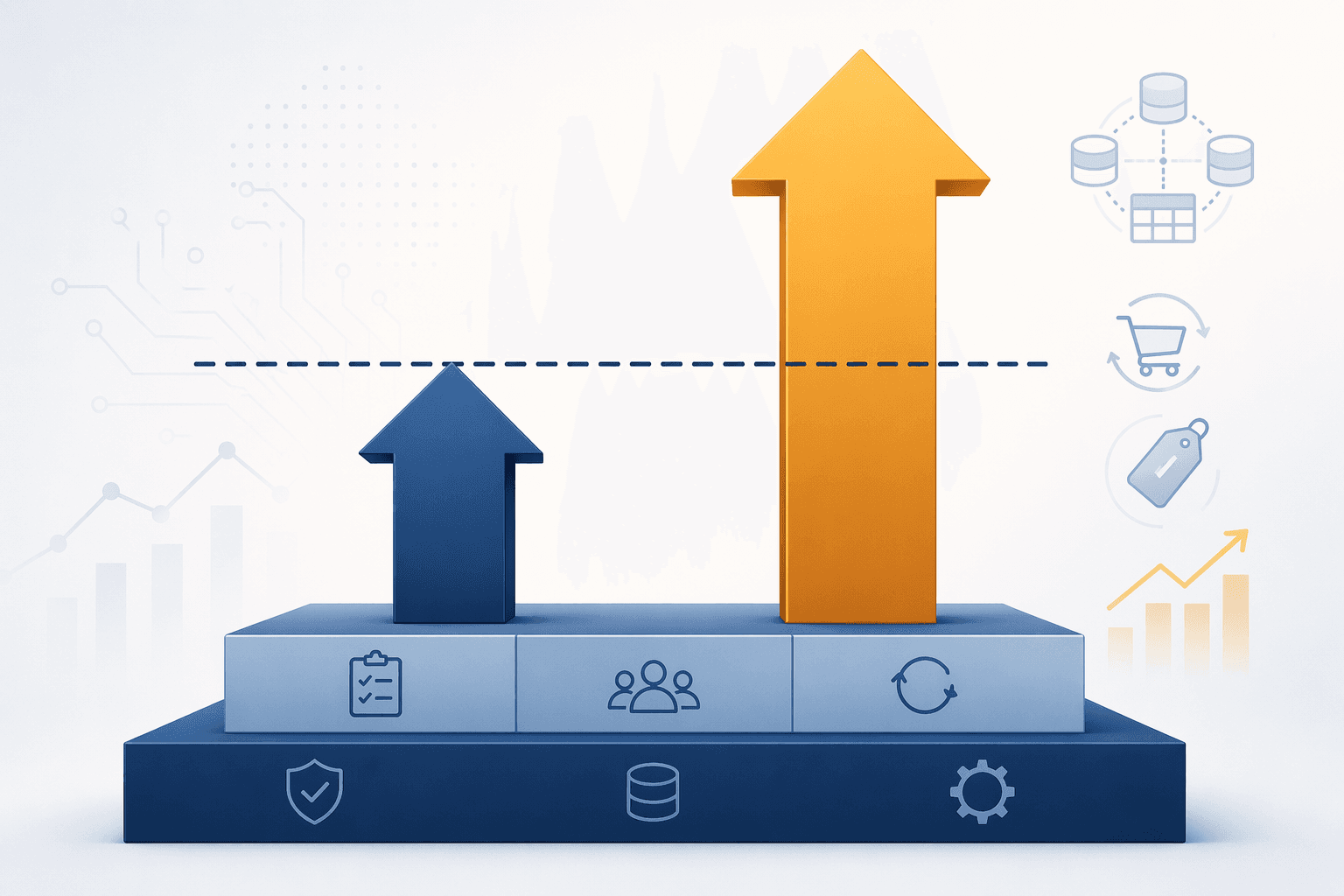
This is the biggest weakness in many vendor narratives. A better algorithm may deliver incremental gains. A better data structure may change the forecast problem itself. Kumo.ai and Horizon Solutions argue that flat time-series approaches can miss 25–30% of demand signal because they struggle to represent cross-product substitution, supplier constraint propagation, and multi-dimensional promotional lift interactions in one table.[3][4]
The SAP SALT benchmark published by Kumo.ai is especially interesting for this reason. Kumo reports 89% accuracy for a relational/GNN approach, compared with 75% for PhD+XGBoost and 63% for LLM+AutoML.[4] The proper reading is cautious. This is a vendor-published benchmark, so selection bias is a real possibility. Still, the benchmark points at the right question: did the model win because it was more sophisticated, or because it could access the business relationships that a flat table suppressed?
That question is more important than whether a vendor says “GNN,” “graph,” or “relational AI” in the demo. If a retailer has meaningful substitution between pack sizes, brands, stores, and channels, a flat SKU-location time series is leaving context outside the forecast. If a manufacturer’s demand is shaped by constrained components and customer allocation logic, historical shipments alone may confuse demand with supply. If promotional lift depends on display, price depth, competitor action, and cannibalization, the model needs more than a dated event flag.
For teams wrestling with this particular issue, ChainSignal’s analysis of the substitution blind spot in AI demand forecasting is a useful companion. The decision is not whether every company needs a graph model. The decision is whether the demand signal is actually relational enough that conventional time-series representation is now the limiting factor.
Where generative AI helps, and where it should not be oversold
Generative AI has a place in demand planning, but it is usually not the place the sales deck implies. It should not be positioned as the main engine that creates the numerical forecast. The stronger use cases sit around the forecast: explaining changes, drafting variance commentary, summarizing assumptions, comparing scenarios, preparing executive narratives, and helping planners interrogate why a number moved.
Kanerika’s 2026 discussion makes that distinction directly: generative AI adds value to the workflow around forecasting, while hybrid approaches that combine structured ML with generative interfaces are more credible than either capability standing alone.[5] In practice, that means the machine learning model produces the demand estimate, while a generative layer helps a planner or executive understand the movement, caveats, drivers, and decisions attached to that estimate.
A useful GenAI planning assistant might answer: which forecast families moved most after the new promotion file loaded; which assumptions differ from last cycle; which items have overrides inconsistent with recent performance; which executive narrative explains the gap between consensus demand and financial target. Those are workflow problems. They are real problems. They just should not be confused with proof that a language model can replace the structured forecasting stack.
Agentic forecasting is an operating-layer idea, not a standard purchase yet
Agentic AI is the more ambitious proposition: software agents that sense demand changes, trigger model runs, validate exceptions, ask for missing inputs, recommend actions, and possibly initiate downstream decisions. IBM’s February 2026 analysis places AI agents across demand forecasting as part of a coherent operating layer, and notes Gartner’s identification of agentic AI as a top supply chain technology trend for 2025.[6]
That does not make enterprise-scale multi-agent forecasting orchestration standard practice in mid-2026. It makes it worth piloting where the planning process is already instrumented well enough to keep agents from simply automating confusion. Sensing, forecasting, validation, and action are different responsibilities. A system that routes an exception to the wrong owner, accepts a noisy promotion feed, or auto-approves an override without context can create speed without control.
The better pilots will have narrow boundaries: a defined product family, clear exception thresholds, auditable decisions, human review points, and explicit rollback rules. A replenishment recommendation can be tested. A variance explanation can be compared with planner judgment. A forecast exception can be routed and measured. Fully autonomous closed-loop planning should have to earn its way through those smaller proofs.
ChainSignal’s piece on what works in agentic AI for supply chain in 2026 fits this stage of the conversation. The question is not whether agents will matter. It is whether the company has enough governance, data lineage, and planner trust to let them touch decisions that carry service, inventory, and margin consequences.
The risks are not equal
Implementation risk is often presented as a balanced checklist. In real programs, the risks do not arrive with equal force. Data fragmentation and quality usually come first. LeewayHertz and GroupBWT both emphasize data quality and integration as central barriers, and one directionally consistent industry figure suggests that 60% of organizations struggle with data quality, though that specific figure is not independently verified from a primary source.[1][2]
The ranking matters because the mitigation work is different. A black-box concern can be addressed with explainability, model comparison, and forecast value added review. A skill gap can be addressed with training, managed services, or a narrower operating model. Adoption resistance can be reduced when planners see that the system captures their judgment rather than bypassing it. Fragmented data is harder. If promotion calendars, customer orders, shipments, lost sales, substitutions, and planner overrides sit in disconnected systems, even a strong model is learning from a partial version of the business.
- First-order risk: fragmented and low-quality data, especially when demand history is polluted by stockouts, allocation, channel shifts, or inconsistent promotion coding.
- Second-order risk: interpretability, particularly when planners cannot see why the forecast changed or why the system rejected an override.
- Third-order risk: skill gaps, including the ability to maintain model monitoring, segmentation logic, and exception governance after implementation.
- Fourth-order risk: adoption resistance, which becomes worse when automation is introduced before the organization has agreed what good planner intervention looks like.
The planner override process deserves special attention. Many organizations say they want touchless forecasting, then quietly preserve a shadow process where commercial teams pressure planners to adjust the number outside the system. The tool may still report high automation, but the forecast is no longer governed. A credible AI forecasting implementation needs a place to capture judgment, reason codes, override performance, and feedback into the next cycle.
For a more operational view of readiness, ChainSignal’s AI demand forecasting challenges and readiness and implementation risks articles cover the surrounding issues in more detail. In a buying decision, the practical test is simple: if the vendor demo assumes cleaner data, tighter process control, and more complete signal capture than the business actually has, the promised accuracy will be fragile.
How to allocate investment in 2026
The best investment posture is not conservative; it is sequenced. Structured ML should be the production bet because it has the strongest evidence base and the clearest role in generating the numerical forecast. Relational and multi-table architectures deserve serious evaluation where substitution, constraints, promotional interaction, or network effects are material enough to create a structural ceiling. Generative AI belongs around the forecast, especially where planners spend too much time producing commentary, documenting assumptions, and explaining forecast movement. Agentic AI should be piloted with governance rather than bought as if autonomous forecasting were already routine.
That allocation also changes the vendor conversation. Instead of asking whether the tool has AI, ask what layer of AI is being sold. Is it improving the forecast number, improving the data representation behind the number, improving the planner’s ability to explain and challenge the number, or orchestrating the workflow after the number changes? Those are different capabilities, and they should be evaluated with different proof points.
A planning leader does not need to reject the emerging stack to be disciplined. GenAI and agents will almost certainly become more useful as planning systems get better connected and workflows become more observable. But in 2026, the money that must deliver forecast accuracy should still be tied to structured ML, data architecture, segmentation, override governance, and measurable forecast value added. The rest should be funded as targeted learning, not as a substitute for the foundations.
References
- AI in Demand Forecasting, LeewayHertz, https://www.leewayhertz.com/ai-in-demand-forecasting/
- AI Demand Forecasting, GroupBWT, https://groupbwt.com/blog/ai-demand-forecasting/
- Best Demand Forecasting Software 2026, Horizon Solutions, https://www.horizonsolutions.ai/supply-chain-planning/best-demand-forecasting-software-2026
- Best Demand Forecasting Tools, Kumo.ai, https://kumo.ai/resources/learn/best-demand-forecasting-tools/
- What Actually Works in 2026, Kanerika, https://kanerika.com/blogs/ai-in-demand-forecasting/
- AI demand forecasting, IBM, February 2026, https://www.ibm.com/think/topics/ai-demand-forecasting
Comments
Join the discussion with an anonymous comment.