

The Adoption Gap: High Intent, Low Readiness
The numbers paint a picture of near-universal ambition paired with fragile execution capacity. According to ABI Research (2025), 94% of supply chain companies plan to use AI or generative AI for decision support within two years. Yet Gartner's 2025 survey found that only 23% of organizations have a formal AI strategy in place. This is not a minor execution gap — it is a structural mismatch between intent and institutional readiness.
Demand forecasting is where this gap hits hardest. Unlike warehouse robotics or procurement automation — which can be deployed as relatively bounded point solutions — AI demand forecasting requires access to clean, integrated historical data, cross-functional alignment between planning and IT, and a planning culture that trusts model-driven outputs over intuition. When an organization lacks a formal AI strategy, it almost certainly lacks the data governance, infrastructure, and change management discipline that forecasting AI demands.
The consequences of this readiness gap are measurable. Companies with AI-mature supply chains are 23% more profitable than their peers, according to Accenture's 2024 analysis. But profitability gains do not materialize from intent alone. They require deliberate investment in the foundations that make AI forecasting viable: data quality, system integration, model transparency, and organizational capability.
For supply chain executives evaluating AI forecasting investments, the first question should not be "which vendor has the best algorithm?" It should be "are we ready to use it?" The remainder of this article examines the specific barriers that make demand forecasting a uniquely challenging AI use case and provides a practical framework for assessing organizational readiness before committing to a deployment.
Why Data Quality Is the #1 Barrier to AI Forecasting
Machine learning models are only as good as the data they are trained on. In demand forecasting, this truism becomes a hard operational constraint. An estimated 60% of organizations cite poor data quality as a primary obstacle to deploying AI forecasting models, according to industry surveys cited by Kanerika and other sources. This is not a minor inconvenience — it is the single most common reason forecasting AI projects underperform or fail outright.
The specific data challenges that plague demand forecasting include:
- Incomplete historical records. Many organizations lack clean, uninterrupted sales or order histories spanning multiple years. Gaps caused by system migrations, product assortment changes, or inconsistent data capture create blind spots that models cannot easily compensate for.
- Siloed data across ERP, CRM, and warehouse systems. Demand signals live in multiple systems — order management, point-of-sale, inventory, promotions, and external market data — and these systems rarely speak to each other natively. AI forecasting requires a unified data layer that most organizations do not have.
- Inconsistent formats and taxonomies. Product codes, customer hierarchies, and date formats differ across business units and geographies. Cleaning and harmonizing this data is often the most labor-intensive phase of any forecasting AI project.
- Insufficient data volume for certain patterns. Seasonal products, new product introductions, and SKUs with intermittent demand may not have enough historical data points for ML models to learn meaningful patterns. This is particularly acute in industries like fashion or consumer electronics where product lifecycles are short.
Oracle's guidance on AI demand forecasting is direct on this point: "The quality and range of data used to train an AI model directly impacts the accuracy of the forecasts it produces. Insufficient data, poor quality data, and imbalanced data can produce AI hallucinations." In a planning context, a hallucinated forecast is not an academic problem — it leads to stockouts, excess inventory, and lost revenue.
The practical implication is clear: investing in data quality infrastructure — data lakes, master data management, automated validation pipelines — should precede or at least parallel any AI forecasting software evaluation. Organizations that skip this step often find that their expensive AI platform is producing forecasts no better than a simple moving average, because the underlying data cannot support the model's requirements.
Legacy ERP Integration: The Hidden Infrastructure Cost
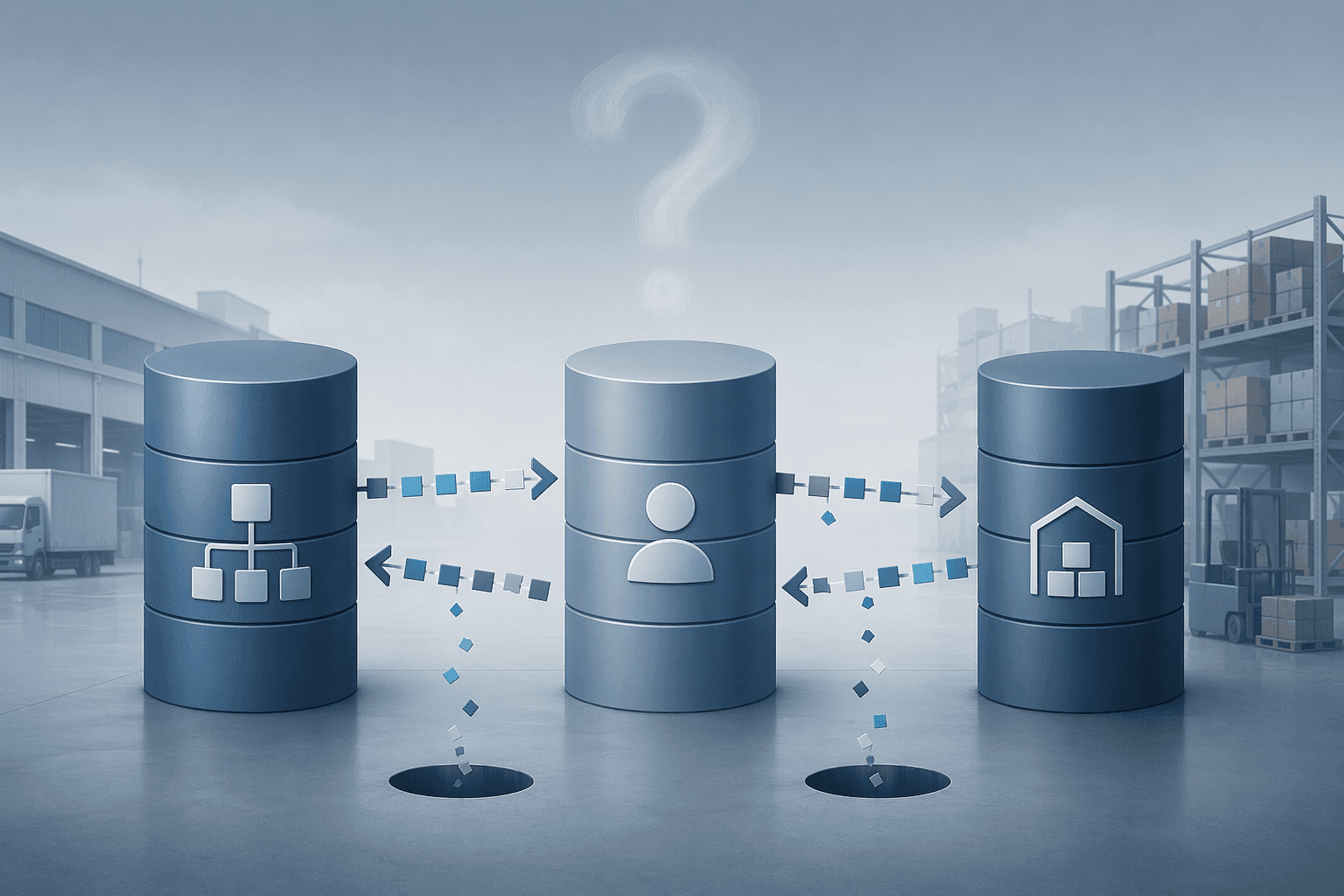
Most organizations running SAP, Oracle EBS, or legacy on-premise ERP systems face a fundamental architectural problem: these systems were designed for transactional processing and batch reporting, not for the high-frequency, high-volume data ingestion that AI forecasting models require. The integration challenge is not merely technical — it is organizational and financial.
The specific integration barriers include:
- Batch-oriented data flows. Legacy ERP systems typically update data in daily or weekly batches. AI forecasting models perform best when they can ingest near-real-time demand signals — point-of-sale data, web traffic, weather feeds, social sentiment. Retrofitting real-time data pipelines onto batch architectures is expensive and often requires middleware or data lake infrastructure that was not budgeted.
- Limited API surface area. Older ERP versions may lack modern REST APIs, requiring custom connectors or ETL processes that are brittle and costly to maintain. Each integration point becomes a potential failure mode when data pipelines break.
- Data model mismatches. ERP data models are optimized for financial and inventory transactions, not for the multi-dimensional data structures that ML models expect. Transforming ERP data into feature vectors suitable for model training requires significant data engineering effort.
- Organizational friction. ERP ownership typically sits with IT, while forecasting ownership sits with the supply chain planning team. AI forecasting projects require these groups to collaborate on data access, pipeline design, and system changes — a cross-functional coordination that many organizations struggle to sustain.
IBM's guidance on AI demand forecasting implementation emphasizes that organizations should "assess business needs, choose the right providers, use high-quality data, involve stakeholders, and monitor and iterate over time." The stakeholder involvement piece is often the most underestimated: connecting planning systems to AI platforms requires buy-in from IT leadership, data governance teams, and the business units that own the source systems.
The cost of integration is frequently the largest line item in an AI forecasting project, exceeding the software license cost by a factor of two or three. Organizations that budget only for the AI platform and not for the data infrastructure and integration work are setting themselves up for budget overruns and delayed timelines.
The Black-Box Problem: Why Planners Don't Trust AI Forecasts
Even when data quality and integration challenges are solved, a more subtle barrier remains: trust. Demand planners who have spent years building intuition about their products, customers, and seasonal patterns are unlikely to accept forecasts from a system they cannot interrogate. This is the black-box problem, and it is one of the most frequently cited reasons AI forecasting projects stall after the pilot phase.
ToolsGroup, a vendor in the demand planning space, frames the issue directly: "Trust and explainability remain key. Transparent models and clear insights help planners rely on AI demand forecasting without treating it as a black box." The emphasis on "without treating it as a black box" is telling — it acknowledges that many AI forecasting tools are, in practice, opaque to the planners who are expected to use them.
The trust problem manifests in several ways:
- Planners override AI forecasts without understanding why the model made a particular prediction, defeating the purpose of the AI system.
- When a forecast is wrong — and all forecasts are wrong to some degree — planners cannot diagnose whether the error was caused by a data issue, a model limitation, or an external event the model could not have anticipated.
- Organizations revert to manual forecasting during high-stakes periods (peak season, product launches) because they lack confidence in the model's outputs.
The solution is not to abandon AI forecasting but to adopt a human-in-the-loop design pattern where the AI generates baseline forecasts and planners review, adjust, and approve them. This approach preserves the accuracy gains of ML — McKinsey research shows AI-powered forecasting can reduce errors by 20% to 50% and product unavailability by up to 65% — while keeping the planner in the decision loop. It also generates feedback data that can be used to retrain and improve models over time.
Kanerika's analysis of AI in demand forecasting reinforces this point, noting that "model interpretability — the 'black box' problem — reduces trust" and that "overreliance on AI without human oversight" is a key failure mode. The most successful deployments treat AI as an augmentation of planner expertise, not a replacement for it.
Cost, Talent, and the Realistic ROI Timeline
The investment required for AI demand forecasting extends well beyond software licensing. Organizations must budget for cloud infrastructure, data engineering, system integration, model training and validation, and ongoing maintenance. The talent component is particularly challenging: data scientists with supply chain domain expertise are scarce and expensive, and demand planning teams with the skills to work alongside AI systems are equally hard to build.
The ROI timeline is longer than many executives expect. According to Deloitte's 2025 survey, 85% of organizations increased AI investment in the past year, yet only 6% saw ROI in under a year. Most organizations achieve satisfactory ROI within 2 to 4 years. This timeline is not a sign of failure — it reflects the reality that AI forecasting requires upfront investment in data infrastructure, model development, and organizational change before the accuracy gains translate into inventory reductions and cost savings.
| Investment Area | Typical Cost Range | Notes |
|---|---|---|
| AI forecasting platform license | $50K–$500K+ annually | Varies by SKU count, data volume, and deployment model |
| Data infrastructure (data lake, pipelines) | $100K–$1M+ | One-time setup plus ongoing cloud costs |
| Data engineering and integration | $150K–$500K | Custom connectors, data cleaning, and harmonization |
| Data science talent | $150K–$250K per FTE | Scarce supply chain ML expertise commands premium compensation |
| Change management and training | $50K–$200K | Often overlooked but critical for planner adoption |
| Ongoing model maintenance | 15–25% of initial investment annually | Model retraining, monitoring, and data pipeline maintenance |
The counterpoint to these costs is the potential return. Companies with AI-mature supply chains are 23% more profitable, per Accenture's 2024 research. AI-enabled distribution can reduce inventory by 20% to 30% and logistics costs by 5% to 20%, according to McKinsey (2024). And 85% of executives plan to increase AI spending in 2026, per Supply Chain Brain (2025), indicating that early adopters see enough value to double down.
For a deeper examination of the specific payback periods and cost savings associated with AI demand forecasting, see our companion article: The Measurable ROI of AI in Demand Forecasting: Accuracy, Inventory, and the 2–4 Year Payback Timeline.
A Readiness Framework for AI Demand Forecasting

The following framework is designed to help supply chain leaders assess their organization's readiness for AI demand forecasting before committing to a specific vendor or deployment timeline. It is organized into four stages, each with specific evaluation criteria and prerequisites.
| Stage | Key Questions | Prerequisites | Go/No-Go Criteria |
|---|---|---|---|
| 1. Data Maturity Assessment | Do we have 2+ years of clean, accessible historical data? Are demand signals unified across channels? Is our data governance framework mature enough to support ML pipelines? | Data inventory, quality audit, gap analysis | Proceed if ≥80% of SKUs have clean 2-year history; otherwise invest in data remediation first |
| 2. Organizational Alignment | Do we have executive sponsorship for a multi-year investment? Is there cross-functional buy-in from IT, planning, and finance? Do we have a change management plan for planner adoption? | Stakeholder map, governance charter, change management plan | Proceed if executive sponsor is identified and cross-functional steering committee is formed |
| 3. Pilot Design and Execution | What is the bounded scope (product category, region, planning horizon) for the pilot? What success metrics will we use? How will we measure against a baseline? | Pilot scope document, baseline performance data, success criteria | Proceed if pilot scope is narrow enough to deliver results within 3–6 months |
| 4. Scaled Deployment Planning | What is the phased rollout plan? How will we retrain and monitor models in production? What is the ongoing governance model? | Deployment roadmap, model governance framework, retraining schedule | Proceed only after pilot demonstrates measurable improvement over baseline |
The most common mistake organizations make is skipping directly to Stage 4 — selecting a vendor and planning a full rollout — without completing Stages 1 and 2. This is the root cause of the "94% intent, 23% strategy" gap. A vendor cannot fix poor data quality or organizational misalignment. The readiness assessment must come first.
For a detailed, step-by-step guide to data readiness and vendor evaluation, see our implementation guide: Implementing AI Forecasting Without the Hype: A Practical Guide to Data Readiness, Model Selection, and Vendor Evaluation.
Best Practices from Successful Deployments
Organizations that have successfully deployed AI demand forecasting at scale share several common practices. These are not theoretical recommendations — they are patterns observed across multiple industries and deployment contexts.
- Start with a bounded pilot. Successful deployments almost always begin with a narrow scope — a single product category, a specific region, or a particular planning horizon. This allows the organization to validate the approach, build internal confidence, and identify integration issues before committing to a full rollout. Kanerika's analysis explicitly recommends: "start small with pilot projects."
- Invest in data quality before model sophistication. The most accurate model in the world is useless if the data feeding it is incomplete or inconsistent. Organizations that prioritize data cleaning, harmonization, and governance before model selection consistently outperform those that lead with algorithm choice.
- Combine AI with human expertise. The best forecasting outcomes come from human-in-the-loop systems where AI generates baseline forecasts and planners apply contextual knowledge — promotions, competitor actions, weather events — that the model may not capture. ToolsGroup emphasizes that "AI is designed to support planners, not replace them."
- Continuously retrain models. Demand patterns change. Product assortments change. Market conditions change. AI forecasting models must be retrained on a regular cadence — typically monthly or quarterly — to maintain accuracy. IBM's implementation guidance stresses the need to "monitor and iterate over time."
- Use hybrid forecasting methods. Pure ML approaches are not always the best choice. For products with stable, predictable demand, simpler statistical methods may perform as well as or better than complex models. Hybrid approaches that combine ML with traditional time-series methods often deliver the best overall accuracy.
For concrete examples of what successful AI demand forecasting looks like across different industries, see our case study collection: AI Demand Forecasting in Production: What It Actually Looks Like Across Six Industries. These examples provide a useful contrast to the readiness challenges discussed in this article — showing what is possible when the foundational prerequisites are in place.
Idaho Forest Group provides a concrete illustration of the potential. According to an IBM case study, the company reduced forecasting time from more than 80 hours to under 15 hours using AI, while also reducing forecasting errors by as much as 50%. This is the kind of outcome that becomes achievable when data quality, integration, and organizational readiness are addressed upfront.
Next Steps: From Readiness to Action
The evidence is clear: AI demand forecasting can deliver substantial improvements in accuracy, inventory efficiency, and profitability — but only when the foundational prerequisites are in place. Organizations that rush to deploy without addressing data quality, system integration, model explainability, and organizational readiness are likely to join the majority that see no ROI in the first year.
The path forward is not complicated, but it requires discipline:
- Conduct a data maturity assessment before evaluating vendors.
- Secure executive sponsorship and cross-functional alignment for a multi-year investment.
- Design a bounded pilot with clear success criteria and a baseline for comparison.
- Plan for ongoing model maintenance and governance from the start.
- Build a change management plan that addresses planner trust and adoption.
For readers who have completed their readiness assessment and are ready to move to vendor evaluation, our step-by-step guide provides a formal evaluation framework: How to Evaluate and Select AI-Powered Demand Forecasting Tools: A Step-by-Step Implementation Guide.