
The Pilot Purgatory Problem
Walk the floor of any major supply chain technology conference in 2026 and you will see the same spectacle: a vendor demo showing an AI agent autonomously rerouting a shipment around a port disruption, adjusting inventory buffers in real time, and negotiating a supplier contract — all in under 90 seconds. The audience nods. The applause lands. Then everyone returns to an operations center where the most advanced "AI" in use is a demand forecast that still requires a planner to manually override 40% of the SKUs.
That gap between the conference demo and the operational reality is not a timing problem. It is a structural one. Gartner predicts that 60% of AI projects will be abandoned through 2026 if they are not supported by AI-ready data. Meanwhile, only 23% of supply chain organizations have a formal AI strategy in place, according to Gartner's 2025 survey. The remaining 77% are running experiments — pilots, proofs of concept, sandbox projects — that rarely graduate to production.
This article is not about general AI adoption. It is about a specific, expensive, and increasingly common phenomenon: the AI agent pilot that looks promising in a sandbox, stalls during integration, and never makes a single operational decision in production. We will diagnose five distinct failure patterns that keep agents stuck in demo mode, examine a rare counterexample where agent deployment actually worked, and provide a four-step framework for building agent pilots that cross the production threshold.
Five Failure Patterns That Keep AI Agents Stuck in Demo Mode
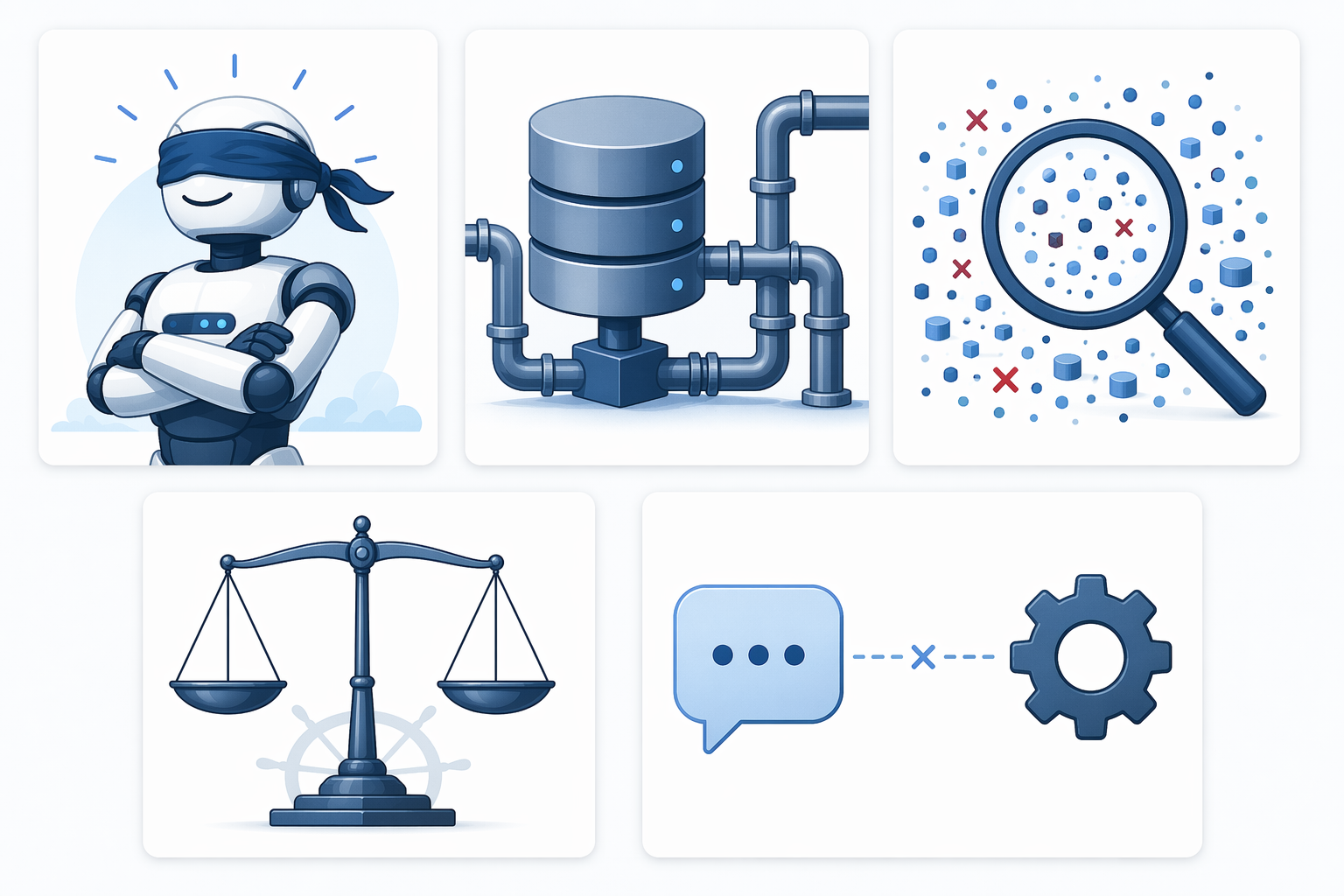
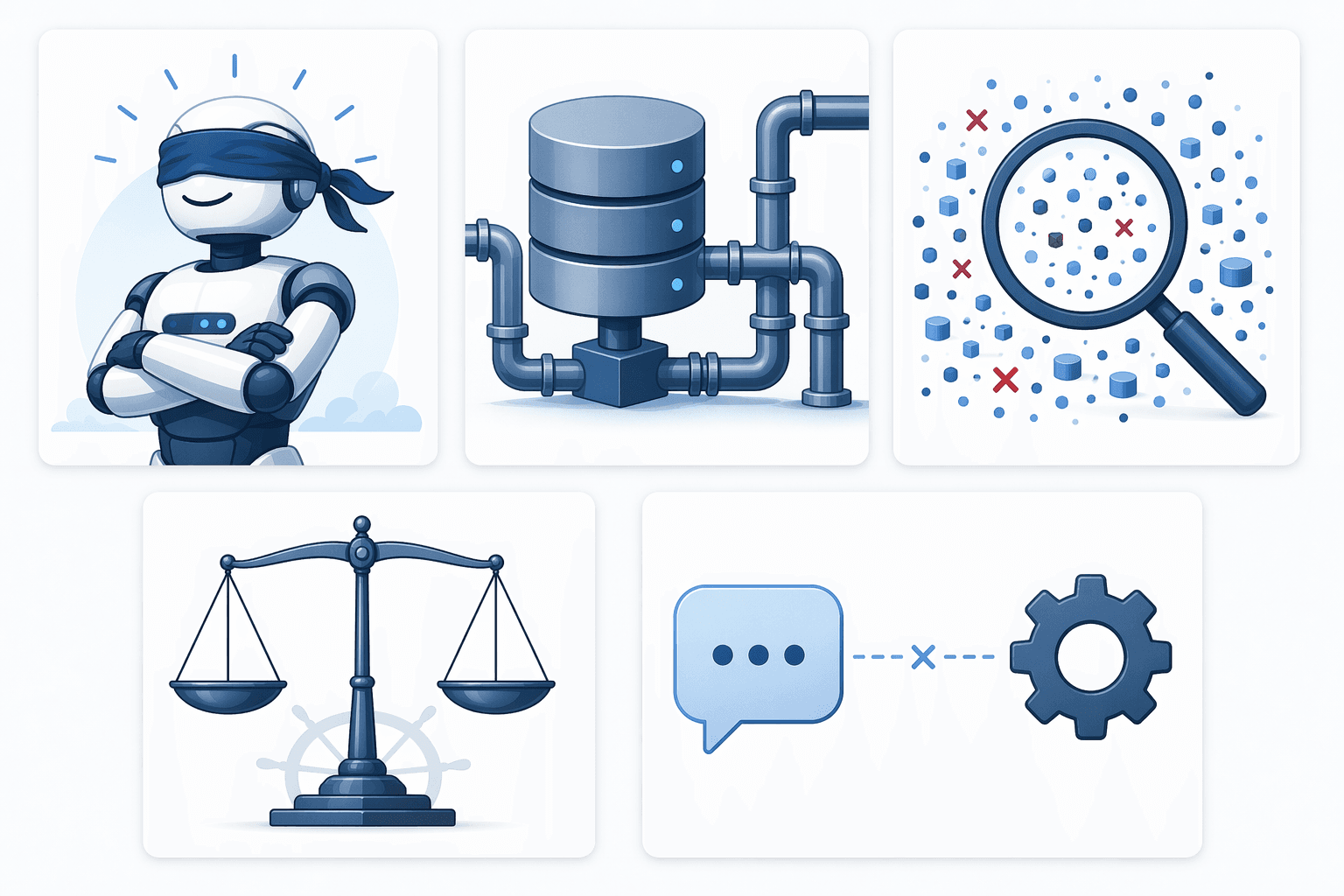
After analyzing stalled agent deployments across multiple supply chain functions, a consistent set of failure patterns emerges. These are not technical bugs. They are design and strategy errors that compound as the pilot scales.
1. The Autonomy Illusion
The most common mistake is assuming that an AI agent trained on historical data can handle end-to-end supply chain decisions from day one. A demand-sensing agent that performs well on clean, retrospective data will fail when confronted with a supplier bankruptcy, a sudden tariff change, or a port closure — events that do not exist in the training distribution. The agent does not know what it does not know. It generates confident but wrong recommendations, eroding trust faster than any technical failure could.
The autonomy illusion is reinforced by vendor demos that show agents operating independently in simplified environments. In production, the same agent needs exception-handling logic, fallback procedures, and explicit boundaries on what it can and cannot decide. Without those boundaries, the pilot either produces unusable outputs or requires so much human oversight that the automation benefit disappears.
2. The ERP Mindset
Many supply chain organizations approach AI agents the same way they approached their ERP implementation: define rigid business rules, map every exception, and then let the system execute. But agents are probabilistic systems, not deterministic ones. They do not follow if-then-else logic. They generate predictions and recommendations based on pattern recognition, which means they require a fundamentally different governance model.
When teams try to hard-code rules into an agent — "never order more than 500 units from Supplier X" — they strip away the very flexibility that makes agents valuable. The result is a system that is more rigid than the ERP it was meant to augment, and the pilot stalls because it cannot handle the variability that motivated the investment in the first place.
3. Data Quality Denial
Agents amplify bad data. A traditional forecasting model with dirty data produces a bad forecast. An agent with dirty data produces a bad forecast and then autonomously executes a purchase order, adjusts a safety stock level, or reroutes a shipment based on that forecast. The damage multiplies.
Gartner reports that 85% of AI projects fail due to poor data quality. The Industrial Agility Assessment 2025found that 57% of organizations struggle with data readiness, 56% face skills gaps, and 55% report integration issues. These are not peripheral concerns. They are the primary reasons agent pilots fail during the transition from sandbox to production, because the sandbox uses curated data and production uses whatever the ERP, WMS, and TMS actually produce.
4. Missing Decision Governance
The most operationally damaging failure pattern is the absence of decision governance — clear thresholds that define when an agent can act autonomously, when it must recommend and wait for approval, and when it must escalate to a human. Without these thresholds, every decision becomes either too risky (the agent acts on a high-value procurement without oversight) or too slow (every recommendation requires human review, defeating the purpose of automation).
Decision governance is not a one-time configuration. It must be calibrated to the specific operational context: the financial risk of a wrong decision, the time sensitivity of the decision, the availability of human reviewers, and the agent's confidence score for that specific prediction. Organizations that skip this step find that their agent pilot produces either chaos or paralysis.
5. Chat vs. Execution Confusion
A growing number of agent pilots are built as conversational interfaces — a chat window where a supply chain manager asks "What should I reorder for SKU 4472?" and the agent responds with a recommendation. These are useful for exploration but fundamentally miss the point of agentic AI. The value of an agent is not in answering questions. It is in executing decisions within a defined scope.
When teams build chat interfaces instead of decision engines, they create a tool that requires a human to be present, attentive, and decisive at every step. That is not automation. It is a slightly faster way to look up information. The pilot may generate engagement metrics — number of queries, user satisfaction scores — but it will not generate operational outcomes. And when the engagement novelty fades, the pilot is abandoned.
What Success Actually Looks Like: Hershey's Governed Agent Teams
The Hershey Company's partnership with Aera Technology offers a rare, documented counterexample to the pilot purgatory pattern. Rather than deploying a single agent to handle end-to-end supply chain decisions, Hershey deployed autonomous agent teams that self-assemble for specific, bounded decisions. Each team includes dedicated learning agents and governance agents — not as an afterthought, but as a core architectural component.
The key design choice was the narrow decision boundary. Instead of asking an agent to "optimize the supply chain," Hershey defined specific operational decisions — inventory replenishment for a category of SKUs, order promising for a specific distribution center — and scoped each agent team to that single decision. The governance agent monitors the decision context, checks confidence thresholds, and escalates when the situation falls outside the agent's training distribution.
This approach aligns with McKinsey's finding that 41% of successful AI implementers report 10–19% cost reductions from focused deployments with clear decision boundaries. The companies that succeed are not the ones pursuing the most ambitious end-to-end automation. They are the ones that pick a single, high-value operational decision, scope the agent to that decision, and build governance around it.
A 4-Step Framework for Building Agent Pilots That Reach Production
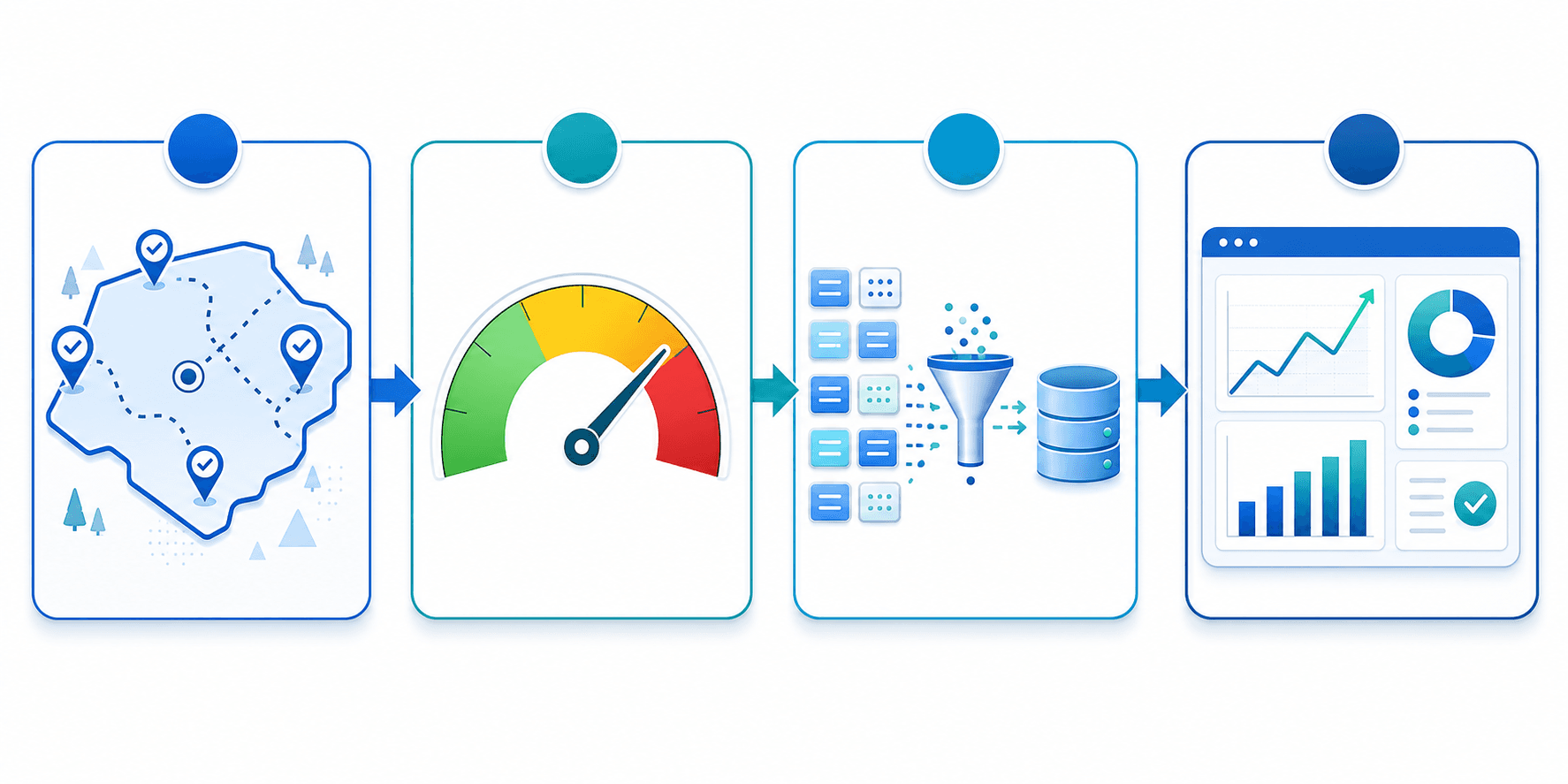
The following framework synthesizes the lessons from the failure patterns and the Hershey counterexample. It is designed for supply chain leaders who have a stalled pilot or are planning a new one and want to avoid the most common traps.
Step 1: Define the Decision Boundary
Scope the agent to one bounded operational decision. Not "demand planning" — that is a function, not a decision. A bounded decision is "set the safety stock level for fast-moving SKUs in the Midwest distribution center." The decision boundary must specify the inputs (which data sources), the outputs (what the agent produces), the frequency (daily, weekly, event-triggered), and the exceptions that trigger escalation.
Organizations that try to build an agent for "supply chain optimization" fail because the decision space is too large. Organizations that scope to a single SKU category, a single facility, or a single supplier relationship have a path to production.
Step 2: Set Governance Thresholds
Define three decision zones for every agent action: autonomous execution, recommend-and-wait, and escalate-to-human. The thresholds depend on the operational context, but a common pattern from the CXTMS framework is:
| Decision Zone | Threshold Example | Agent Action | Human Role |
|---|---|---|---|
| Autonomous | Below $50K value or low-impact inventory adjustment | Executes without approval | Monitors via dashboard; can override |
| Recommend | $50K–$500K value or medium-impact routing change | Generates recommendation with confidence score | Reviews and approves or rejects within time window |
| Escalate | Above $500K value, novel disruption, or low confidence | Pauses and alerts with context summary | Makes final decision; agent logs outcome for learning |
These thresholds are not static. They should be reviewed quarterly and adjusted as the agent's performance track record grows. An agent that demonstrates 99% accuracy on autonomous decisions over six months may earn a higher threshold. An agent that encounters a novel disruption pattern may need tighter boundaries until retrained.
Step 3: Invest in Data Readiness First
Before the agent sees a single production decision, the data pipelines must be validated. This means:
- Auditing data completeness for the specific decision boundary — not all data, just the data the agent needs.
- Establishing data freshness SLAs — an agent using stale data will make bad decisions faster than a human would.
- Creating a feedback loop where the agent flags data quality issues it encounters, turning data readiness into a continuous process rather than a one-time project.
For a detailed walkthrough of data readiness prerequisites, see The CSCO's Data Readiness Checklist for Supply Chain AI Implementation. That guide covers the organizational and technical dimensions of data readiness that apply directly to agent deployments.
Step 4: Measure Outcomes, Not Activity
The most common pilot metric is "hours saved." It is also the most misleading. Hours saved does not correlate with business outcomes unless the freed time is actually reallocated to higher-value work. Instead, measure:
- Decisions made vs. decisions executed — how many recommendations the agent generated versus how many were actually acted upon.
- Decision accuracy — for autonomous decisions, what percentage produced the intended operational outcome.
- Escalation rate — how often the agent correctly identified situations it could not handle and escalated to a human.
- Time-to-decision — the elapsed time from an event occurring to a decision being executed, compared to the pre-agent baseline.
McKinsey research shows that companies achieving AI value within six months see 3.2 times higher ROI over five years than those with extended timelines. The fastest path to value is not a broader scope — it is a narrower one, executed with discipline and measured on outcomes.
Human-in-the-Loop Is a Feature, Not a Weakness
A common objection to the governance-threshold approach is that requiring human approval for medium- and high-stakes decisions means the agent "failed." This framing is counterproductive. In supply chain operations, where a single bad procurement decision can cost millions and a single inventory miss can shut down a production line, permanent human oversight is not a concession — it is an architectural requirement.
The Dataiku and BCG projection that agentic systems will grow from 17% of total AI value in 2025 to 29% by 2028 assumes that these systems are deployed with proper guardrails. Without guardrails — without humans in the loop for consequential decisions — the adoption curve will flatten as organizations encounter the failure patterns described above.
The organizations that succeed with agentic AI are not the ones that remove humans from the loop. They are the ones that redesign the human role: from manual decision-maker to exception handler, from data entry to governance oversight, from reactive firefighter to strategic optimizer. That is a more valuable role, not a less valuable one.
How to Escape Pilot Purgatory for Each Common Use Case
The four-step framework applies across use cases, but the specific decision boundary, governance thresholds, and data prerequisites vary. The table below maps the framework to three common agent use cases in supply chain.
| Use Case | Decision Boundary | Governance Threshold Example | Key Data Prerequisite | Human-in-the-Loop Role |
|---|---|---|---|---|
| Demand sensing | Adjust short-term forecast for top 20% of SKUs in one region | Autonomous: forecast deviation < 5%; Recommend: 5–15%; Escalate: > 15% or external disruption detected | Clean POS or sell-through data with < 24-hour latency | Review and approve forecast changes during S&OP cycle; override for known promotions or events |
| Inventory replenishment | Set order quantities for one DC's fast-moving SKU category | Autonomous: order value < $50K; Recommend: $50K–$500K; Escalate: > $500K or supplier risk flag | Inventory accuracy > 98%, lead time data from TMS, supplier on-time delivery history | Approve medium-value orders; manage supplier relationships for escalated cases |
| Procurement negotiation | Negotiate pricing for one commodity category with pre-qualified suppliers | Autonomous: within 2% of target price; Recommend: 2–5% deviation; Escalate: > 5% or new supplier | Historical contract data, market price indices, supplier performance scores | Approve deviations outside autonomous zone; handle strategic supplier relationships |
For a broader discussion of why pilots stall and how to build a business case that survives internal scrutiny, see From Pilot to Profit: The Real ROI of AI in Procurement and Supply Chain. That article covers the financial justification and organizational alignment required to move from pilot to production, complementing the agent-specific failure diagnosis and remediation framework presented here.
The path out of pilot purgatory is not a bigger budget, a better vendor, or a more powerful model. It is a narrower scope, clearer governance, and the discipline to treat human-in-the-loop as a permanent feature rather than a temporary crutch. Start with one bounded decision. Get it to production. Measure the outcomes. Then expand.
Comments
Join the discussion with an anonymous comment.