

The ROI Is Real — But So Are the Failure Modes
The business case for AI-driven demand forecasting is well-documented and compelling. McKinsey research cited by multiple industry sources indicates that organizations deploying these solutions can reduce forecast errors by 30% to 50%, cut lost sales due to stockouts by up to 65%, and lower inventory holdings by 20% to 50%. Accenture's 2024 study of 1,148 companies found that organizations with AI-mature supply chains are 23% more profitable than their peers. These figures explain why 94% of supply chain companies plan to use AI or generative AI for decision support within two years, according to ABI Research 2025 data.
Yet the same research ecosystem that produces these ROI numbers also reports a sobering counter-narrative. Industry estimates suggest that 85% of AI projects fail, with poor data quality, unclear objectives, and lack of organizational alignment cited as the primary causes. Gartner's 2025 survey found that only 23% of supply chain organizations have a formal AI strategy, meaning the vast majority are deploying without a guiding framework. And while 85% of organizations increased AI investment over the past year, Deloitte's 2025 data shows that only 6% saw ROI in under twelve months — most achieve satisfactory returns only within a two-to-four-year window.
This guide is written for supply chain leaders and technology buyers who are past the awareness stage and actively evaluating or piloting AI demand forecasting. It does not re-litigate the ROI case. Instead, it provides a structured, evidence-based examination of five implementation risks that vendors rarely emphasize in their sales cycles, along with specific mitigation strategies for each. The goal is not to discourage adoption but to equip decision-makers with the questions, frameworks, and realistic timelines needed to avoid the failure modes that claim the majority of projects.

Risk 1: Data Quality and Availability — The Foundation That Fails First
Every AI demand forecasting model is only as reliable as the data it trains on. This is not a theoretical concern. Industry sources cited by IBM indicate that 60% of organizations struggle with poor data quality, making it the single most common reason AI projects underperform or fail outright. Incomplete historical sales records, siloed data across ERP and CRM systems, inconsistent product hierarchies, and biased training data that does not reflect actual market conditions all produce forecasts that look statistically valid but fail in production.
The data requirements for reliable AI forecasting are specific and non-negotiable. Most models require a minimum of two to three years of clean, structured historical data at the appropriate granularity — weekly or daily sales by SKU-location combination, not monthly aggregates. This data must include not just sales volumes but also the variables that influenced them: promotions, pricing changes, competitor activity, weather events, and supply disruptions. Organizations that skip the data readiness phase and move directly to model selection are building on sand.
Mitigation Playbook
- Conduct a structured data audit before any vendor selection or model development. Map every data source, assess completeness and consistency, and identify gaps in historical coverage.
- Establish a minimum data threshold. If you cannot provide two to three years of clean, SKU-location-level historical data with associated causal variables, your pilot timeline must include a data collection and cleansing phase before model training begins.
- Invest in data governance tooling and processes. Automated data quality monitoring, anomaly detection, and lineage tracking should be in place before the model goes into production, not after a failure event.
- Plan for ongoing data maintenance. Demand forecasting models require continuous data feeds, not one-time historical loads. Ensure your data pipeline can handle real-time or near-real-time updates from POS systems, ERP modules, and external data sources.

Risk 2: The Black-Box Problem — When Planners Can't Trust What They Can't See
Advanced machine learning models — particularly deep learning architectures like LSTMs and transformer-based networks — can capture complex non-linear patterns in demand data that traditional statistical methods miss. But this predictive power comes with a significant operational cost: these models are largely opaque. A demand planner who has spent years developing intuition about seasonal patterns, promotion lift factors, and category dynamics cannot easily understand why a neural network produced a specific forecast for a specific SKU in a specific week.
This is not a minor usability concern. The Visualfabriq analysis of AI-driven demand forecasting in CPG identifies the "black box syndrome" as a key challenge, noting that complex AI algorithms are difficult for non-technical users to understand, which reduces trust and ultimately adoption. When planners cannot explain or defend a forecast to their commercial counterparts in sales or marketing, they revert to manual overrides or simply ignore the AI output. The model may be statistically superior, but if it is not trusted, it delivers no value.
Mitigation Playbook
- Prioritize explainability in vendor selection. Require vendors to demonstrate how their models provide feature importance scores, prediction breakdowns, and counterfactual explanations — not just accuracy metrics on holdout data.
- Invest in Explainable AI (XAI) tooling as a separate budget line item. SHAP values, LIME, and partial dependence plots are not optional extras; they are core infrastructure for maintaining planner trust and regulatory defensibility.
- Maintain a human-in-the-loop review process for all AI-generated forecasts, particularly during the first 12 to 18 months of deployment. Planners should review, challenge, and approve or override every forecast before it enters the S&OP cycle.
- Build model literacy across the planning team. Invest in training that helps planners understand how machine learning models work at a conceptual level, what drives forecast variance, and how to interpret explainability outputs.

Risk 3: Integration with Legacy ERP Systems — The Hidden Timeline Killer
Most enterprise demand forecasting data lives in SAP, Oracle, Microsoft Dynamics, or homegrown ERP systems that were designed for transaction processing, not real-time AI data feeds. These systems typically store historical sales data in batch-processed tables with rigid schemas, limited API access, and update cycles measured in hours or days rather than minutes. Connecting a modern AI forecasting platform to this infrastructure is rarely a plug-and-play exercise.
The Kanerika analysis of AI demand forecasting challenges identifies integration with legacy ERP systems as one of the top implementation hurdles, often requiring custom middleware development, data transformation pipelines, and API wrappers that extend project timelines by months and add significant cost. Organizations that budget only for the AI platform license and underestimate the integration effort frequently find themselves in a cycle of scope creep, delayed go-live dates, and frustrated stakeholders.
Mitigation Playbook
- Conduct a technical integration assessment before vendor selection. Map your current ERP architecture, data extraction capabilities, API availability, and batch update cycles. Identify whether real-time data feeds are feasible or whether you will need to work with daily or hourly batch extracts.
- Budget for integration as a separate workstream with its own timeline and contingency. A reasonable rule of thumb: allocate 30% to 50% of the total project budget to data integration and pipeline development, not to the AI platform itself.
- Implement a staged integration approach. Start with a limited data feed for a pilot product category or region, validate the pipeline, and then expand. Do not attempt a full ERP integration in the first phase.
- Maintain fallback processes. Until the integration is fully stable, ensure that planners can continue to generate baseline forecasts using existing tools. The AI system should augment, not replace, the existing planning workflow during the transition period.
Risk 4: Overreliance and Model Fragility — When Algorithms Fail Without Warning
AI demand forecasting models are trained on historical data, and they perform well when future conditions resemble the past. But supply chains do not operate in stable environments. The Visualfabriq analysis explicitly warns that AI models trained on historical data may not accurately predict demand during unprecedented events, and that sudden market shifts — a pandemic, a tariff escalation, a port closure, a raw material shortage — can render pre-trained models obsolete almost overnight.
This is not a failure of the AI technology itself. It is a failure of deployment design. Organizations that treat the AI forecast as a final answer rather than a decision-support input create a brittle planning process that breaks when the model encounters data outside its training distribution. The GroupBWT framework for AI demand forecasting warns that overreliance on AI without dual control — where algorithms recommend and managers decide — creates exactly this fragility.
Mitigation Playbook
- Implement dual control as a non-negotiable design principle. The AI system generates forecasts and confidence intervals; human planners review, challenge, and approve or override. No forecast enters the S&OP cycle without human sign-off.
- Establish model monitoring and drift detection processes. Track forecast accuracy against actuals in near-real-time and set automated alerts when error rates exceed predefined thresholds. A model that was accurate last quarter may be degrading this quarter without visible warning.
- Plan for continuous model retraining. Demand patterns shift seasonally, promotion strategies change, and external conditions evolve. Models should be retrained on a regular cadence — monthly or quarterly — not deployed once and left static.
- Develop scenario planning capabilities that complement the AI forecast. Use the model's baseline prediction as one input in a structured scenario analysis that includes upside, downside, and black-swan cases. This prevents the organization from anchoring on a single AI-generated number.
Risk 5: Organizational Resistance — The Human Factor That Derails Deployments
The most technically sound AI demand forecasting implementation will fail if the people who are expected to use it do not trust it, do not understand it, or feel threatened by it. The SPD Technology analysis of AI demand forecasting notes that change management and cultural readiness are as critical as technical implementation, and that resistance to AI replacing human judgment is a documented failure cause across multiple industries.
This resistance is not irrational. Demand planners have spent years building expertise in their product categories, supplier relationships, and market dynamics. An AI system that arrives with vendor promises of "touchless forecasting" and "autonomous planning" can feel like a direct threat to their professional identity and job security. When combined with the black-box problem — where planners cannot understand why the model produced a particular forecast — the natural response is to resist, ignore, or actively undermine the system.
Mitigation Playbook
- Frame AI as augmentation, not replacement. From the first communication through every training session, emphasize that the AI system handles pattern recognition and data processing at scale while planners provide the contextual judgment, exception handling, and strategic decision-making that machines cannot replicate.
- Involve planners in the vendor evaluation and pilot design process. When planners have a voice in selecting the tool and defining the use cases, they develop ownership of the outcome rather than feeling that the system is being imposed on them.
- Invest in structured change management with dedicated budget and timeline. A two-day training session is not sufficient. Plan for a multi-month change program that includes hands-on workshops, peer mentoring, transparent communication about job impacts, and visible executive sponsorship.
- Measure adoption metrics alongside accuracy metrics. Track what percentage of AI-generated forecasts are accepted without override, how quickly planners incorporate model outputs into their workflow, and whether override rates decrease over time as trust builds. These are leading indicators of deployment health.
A Staged Risk Mitigation Framework: From Pilot to Enterprise Integration
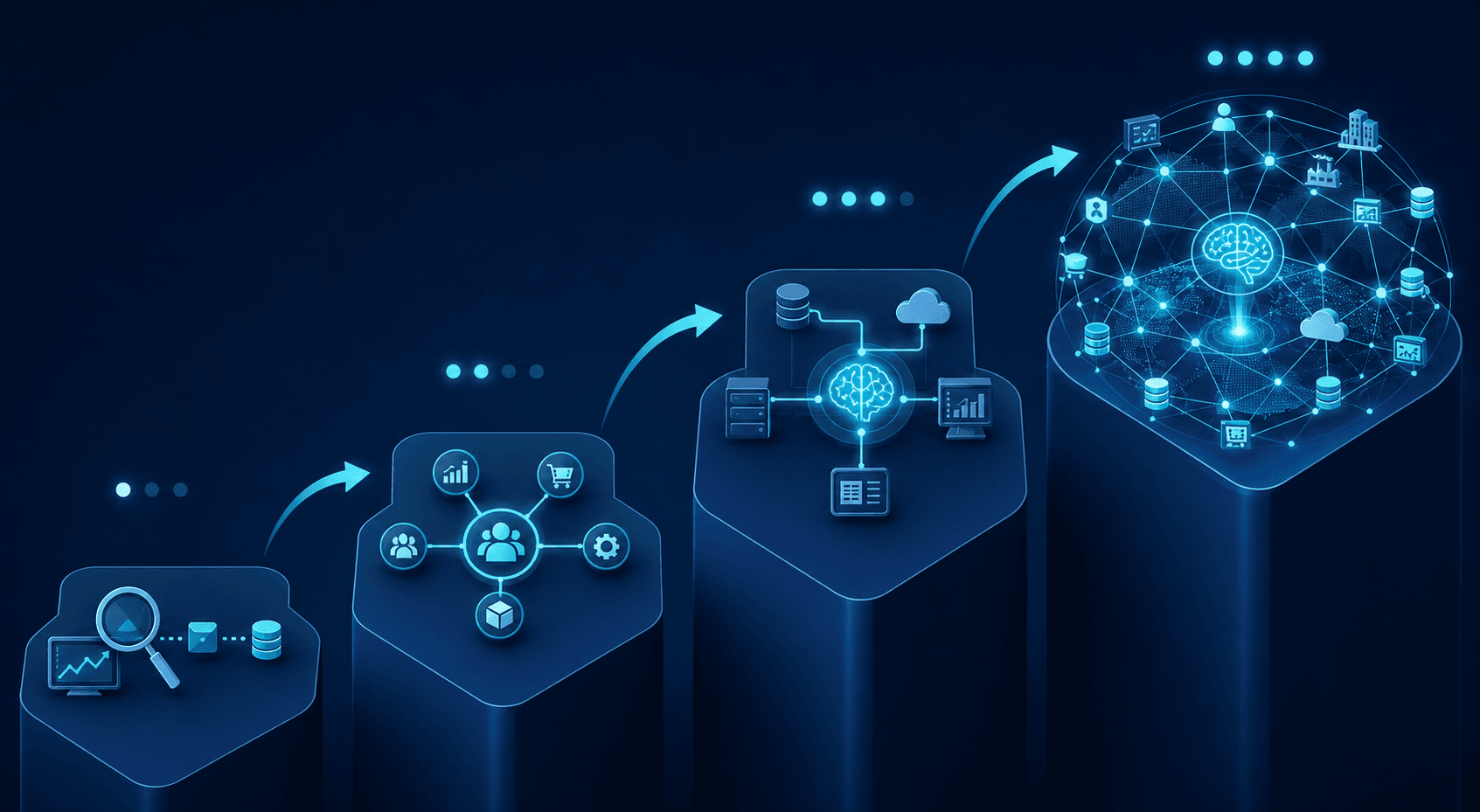
The risks described above are manageable, but they cannot be addressed all at once. A staged maturity framework allows organizations to build capability, trust, and infrastructure incrementally while containing the cost and complexity of failure at each stage. The following framework, derived from implementation roadmaps published by GroupBWT and informed by MIT and Veritis maturity models, provides a structured path from pilot to enterprise-wide deployment.
| Stage | Timeline | Budget Range | Scope | Key Risk Mitigation Focus |
|---|---|---|---|---|
| Pilot | 0–3 months | $100K–$500K | Single product category or region, 1–2 data sources | Data quality validation, explainability testing, planner trust building |
| Expansion | 6–12 months | $500K–$2M | Multiple categories or regions, expanded data sources | Integration pipeline stabilization, model monitoring setup, change management scaling |
| Enterprise | 18–24 months | $2M–$10M | Full product portfolio, all regions, real-time data feeds | Dual control process hardening, drift detection automation, governance framework |
| Adaptive | 36+ months | $10M+ | Cross-functional integration with S&OP, procurement, and logistics | Continuous retraining cadence, scenario planning integration, autonomous exception handling |
The budget ranges in this framework reflect total project cost including data integration, change management, and ongoing operations — not just software licensing. Organizations that attempt to skip stages or compress timelines typically encounter the failure modes described in this guide. The Deloitte 2025 finding that most organizations achieve satisfactory ROI within two to four years, not twelve months, reinforces the importance of realistic timeline expectations.
Decision Checklist: Choosing Vendors and Setting Realistic Expectations
The following checklist is designed for supply chain leaders who are in active vendor evaluation or pilot planning. It translates the risk mitigation strategies from this guide into specific evaluation criteria and decision questions. Use it as a structured tool during vendor demonstrations, proof-of-concept design, and internal stakeholder discussions.
- Data readiness: Does the vendor require a minimum of two to three years of clean historical data? Do they provide a structured data readiness assessment before the pilot begins? What data quality issues will disqualify a pilot from proceeding?
- Explainability: Can the vendor demonstrate how their model explains individual forecast outputs — not just aggregate accuracy metrics? Do they provide SHAP values, feature importance scores, or prediction breakdowns in their standard interface, or are these available only as custom reports?
- Integration: What ERP systems has the vendor integrated with in production deployments? Can they provide reference customers with similar ERP architectures? What is the typical timeline and cost range for integration in their past deployments?
- Human-in-the-loop: Does the vendor's platform support structured human review and override workflows, or is it designed as a fully automated system? Can the platform log and audit every override for governance and model improvement purposes?
- Model monitoring: What model drift detection and accuracy monitoring capabilities does the vendor provide out of the box? Can the platform trigger automated alerts when forecast error rates exceed defined thresholds?
- Change management: Does the vendor offer change management support, training programs, or organizational readiness assessments as part of their implementation package, or is the deployment purely technical?
- Timeline expectations: What is the vendor's track record for pilot-to-production timelines? Can they provide reference customers who achieved satisfactory ROI within two to four years, consistent with the Deloitte 2025 benchmark?
AI demand forecasting is not a technology purchase. It is an operational transformation that touches data infrastructure, planning processes, organizational culture, and governance frameworks. The organizations that succeed are not the ones with the most advanced models or the largest budgets. They are the ones that go into the deployment with their eyes open to the risks, a structured mitigation plan for each one, and a realistic timeline that accounts for the human and organizational dimensions of change.
Comments
Join the discussion with an anonymous comment.