The useful question in AI supply chain earthquake disruption planning is not whether an algorithm can notice that the ground shook. It is whether the system can connect the epicenter to a supplier site, the supplier site to a part number, the part number to a product family, and the product family to a mitigation option before the first executive status call turns into a search party.
The April 2024 Taiwan earthquake is a good place to test that question because it did not become the global semiconductor crisis many people feared. TSMC reportedly recovered 70% of its tools within 10 hours, avoided critical EUV damage, and resumed operations within two days; reporting at the time also characterized the chip-industry impact as likely to be “moderate.”[1][2] That outcome was impressive. It was also not magic, and it was not mainly a software story. It reflected years of structural preparation: building standards, fab hardening, shutdown procedures, drills, and disciplined recovery routines.
The uncomfortable part is what sat behind that relatively controlled recovery. Taiwan produces about 60% of global semiconductors and about 90% of advanced chips, and Interos estimated that a significant disruption could affect roughly $1.6 trillion, or 8% of U.S. GDP.[3] Its proprietary database also showed G7 companies sharing about 70,000 Tier-1, 315,000 Tier-2, and 750,000 Tier-3 supplier connections to Taiwan.[3] Those figures should make any Tier-1-only exposure review feel thin.
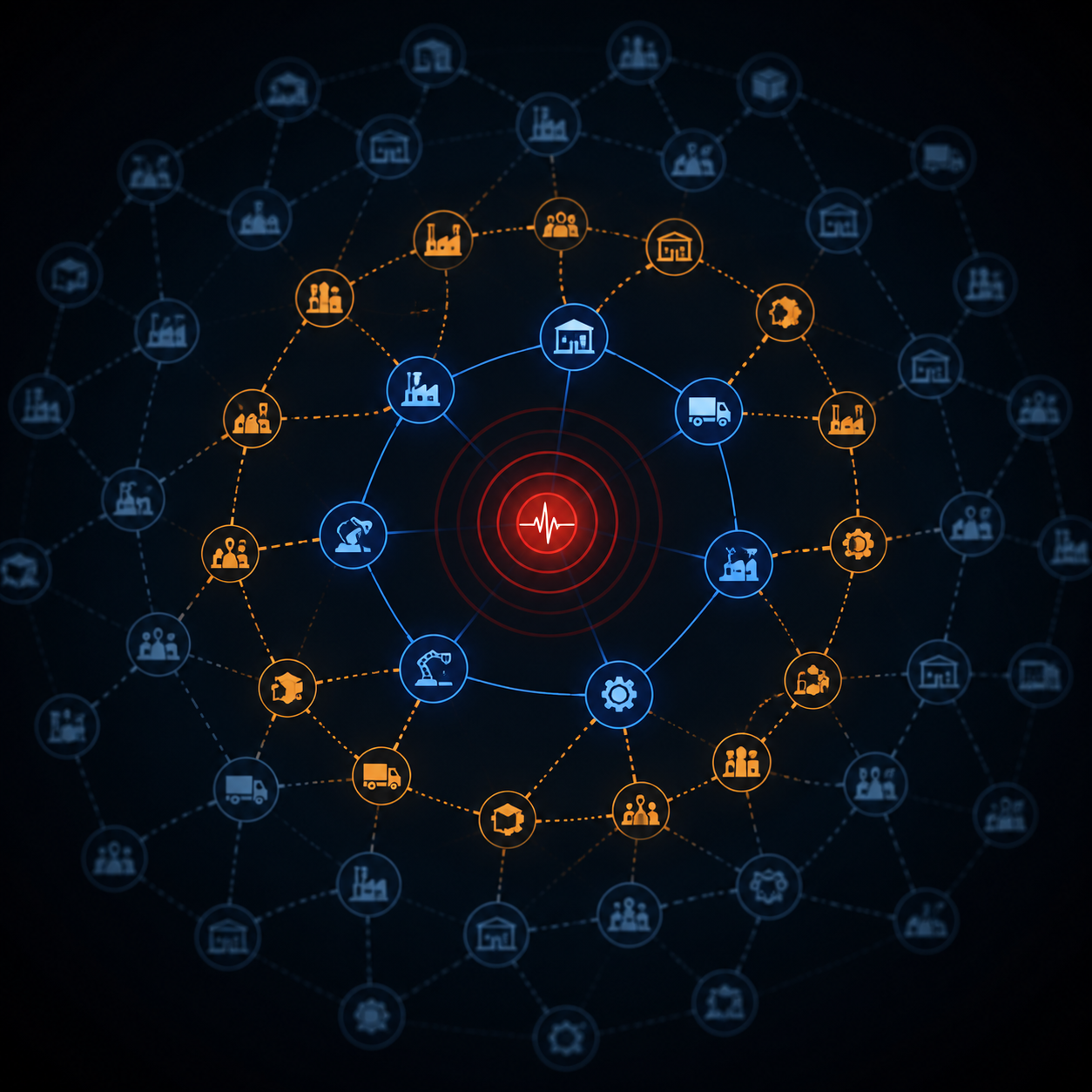
For a well-prepared semiconductor leader, the earthquake became a visible demonstration of resilience. For a less-mapped buyer three tiers downstream, the same event could have started with a deceptively simple question: are we exposed? The answer depends less on a dashboard’s color scheme than on whether the company already knows which sites, subassemblies, contract manufacturers, distributors, and alternate parts sit behind the supplier names in its ERP.
What AI Can Know Before the War Room Forms
Earthquake planning starts upstream of procurement. Seismic alerts, satellite observations, logistics telemetry, supplier notices, local news, and social posts all arrive in different formats and at different levels of credibility. AI earns its place when it turns that noise into structured exposure: location, event severity, affected infrastructure, named companies, facilities, materials, lanes, and likely operational constraints.
This is where predictive analytics and NLP are useful but often oversold. They can ingest early signals faster than a human team can refresh news sites, and they can extract entities from messy text that would otherwise sit outside the planning system. They do not, by themselves, prove that a supplier is down or that a shipment will miss a production slot. Their better role is to narrow the search area and trigger the next layer of analysis.
A related question is whether AI can forecast the earthquake itself early enough to matter. That is a narrower and more technical topic than disruption planning; the useful connection is that seismic detection and warning feeds become one input into the operational workflow. For more on that boundary, see AI earthquake forecasting for supply chains. In planning, the larger question is what the organization does with the signal once it arrives.
Resilinc said it tracked the Taiwan earthquake’s impact across more than 13,000 sites, 5,800 parts, and 21,000-plus products.[4] That kind of blast-radius analysis is exactly what buyers want in the first hours after a quake. The caveat matters: it works for clients whose networks have already been mapped. If the supplier graph is missing, AI can still read the news, but it cannot infer a part-level dependency that the company never captured.
From One Forecast to Many Plausible Failure Paths
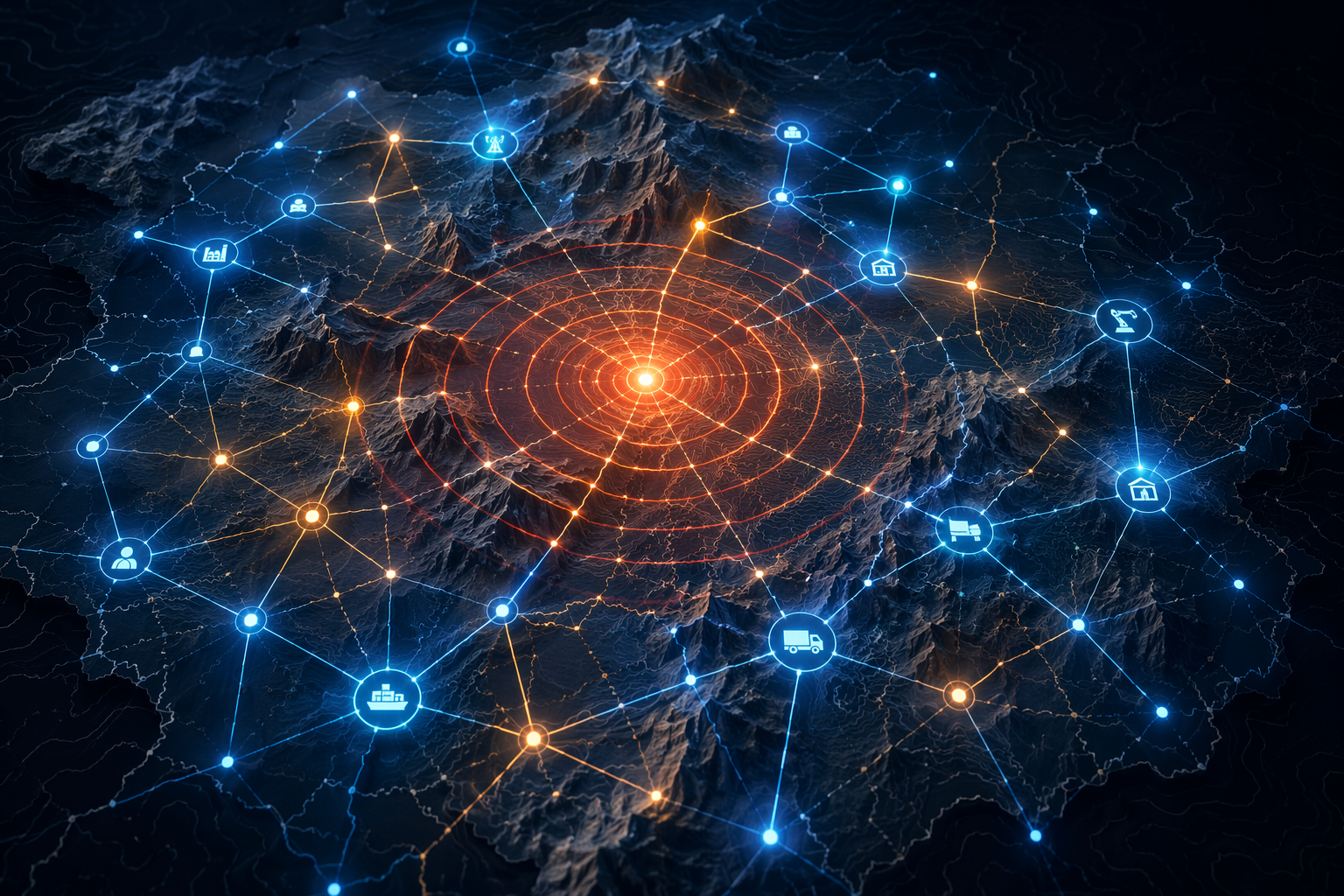
The strongest earthquake-planning systems do not stop at “site affected.” They ask what happens if power returns in six hours, if aftershocks delay inspection, if a port slows outbound freight, if a specialty chemical supplier is fine but its upstream packaging source is not, or if every customer tries to pull the same alternate capacity at once.
Digital twins are the practical bridge between an alert and a decision. A planning twin can represent facilities, inventory positions, production constraints, lanes, lead times, qualification rules, and service commitments. When an earthquake scenario changes one part of the model, planners can see which orders, plants, or customers become constrained under different assumptions.
The important shift is from a single most-likely forecast to a portfolio of plausible impact paths. SCMR, in a Rutgers-authored 2025 article, reported that Siemens models more than 500 earthquake scenarios daily and reduced downtime by about 20%.[5] That is a vendor case reported through a supply chain publication, not a universal benchmark, but it illustrates the operational pattern: simulate many variations before the disruption forces a single rushed choice.
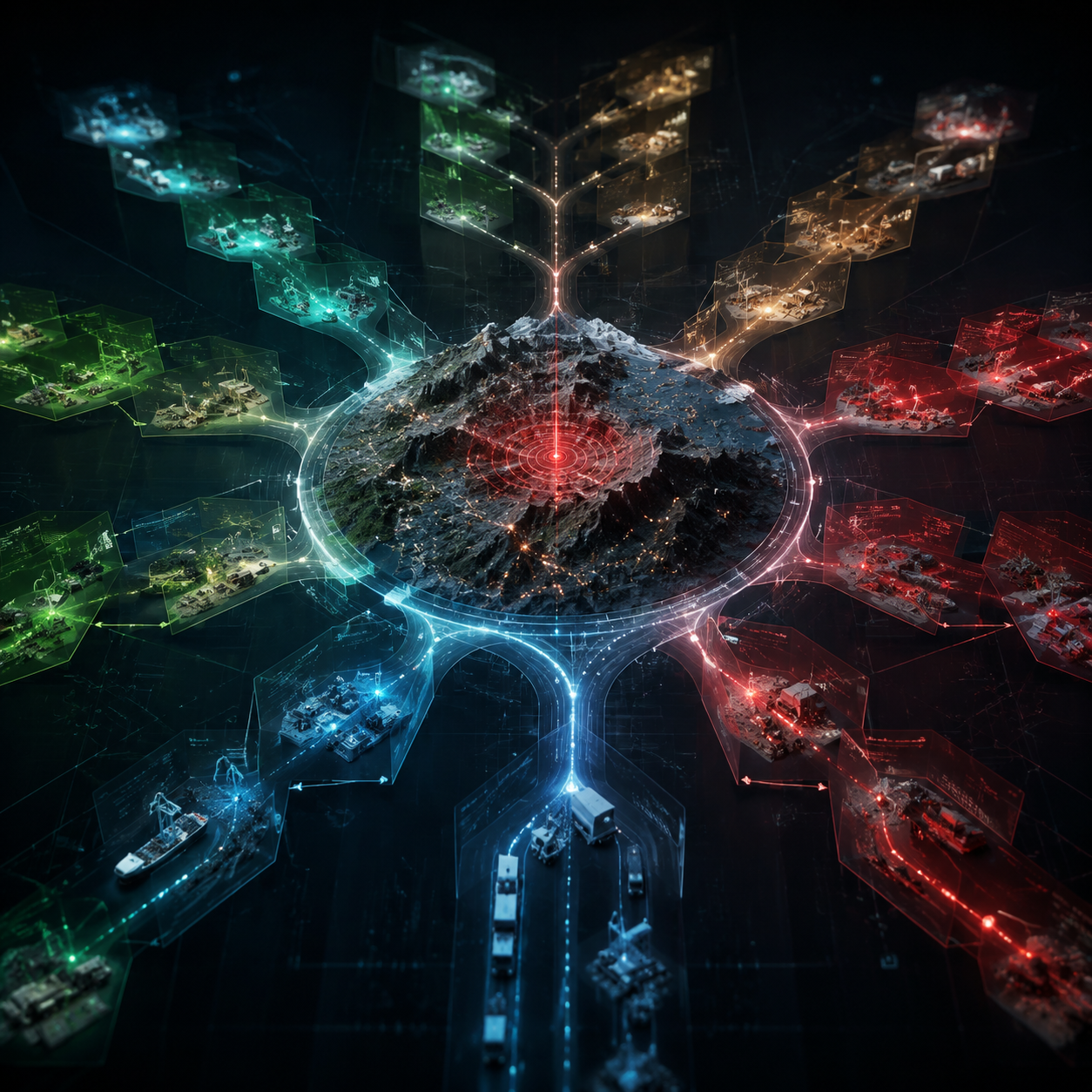
This is also where earthquake planning starts to resemble flood, hurricane, tsunami, and geopolitical disruption planning. The trigger changes, but the planning pattern remains recognizable: detect the event, map exposure, simulate constraints, select mitigations, and keep updating as ground truth improves. That is why earthquake planning belongs inside a broader disruption capability, alongside AI flood risk management, hurricane disruption planning, and tsunami response coordination.
The Multi-Tier Problem AI Cannot Skip
Most earthquake exposure is not conveniently labeled as earthquake exposure. It is buried in a second-tier supplier that does plating for a component family, a third-tier wafer dependency shared by multiple Tier-1s, a logistics node that everyone assumed was replaceable, or a sole-qualified material that appears nowhere in the executive supplier list.
That is why multi-tier disruption tracing deserves more attention than the first-alert layer. The warning tells teams where to look. The supplier graph tells them whether the event matters to them. The Cambridge agentic AI paper cites prior research that more than 50% of disruptions originate beyond Tier-1 and that only 40% of companies use dedicated tools to systematically log disruptions.[6] Those two facts explain a familiar failure mode: the company is not blind because information does not exist; it is blind because the information is fragmented, informal, and not connected to decision rights.
Knowledge graphs give AI a structure to reason over. They can connect a seismic event to a latitude-longitude point, the point to facilities, facilities to legal entities, entities to supplier tiers, supplier tiers to parts, parts to bills of materials, and bills of materials to revenue or service obligations. Without that graph, a model can summarize the earthquake. With it, the system can start asking operational questions: which SKUs depend on affected nodes, where dual sourcing is real rather than contractual, which substitutions require customer approval, and which inventory buffers are already allocated elsewhere.
This is the same infrastructure problem covered in knowledge graphs for multi-tier supply chain visibility. For earthquake planning, the graph does not need to be academically elegant. It needs enough reliable entity resolution, site-level mapping, part-level linkage, and tier-depth coverage to support decisions under time pressure.
| Planning Question | AI Capability That Helps | Data It Needs First |
|---|---|---|
| Which supplier sites are near the epicenter? | Geospatial matching and NLP entity extraction | Supplier facility locations, not just headquarters |
| Which products use those sites? | Knowledge graph traversal | Part, BOM, supplier, and product relationships |
| What happens if recovery takes 2 days versus 2 weeks? | Digital twin scenario simulation | Inventory, capacity, lead-time, lane, and qualification constraints |
| Which mitigation should be triggered first? | Agentic workflow with deterministic planning tools | Approved alternates, allocation rules, cost-to-serve, and decision owners |
The Taiwan case shows why that granularity matters. A buyer that only knew its Tier-1 electronics assembler might have seen no immediate issue. A buyer with mapped Tier-2 and Tier-3 dependencies could ask whether the assembler relied on Taiwan-origin wafers, substrates, chemicals, test capacity, or packaging steps. The second company has a chance to manage the event. The first company waits for a supplier email.
Where Agentic AI Fits Without Pretending to Be Autonomous Resilience
Agentic AI becomes interesting when the workflow requires several bounded actions, not one generic answer. One agent monitors seismic and news feeds. Another extracts affected entities. Another queries the supplier graph. Another runs impact scenarios. Another calls deterministic tools for inventory, allocation, sourcing, or transport options. The useful system is not a chatbot with a dramatic incident summary; it is a coordinated set of tasks that produces a traceable recommendation.
The Cambridge 2026 arXiv preprint is worth attention because the reported speed is unusually stark. In 30 synthesized automotive disruption scenarios, its agentic framework reduced response from an industry-average estimate of about five days to 3.83 minutes per event, at about $0.08 per analysis, with F1 scores from 0.962 to 0.991.[6] Those are not production guarantees. They are preprint results on synthesized scenarios, and real supplier records are usually messier than benchmark data. Still, the paper points to a credible use pattern: let agents do the repetitive collection, extraction, graph traversal, and tool calls while humans review the operational trade-offs.
The deterministic-tool part matters. If an AI agent recommends moving demand to an alternate supplier, the recommendation should be grounded in approved-source lists, qualification status, capacity constraints, transportation feasibility, and contractual limits. Otherwise the system simply moves uncertainty from the risk team to procurement, where someone still has to discover that the alternate cannot ship, cannot qualify, or cannot absorb volume.
The same agentic pattern appears outside natural disasters, such as geopolitical disruption and recall response. The details differ, but the governance lesson is similar: agents should be allowed to gather, structure, simulate, and recommend; humans still need escalation rules for customer allocation, supplier switching, expedited freight, and margin-impacting decisions. See the related discussions of agentic AI for geopolitical supply chain risk and AI agents in recall response.
What the Measured Outcomes Actually Say
There are encouraging numbers around AI-enabled disruption planning, but they do not all carry the same evidentiary weight. Trax Technologies cites MIT Center for Transportation & Logistics research saying organizations using AI-enhanced scenario planning achieve 35% faster disruption response and 23% lower costs.[7] The same Trax content cites Gartner 2025 figures that AI risk metrics deliver 28% faster response and 19% shorter recovery.[7] Those figures are useful directional evidence, but in this research set they are vendor-presented, second-hand attributions rather than independently reviewed primary sources.
Samsara’s disaster-preparedness research adds a different angle: appetite for AI is high, but crisis data is still weak. It reported that 89% of leaders believe AI will reshape disaster response within five years, while 64% lack real-time crisis data and 95% report financial losses from inability to locate critical assets.[8] That gap is familiar in physical operations. Executives want faster decisions; field teams are still reconciling asset location, site status, carrier position, and supplier confirmation.
A fair reading is that AI can compress response time when the organization has enough mapped data for the system to act on. It can also reduce analysis cost when repetitive monitoring and extraction tasks are automated. What it cannot do is conjure a qualified alternate source, harden a fab, repair a port, or turn a headquarters address into a site-level dependency map during the first hour of an earthquake.
The Deployment Gate Is Visibility, Not Model Ambition
A practical earthquake-planning architecture usually has four connected layers: signal ingestion, scenario simulation, multi-tier tracing, and mitigation workflow. The order matters. Alerts without supplier mapping create anxiety. Supplier graphs without simulation create static exposure lists. Simulations without deterministic constraints produce attractive but unusable options. Recommendations without governance create decision debt.
Control towers, risk platforms, and agentic systems can sit in different parts of that architecture. Interos and Resilinc appear in the Taiwan evidence as network-mapping and monitoring examples. Siemens illustrates digital twin scenario modeling. Trax points to AI-enabled scenario-planning outcomes. SeismicAI and similar providers sit closer to the event-detection layer. None of those categories removes the need to decide what data is authoritative, who owns supplier mapping, and which recommendations can be executed without a senior escalation.
For teams comparing investment choices, the useful shortlist is not “buy AI for earthquakes.” It is more specific: invest in the capabilities that shorten the time from event detection to exposure confirmation to feasible mitigation. That broader capability question is covered in AI capabilities for disruption planning, while control tower model selection is the adjacent architecture decision.
The Taiwan earthquake should leave planners with two conclusions at the same time. First, extraordinary recovery is possible when physical resilience, operating discipline, and prepared response routines are already in place. Second, most buyers cannot assume they would see the true blast radius unless their multi-tier network is mapped before the quake. AI can move earthquake disruption planning from reactive cleanup to proactive resilience, but only for supply chains that have given it a network detailed enough to reason over.
References
- Taiwan Quake Was a Lesson in Resiliency for the Global Supply Chain, SupplyChainBrain.
- Taiwan earthquake's impact on chip industry likely to be 'moderate', Manufacturing Dive.
- Navigating Semiconductor Supply Chain Disruptions: Insights from Taiwan's Earthquake, Interos.
- Supply chain shockwaves from the Taiwan earthquake, Resilinc.
- Beyond resilience: How AI and digital twins are rewriting the rules, SCMR.
- Automating Supply Chain Disruption Monitoring via an Agentic AI Approach, arXiv, 2026.
- AI-Powered Scenario Planning, Trax Technologies.
- SOCO Report: Disaster Preparedness in Physical Operations, Samsara.
Comments
Join the discussion with an anonymous comment.