
A global supply chain team does not need another alert telling it the Iran deal collapse is serious. By mid-July 2026, the operating picture is already ugly enough: the Strait of Hormuz closure has pushed commercial traffic down by more than 90%, removed more than 10 million barrels per day of oil production from the market, and been described by the IEA as the largest supply disruption in the history of the global oil market. Reported Gulf facility damage has reached $58 billion, while oil prices spiked roughly 58% in one month.[1]
Those are not abstract geopolitical indicators. They become purchase-order exceptions, supplier promises that need reconfirmation, carriers asking for revised terms, finance teams recalculating exposure, and executives asking whether the next shipment can still arrive before a line goes down. Tanker rerouting around the disrupted zone has added 10 to 14 days to transit times, raised fuel consumption by 30% to 35%, and pushed freight rates 25% to 35% above pre-crisis levels in cited snapshots.[2]
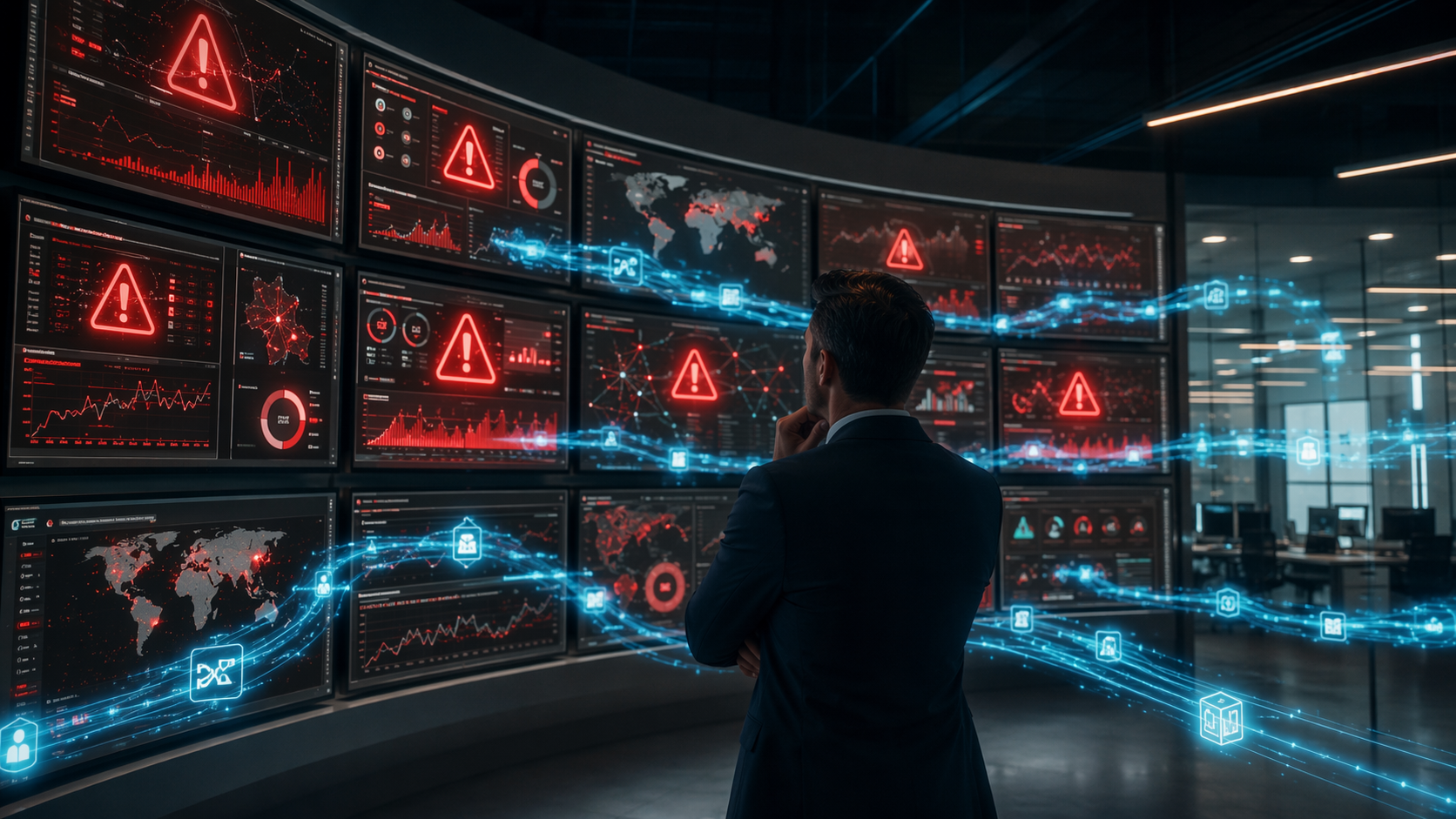
This is where the question becomes practical. The hard part is no longer detecting that a shock exists. The hard part is compressing the time between detection and governed action across procurement, logistics, treasury, compliance, and supplier management.
The dashboard-action gap is now the bottleneck
Traditional supply chain risk systems have improved in ways that matter. They ingest news, monitor ports and lanes, flag supplier locations, score exposure, and help teams separate a real disruption from background noise. In a contained event, that signal quality can be enough to buy time.
The Iran shock is not contained. Energy cost, vessel availability, insurance exposure, regional supplier continuity, sanctioned-party screening, and customer allocation all move at once. A dashboard can show six red indicators on one screen. It cannot, by itself, decide which open purchase orders should be pulled forward, which alternate suppliers should receive confirmation requests, which shipments should be rerouted, which customers need allocation notices, and which cost thresholds require treasury approval.
That dead space is familiar inside large enterprises. Procurement waits for logistics to confirm lane options. Logistics waits for procurement to decide whether the supplier can ship from a different origin. Finance waits for cost exposure estimates. Compliance wants screening before anyone moves too quickly. Senior leaders ask for a scenario view, and the people closest to the work spend the next several hours stitching together spreadsheets, emails, supplier portal updates, and carrier notes.
GEP described the same capability gap in early 2026: many current AI analytics tools can summarize news and flag risk, but they rarely execute coordinated actions across procurement, logistics, and finance workflows.[3] That distinction matters more than the label on the software. A tool that detects a crisis but leaves every response step to manual coordination is still an alerting system, even if it uses a sophisticated model.
What agentic AI changes in a crisis workflow
Agentic AI is being used loosely in the market, so the useful test is operational. In a supply chain crisis, an agentic system should not merely describe the risk. It should connect a verified signal to a constrained workflow: identify exposed suppliers, model alternatives, launch confirmation tasks, recommend or trigger routing changes, escalate exceptions, and preserve an audit trail.
| Crisis need | Traditional analytics response | Agentic workflow response |
|---|---|---|
| A choke point disrupts traffic | Flag affected lanes and summarize news | Map open orders, shipments, suppliers, and customer commitments tied to the lane |
| Fuel and freight costs jump | Show cost movement and exposure dashboards | Model cost thresholds, route alternatives, and approval requirements |
| Supplier continuity is uncertain | Identify supplier locations near the affected region | Send supplier confirmation requests and track responses against production priorities |
| Executives need a decision | Prepare manual scenario slides | Generate governed options with owners, constraints, and escalation points |
Reslinc’s March 2026 Iran-related risk snapshot, for example, described agentic capabilities such as mapping tier-1 through tier-3 supplier exposure to Persian Gulf routes, modeling alternate scenarios, and automating supplier confirmation workflows.[2] That is vendor material, so it should not be read as independent proof of market-wide capability. It is still useful as a description of where the category is moving: from passive visibility toward response orchestration.
The important word is orchestration. A planner does not need an AI system to say “Hormuz risk high” for the seventh time. The planner needs the system to know which approved suppliers use exposed routes, which materials are single-sourced, which shipments are within the decision window, which alternate lanes breach cost tolerances, and which approvals must happen before a workaround can move from suggestion to execution.
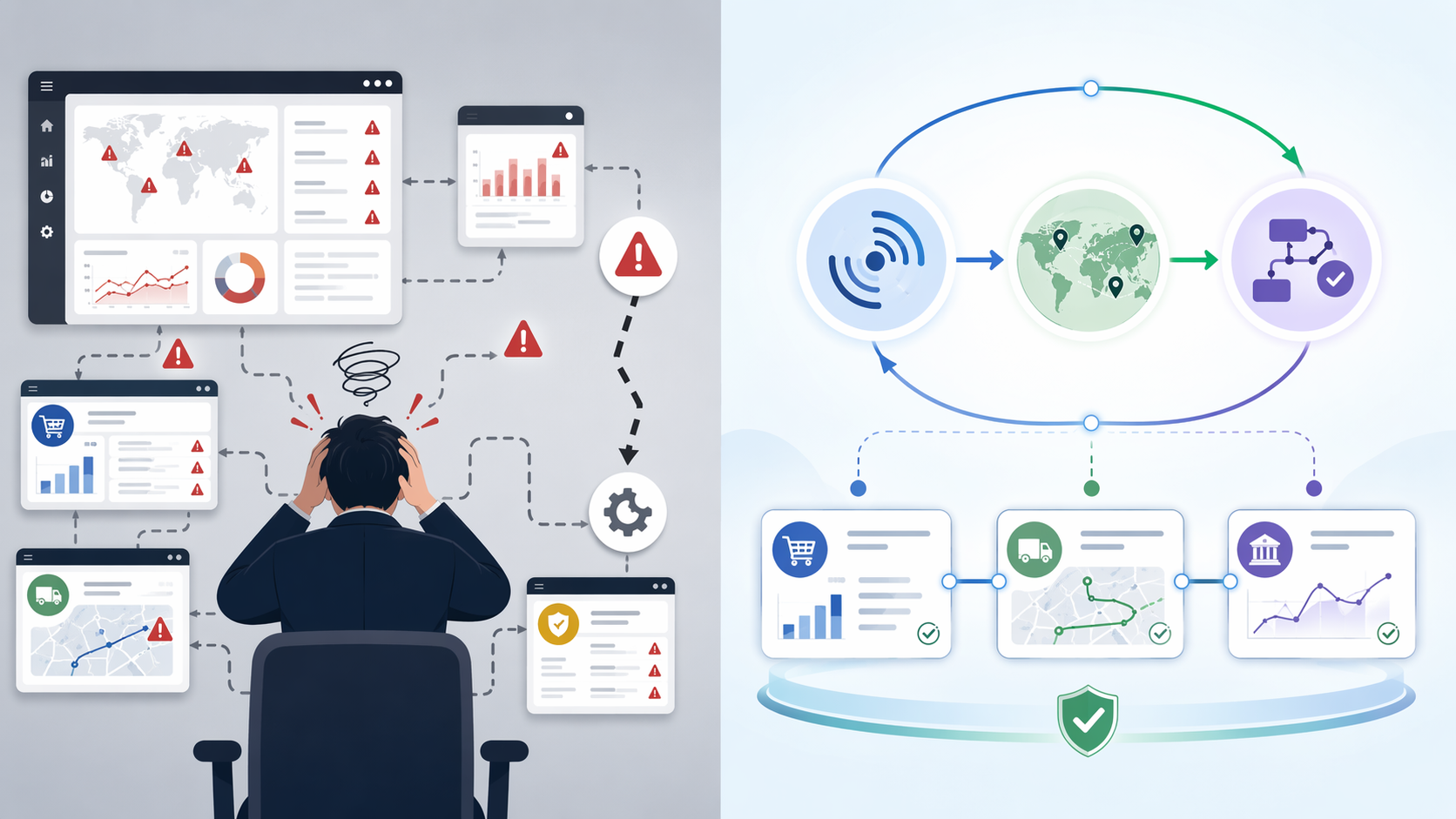
The Iran collapse exposes multi-front latency
A single-lane disruption can often be handled by a logistics team with a playbook. A supplier bankruptcy can often be handled by procurement with qualification support. A currency or fuel shock can often be handled by finance and pricing governance. The Iran deal collapse is harder because these events interact.
When commercial traffic through a critical energy and shipping corridor falls by more than 90%, the rerouting decision is not just a transportation question.[1] Longer transit affects safety stock. Higher fuel consumption affects landed cost. Freight-rate escalation changes customer margin and supplier payment terms. Oil production loss feeds input-cost assumptions far beyond the vessel currently at sea. The operational queue expands faster than a weekly risk committee can process it.
This is why broad geopolitical frameworks are useful only when they sharpen action. MIT Sloan Management Review’s three-part geopolitical risk framing — understand, anticipate, adapt — is a clean way to describe the management challenge, but the adapt step is where enterprises tend to expose their weakness.[4] Many companies can understand the event. Fewer can anticipate the second-order operational effects. Fewer still can adapt quickly without turning every exception into a meeting.
The World Food Programme’s warning that cascading effects could leave 45 million additional people facing acute food insecurity shows the same propagation pattern outside corporate supply chains: energy, transport, availability, and affordability do not fail in neat sequence.[5] For enterprise operators, the lesson is narrower but urgent. A geopolitical shock becomes a supply chain crisis when indirect effects hit the operating model faster than decision rights can move.
Where autonomous triggers actually matter
The most valuable agentic workflows are not the flashiest. They are the ones that remove avoidable waiting from repeatable crisis actions while leaving irreversible or high-risk decisions under human governance.
Supplier confirmation
In a Hormuz-linked disruption, an agentic system can identify suppliers and sub-tier suppliers tied to exposed routes, then issue structured confirmation requests: current inventory, next shipment date, origin port, alternate lane availability, constrained raw materials, and expected cost changes. The point is not to eliminate the supplier manager. It is to keep the supplier manager from spending the first day building the contact list and email template.
Rerouting and inventory trade-offs
When rerouting adds 10 to 14 days and fuel consumption rises 30% to 35%, the question is not simply whether a lane is open.[2] The question is which orders can absorb the delay, which customers require allocation, which plants need expedited replenishment, and which cost increases breach approval thresholds. A useful agentic workflow can generate route and inventory scenarios, attach cost and service implications, and push exceptions to the right approver instead of broadcasting the same alert to everyone.
Procurement execution
GEP’s Iran-related commentary points toward procurement workflow automation as part of the agentic shift.[3] In practical terms, that means the system can prepare alternate-source recommendations, check approved vendor status, draft purchase-order changes, route approvals, and update buyers on blocked items. For many enterprises, even partial automation here would be meaningful because purchase-order changes often sit at the intersection of policy, price, supplier capacity, and customer priority.
Financial exposure and escalation
Freight rates 25% to 35% above pre-crisis levels are not just a logistics metric.[2] They alter margin, working capital, hedging assumptions, and customer pricing conversations. An agentic workflow should be able to flag when a workaround crosses a financial threshold, attach the scenario evidence, and route it to treasury or commercial leadership. Without that connection, the logistics team may solve the physical movement problem while creating an unapproved financial exposure.
Adoption momentum is real, but capability is uneven
The market is moving toward this model, but it is not already solved. Gartner predicted in March 2026 that 60% of supply chain disruptions will be resolved without human intervention by 2031, with agentic AI as a primary enabler.[6] That is a forecast about where operating models may go, not evidence that most companies can autonomously resolve complex geopolitical disruptions today.
The adoption signal is still important. In an October 2025 Gartner survey, 55% of supply chain leaders said they expected agentic AI to change hiring and operating models within two years.[7] Expectations are not behavior, and behavior is not effectiveness. But the survey does suggest that supply chain leaders are no longer treating agentic AI as a distant research topic.
Vendor examples should be read in that context. Reslinc emphasizes multi-tier mapping and supplier-response workflows. Interos has published analysis around global choke points. GEP focuses on procurement workflow automation. These are category signals, not a buyer’s proof that any one platform can safely run crisis response end to end. The right evaluation question is more specific: which decisions can the system execute under existing policy, which decisions can it prepare for approval, and which decisions must remain human-owned?
That same distinction shows up in other crisis-response patterns. AI-driven disruption planning can coordinate phases of response, as in ChainSignal’s discussion of how AI coordinates tsunami supply chain response in five phases. Agentic deployments in industrial settings, such as ChainSignal’s look inside GE Aerospace’s agentic AI supply chain transformation, are useful because they show where automation attaches to fulfillment, sourcing, and maintenance workflows rather than floating above operations as a separate intelligence layer.
Governance is the condition for trust
Autonomous execution is only useful if it is bounded. A system that can trigger supplier outreach, prepare purchase-order changes, or recommend rerouting also needs clear limits on when it can act, when it must ask, and when it must stop.
- Source transparency: risk inputs should show whether they come from independent reporting, public data, vendor interpretation, or internal records.
- Workflow boundaries: the system should know which actions are pre-approved, which require functional approval, and which require executive escalation.
- Audit trails: every recommendation, automated task, approval, override, and data source should be reviewable after the event.
- Threshold controls: cost, compliance, customer allocation, and supplier-change limits should determine whether automation proceeds or pauses.
- Human ownership: named roles should remain accountable for high-consequence decisions, especially where legal, sanctions, customer, or safety risks are involved.
This is not a conservative footnote. It is what separates useful agentic AI from reckless automation. In a geopolitical crisis, bad speed can be as damaging as delay. A reroute that ignores compliance exposure, a supplier substitution that bypasses qualification, or a cost decision that evades treasury controls can create a second crisis while solving the first.
The Iran deal collapse makes manual response orchestration look structurally too slow for globally exposed supply chains. It also clarifies what agentic AI has to earn. Alerting is no longer enough. Autonomous execution deserves trust only when it connects signal, scenario, and action through clear workflows, audit trails, escalation rules, and source-transparent risk inputs.
References
- Economic impact of the 2026 Iran war, Wikipedia.
- Iran Risk Snapshot, Reslinc, March 2026.
- GEP blog on agentic AI and supply chain geopolitical risk, GEP, March 2026.
- Geopolitical Risk: A Three-Pillar Framework, MIT Sloan Management Review.
- World Food Programme data on cascading effects and acute food insecurity, World Food Programme.
- Gartner Says 60% of Supply Chain Disruptions Will Be Resolved Without Human Intervention by 2031, Gartner, March 18, 2026.
- Gartner survey on agentic AI changing supply chain hiring and operating models, Gartner, October 2025.
Comments
Join the discussion with an anonymous comment.