
Seconds of earthquake warning can stop a machine, slow a train, open a warehouse door, or give people time to move away from shelves. They do not give a procurement team time to qualify an alternate supplier, pull inventory forward, reroute ocean freight, change customer commitments, or decide which distribution center should carry extra buffer stock.
That is the planning gap for supply chain earthquake preparedness in 2026. The question is not whether AI can make earthquakes harmless. It is whether a forecast with days or weeks of lead time is reliable enough to change tomorrow’s work before shaking begins.
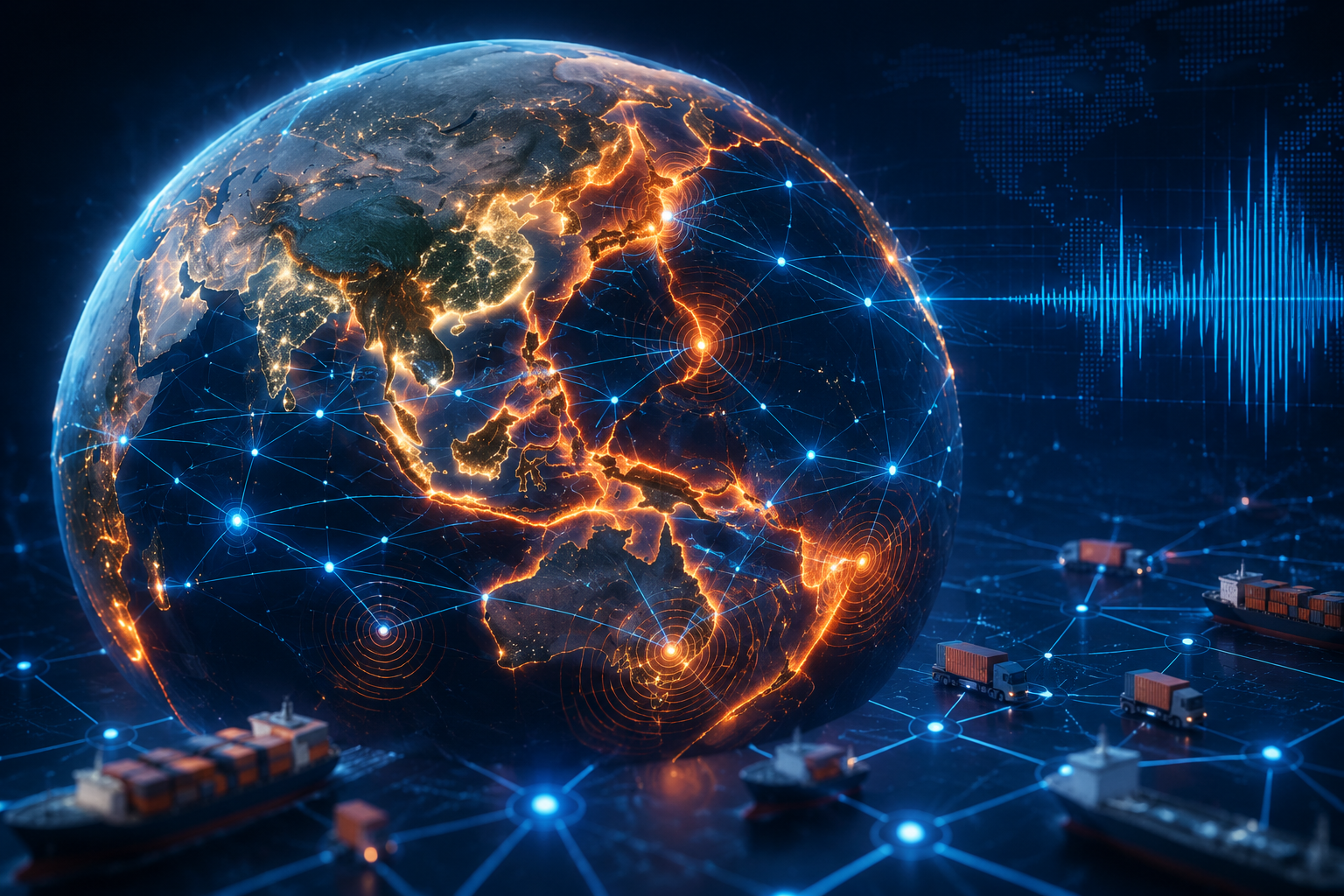
The most useful answer starts with a narrow claim: AI earthquake forecasting has become operationally interesting in select regions, but it is not mature enough to become an automatic trigger for inventory moves, supplier shifts, or transport rerouting. The value is earlier, imperfect signal. The danger is treating that signal as certainty.
The UT Austin China Trial Is the Right Place to Start
The strongest public evidence for pre-event AI earthquake forecasting is a University of Texas at Austin algorithm tested in China. During a seven-month trial, the system predicted 70% of earthquakes one week before they happened, missed one earthquake, and issued eight false warnings. The work was published in the Bulletin of the Seismological Society of America in 2023.[1]
For a supply chain team, one week is a meaningful interval. It is long enough to review open purchase orders, ask logistics providers for routing alternatives, check finished-goods coverage near exposed demand centers, inspect business-continuity plans for high-risk facilities, and warn regional procurement teams that a decision window may be coming.
It is also short enough that actions can become expensive quickly. If a forecast leads a company to expedite parts, hold shipments, increase warehouse labor, or shift production away from a region, the false warning is not just a model-quality statistic. It becomes a cost center with a name on it.
That is why “70% predicted” should not be translated into “safe to automate.” The trial result says the model found a real signal in a specific test setting. It does not prove that the same performance will hold across every tectonic environment, every asset footprint, or every supplier network. It also does not answer the operating question: how much false-alarm cost can the business tolerate for each avoided disruption?
| Trial result | Why it matters for supply chain planning |
|---|---|
| One week of lead time | Useful for preparedness review, low-regret actions, and selective escalation |
| 70% of earthquakes predicted | Promising recall, but not a guarantee that exposed sites are safe when no alert appears |
| One missed earthquake | Post-event monitoring and emergency response remain necessary controls |
| Eight false warnings | Cost thresholds matter before any inventory, routing, or supplier action is triggered |
| Seven-month China trial | Performance should be validated region by region before enterprise rollout |
A miss has one kind of consequence: the company remains exposed and must rely on emergency response, facility preparedness, insurance, and post-event visibility. A false warning has another: the company may spend money, disturb suppliers, crowd logistics capacity, or create customer noise for an event that does not occur. Both belong in the business case.
The practical lesson is not to ignore the forecast. It is to tier the response. A one-week forecast might justify checking backup power at a semiconductor supplier, confirming truck capacity near a port, or asking a regional team to freeze nonessential maintenance at a vulnerable facility. It may not justify moving weeks of inventory across the network unless the affected node is critical, the confidence band is high, and the cost of inaction is clearly larger than the cost of a false alarm.
Aftershock AI Shows Progress, But It Solves a Different Problem
Another useful signal comes from aftershock modeling. Researchers from the British Geological Survey and the University of Edinburgh developed machine-learning models that forecast aftershock risk in seconds, with quality comparable to traditional ETAS models that can take hours or days. The models were trained on data from California, New Zealand, Italy, Japan, and Greece, and the work was published in Earth, Planets and Space in November 2025.[2]
That is operationally valuable, especially after a first event when teams are deciding whether to re-enter facilities, resume loading, dispatch repair crews, or reopen transport lanes. It is not proof that AI can forecast the initial earthquake before it happens. Aftershock risk sits in a different decision window: the network is already disrupted, people are waiting for the next instruction, and the question is how to manage continuing hazard.
For supply chain resilience, the distinction matters. Pre-event forecasting supports preparedness decisions. Post-event and aftershock tools support safety, damage assessment, recovery sequencing, and restart decisions. A mature earthquake-risk stack may need both, but they should not be evaluated as if they do the same job.
For the post-event side of the problem, the complementary workflow is covered in How AI Monitors Earthquake Risk in Multi-Tier Supply Chains. This article stays on the earlier and less settled question: whether a forecast before the event should influence preparedness.
Why Imperfect Warning Still Matters
Earthquake exposure is not only a facilities problem. It is a network problem. Munich Re analysis cited in July 2026 reported that a repeat of the 1906 San Francisco earthquake would produce more than $200 billion in direct losses, while the USGS places the 30-year probability of a magnitude 6.7 or greater Bay Area earthquake at 63% to 72%.[3]
Those numbers do not tell a procurement team which shipment to move next Tuesday. They do explain why a one-week signal, even an imperfect one, deserves attention in regions where facilities, ports, suppliers, and demand centers cluster along the same hazard corridor.
Taiwan shows the same problem in a more concentrated form. The island produces about 92% of the world’s most advanced chips and about 60% of global semiconductor output; Interos, citing USITC data, noted that a worst-case disruption could affect $1.6 trillion, or roughly 8% of US GDP.[4]
A forecast does not create spare advanced-chip capacity. It can, however, change the order in which teams check constraints. A company with exposed electronics supply might review allocation rules, customer priority lists, alternate bill-of-material options, and in-transit inventory before an event rather than after every buyer in the market is trying to do the same thing.
The lasting damage can also be relational. Research from Bayes Business School on the 2011 Japan earthquake found that affected firms reduced supplier counts after the disaster, and that their customer networks also shrank as buyers avoided disrupted nodes.[5]
That finding is easy to underweight in a dashboard. The disruption is not finished when a facility reopens. Buyers may shift demand, suppliers may narrow their relationships, and the network may come back smaller or less resilient than before. Earlier warning is useful if it helps preserve confidence as well as protect assets.
Weeks-Ahead Claims Need a Different Evidentiary Standard
The most operationally attractive claims are the ones with the longest lead time. AstroTeq, described in a July 2026 Risk & Insurance interview, says its model uses deep-space cosmic-radiation data, satellite imagery, and AI/ML to forecast earthquakes up to 25 days in advance. The same article reports claimed damage-reduction ratios ranging from 1:7 to 1:160 depending on industry.[3]
Twenty-five days would be a different planning instrument. It could support inventory positioning, contract review, supplier outreach, freight-mode changes, and customer allocation planning with less panic and more room for finance approval. It is exactly the kind of lead time supply chain teams wish seconds-only systems could provide.
But the source matters. The AstroTeq material is a CEO interview, not peer-reviewed validation. That does not make it useless; vendor disclosures can identify where the market is going. It does mean a resilience team should treat the claim as something to test under controlled conditions, not as a performance benchmark to write into operating policy.
A pilot should ask simple questions before it asks ambitious ones: Which regions have retrospective performance evidence? How are false warnings counted? How are missed events counted? Are forecasts calibrated by magnitude and location, or presented as broad regional concern? Can the model show confidence levels that map to specific actions? Can the provider explain when the model should not be used?
The Workflow Matters More Than the Alert
An earthquake forecast becomes useful only when it enters a decision system. CETaS at the Alan Turing Institute frames AI-enabled early warning as a way to mitigate supply chain threats by turning forecast data into planning decisions, rather than leaving it as a passive signal.[6]
For earthquake planning, the first step is exposure mapping. The forecast region has to be overlaid with owned facilities, supplier sites, contract manufacturers, ports, airports, rail corridors, warehouses, and customer-critical lanes. A generic alert for a broad seismic zone is rarely enough; the team needs to know which nodes fall inside the concern area and which products or customers depend on them.
Everstream Analytics describes a scenario-planning workflow in which teams can geofence an epicenter radius, identify impacted supplier, warehouse, and port nodes, and score incident risk across more than 40 location-based risk dimensions.[7]
That kind of architecture is where AI earthquake forecasting belongs: not as a separate miracle dashboard, but as another input into scenario planning, control-tower review, and a digital twin supply chain model that already understands products, lanes, lead times, inventory, and revenue exposure.
A Practical Decision Ladder
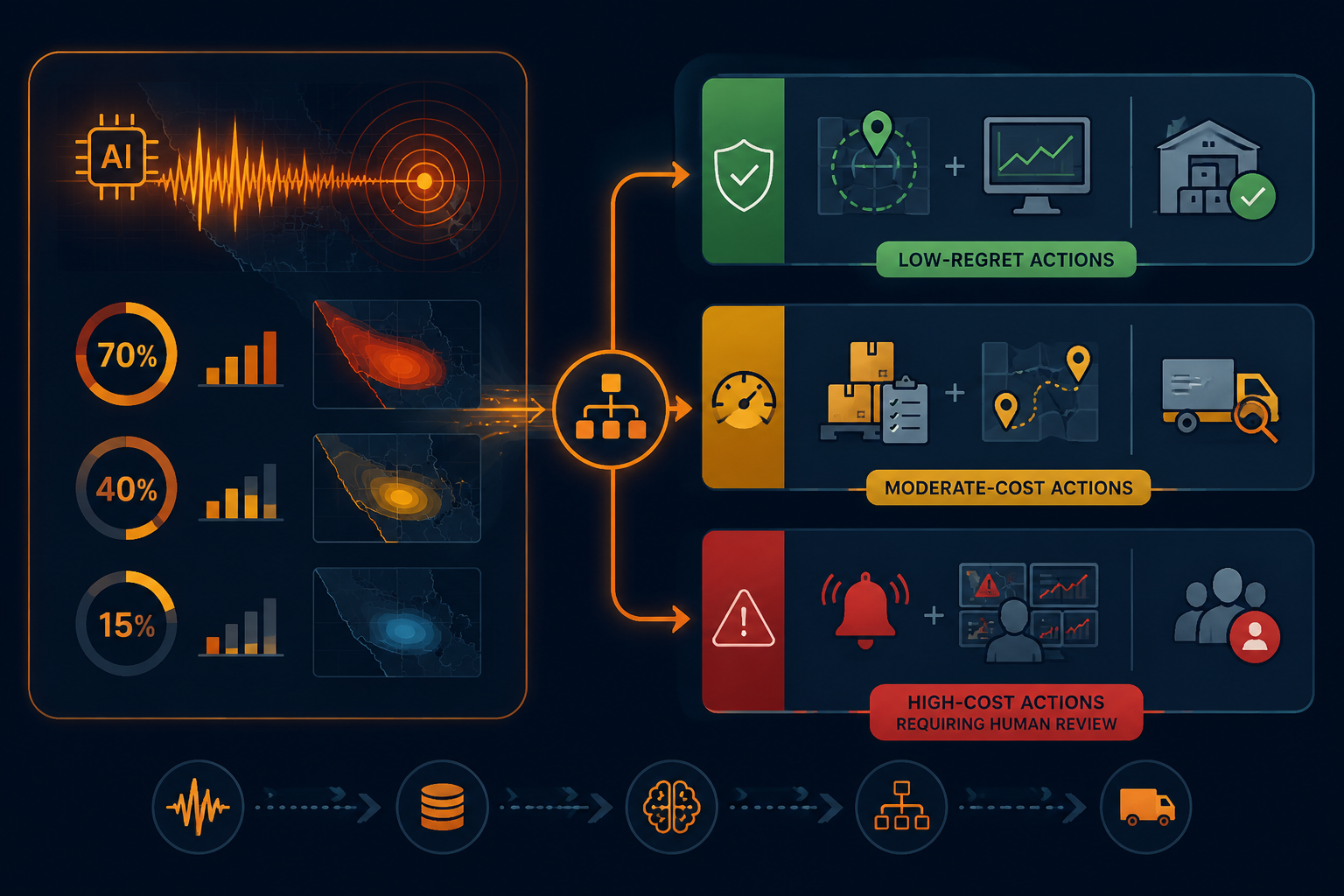
The response ladder should separate low-regret preparation from costly intervention. That separation prevents a probabilistic forecast from becoming an uncontrolled spending trigger.
| Forecast use | Example action | Review standard |
|---|---|---|
| Low-regret monitoring | Geofence exposed nodes, confirm contacts, review open orders, check backup plans | Can be triggered at lower confidence because cost and disruption are limited |
| Moderate-cost preparation | Hold optional shipments, review alternate routings, stage critical spares, increase supplier check-ins | Requires asset criticality, regional exposure, and forecast confidence review |
| High-cost intervention | Move inventory, change production sequence, shift suppliers, reroute major freight flows | Requires human approval, cost threshold, and documented false-alarm tolerance |
| Post-event control | Assess damage, monitor aftershocks, confirm supplier status, sequence recovery | Remains necessary even when pre-event forecasts are used |
A forecast-confidence band should not be a decorative field on the screen. It should decide who is notified, how quickly a scenario is opened, which assets are reviewed, and what approvals are needed before money moves.
The supplier tier matters as much as the map. A tier-one supplier with redundant production may need only monitoring. A tier-two component supplier with a long qualification cycle may deserve earlier escalation, even if its spend is small. A logistics hub may be less important because of its address than because every alternate route is already constrained.
This is also where adjacent natural-disaster playbooks help. Flood and weather-emergency planning already force teams to connect forecasts with exposed assets, lead times, and escalation rules. The evidence patterns differ, but the operating discipline is similar; teams comparing use cases can draw on AI real-time flood monitoring and AI weather-emergency planning without pretending earthquakes behave like storms.
What to Ask Before Piloting AI Earthquake Forecasting
A useful pilot does not start with a global rollout. It starts with a region where exposure is high, the business can define what it would do with warning, and the provider can show performance evidence for that tectonic environment.
- Region: Has the model been tested in the specific seismic environment where the company has assets or suppliers?
- Lead time: Is the forecast window seconds, days, one week, or longer, and which supply chain actions actually fit that window?
- Error profile: How many misses and false warnings occurred in testing, and how are those events defined?
- Action threshold: Which forecast confidence level opens a scenario, which level notifies executives, and which level permits costly intervention?
- Asset linkage: Can the forecast be joined to supplier tiers, logistics nodes, inventory positions, customer commitments, and recovery plans?
- Audit trail: Can the team reconstruct why it acted or chose not to act after a forecast?
The audit trail is not bureaucracy. It is how the team learns whether the model improved decisions. After a false warning, the review should not stop at “the earthquake did not happen.” It should ask which actions were low-regret, which were wasteful, which approvals were too slow, and whether the next threshold should move.
The same discipline applies after a missed event. The team should compare the forecast output, the exposed-node map, the actual damage, and the recovery sequence. A miss does not automatically disqualify the tool, but it should narrow how the tool is used until regional performance is better understood.
For companies evaluating broader risk platforms, earthquake forecasting should be one test case inside a larger architecture. The same procurement questions raised in Choosing an AI Platform for Geopolitical Supply Chain Risk apply here as well: evidence quality, integration, explainability, governance, and workflow fit matter more than a dramatic demo.
Where This Belongs in the Preparedness Stack
AI earthquake forecasting should sit between long-range seismic exposure analysis and immediate earthquake early warning. It is not a replacement for building standards, supplier diversification, emergency response, insurance, or post-event monitoring. It is an additional planning input for the narrow window where a team may still be able to reduce exposure without pretending the event is certain.
The strongest current use cases are in high-exposure regions where the company already knows what low-regret action looks like. A manufacturer with a critical supplier near a known seismic zone may use a one-week forecast to confirm capacity, inspect inventory coverage, and prepare customer allocation rules. A retailer with many interchangeable suppliers may do less. A semiconductor-dependent company may watch Taiwan forecasts differently from a company whose Taiwan exposure is indirect and buffered.
The weakest use case is automated disruption management. A model output should not directly move inventory, reroute shipments, or switch suppliers without human review. The cost of false positives is too real, and the public evidence is still too region-specific.
For teams building an AI roadmap, earthquake forecasting belongs in the emerging category of high-impact supply chain applications: worth monitoring, worth piloting where exposure is material, and worth integrating carefully into planning workflows. It should be evaluated alongside the broader AI use case library for supply chain management, not treated as a standalone bet on prediction science.
The procurement judgment for Q3 2026 is bounded. AI earthquake forecasting is credible enough to monitor and pilot in selected seismic regions, especially where exposed nodes are critical and low-regret preparation actions already exist. It is not mature enough to run automatic rerouting, inventory moves, or supplier shifts without human review, regional validation, and cost thresholds.
The responsible unit of adoption is not “AI predicts earthquakes.” It is “AI adds earlier, imperfect signals to supply chain risk planning.”
References
- AI-Driven Earthquake Forecasting Shows Promise in Trials, UT Austin News, October 5, 2023.
- Research shows AI earthquake tools forecast aftershock risk in seconds, PreventionWeb, November 2025.
- Shifting to Meaningful Earthquake Preparedness with AI and Deep Space Data, Risk & Insurance, July 2026.
- Navigating Semiconductor Supply Chain Disruptions: Insights from Taiwan’s Earthquake, Interos.
- From earthquakes to outbreaks: how supply chain networks are affected by catastrophe, Bayes Business School, July 2020.
- Mitigating Supply Chain Threats: Building Resilience Through AI-Enabled Early Warning, CETaS / Alan Turing Institute.
- Scenario Planning for Supply Chain Risk Management, Everstream Analytics.
Comments
Join the discussion with an anonymous comment.