
A tsunami does not give a supply chain the courtesy of a planning cycle. The warning window can collapse detection, evacuation, port exposure, supplier impact, carrier decisions, and customer commitments into the same narrow operating period. For a logistics team, the hard question behind AI for tsunami supply chain logistics is not whether an algorithm can draw a better dashboard. It is whether the first credible signal can trigger useful action before roads close, terminals suspend operations, and planners discover that a tier-4 material source sits inside the disruption zone.
That is why detection speed matters, but only as the first handoff. UNESCO’s Intergovernmental Oceanographic Commission has described AI-based tsunami prediction work, drawing on Cardiff University research, that analyzes earthquake hydrophone signals and assesses potential global coastline impact in under 30 seconds.[1] That does not make buoy confirmation obsolete. It changes the latency budget. A system that can flag probable exposure in seconds gives enterprise platforms more time to stage inventory moves, identify exposed suppliers, freeze risky releases, reroute freight, and prepare human review before the official picture is fully settled.
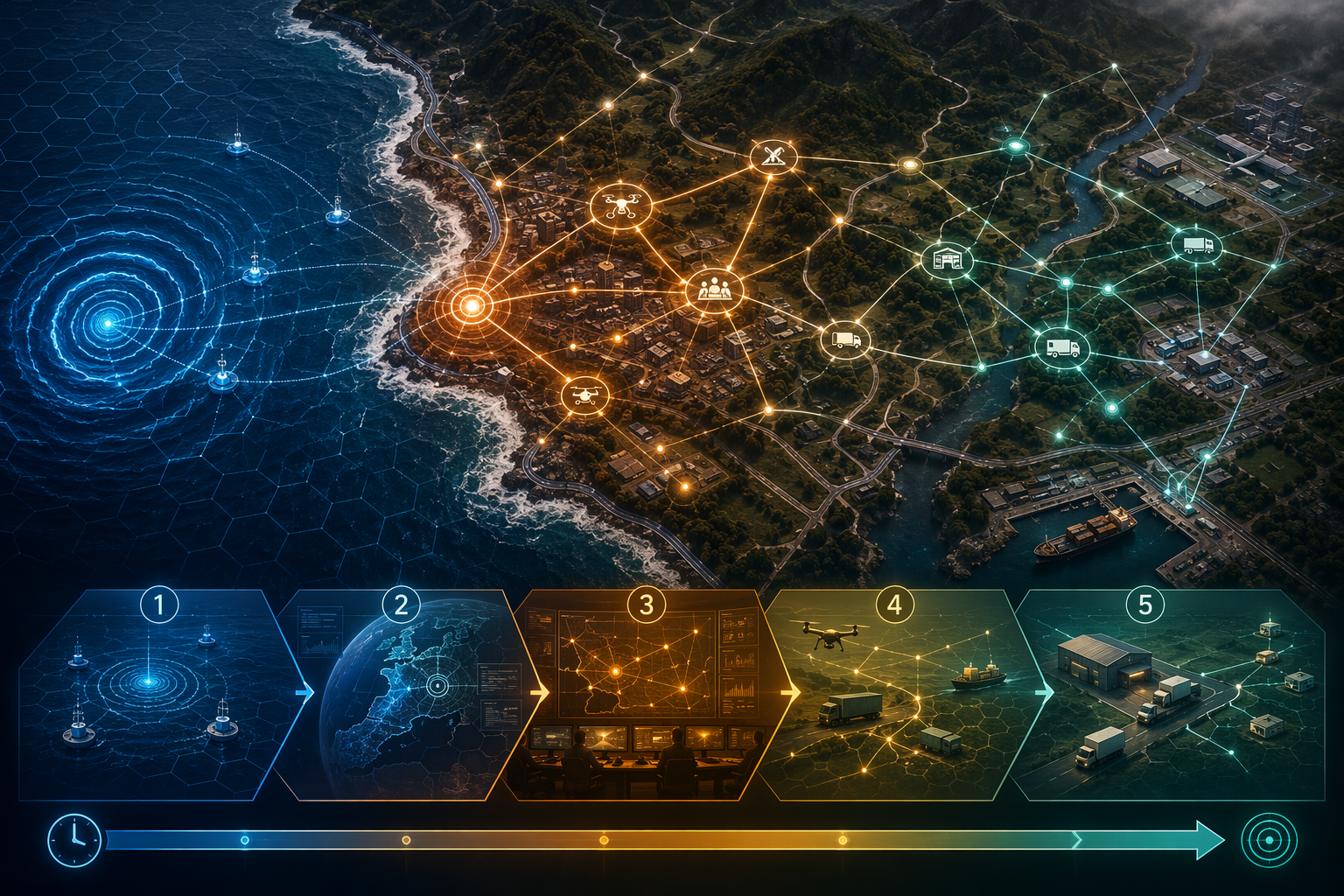
The useful architecture is a five-phase operating stack: detection, preparation, impact assessment, response, and recovery. No single vendor offers that full stack as a finished product. In practice, it is assembled from early-warning models, inventory systems, supplier intelligence, control tower visibility, agentic workflow tools, scenario planning, and governance processes that decide when software acts and when people intervene.
| Phase | AI role | Operational handoff |
|---|---|---|
| Detection | Identify likely tsunami exposure faster than conventional confirmation cycles alone | Send a structured alert to planning, inventory, sourcing, and logistics systems |
| Preparation | Pre-position inventory and define trigger rules before an event | Convert a warning into executable stock, lane, and facility actions |
| Impact assessment | Map exposed ports, roads, facilities, customers, and multi-tier suppliers | Prioritize what must be protected, rerouted, substituted, or escalated |
| Response | Coordinate carrier switching, modal rerouting, sourcing alternatives, and scenarios | Execute governed decisions while humans retain authority over exceptions |
| Recovery | Feed event data back into assumptions, models, supplier maps, and playbooks | Improve the next detection-to-action cycle rather than writing a static postmortem |
Detection only matters when it starts a workflow
Traditional tsunami warning depends on a chain of observation and confirmation: seismic activity, ocean behavior, buoy data, modeling, and official communication. AI hydrophone analysis does not remove the need for that chain. It creates an earlier probabilistic signal that can be treated differently from a public warning: not as permission to act recklessly, but as permission to prepare controlled actions.
In a mature supply chain environment, the first signal should not land as an email. It should arrive as structured event data: affected coastlines, likely time windows, confidence levels, vulnerable nodes, and escalation rules. A transportation management system can then identify shipments approaching exposed ports. An order promising engine can flag commitments dependent on those lanes. A procurement system can surface suppliers in likely inundation zones. A control tower can show which actions are reversible and which require senior approval.
The difference between a 30-second model and a slower confirmation cycle is not that the enterprise suddenly has certainty. It is that uncertainty becomes visible early enough to sort actions by reversibility. Holding a container outside a port call, preparing an alternate carrier tender, or freezing a noncritical release is not the same as declaring a full network emergency. Tsunami response needs those distinctions because the decision clock is short and the cost of both delay and overreaction is real.
Preparation decides whether the signal has anything useful to trigger
Inventory pre-positioning is where many AI resilience plans become either practical or decorative. Humanitarian supply chain research has documented AI-driven pre-positioning models associated with response-delay reductions of 21% or more.[2] That figure is useful, but it should not be read as a universal tsunami promise. It says that better placement and allocation logic can reduce delay when the data, constraints, and operating procedures are ready enough for the model to act on them.
For enterprise teams, the preparation problem is less glamorous than the optimization chart. The model needs clean facility master data, usable inventory status, current lane options, substitution rules, shelf-life constraints, customer priority rules, and authority to recommend or trigger movement. A data readiness assessment for AI inventory optimization is often the unglamorous prerequisite for making tsunami triggers operational rather than theoretical.[3]
A plausible tsunami playbook might pre-stage critical maintenance parts away from a coastal warehouse during elevated seismic risk, reserve air capacity for medical or semiconductor components, or shift replenishment from a port-dependent distribution center to an inland node. Those actions are only safe if planners know what stock exists, what demand it protects, which customers or sites outrank others during scarcity, and which moves can be reversed if the wave threat does not materialize.
This is where broader AI supply chain ROI benchmarks belong: as context, not proof. ChainSignal’s AI supply chain ROI analysis and McKinsey adoption outcomes cited in industry sources point to material gains in logistics cost, inventory levels, and service levels for early adopters, including 15% lower logistics costs, 35% better inventory levels, and 65% improved service levels.[4] Those numbers help justify investment in the underlying capabilities. They do not guarantee that a tsunami-specific network will perform unless the trigger logic, data quality, and human authority model are designed before the event.
Impact assessment has to look past the inundation map
The map that matters to a supply chain is not only the wave map. It is the dependency map. A tsunami can close a port, damage a coastal industrial zone, interrupt a road corridor, disable a utility, strand labor, or cut off a small upstream supplier whose name never appears in the enterprise resource planning system.
That blind spot is not hypothetical. A 2021 McKinsey survey found that only 2% of companies had visibility beyond tier-2 suppliers.[5] For tsunami exposure, that is a serious gap. A manufacturer may know its tier-1 contract manufacturer and perhaps a tier-2 component source, while the actual raw material, chemical, packaging, tooling, or specialty processing dependency sits several tiers deeper in a coastal zone.
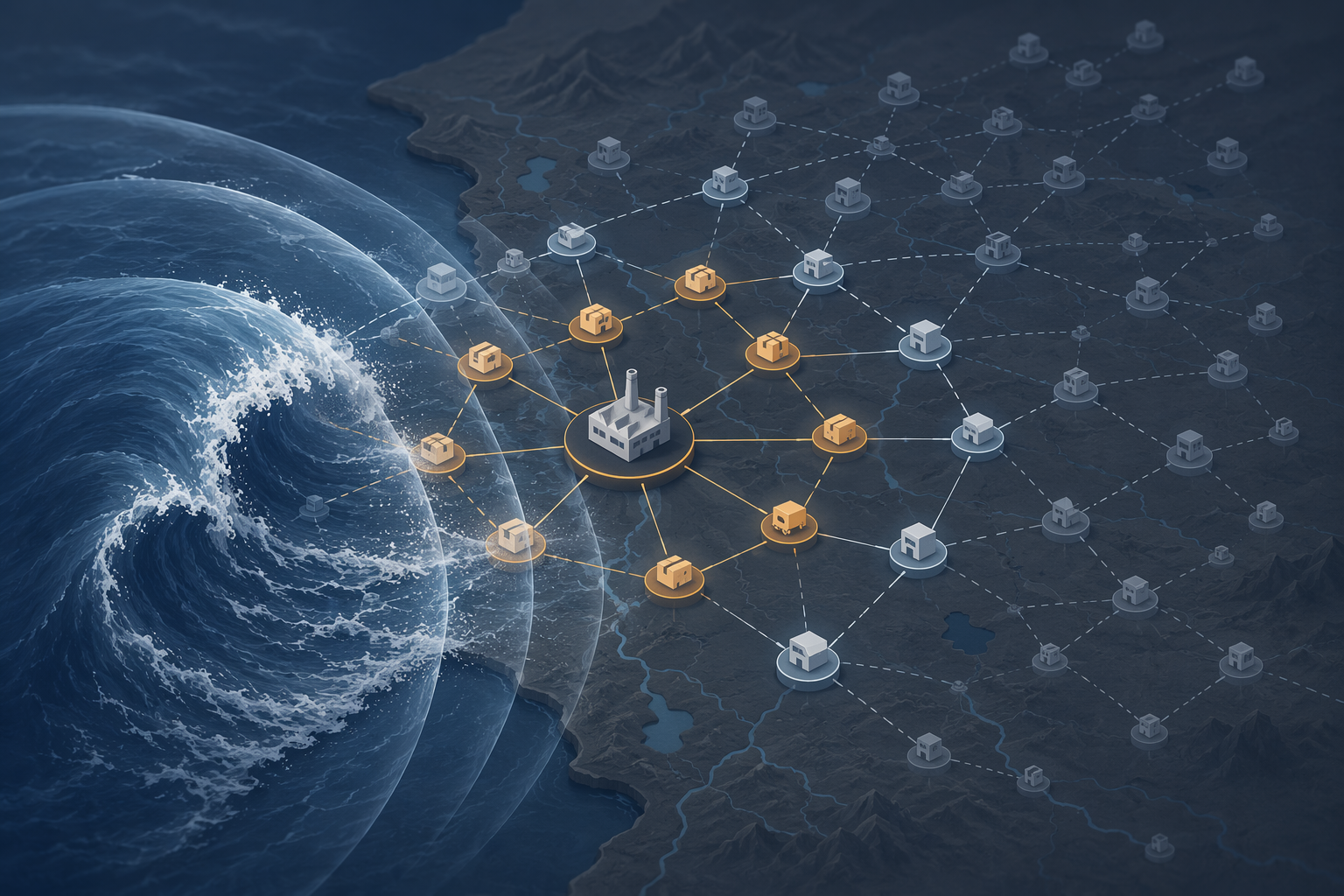
AI supply chain mapping platforms such as the Altana Atlas approach combine public and private data to infer multi-tier trade relationships and expose dependencies that standard supplier records miss.[6] In a tsunami workflow, that capability should sit between detection and response. Once a probable coastline impact is identified, the system can ask which known and inferred nodes touch the exposed geography, which products depend on them, which customers are affected, and which alternatives are already qualified.
The same discipline appears in non-tsunami disruption planning. ChainSignal’s Garden Grove chemical leak case study shows how AI-assisted disruption planning can identify hidden single-source risks before a local incident becomes a wider operating problem.[7] The lesson transfers cleanly: the value is not the diagram itself, but the moment when the diagram changes a decision. If the map only confirms known tier-1 exposure, it is a nicer dashboard. If it surfaces an unqualified tier-4 dependency before the port is compromised, it has done supply chain work.
Response orchestration is where agentic AI needs the tightest leash
During the response phase, the enterprise is no longer asking one clean optimization question. It is managing simultaneous exceptions: vessels approaching a threatened port, trucks already on closed or soon-to-close roads, suppliers unable to confirm production status, inventory that may be safe but unreachable, customers waiting for allocation decisions, and executives asking whether revenue, safety, or contractual exposure takes priority.
Agentic AI is relevant because it can coordinate across those moving parts rather than wait for one planner to run one scenario at a time. A logistics agent might identify shipments at risk, compare alternate ports, request carrier capacity, evaluate air conversion for critical SKUs, check whether substitute suppliers are approved, and generate a scenario tree for human review. Traxtech’s agentic logistics model describes this kind of simultaneous rerouting across ocean, air, and ground freight.[8]
The adjacent enterprise evidence is getting more concrete. The GE Aerospace and Palantir partnership described by ChainSignal shows agentic AI being applied to fulfillment, sourcing, and carrier switching rather than only forecasting or reporting.[9] Defense Logistics Agency material on AI-assisted supply chain risk also points to scenario planning as a way to illuminate risk before and during disruption.[10] Neither example is a tsunami-specific full stack, but both show the coordination pattern that tsunami response requires: multiple systems proposing actions against changing constraints.
The danger is treating that coordination as permission for autonomous improvisation. Emergency logistics is full of constraints that software can violate quickly: regulated materials, customs requirements, humanitarian access rules, carrier safety, port restrictions, customer allocation policies, insurance terms, and public-sector directives. ChainSignal’s analysis of agentic AI supply chain planning risks identifies risk categories including cascading multi-agent failures and regulatory exposure.[11] In tsunami response, those are not abstract AI ethics concerns. They are the difference between a useful recommendation engine and a system that tenders freight into a closed corridor or reallocates scarce inventory without authority.
A governed response architecture should make the boundary explicit. Low-risk actions can be automated: compiling exposed orders, ranking alternate lanes, drafting carrier tenders, preparing customer impact lists, or generating sourcing scenarios. Higher-risk actions require approval: canceling a vessel booking, shifting strategic inventory, overriding customer allocation rules, moving regulated goods, or activating an unqualified supplier. The agent should maintain an audit trail showing what it saw, what it recommended, which constraint it used, who approved the action, and what changed afterward.
| Response action | Good use of AI | Human control point |
|---|---|---|
| Carrier switching | Compare capacity, cost, lead time, port exposure, and service commitments | Approve tender changes that affect contracts or priority customers |
| Modal rerouting | Model ocean-to-air or ground diversion options for critical shipments | Authorize premium freight and confirm safety or regulatory limits |
| Sourcing alternatives | Surface qualified suppliers outside the exposed zone | Validate quality, compliance, and allocation tradeoffs |
| Customer allocation | Show which orders are affected and which substitutions are feasible | Set priority rules when supply is insufficient |
| Scenario planning | Run fast branches for port closure, road loss, supplier outage, or demand surge | Choose the scenario to execute and document the reason |
This is also where a control tower matters, provided it is not confused with the whole solution. A platform such as SAP Supply Chain Control Tower can provide a visibility layer for orders, inventory, logistics, and exceptions, which is a useful foundation for disruption management.[12] But visibility alone does not decide which alternate supplier is qualified, which port diversion is lawful, or which customer should receive constrained stock. The control tower has to be connected to decision rules and accountable people.
Recovery is a data problem before it is a lesson learned
After the wave, the enterprise usually wants a postmortem. That is necessary, but too weak if the findings stay in slides. Recovery should update the next cycle: detection thresholds, inventory staging assumptions, supplier maps, alternate lane playbooks, approval rules, customer allocation policies, and model confidence scores.
The strongest empirical material here should be handled carefully. An INFORMS study published in March 2025 found that firms with 2.4% AI-related job demands in postings recovered full disaster-related valuation damage.[13] The 2.4% figure refers to cumulative AI-relevant skills in job postings, not AI spend, not deployed software count, and not proof that an AI platform caused recovery by itself. The safer reading is that firms building AI capability into their workforce may be better positioned to absorb and respond to natural disaster shocks.
For tsunami logistics, that workforce signal matters because recovery learning crosses organizational boundaries. A carrier knows which diversions actually worked. A supplier knows how long a coastal facility stayed offline. A port authority knows which access roads reopened first. A manufacturer knows which inferred dependency turned out to be real. Federated data-sharing models discussed by the World Economic Forum are one way to learn across organizations without forcing every participant to surrender raw data into a single central pool.[14]
The recovery loop should ask operational questions, not only strategic ones. Which early signal arrived first, and who trusted it? Which data field blocked an inventory move? Which supplier dependency was missing? Which agentic recommendation was rejected, and why? Which manual approval created delay but prevented a worse decision? Which alternate route looked good in the model but failed in the field? Those answers should alter the playbook before the next coastal event.
The five phases are an architecture, not a product SKU
The honest version of AI for tsunami supply chain logistics is neither a command-center fantasy nor a shrug. AI can compress the signal-to-action gap, make pre-positioning more precise, expose dependencies beyond tier 2, coordinate response options across modes and suppliers, and turn each event into better assumptions. Those capabilities are real enough to plan around.
They are also not a single purchasable system. The hard work is in the handoffs: detection into planning, planning into inventory, inventory into supplier mapping, mapping into governed response, and response back into learning. Humans still validate signals, set authority thresholds, approve high-consequence moves, and decide which tradeoffs the enterprise is willing to make under time pressure. Coordinated AI can make tsunami response faster and more informed. It cannot remove the need to design the operating system before the water moves.
References
- Applying AI-based models to predict tsunamis, UNESCO
- AI-driven inventory pre-positioning models in humanitarian supply chains, MIT
- Data Readiness Assessment for AI Inventory Optimization, ChainSignal
- AI Use Cases in Supply Chain: ROI 2026, ChainSignal
- McKinsey 2021 supply chain survey, McKinsey & Company, 2021
- Altana Atlas, Altana
- Garden Grove Chemical Leak AI Case Study, ChainSignal
- Agentic AI for logistics coordination, Traxtech
- GE Aerospace Palantir Agentic AI Supply Chain, ChainSignal
- Utilization of AI to Illuminate Supply Chain Risk, Defense Logistics Agency
- Agentic AI Supply Chain Planning Risks, ChainSignal
- SAP Supply Chain Control Tower Vendor Profile, ChainSignal
- Artificial Intelligence and Firm Resilience: Empirical Evidence from Natural Disaster Shocks, INFORMS, March 2025
- Federated data-sharing models for cross-organization learning, World Economic Forum
Comments
Join the discussion with an anonymous comment.