
Energy supply chain disruption planning has become expensive enough that “wait and expedite” is no longer a serious operating model. Interos and BCI put the average annual cost of supply chain disruptions for energy organizations at about $182 million, while Swiss Re reports a nearby but separate estimate of $184 million; the figures should not be blended, but both point to the same scale of exposure.[1][2] In the past year, 80% of organizations experienced between one and ten adverse supply chain events, and 81% planned to increase resilience investments.[1]
The practical question is not whether AI can make a better dashboard. It is whether AI for energy supply chain disruption planning can move a decision earlier: supplier risk identified before a purchase order fails, a reroute tested before vessel capacity tightens, a maintenance issue flagged before the spare part becomes the emergency. The strongest reported results are still unevenly attributed, but they are now specific enough to matter: 30–50% faster disruption response times, 15% lower logistics costs, and supplier risk detection up to 45 days earlier than traditional methods.[3][4][5]

The useful shift is from alerts to usable lead time
In energy, a disruption is rarely just a late truck or a delayed component. A refinery turnaround can lose its sequence because one specialty valve is missing. A utility storm-response plan can consume available crews and pole-top materials faster than procurement can replenish them. A renewables project can slip because transformers, vessels, grid interconnection equipment, or balance-of-plant materials are tied up somewhere else. The planner does not need an impressive prediction after the constraint is already visible to everyone. The planner needs enough warning to reserve capacity, approve substitutions, re-sequence work, or escalate with evidence.
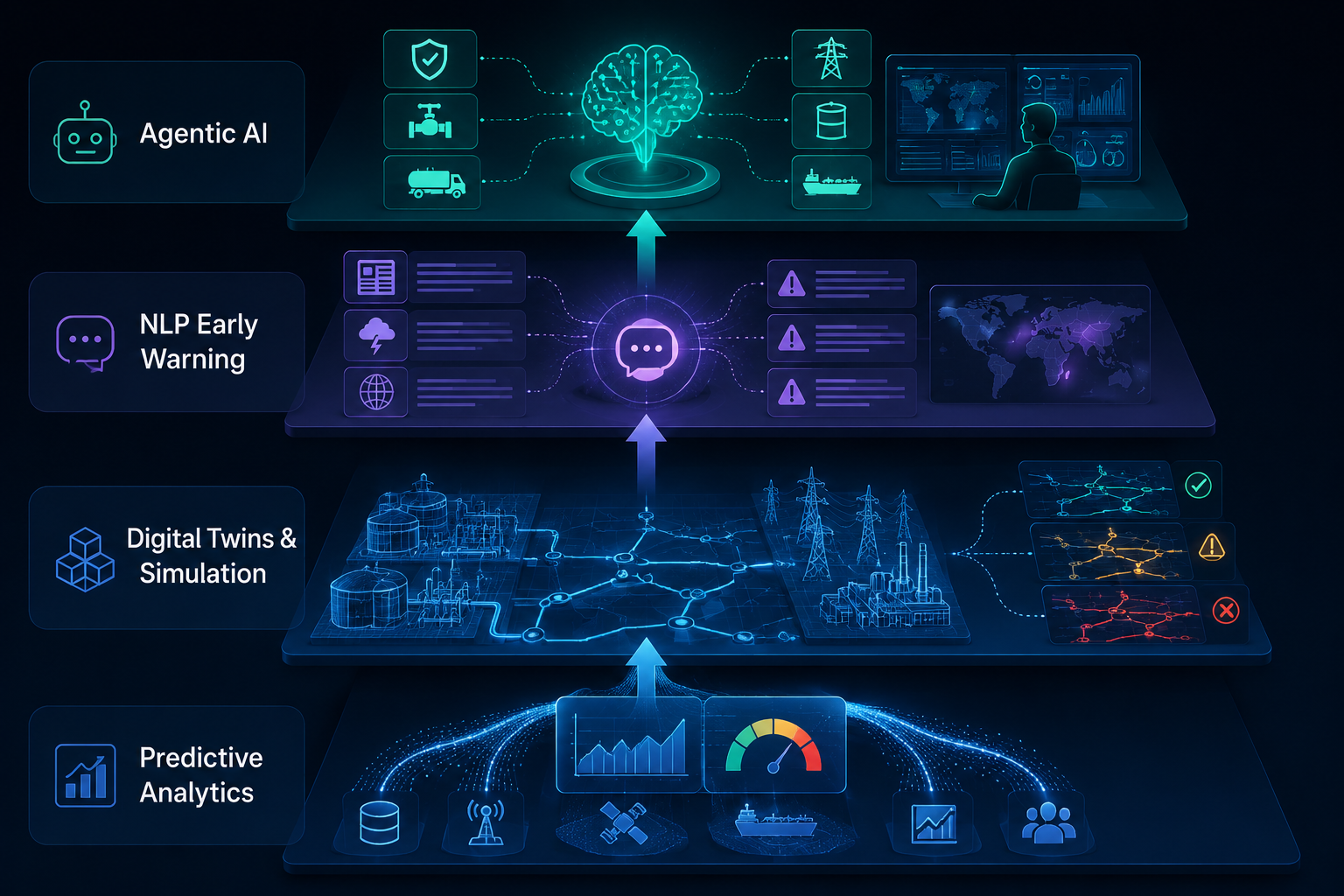
That is where the better energy AI deployments are becoming more credible. They combine several layers: predictive analytics to detect risk patterns, digital twins and agent-based simulation to test options, natural language processing to read unstructured warning signals, and agentic AI to recommend or initiate bounded mitigation actions. The names matter less than the handoff between layers. A risk score by itself is not resilience. A risk score that triggers a simulation, identifies a feasible mitigation, and routes the decision to the right owner is closer to an operating system.
| AI layer | Planning job | What it changes operationally |
|---|---|---|
| Predictive analytics | Forecast supplier, asset, logistics, or demand risk from structured data | Moves risk detection earlier than periodic reviews |
| Digital twins and agent-based simulation | Model facilities, routes, inventories, suppliers, vessels, crews, and constraints | Lets planners compare responses before committing scarce capacity |
| NLP early warning | Scan news, weather, filings, geopolitical updates, and other text signals | Surfaces weak signals that do not appear first in ERP or transport systems |
| Agentic AI | Recommend or execute constrained actions under policy and human oversight | Shortens the gap between warning, decision, and action |
Predictive analytics works best when it is tied to physical constraints
The first layer is familiar: predictive models look for patterns in supplier performance, maintenance histories, shipment events, demand signals, inventory movement, asset condition, and external data. The useful distinction is whether those models are predicting an administrative metric or a physical constraint. A late invoice flag may be interesting. A likely compressor failure during a maintenance window, or a supplier quality issue that could strand a turnaround package, is operationally different.
Shell is the clearest production-scale example in the available material. Energies Media reports that Shell monitors more than 10,000 equipment assets, processes 20 billion data rows weekly, runs more than 10,000 machine-learning models, and generates 15 million predictions daily. The same source reports a 20% reduction in maintenance costs from the predictive maintenance system.[3] Those numbers do not prove that every operator can reproduce Shell’s outcome, but they do show what AI looks like when it is embedded in asset operations rather than left as a planning experiment.
For supply chain disruption planning, the maintenance example matters because asset condition becomes demand. A predicted failure can create a future parts requirement, a future crew requirement, and sometimes a future logistics exception. If that signal arrives early enough, procurement can secure alternates, inventory teams can rebalance spares, and planners can protect the work sequence. If it arrives late, the same signal becomes an expediting problem.
Chevron’s reported supplier-risk early warning result is narrower but directly relevant. Energies Media says Chevron uses AI to detect supplier risks up to 45 days earlier than traditional methods.[3] The publication does not fully detail the calculation methodology, so the figure should be treated as an industry-reported benchmark rather than an audited universal result. Still, the planning value is obvious: 45 days can be the difference between qualifying an alternate supplier and explaining why the alternate was never ready.
Simulation is where risk detection becomes a decision
A warning does not answer the next question: what should change? Energy supply chains are full of substitutions that look simple until they touch real constraints. A different port may add customs exposure. A different supplier may need engineering approval. A different maintenance sequence may collide with crane availability, safety permits, or outage commitments. Digital twins and agent-based models are useful because they allow planners to test those interactions before a choice hardens into a field consequence.
In this context, a digital twin is not a decorative 3D model. It is a working representation of the supply chain, asset network, route structure, inventory posture, and constraints that matter for decisions. Agent-based modeling adds simulated actors—such as suppliers, carriers, crews, warehouses, or demand nodes—that respond to changes in the modeled environment. AWS describes the combination as a way for energy supply chains to test scenarios and reports that agent-based modeling and digital twin simulation can reduce disruption response times by 30–50% and deliver 15–25% supply chain efficiency gains.[4]
The best use of simulation is not to produce a perfect answer. It is to remove bad options early. If a canal delay threatens a critical shipment, the model can compare rerouting, air freight, supplier substitution, schedule resequencing, or inventory reallocation. Some options will fail because the capacity is not there. Some will fail because the cost is irrational. Some will work technically but require a governance decision. That sorting function is valuable because the real world does not pause while teams debate scenarios in sequence.
Reported logistics-cost benchmarks also belong here, with careful attribution. AWS and TraxTech cite McKinsey-linked figures indicating 15% lower logistics costs, 35% reduced inventory, and 65% improved service levels from AI-enabled supply chain approaches.[4][5] Because the McKinsey methodology and original report details are not independently verified in the available material, these should be read as secondhand benchmarks. They are still useful as directional evidence, especially when paired with operational examples rather than treated as guaranteed savings.
Inventory optimization is a cash-flow story only if service risk is visible
Energy companies have always had a complicated relationship with inventory. Too much inventory ties up cash and hides weak planning. Too little inventory turns an outage, shutdown, or storm response into a scramble. AI inventory optimization is attractive because it promises to make those tradeoffs more explicit: which spares are genuinely critical, which demand patterns are changing, which suppliers can be trusted to replenish, and which materials only look safe because the last disruption has not arrived yet.
bp’s reported target shows how financially material this has become. Energies Media says bp is using AI inventory optimization with a goal of about $2 billion in operational cash-flow improvement by 2027 versus a 2024 baseline.[3] That is a target, not a completed result, and it should be read as financial ambition around inventory and working capital rather than proof that AI alone creates the improvement.
The planning discipline is to avoid optimizing inventory in isolation. A model can recommend lower stock levels, but the decision is only sound if supplier reliability, transport lead time, asset criticality, and substitution rules are visible. For a noncritical consumable, lower inventory may be reasonable. For a long-lead part tied to a regulated outage or a safety-critical asset, the cost of being wrong can exceed the carrying cost that looked excessive in a spreadsheet.
NLP expands the warning system beyond internal data
Many disruption signals do not begin inside an ERP, TMS, or supplier portal. They appear first in port notices, weather alerts, local news, regulatory filings, earnings commentary, sanctions updates, labor reports, or geopolitical analysis. Natural language processing gives planners a way to monitor those unstructured signals at scale and connect them to exposed suppliers, lanes, commodities, facilities, or projects.
This is especially relevant in energy because the same external event can affect multiple planning layers. A weather system can change offshore operations, vessel availability, utility restoration demand, and regional fuel logistics. A geopolitical development can affect marine routes, insurance, sanctions exposure, and supplier financing. The value of NLP is not that it “reads the news.” The value is that it helps map a weak signal to the parts of the network that have exposure.
A useful early-warning workflow is usually more modest than the sales language around it. The system ingests text sources, classifies the event, links named entities to suppliers or locations, scores likely relevance, and sends an alert into a planning queue. A human still needs to judge whether the signal is credible, whether the exposure is material, and whether the mitigation cost is justified. Without that review loop, NLP can become a faster way to create noise.
Agentic AI raises the hardest governance question
Agentic AI is the point at which disruption planning starts to move from recommending actions toward executing or coordinating them. In supply chain terms, an AI agent might draft a supplier escalation, identify alternate approved vendors, reserve transportation capacity within policy limits, open a workflow for engineering approval, or update a scenario plan as new constraints arrive. That is useful only if the system knows where its authority stops.
BCG describes AI agents as an emerging force in supply chains and reports potential working capital reductions of up to 30% and EBITDA uplift of 2–4 percentage points.[6] Those are broad consulting estimates, not energy-specific audited outcomes. They do, however, frame why companies are interested: if agents can compress cycle time between signal, analysis, approval, and action, the financial effect can reach beyond a single avoided disruption.
The governance issue is sharper in energy than in many sectors. A recommendation to shift freight mode may be commercially sensitive but manageable. A recommendation that affects safety-critical equipment, outage timing, sanctions exposure, environmental obligations, or grid reliability needs clear human accountability. The right operating model is usually graduated autonomy: low-risk actions can be automated within thresholds, medium-risk actions can be prepared for approval, and high-risk actions require named decision owners.
- Automate when the action is reversible, low value, policy-bounded, and already covered by approved playbooks.
- Require approval when the action changes suppliers, inventory policy, transport mode, maintenance sequence, or customer commitment.
- Escalate explicitly when the action touches safety, compliance, sanctions, environmental exposure, regulated service levels, or major capital-project milestones.
What the stronger deployments have in common
The strongest examples come from large, data-rich energy companies. That matters. Shell’s predictive maintenance scale is persuasive because it sits on enormous data volume, deployed models, and asset coverage.[3] A utility or upstream operator still reconciling fragmented supplier masters, inconsistent material codes, manual expediting notes, and partial shipment visibility should not expect the same starting point.
Even so, the pattern is transferable. The companies that get value are not simply buying an AI product. They are connecting signals to decisions. Predictive analytics flags the likely exception. Simulation tests what can be done. NLP expands the perimeter of warning. Agentic AI shortens the administrative distance between a decision and the first mitigation step. Vendors such as AWS, Exiger, Kinaxis, Blue Yonder, and C3.ai can support pieces of that architecture, but the use case should lead the shortlist, not the other way around.
A practical energy supply chain team can start by choosing disruptions where earlier action has obvious value: critical spares for high-consequence assets, long-lead electrical equipment, refinery turnaround materials, marine logistics exposure, storm-response inventory, or sanctioned-region supplier risk. The test is not whether the AI model is elegant. The test is whether the organization can use the warning before crews, vessels, materials, engineering approvals, or cash are already constrained.
Where the evidence is strong, and where it still needs discipline
The evidence is strongest for production-scale predictive maintenance and for the general efficiency case around simulation-enabled planning. Shell’s reported deployment has the operational scale that many AI case studies lack.[3] AWS’s reported 30–50% response-time reduction and 15–25% efficiency gains give a useful benchmark for digital twin and agent-based simulation, provided they are treated as reported outcomes rather than guarantees.[4]
The evidence is more qualified for some of the sharper supply chain claims. Chevron’s 45-day earlier supplier-risk detection is memorable and directly relevant, but the available source does not fully explain the calculation.[3] The 15% lower logistics-cost figure is useful, but it is secondhand through AWS and TraxTech rather than independently verified from the original McKinsey material in the available research.[4][5] bp’s $2 billion cash-flow improvement by 2027 is a target against a 2024 baseline, not a completed result.[3]
That does not make the case weak. It makes attribution important. AI is now credible for energy supply chain disruption planning when it is deployed as a layered decision system with clear data ownership, operational workflows, and governance. The strongest claims still depend on data maturity, source quality, and the hardest part of all: whether earlier warnings actually turn into earlier action.
References
- Supply chain disruption cost and resilience investment findings, Interos / Business Continuity Institute
- Supply chain disruption cost findings, Swiss Re
- AI in Supply Chain Management: Real Results from Top Energy Companies in 2025, Energies Media
- Top-performing supply chains: When AI meets energy industry experience, AWS
- McKinsey supply chain AI benchmark figures, TraxTech
- How AI Agents Are Transforming Supply Chains, BCG
Comments
Join the discussion with an anonymous comment.