
A retail recall becomes real work when the first signal stops being an alert and starts becoming a routing problem. A supplier letter lands as a PDF. A customer complaint mentions a symptom that might match policy. Lot codes sit inside paragraphs instead of fields. Someone has to identify the affected item, match it to enterprise records, decide which stores and customers are exposed, notify the right people, quarantine inventory, and later prove that the product was returned, destroyed, refunded, or otherwise reconciled.
That is the practical center of AI-enabled retail recall management in 2026. The useful question is not whether an agent sounds autonomous. It is whether the system can take a messy recall signal, turn it into structured product, lot, serial, customer, and location data, trigger the next action, and leave a reviewable trail for the people who still own the outcome.
Oracle’s Recalls Curation Assistant makes the ingestion problem concrete. The agent is described as auto-parsing supplier recall notices, including PDFs, extracting header, contact, part, lot, and serial information, creating structured recall notices, and notifying recall managers inside Oracle Fusion Cloud Inventory Management.[1] That is not a glamorous step, but it is where many recall workflows lose hours: before anyone can act, someone must first turn supplier prose into usable fields.

The pressure on that middle layer is not theoretical. Product recalls in Q1 2026 reached 492 million recalled units, a four-year high, even as recall events reportedly dropped in frequency.[2] In food, FDA recalls reached 571 in 2025, up 15.4% year over year, while recalled food units rose to 138.5 million, a 209% increase.[3] Those figures do not prove AI is effective. They explain why the old pattern of inbox monitoring, spreadsheet targeting, and manual proof-chasing is under strain.
Readers looking for the broader detection and prevention arc can step back to how AI transforms recall management from reactive to predictive. The narrower issue here is execution after the signal arrives: how agents reduce the translation work between what the organization knows and what it must do.
What the agent actually has to do
A credible recall agent does not simply send alerts faster. It has to move through a chain of tasks that used to sit across quality, supply chain, store operations, customer service, and IT.
| Recall step | Agent task | Human role that remains |
|---|---|---|
| Signal ingest | Read supplier letters, PDFs, customer complaints, or policy-triggering events | Confirm whether the signal should become a formal recall action |
| Data extraction | Normalize product identifiers, lot codes, serial numbers, dates, contacts, and affected quantities | Review ambiguous or incomplete source material |
| Enterprise matching | Cross-reference ERP, inventory, customer, shipment, and partner records | Resolve mismatches, substitutions, and missing master data |
| Action orchestration | Create notifications, quarantine tasks, return instructions, refund or replacement workflows | Approve external communication and regulated handling steps |
| Verification | Check product eligibility, returned goods, decommission records, and store-level evidence | Handle exceptions and disputed claims |
| Reconciliation | Log follow-up actions and evidence for audit, compliance, and financial closure | Accept accountability for closure |
That sequence matters because recall work fails in the gaps between systems. A recall manager may know the supplier’s affected lot. Store operations may need location-specific quarantine instructions. Customer support may need to know which consumer is eligible for a refund. Finance may need evidence before issuing credits. Compliance may need proof that affected product was removed. Agents are commercially interesting when they carry context across those gaps instead of creating another dashboard to watch.
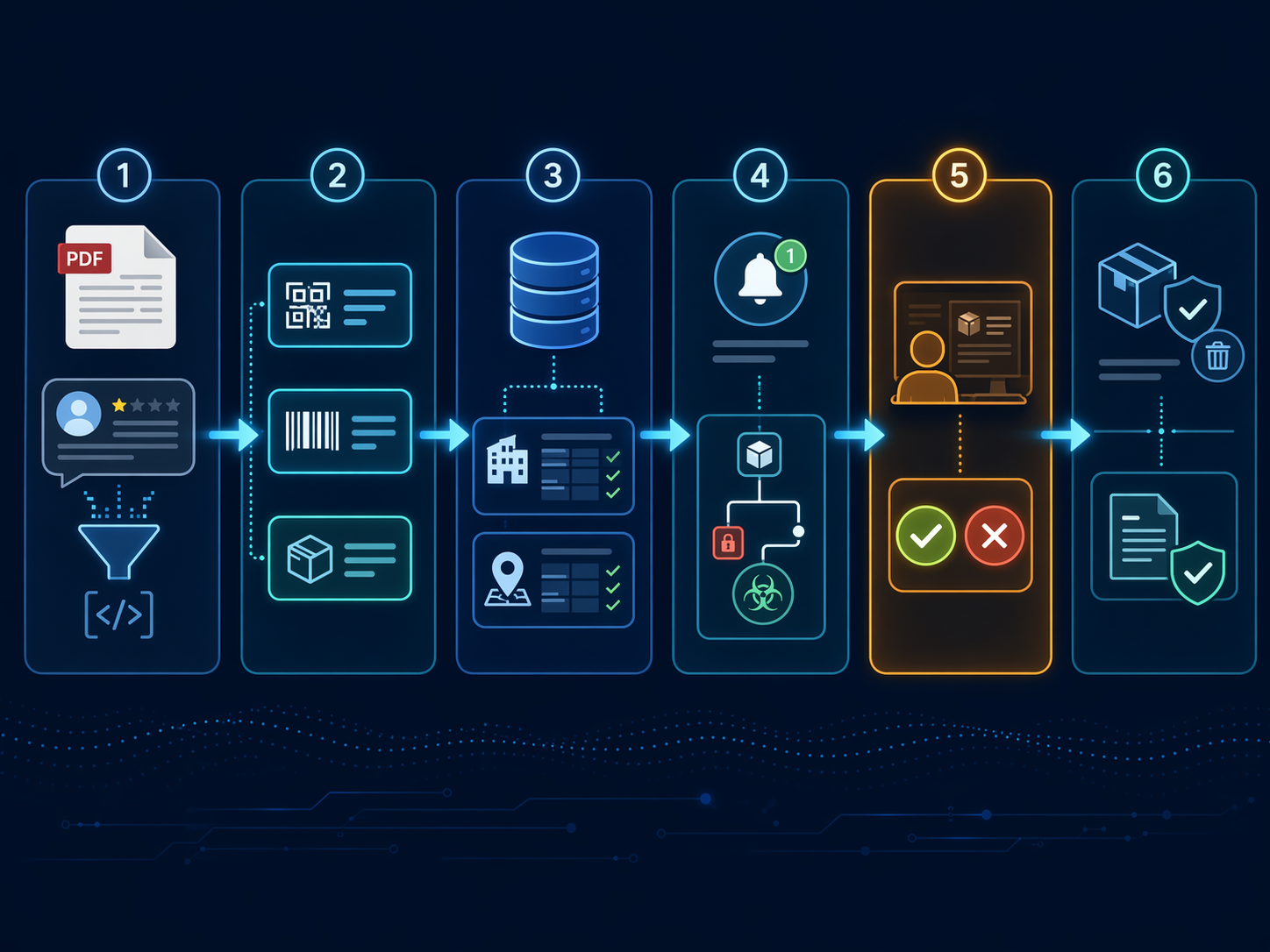
From supplier PDF to structured recall notice
The first meaningful automation point is document interpretation. In a traditional process, a supplier notice may include affected products, dates, lot ranges, contact names, recommended actions, and replacement instructions, but not in a format that the retailer’s systems can immediately use. Someone reads the notice, copies values into a form, asks for clarification, or circulates the file while different teams decide what it means.
Oracle’s approach is useful because it begins with that unglamorous work. Its Recalls Curation Assistant is documented as extracting recall header information, contacts, parts, lots, and serials from supplier notices, then creating recall notices and notifying recall managers.[1] In operational terms, the agent reduces the delay between receiving the document and having a structured case that downstream teams can act on.
There are two caveats. First, Oracle’s capability appears in 26A readiness documentation, so public deployment evidence is still limited compared with mature recall-management products.[1] Second, parsing is not the same as judgment. If a supplier writes a lot range ambiguously, refers to a product by a legacy name, or sends a corrected notice later, the system still needs an exception path. The gain is not that the agent becomes the recall authority. The gain is that recall managers stop doing first-pass data entry before they can do recall management.
For organizations already evaluating Oracle’s broader supply chain AI layer, the relevant ecosystem question is how this recall-specific agent fits with the larger command and execution environment. ChainSignal’s profile of Oracle’s Supply Chain Command Center is the natural next stop for that vendor-context decision.
ERP context decides whether the action is useful
After extraction comes the harder question: what should happen inside the business system? A recall notice that is structurally clean but disconnected from ERP records still leaves teams checking open orders, shipped units, inventory status, complaints, and customer exposure by hand.
Cegeka’s Quality Impact Recall Agent is positioned at that point in the chain. Built into Microsoft Dynamics 365, it uses Microsoft’s Model Context Protocol to access ERP tools, cross-reference customer complaints against company policy, and log follow-up actions.[4] The value is not simply that an agent reads text. It can operate in the context where product, customer, quality, and follow-up records already live.
That architecture also narrows the buying case. A Dynamics 365-embedded agent can be compelling for companies already standardized on Microsoft ERP, but it is not automatically portable to every retail stack. A retailer with heavily customized legacy inventory systems, separate store execution tools, or fragmented customer records would need to ask where the agent can actually write, which workflows it can trigger, and what happens when the system of record sits outside its native environment.
The important test is practical: when the agent sees a complaint that matches recall policy, can it create the right quality action, link it to the right item and customer record, notify the right team, and log the follow-up without forcing someone to re-enter the same facts elsewhere? If not, the operation has automated recognition but not response.
Precision matters more than blast speed
The most expensive recall automation mistake is treating speed and precision as interchangeable. A fast over-notification creates unnecessary store labor, call-center volume, customer anxiety, and reverse-logistics cost. A fast under-notification is worse. Retail recall response needs to know not only which product family is affected, but which lots, serials, shipments, locations, and customers are in scope.
LSPedia’s Serialized Recall module is the clearest example in the current vendor set because it pushes automation down to lot and serial targeting. The company describes AI monitoring for recall signals, auto-populated notification workflows, EPCIS integration for decommission data, and targeting at the lot and serial number level.[5] That last point is the difference between telling a chain to pull a broad category from shelves and telling specific locations what affected serialized inventory must be quarantined or removed.
Serialized recall also changes reconciliation. If EPCIS-linked events can show decommission or related product-status data, the recall process no longer depends only on emails, manual store attestations, or spreadsheet updates. The system can support a cleaner chain of evidence: this serial was identified, this partner was notified, this action was taken, and this record supports closure.[5]
LSPedia says operational testing with early adopters showed up to a 90% reduction in manual recall labor.[5] That number is worth attention, but it should be read carefully. It is vendor-reported early-adopter testing, not an independent benchmark across retail verticals. The direction is still plausible because the manual work being reduced is visible: searching, targeting, notifying, and reconciling. The figure should not be treated as a guaranteed savings percentage for every supply chain.
The better buying question is where manual labor lives today. If the team spends most of its time identifying affected lots, building notification lists, checking returned or decommissioned goods, and chasing proof of completion, serialized automation can attack the right work. If the hard part is poor supplier data, missing item masters, or unclear legal decision rights, the same module may expose those weaknesses before it reduces them.
The recall workflow now reaches the customer’s camera
Once a recall reaches consumers, the bottleneck often moves from supply chain operations to eligibility verification. Customer support has to determine whether a product is actually in scope. The customer may not know the lot code, may photograph the wrong side of the package, or may need help finding the right identifier. Every unclear case becomes a call, an email thread, or a manual review queue.
TechSee’s visual AI agents extend recall response into that customer-facing step. The company describes a workflow where consumers submit product photos, AI reads packaging to verify recall eligibility, and refund or replacement steps are automated.[6] In one multinational recall event for an unnamed consumer goods brand, TechSee says its system handled more than 300,000 automated interactions and delivered 40% faster resolution.[6]
Again, the metric is useful but bounded. The brand is not named, and the result is vendor-reported, so it should be treated as directional evidence rather than a public retailer benchmark. The operational logic, however, is clear. If a customer can submit a package image and the system can read the relevant packaging information, customer support does not have to manually inspect every claim before the refund or replacement path begins.
This is also where image verification becomes more than a security add-on. The same capability family that checks labels, packaging, or visible product attributes can reduce friction in recall eligibility decisions. ChainSignal’s analysis of AI image verification in supply chain security covers that adjacent verification layer.
Minutes-level response still needs a governed stopping point
The strongest case for AI agents is speed through the handoffs. The weakest case is pretending that speed removes accountability. Recall response contains decisions that can damage customers, suppliers, stores, and brands if the agent acts on incomplete or misunderstood information. Over-notify and the company may create avoidable disruption. Under-notify and affected product may remain in circulation. Mishandle regulated inventory and the reconciliation record becomes a liability instead of protection.

The market is already signaling that buyers understand this distinction. RELEX’s 2026 supply chain AI survey found that 67% of supply chain leaders reported growing confidence in AI, but only 10% trusted full autonomy.[7] That is not a philosophical footnote. It is the deployment pattern most likely to clear procurement, compliance, quality, and operations review.
In practice, human-in-the-loop recall automation should not mean routing every ordinary action back to a manager. That would preserve the old bottleneck with a better interface. The better boundary is exception-based: let agents extract, match, pre-populate, notify within approved rules, create quarantine tasks, and assemble reconciliation evidence; require human approval for uncertain scope, customer-facing language, regulatory escalation, supplier disputes, financial exceptions, and closure of high-risk cases.
This is the same governance pattern appearing in other regulated supply chain AI deployments. The useful comparison is not a fully autonomous agent making unsupervised decisions. It is an agentic layer that compresses analysis and action while humans retain approval rights at defined control points. ChainSignal’s work on GE Aerospace’s agentic AI supply chain transformation is a useful parallel for that pattern in a high-accountability environment.
What early results can and cannot prove
The headline outcomes around recall agents are encouraging: up to 90% reduction in manual recall labor from LSPedia’s early-adopter operational testing, and 40% faster resolution in TechSee’s unnamed multinational consumer-goods recall case.[5][6] Those are not interchangeable proof points. One measures manual labor reduction in serialized recall operations. The other measures faster resolution in a visual customer-interaction workflow. Both are vendor-reported.
That does not make them useless. It means they belong in the right column of the business case. They are directional evidence that agentic recall workflows can remove work from document processing, targeting, notification, verification, and reconciliation. They are not independent guarantees that every retailer will cut recall labor by the same amount or resolve every event 40% faster.
The strongest evaluation will start with a process inventory rather than a vendor demo. A retailer should know how many handoffs currently sit between recall signal and action, which fields are manually rekeyed, how often lot or serial targeting is available, how store quarantine is confirmed, how customer eligibility is verified, and what evidence is required before closure. The agent’s value shows up where those steps become structured, triggered, and reviewable.
The credible Q3 2026 buying case
AI agents are already commercially meaningful for recall response when the process is document-heavy, data-linked, and reconciliation-driven. Oracle points to the front end of the workflow: supplier notice parsing and structured recall creation. Cegeka shows the importance of ERP-contextual action and follow-up logging inside a Microsoft Dynamics 365 environment. LSPedia shows why lot- and serial-level targeting matters when speed without precision would create more work. TechSee shows how visual AI can move eligibility verification out of the call center and into a customer-submitted product image.
The buying case is not autonomous recall management. It is supervised automation: agents handle the translation, targeting, workflow creation, evidence gathering, and routine orchestration; humans govern approvals, exceptions, regulated communications, and accountability. That pattern fits both the operational need for faster response and the trust reality that only a small share of supply chain leaders are ready to let AI act fully on its own.[7]
For retail supply chains, that is enough to matter. The recall crisis may begin with a supplier letter, a regulator notice, or a customer complaint, but the operational damage accumulates in the hours after: the copying, matching, routing, checking, chasing, and proving. AI agents are most useful when they remove that ugly middle without erasing the human responsibility that recall management still requires.
References
- AI Agent: Recalls Curation Assistant, Oracle, 26A
- Product Recalls Drop in Frequency but Surge in Scale, With Units Reaching Four-Year High, Risk & Insurance
- Why America’s Food Recalls Are Surging, The Food Institute
- Transforming Product Recalls with AI, Cegeka
- Recall Management Module, LSPedia
- How AI Is Transforming Product Recall Management Services, TechSee
- Supply chain AI in 2026, RELEX
Comments
Join the discussion with an anonymous comment.